
A hill town east of Hartford, first called Hartford Mountains, where Jonathan Edwards was called to preach, Rochambeau's army camped on the road to Yorktown, and the quarries near Bolton Notch sent flagstone as far as Washington.
Bolton on the map
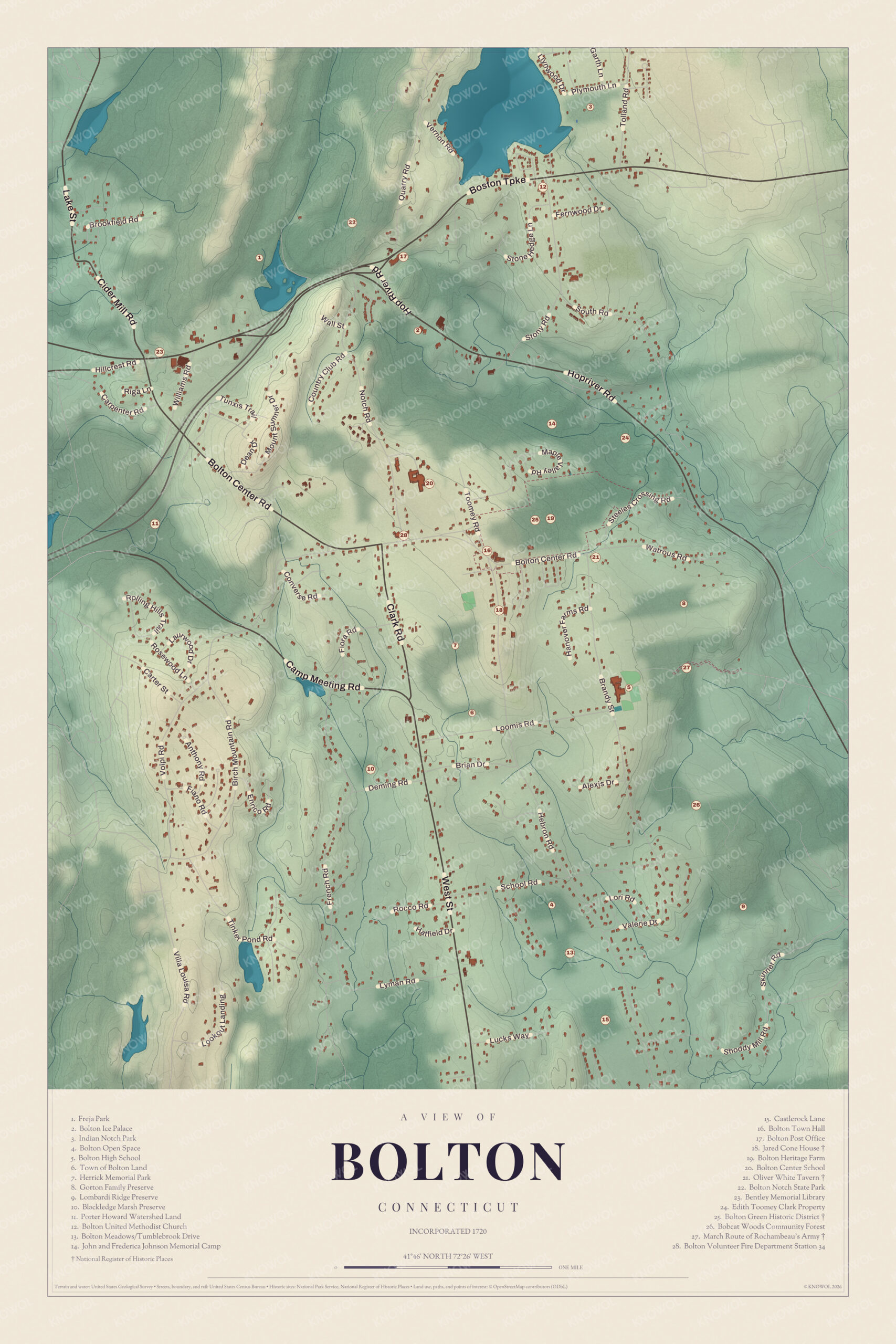
Click the map to look closer.
Bolton today
By KNOWOL
Shaded hills from Box Hill to the gap at Bolton Notch, Bolton Lake and the Hop River drawn to their true shape, every street, and a guide of 28 numbered landmarks with the National Register sites marked.5
The story of Bolton
The High Priest of Bolton
George Colton came to Bolton's pulpit in 1763 and stayed forty-nine years. He stood six feet seven inches, and people called him the High Priest of Bolton. Until he died in 1812 he wore a cocked hat and an enormous white wig, and a salary of 80 pounds and thirty cords of wood made him one of the better-off ministers around. A woman born in 1775 remembered his chaise as the only one in town. When a Hartford minister asked him to pray in rhyme, Colton answered, "Why, Brother Strong, I think you do wrong in making rhyme at this solemn time. Let us pray." He preached against balls, though the young people danced anyway, and he was deeply offended when Lorenzo Dow held a camp meeting in his town in 1805.678910
One umbrella in Bolton
Mrs. Jonathan Birge, a doctor's daughter born in Bolton in 1775, told Sylvester Judd of Northampton what she remembered of her girlhood here. There was only one umbrella in town, and on drizzly days she and others watched it at the meeting house to see it open and shut. Breakfast was meat and tea, but the children had bread and milk. Balls were common, and girls got a side saddle as part of a marriage portion; hers cost $20. At school the one at the head of each side chose spellers in turn, and those picked last were the poorest spellers and looked cheap. When a pitch pipe first came into the meeting house, it grievously offended some people.89
Stone from the hills
Bolton's stone traveled a long way. In the 1700s gravestone carvers such as Gershom Bartlett and Jonathan Loomis got their stone from Bolton quarries, and a village called Quarryville grew up at Bolton Notch. An 1883 review described the flagging quarry as a ledge never more than 200 feet wide, worked for three miles and about eighty feet deep. Bolton flagging went all over New England and as far as New Orleans, and part of the walk in front of the National Capitol was Bolton stone, along with every corridor of the Eastern Penitentiary in Philadelphia. When the railroad came, engineer John W. Bacon took charge of the heavy rock cut at Bolton Notch.11112
Through the years
22 moments from 1673 to today.
- 1673Capt. Thomas Bull is granted two hundred acres near Cedar Swamp, the oldest land record for Bolton.13
- 1675Joshua, son of Uncas, sells Henry Hayward one hundred acres here for two coats of trading cloth and seven shillings.13
- 1718Jabez Loomis and Francis Smith are already settled on home lots in the hills.13
- 1720The settlers ask to be named Hannover, and the town is incorporated as Bolton, with the figure 7 as its horse brand.14
- 1723Jonathan Edwards, twenty years old, accepts the call to be Bolton's pastor, then leaves to teach at Yale.15
- 1725Rev. Thomas White becomes the first settled pastor, and the church begins with seventeen members.15
- 1726Samuel Grant trades his hundred-acre Bolton farm for five hundred acres in North Bolton, land that becomes Rockville.16
- 1763Rev. George Colton, six feet seven inches tall, is installed as pastor and serves forty-nine years.6
- 1775Sixty-three Bolton men volunteer at the Lexington Alarm.2
- 1781Rochambeau's French army camps in Bolton for four nights in June on the march toward Yorktown.3
- 1785Bolton moves from Hartford County into the new Tolland County.1
- 1805Lorenzo Dow leads a camp meeting near the Andover line that draws great crowds.10
- 1808The northern half of Bolton is set off as the town of Vernon.1
- 1812Bolton's post office opens on September 30, with Saul Alvord as postmaster.17
- 1834The first Methodist church is built at Quarryville.10
- 1835About this year a cannon packed with stones and turf explodes at a training on Bolton Green, killing one man.18
- 1861Bolton sends fifty men to the Civil War.17
- 1883Flagging from the Bolton quarry is reported in front of the National Capitol and in the Eastern Penitentiary in Philadelphia.11
- 1893Daniel Russell Brown, born on Birch Mountain in Bolton, becomes Governor of Rhode Island.19
- 1920Bolton celebrates its two hundredth birthday on September 4.20
- 1983Plans to run Interstate 84 through Bolton Notch and the Hop River valley are cancelled.1
- 2000The town buys Rose's Farm, where Rochambeau's troops camped, now Bolton Heritage Farm.1
Places to see
The numbers match the landmark guide printed on the 2026 map.
- 10Blackledge Marsh PreserveBolton. One of the town's nature preserves.
- 12Bolton United Methodist ChurchNorth part of town. In the north part of town.
- 16Bolton Town HallBolton Center. The middle of town.
- 18Jared Cone HouseHebron Road. Federal house with a Palladian window.
- 19Bolton Heritage FarmNear the Green. Where Rochambeau's troops camped.
- 21Oliver White TavernBrandy Street. Marked Tavern on the French map.
- 22Bolton Notch State ParkBolton Notch. The gap in the hills at Bolton Notch.Visit their website
- 23Bentley Memorial LibraryBolton Center. Named for a longtime town librarian.Visit their website
- 25Bolton Green Historic DistrictBolton Center. The common where French musicians played.
- 27March Route of Rochambeau's ArmyToward Andover. The French army's road of 1781.
On the National Register
All 5 places in Bolton on the National Register of Historic Places that still stand today, oldest first, and why each one matters.4
-
March Route of Rochambeau's Army: Bailey Road
An abandoned road first laid out in 1710 and one of the most intact stretches in Connecticut of the route Rochambeau's army took in 1781. French officers called the climb toward Bolton frightful, and stone walls and slab bridges still line it.21
-
Oliver White Tavern
A Georgian house that became a tavern before the Revolution. The French engineers' map of the Bolton camp marks a tavern here, across the road from the field where the army camped.22
-
Fifth Camp of Rochambeau's Infantry
The open field where each of Rochambeau's four regiments camped for one night, June 22 to 25, 1781. Stone walls still follow the field lines on the French map, and regimental buttons and musket balls have been found here.3
-
Jared Cone House
One of Bolton's finest Federal houses, with a Palladian window over the door and a kitchen ell from about 1770. Local lore says Jared Cone went broke building it, and Saul Alvord, Bolton's first postmaster, bought it in 1804.23
-
Bolton Green Historic District
The triangular town green and the buildings around it, with the Greek Revival Congregational church, the old tavern, the general store and the town hall. The Washington-Rochambeau trail passes through it.24
In their words
“I shall count it with a smile of Providence upon me if ever I should be settled among such a people as your society seems to be.”
Jonathan Edwards on the people of Bolton, quoted in A historical sketch of Bolton, Connecticut, 192020
“Bolton has never had many resident lawyers. Perhaps its people were too law abiding to need them.”
Samuel Morgan Alvord, A historical sketch of Bolton, Connecticut, 192025
“Bolton is situated on the western brow of the hills of Tolland County. The scenery from some of the hills is exceedingly beautiful.”
The historical, statistical and industrial review of the state of Connecticut, 188426
Nearby towns
Sources
- Bolton, Connecticut, Wikipedia
- A historical sketch of Bolton, Connecticut (1920), on the Revolution, Internet Archive
- Fifth Camp of Rochambeau's Infantry, Wikipedia
- National Register of Historic Places listings in Tolland County, Connecticut, Wikipedia
- Map of Bolton, Connecticut in 2026, KNOWOL (USGS elevation, Census Bureau roads)
- A historical sketch of Bolton, Connecticut (1920), on Rev. George Colton, Internet Archive
- Papers of the New Haven Colony Historical Society (1918), on Rev. George Colton, Internet Archive
- A historical sketch of Bolton, Connecticut (1920), on Vernon and Mrs. Birge, Internet Archive
- A historical sketch of Bolton, Connecticut (1920), on Mrs. Birge's memories, Internet Archive
- A historical sketch of Bolton, Connecticut (1920), on the camp meeting and Methodist church, Internet Archive
- The historical, statistical and industrial review of the state of Connecticut (1883), on the Bolton Flagging Stone Quarry, Internet Archive
- History of Fairfield County, Connecticut (1881), on engineer John W. Bacon, Internet Archive
- A historical sketch of Bolton, Connecticut (1920), on the earliest deeds and settlers, Internet Archive
- A historical sketch of Bolton, Connecticut (1920), on naming the town, Internet Archive
- A historical sketch of Bolton, Connecticut (1920), on the first ministers, Internet Archive
- The Connecticut magazine (1899), on Samuel Grant's trade, Internet Archive
- A historical sketch of Bolton, Connecticut (1920), on the Civil War and the post office, Internet Archive
- A historical sketch of Bolton, Connecticut (1920), on the militia, Internet Archive
- A historical sketch of Bolton, Connecticut (1920), on Daniel Russell Brown, Internet Archive
- A historical sketch of Bolton, Connecticut (1920), title page, Internet Archive
- March Route of Rochambeau's Army: Bailey Road, Wikipedia
- Oliver White Tavern, Wikipedia
- Jared Cone House, Wikipedia
- Bolton Green Historic District, Wikipedia
- A historical sketch of Bolton, Connecticut (1920), on doctors and lawyers, Internet Archive
- The historical, statistical and industrial review of the state of Connecticut (1884), on Bolton, Internet Archive