
Once the parish of New Cambridge, Bristol is the clock town where Gideon Roberts rode out with clocks in his saddlebags, with Federal Hill above the Pequabuck River, Forestville to the east and Lake Compounce to the south.
Then and now
The same town 148 years apart. Click either map to look closer.
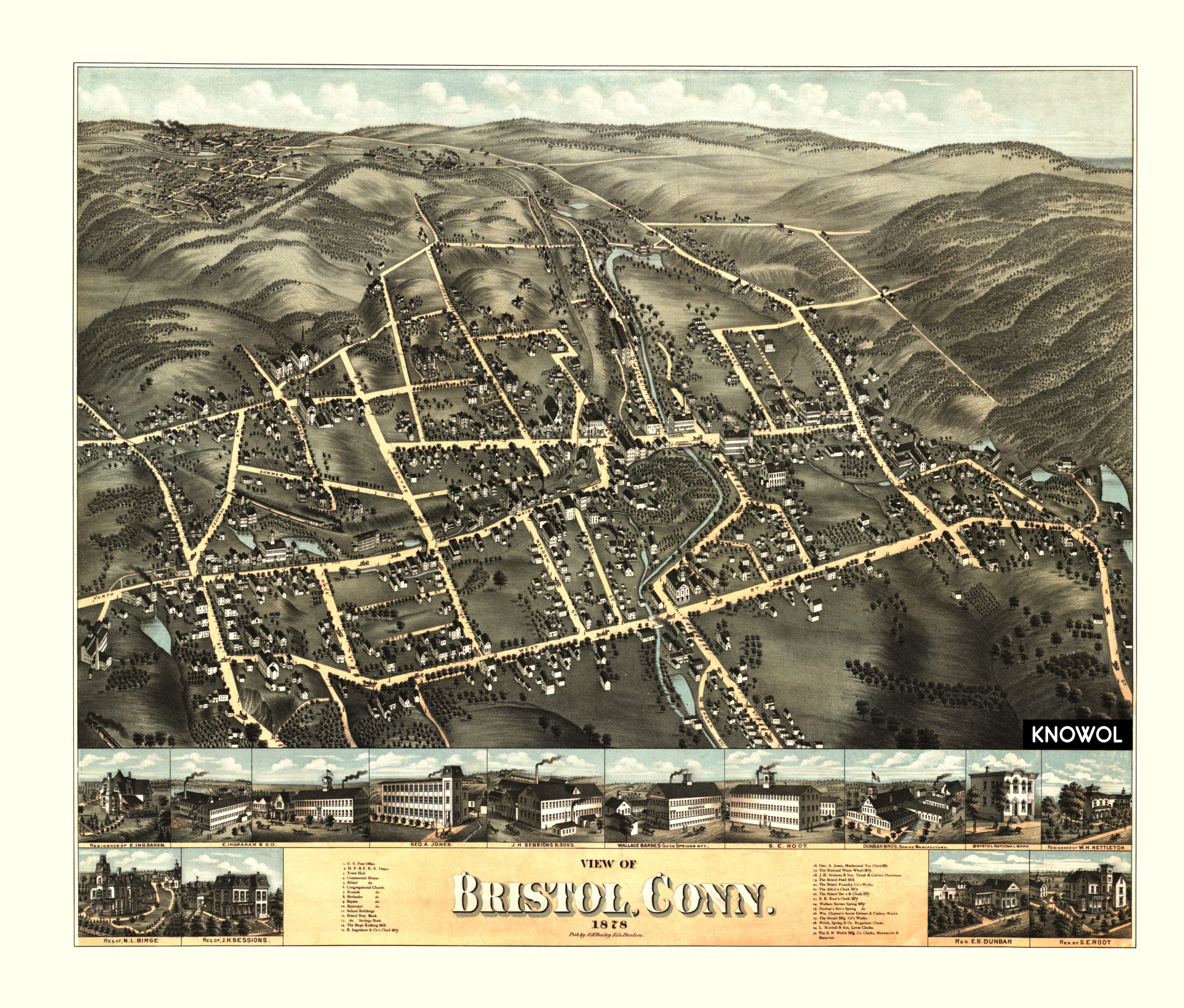
Bristol in 1878
By O.H. Bailey & Co.
Bristol drawn as if from the sky, with the town hall, the Birge knitting mill, the Bristol Commercial House, the George A. Jones mechanical toy clock company and the Bristol feed mill. Forestville isn't part of this view.5
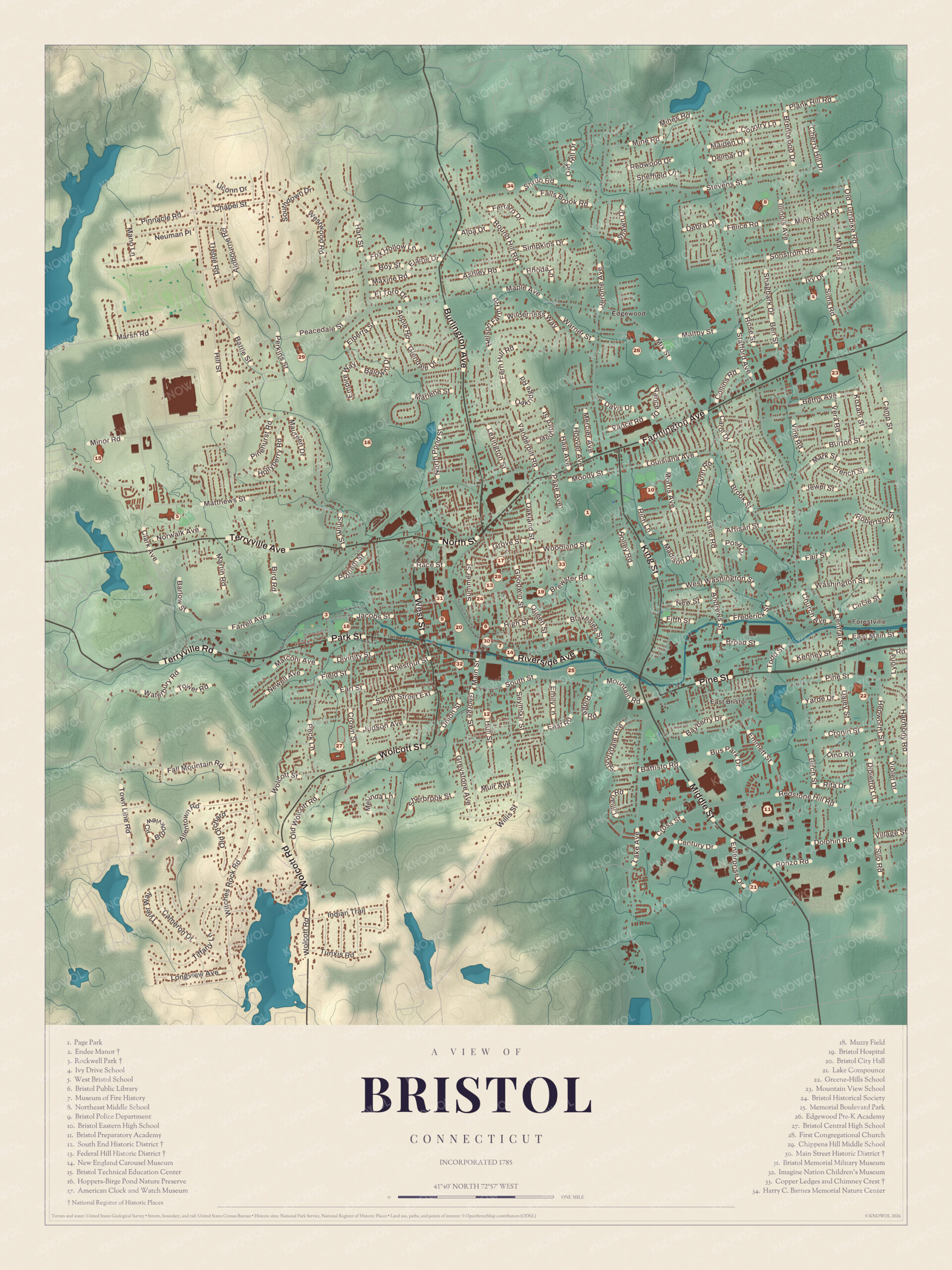
Bristol today
By KNOWOL
Shaded hills around downtown and East Bristol, Cedar Lake and the Pequabuck River drawn to their true shape, Forestville, East Bristol and Edgewood by name, and a guide of 34 numbered landmarks with the National Register sites marked.6
The story of Bristol
The clock town
Bristol was New Cambridge, the western part of Farmington, until it became a town in 1785. A few years later Gideon Roberts, a soldier of the Revolution, was making wooden clocks at his home on the Fall Mountain road. One man remembered seeing him ride past with a clock in each saddlebag and a third tied on behind, dials showing. Chauncey Jerome had Main Street laid out in 1826, and by 1850 his factory on the Pequabuck River was the biggest clockmaker in the country. Clocks led to brass, springs and hardware, and the Bristol Brass and Clock Company grew into the largest factory in town. In 1890 the state still listed clocks first among Bristol's trades.178910112
Forestville, the opening in the woods
In 1833 the firm of Bartholomew, Hills and Brown built a clock factory on the south side of the river in the woods, and the first houses went up two years later. They named the place Forestville for the little opening in the woods. The village grew around its brass and clock shops, got a train station in 1881 with 13 trains a day, and in 1864 its Methodists bought an empty church and moved it to the village. Then, in 1902, word spread that oil was seeping out of the ground at the Taylor farm in the Stafford District. Land prices shot up and experts came from the oil fields to look at the little hole. Each one left quietly, and that was the end of Forestville's oil boom.12131415
The Leather Man comes through
For many years the Old Leather Man was a regular visitor on Bristol's roads. He came in from the west through the north part of town and headed east through Forestville, on a loop that usually took him 34 days. In 1884 and 1885 he made 19 of those trips in a row. Everything he wore, coat, trousers, cap and even moccasins, was made of old bootlegs laced together, and little girls dreaded meeting him on the sidewalk. A Bristol woman fed him whenever he came by and knew which noon to expect him. The picture of him in the town's 1907 history was taken from behind her washing on the line, and he never knew.16
Through the years
25 moments from 1728 to today.
- 1728Nehemiah Manross comes from Lebanon and builds a house on King Street, near Ebenezer Barnes, the first settler to stay.1
- 1742About this year William Jerome builds the saltbox house that still stands on Jerome Avenue.17
- 1744The colony lets the families here form their own church society, New Cambridge, with its church on Federal Hill.1
- 1745Before this year Deacon Hezekiah Rew has a grist mill running near the Barnes tavern.18
- 1770sIn the Revolution the Loyalist Joel Tuttle is hanged from an oak on Federal Hill, cut down alive, and escapes to the Tory Den.19
- 1785New Cambridge is incorporated as the town of Bristol, named for Bristol in England.1
- 1790By now Gideon Roberts is making wooden clocks and selling them from horseback.1
- 1791On April 13 the Bristol Baptist Church is organized in Mr. Todd's new barn at Indian Heaven.20
- 1826Main Street is laid out, through the efforts of the clockmaker Chauncey Jerome.9
- 1833Bartholomew, Hills and Brown build a wooden clock factory in the woods, and Forestville begins.12
- 1837The Methodist church is finished. Its land could only be bought by hiding what it was for.14
- 1846Lake Compounce opens as an amusement park.1
- 1850The Bristol Brass and Clock Company is formed, and the railroad reaches the town center.119
- 1858A New Year's Day meeting in the Polkville schoolhouse starts a tradition that runs 40 years in a row.21
- 1860sBristol sends 250 volunteers to the Civil War, and 54 die in the service.3
- 1881The Forestville station is built, served by 13 trains a day.13
- 1884The Old Leather Man makes 19 straight trips of 34 days each through Bristol and Forestville, into 1885.16
- 1887A Bristol machinist invents the jointed steel "Bristol" fishing rod.22
- 1902Talk of an oil strike at the Taylor farm in Forestville's Stafford District sends land prices soaring.15
- 1911Bristol is incorporated as a city.1
- 1914Albert Rockwell gives the city Rockwell Park, its first public park.23
- 1917Endee Manor's 102 bungalows for New Departure workers are finished in about four months.24
- 1952The American Clock and Watch Museum opens in Bristol.1
- 1962The first Bristol Mum Festival opens on July 7.1
- 1979ESPN comes to Bristol.1
Places to see
The numbers match the landmark guide printed on the 2026 map.
- 2Endee ManorWest of downtown. 102 bungalows built for factory workers.
- 3Rockwell ParkAlong the Pequabuck. The city's first public park.
- 12South End Historic DistrictSouth of downtown. Clock workers' and owners' homes.
- 13Federal Hill Historic DistrictFederal Hill. Where New Cambridge built its first church.
- 17American Clock and Watch MuseumNear the center. In Bristol since 1952.Visit their website
- 18Muzzy FieldNear Rockwell Park. One of the oldest ballparks in the U.S.
- 21Lake CompounceSoutheast Bristol. An amusement park since 1846.
- 24Bristol Historical SocietyNear Federal Hill. In the first high school of 1891.Visit their website
- 28First Congregational ChurchFederal Hill. In the Federal Hill district.
- 30Main Street Historic DistrictDowntown. Laid out by Chauncey Jerome in 1826.
On the National Register
All 17 places in Bristol on the National Register of Historic Places that still stand today, oldest first, and why each one matters.4
-
William Jerome I House
A center-chimney saltbox, probably built by William Jerome, who came here in 1740 when Bristol was still part of Farmington. It's one of the few 18th-century houses left in the city.17
-
Federal Hill Historic District
The green here was the first town green, where Bristol's first church and school stood. Later it became the fashionable place for factory owners to build, and it has more than 250 buildings, many of them Italianate and Queen Anne houses.25
-
Main Street Historic District
The heart of downtown, on a street Chauncey Jerome had laid out in 1826. Its 19 historic buildings include the old town hall and the Bristol National Bank building by McKim, Mead and White.9
-
Terry-Hayden House
A Greek Revival house with a big four-column temple front, built by the clockmaker Theodore Terry, a nephew of Eli Terry. It's part of an office complex called Terry Commons now.26
-
South End Historic District
One of Bristol's oldest neighborhoods, with more than 100 historic buildings. Chauncey Jerome's 1832 Greek Revival house at Main and South Streets, now the Elks lodge, is one of its oldest.10
-
Forestville Passenger Station
Built by the New York and New England Railroad, it was served by 13 trains a day and helped Forestville prosper. Passenger service ended in 1960, and the little station has found other uses.13
-
Beleden House
A rare Beaux Arts mansion of orange brick with a half-round Ionic portico, built for the merchant and banker William Sessions. It's probably the most opulent house on Federal Hill.2725
-
Clara T. O'Connell School
A city school from 1914 until 2012. A fire damaged its top in 2017, but the building survived and now holds apartments.2829
-
Rockwell Park
Albert Rockwell gave this land to the city in 1914, and it was Bristol's only public park until 1933. It spreads along the Pequabuck River, with rustic cobblestone gates and a summerhouse.23
-
Townsend G. Treadway House
One of the city's largest Colonial Revival houses, built for a descendant of the clockmaker Eli Terry. Treadway lived here until his death in 1972.30
-
Clarence A. Bingham School
A city school from 1916 until 2010. It was sold in 2015 to be turned into housing.31
-
Endee Manor Historic District
102 bungalows put up in about four months for workers of the New Departure Manufacturing Company. It was the largest of Bristol's worker housing projects of the 1910s and was praised as a model in its day.24
-
Ernest R. Burwell House
A Classical Revival house with a two-story Doric portico, built for Ernest Burwell, who made his fortune in coal, ice and trucking. The mansion that once stood next door is gone, but this one remains.32
-
Old Bristol High School
The city's high school until 1967, built on land given by Albert Rockwell. After years as a middle school it reopened in 2022 as the Bristol Arts and Innovation Magnet School.33
-
Copper Ledges and Chimney Crest
Two mansions built for the brothers Fuller and Harry Barnes, who grew their grandfather's clock-spring shop into Associated Spring. Both are privately owned.34
-
Marlborough House
A Georgian Revival brick house built for Edward Ingraham, head of the E. Ingraham Company, one of the largest makers of clocks and watches.35
-
Bristol Girls' Club
Believed to be the first clubhouse built for a branch of the Girls Club of America. The club signed up 351 girls in its first month in 1928.36
In their words
“You can better afford to have a country without a husband than a husband without a country.”
Captain N. S. Manross of Bristol, to his wife before leading the town's company to war, as told in the History of the Sixteenth Connecticut Volunteers, 187537
“The people of Bristol early began to develop the mechanical taste which has been so remarkable a feature of the town ever since.”
Bristol, Connecticut, "in the olden time New Cambridge", 190718
Nearby towns
Sources
- Bristol, Connecticut, Wikipedia
- Register and manual of the state of Connecticut (1891), Internet Archive
- The Memorial History of Hartford County, Connecticut, 1633-1884 (1886), on Bristol in the Civil War, Internet Archive
- National Register of Historic Places listings in Hartford County, Connecticut, Wikipedia
- Old map of Bristol, Connecticut, 1878, restored by KNOWOL
- Map of Bristol, Connecticut in 2026, KNOWOL (USGS elevation, Census Bureau roads)
- The Connecticut magazine (1903), on Bristol's clockmakers, Internet Archive
- Bristol, Connecticut: "in the olden time New Cambridge" (1907), on Gideon Roberts, Internet Archive
- Main Street Historic District (Bristol, Connecticut), Wikipedia
- South End Historic District (Bristol, Connecticut), Wikipedia
- The Memorial History of Hartford County, Connecticut, 1633-1884 (1886), on Bristol Brass and Clock, Internet Archive
- The Memorial History of Hartford County, Connecticut, 1633-1884 (1886), on Forestville, Internet Archive
- Forestville station, Wikipedia
- The Memorial History of Hartford County, Connecticut, 1633-1884 (1886), on the Methodist churches, Internet Archive
- Bristol, Connecticut: "in the olden time New Cambridge", which includes Forestville (1907), Internet Archive
- Bristol, Connecticut: "in the olden time New Cambridge" (1907), on the Old Leather Man, Internet Archive
- William Jerome I House, Wikipedia
- Bristol, Connecticut: "in the olden time New Cambridge" (1907), on the first mills, Internet Archive
- The Connecticut magazine (1908 volume), on the Tories of New Cambridge, Internet Archive
- Bristol, Connecticut: "in the olden time New Cambridge" (1907), on Indian Heaven and the Baptist church, Internet Archive
- Commemorative biographical record of Hartford County, Connecticut (1901), on the Polkville meetings, Internet Archive
- Commemorative biographical record of Hartford County, Connecticut (1901), on the Bristol fishing rod, Internet Archive
- Rockwell Park, Wikipedia
- Endee Manor Historic District, Wikipedia
- Federal Hill Historic District (Bristol, Connecticut), Wikipedia
- Terry-Hayden House, Wikipedia
- Beleden House, Wikipedia
- Clara T. O'Connell School, Wikipedia
- O'Connell School apartments at 122 Park Street, Bristol, PadMapper listing
- Townsend G. Treadway House, Wikipedia
- Clarence A. Bingham School, Wikipedia
- Ernest R. Burwell House, Wikipedia
- Old Bristol High School, Wikipedia
- Copper Ledges and Chimney Crest, Wikipedia
- Marlborough House (Bristol, Connecticut), Wikipedia
- Bristol Girls' Club, Wikipedia
- History of the Sixteenth Connecticut Volunteers (1875), Internet Archive