
A hill town between Candlewood Lake and the Housatonic, once the parish of Newbury, where iron was forged at the Half-Way Falls of the Still River by 1732 and the Iron Works village later turned out hats, shears and lime.
Brookfield on the map
Click the map to look closer.
Brookfield today
By KNOWOL
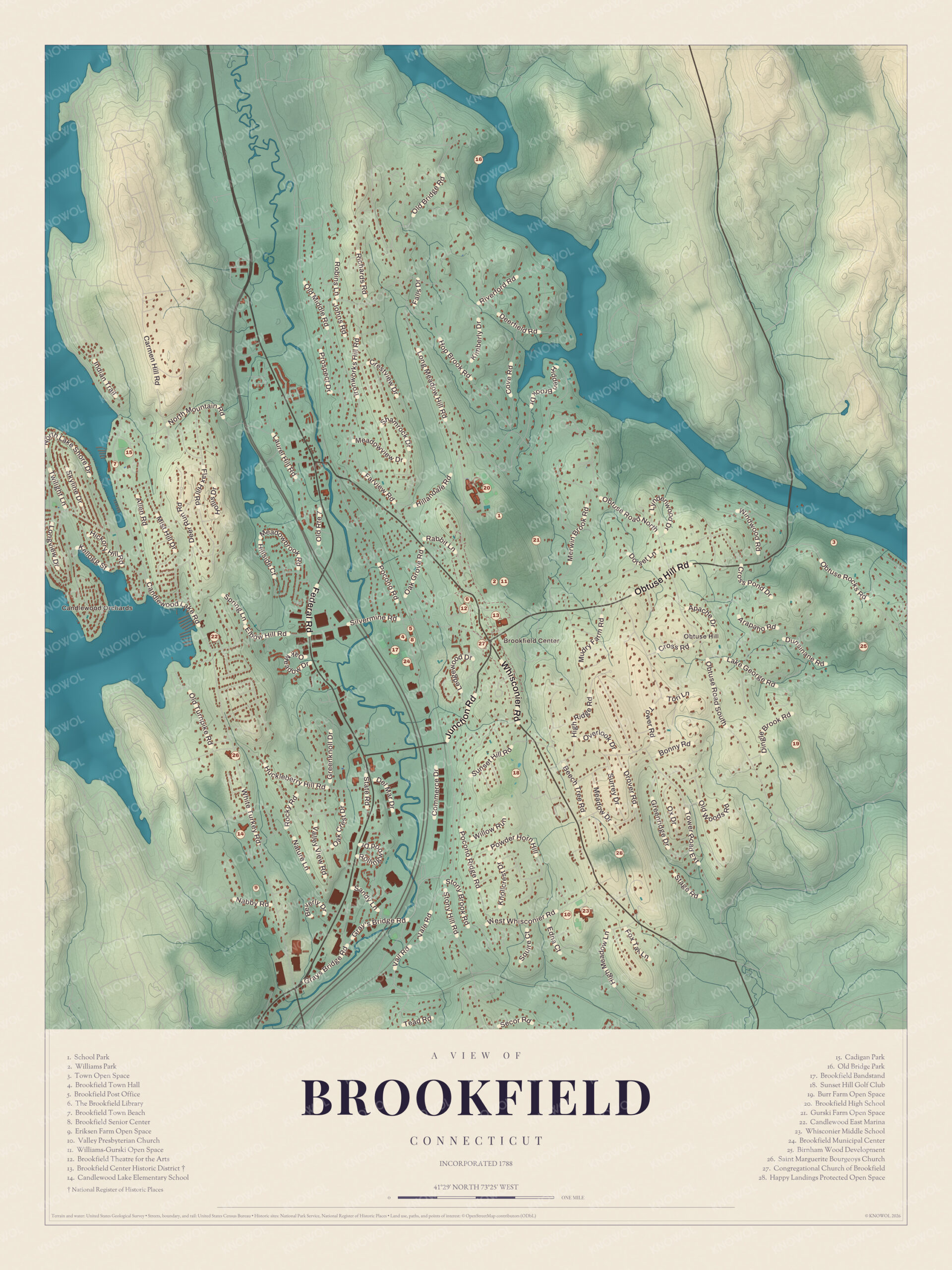
Shaded hills from Obtuse Hill out to Candlewood Shores, Candlewood Lake and the Still River drawn to their true shape, every street, and a guide of 28 numbered landmarks with the National Register site marked.6
The story of Brookfield
The iron works at Half-Way Falls
The Iron Works got its name honestly. By 1732, New Milford records show iron works already set up at the Half-Way Falls of the Still River, where the water drops into a gorge just south of today's stone-arch bridge. The next year the owners hired Eleazer Hathaway to do the work of a skillful bloomer and make twenty-four tons of iron a year from two forges. Tradition says that during the Revolution, iron from here was carried by night to West Point, about forty miles, for the great chain stretched across the Hudson to slow the British. A bridge crossed the river here in 1745, and by 1748 Abel Barnum had a gristmill just to the north. The village's old gristmill still stands today as the Brookfield Craft Center.31
Hats, shears and lime
By the 1800s the Iron Works village made a little of everything. In 1837 Daniel Tomlinson, a one-time state senator, dammed the river and started making currier's knives. The freshet of 1853 carried his dam away, but the shop grew into a shear works that became the Lenox Shear Company in 1889. Just north of the stone-arch bridge, Henry B. Hawley made hats for Pearce and Hall of New York City from 1868 to 1875, with a hundred people at work. Elijah Sturdevant's hat shop in the Beaver Brook district burned in August 1873, a loss of some sixty thousand dollars. And the lime from Brookfield's quarries, a local writer said in 1907, was as fine as any in the state.748
Brooks's field
For most of the 1700s Brookfield was Newbury, a parish pieced together from corners of New Milford, Newtown and Danbury. Its neighbors weren't eager to let it go. In 1743 the Newtown church named a man to oppose a new society here, and later Newbury petitioned the General Assembly for town rights for close to twenty years. It finally won in May 1788 and took the name of its first pastor, Rev. Thomas Brooks, who was still preaching there. At the first town meeting on June 9, the voters formally thanked the spectators who had come over from the neighboring towns. Their meetinghouse used a pulpit given by New Milford, went 67 years without a steeple, and never had a bell of its own.2910
Through the years
25 moments from 1710 to today.
- 1710Colonists settle in what's now Brookfield.1
- 1732Iron works are already running at the Half-Way Falls of the Still River.3
- 1733The owners hire Eleazer Hathaway as bloomer, to make twenty-four tons of iron a year from two forges.3
- 1743Newbury asks to become its own parish, and the Newtown church appoints a man to oppose it.2
- 1745A bridge goes over the Still River at the Iron Works, and the first schoolhouse opens there.3
- 1754The General Assembly incorporates the Society of Newbury.2
- 1757On September 28 the church is organized, the meetinghouse dedicated and Rev. Thomas Brooks ordained.1
- 1757Tradition says Major Nichols, scouting fort sites for the French War, spends a night at the Iron Works tavern.11
- 1777When Governor Tryon's troops burn Danbury, Newbury people rush to help, by local tradition.1213
- 1788In May the parish becomes the town of Brookfield, named for its pastor, Rev. Thomas Brooks.2
- 1788At the first town meeting, June 9, the voters thank the spectators from neighboring towns.9
- 1795Widow Mary Northrop leaves the town an estate for schooling, later known as the Molly Money.14
- 1807Col. Isaac Hawley builds the first bridge over the Housatonic at Southville, at his own expense.15
- 1824After 67 years without one, the meetinghouse gets a steeple. It never gets a bell.10
- 1837Daniel Tomlinson dams the Still River and starts making currier's knives.7
- 1837The Iron Works Aqueduct Company is formed to bring spring water to the village. It still runs as the Brookfield Water Company.1
- 1840Young Elmer H. Northrop of Brookfield Center watches the first rails laid on the Housatonic Railroad.16
- 1868Henry B. Hawley opens a hat factory by the river with one hundred workers.4
- 1873Elijah Sturdevant's hat factory in the Beaver Brook district burns, a loss of about $60,000.4
- 1880C. S. Pendleton of New London builds the stone-arch bridge over the Still River.17
- 1883The Curtis School for Boys moves to Brookfield Center from Bethlehem.18
- 1889The shear works at the Iron Works becomes the Lenox Shear Company.7
- 1901Herbert W. Greene moves his Summer School of Music from New York City to Brookfield Center.19
- 1915Electricity comes to Brookfield.1
- 1991The Brookfield Center Historic District is added to the National Register.20
Places to see
The numbers match the landmark guide printed on the 2026 map.
- 4Brookfield Town HallWest of the Center. Where town business gets done.
- 6The Brookfield LibraryBrookfield Center. The town library by the Center.Visit their website
- 7Brookfield Town BeachCandlewood Lake. The town's beach on Candlewood Lake.
- 12Brookfield Theatre for the ArtsBrookfield Center. Plays in the old Curtis School gym.Visit their website
- 13Brookfield Center Historic DistrictBrookfield Center. The original town center, listed 1991.
- 15Cadigan ParkCandlewood Lake Road. Fields and courts across from the beach.
- 17Brookfield BandstandWest of the Center. Summer concerts and shows outdoors.
- 19Burr Farm Open SpaceDingle Brook Road. 116 acres of protected land.
- 27Congregational Church of BrookfieldBrookfield Center. The parish church gathered in 1757.Visit their website
- 28Happy Landings Protected Open SpaceWhisconier Road. Open fields with old barns and windmills.
On the National Register
All 1 places in Brookfield on the National Register of Historic Places that still stand today, oldest first, and why each one matters.5
-
Brookfield Center Historic District
The original settlement of Brookfield, where the first church, town hall, school and tavern went up at the road junction. Its 67 buildings on 43 acres include a saltbox of about 1700, the 1854 Greek Revival Congregational Church and the 1907 gymnasium of the Curtis School for Boys, now the Brookfield Theatre for the Arts.20
In their words
“There is probably no finer view in Fairfield County than this.”
Historical sketch of the First Congregational Church of Brookfield, 1907, on the top of the Obtuse Hills21
“It is a quaint old spot like many another New England village, shut away from the noise and bustle of the outside world.”
Historical sketch of the First Congregational Church of Brookfield, 1907, on Brookfield Center16
“The lime here is considered to be as fine as any in the state.”
Historical sketch of the First Congregational Church of Brookfield, 19078
Nearby towns
Sources
- Brookfield, Connecticut, Wikipedia
- Historical sketch of the First Congregational Church of Brookfield, Connecticut, and of the town of Brookfield (1907), on the parish of Newbury, Internet Archive
- Historical sketch of the First Congregational Church of Brookfield (1907), on the iron works, Internet Archive
- Historical sketch of the First Congregational Church of Brookfield (1907), on hat making, Internet Archive
- National Register of Historic Places listings in Fairfield County, Connecticut, Wikipedia
- Map of Brookfield, Connecticut in 2026, KNOWOL (USGS elevation, Census Bureau roads)
- Historical sketch of the First Congregational Church of Brookfield (1907), on the shear business, Internet Archive
- Historical sketch of the First Congregational Church of Brookfield (1907), on the lime industry, Internet Archive
- History of Fairfield County, Connecticut (1881), on Brookfield's first town meeting, Internet Archive
- Historical sketch of the First Congregational Church of Brookfield (1907), on the first meetinghouse, Internet Archive
- Historical sketch of the First Congregational Church of Brookfield (1907), on the Iron Works tavern, Internet Archive
- History of Fairfield County, Connecticut (1881), on Brookfield's military record, Internet Archive
- Battle of Ridgefield (the 1777 raid on Danbury), Wikipedia
- History of Fairfield County, Connecticut (1881), on the Molly Money, Internet Archive
- Historical sketch of the First Congregational Church of Brookfield (1907), on Col. Isaac Hawley, Internet Archive
- Historical sketch of the First Congregational Church of Brookfield (1907), on Brookfield Center, Internet Archive
- Historical sketch of the First Congregational Church of Brookfield (1907), on the stone-arch bridge, Internet Archive
- Historical sketch of the First Congregational Church of Brookfield (1907), on the Curtis School, Internet Archive
- Historical sketch of the First Congregational Church of Brookfield (1907), on the Summer School of Music, Internet Archive
- Brookfield Center Historic District (Brookfield, Connecticut), Wikipedia
- Historical sketch of the First Congregational Church of Brookfield (1907), on Obtuse Hill, Internet Archive