
A hill town on the Farmington River, set off from Simsbury in 1806, where the Collins Company turned a grist mill site into Collinsville and sent its axes, ready ground and polished, all over the world.
Then and now
The same town 157 years apart. Click either map to look closer.
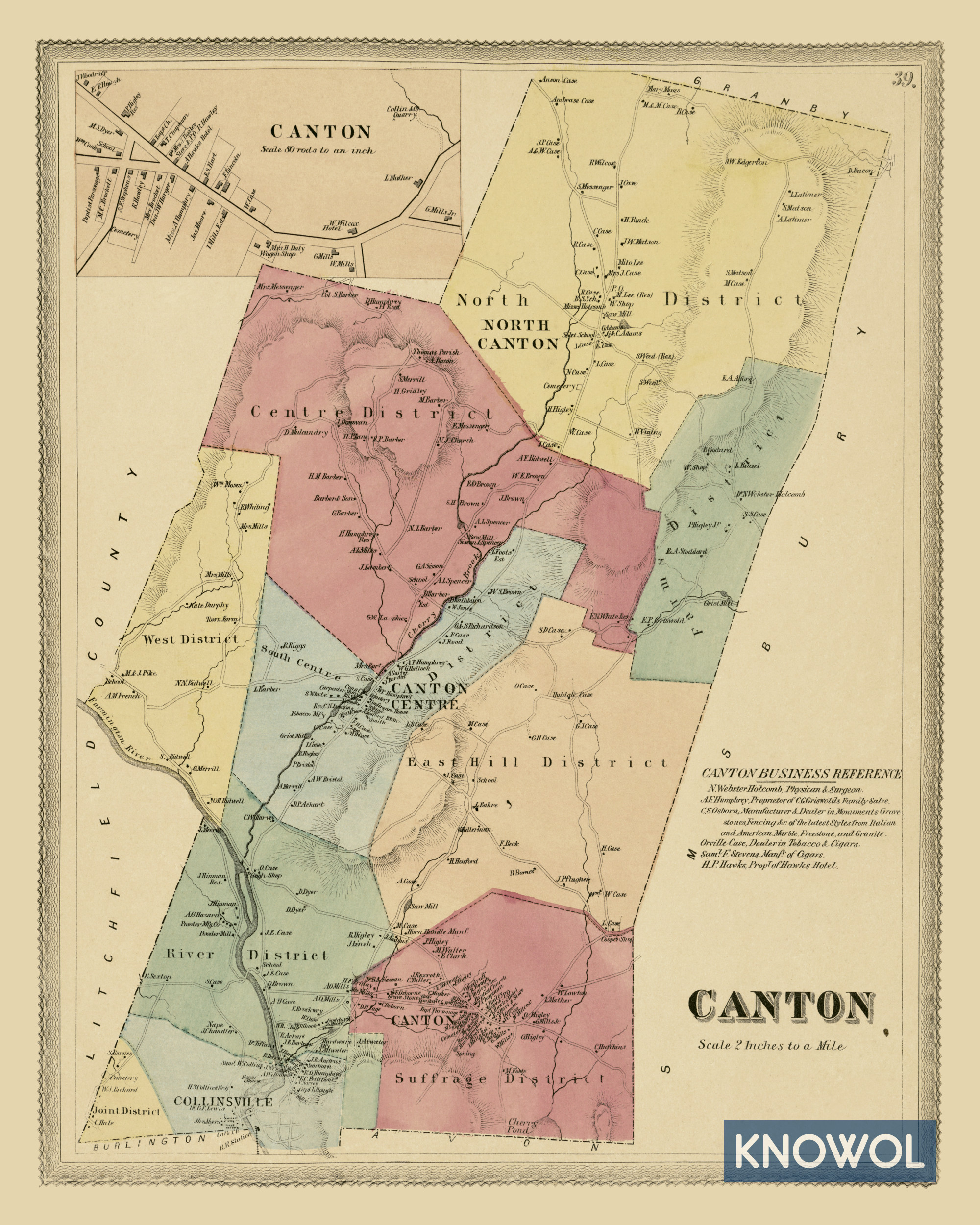
The landowners map
By Baker & Tilden
Canton laid out in its school districts, among them the Suffrage District, River District and Joint District, with every plot marked with its owner's name and landmarks like Hawks Hotel, the Sisson & Spencer Saw Mill, Orville Case's Tobacco & Cigars and the Canton Conference House.5
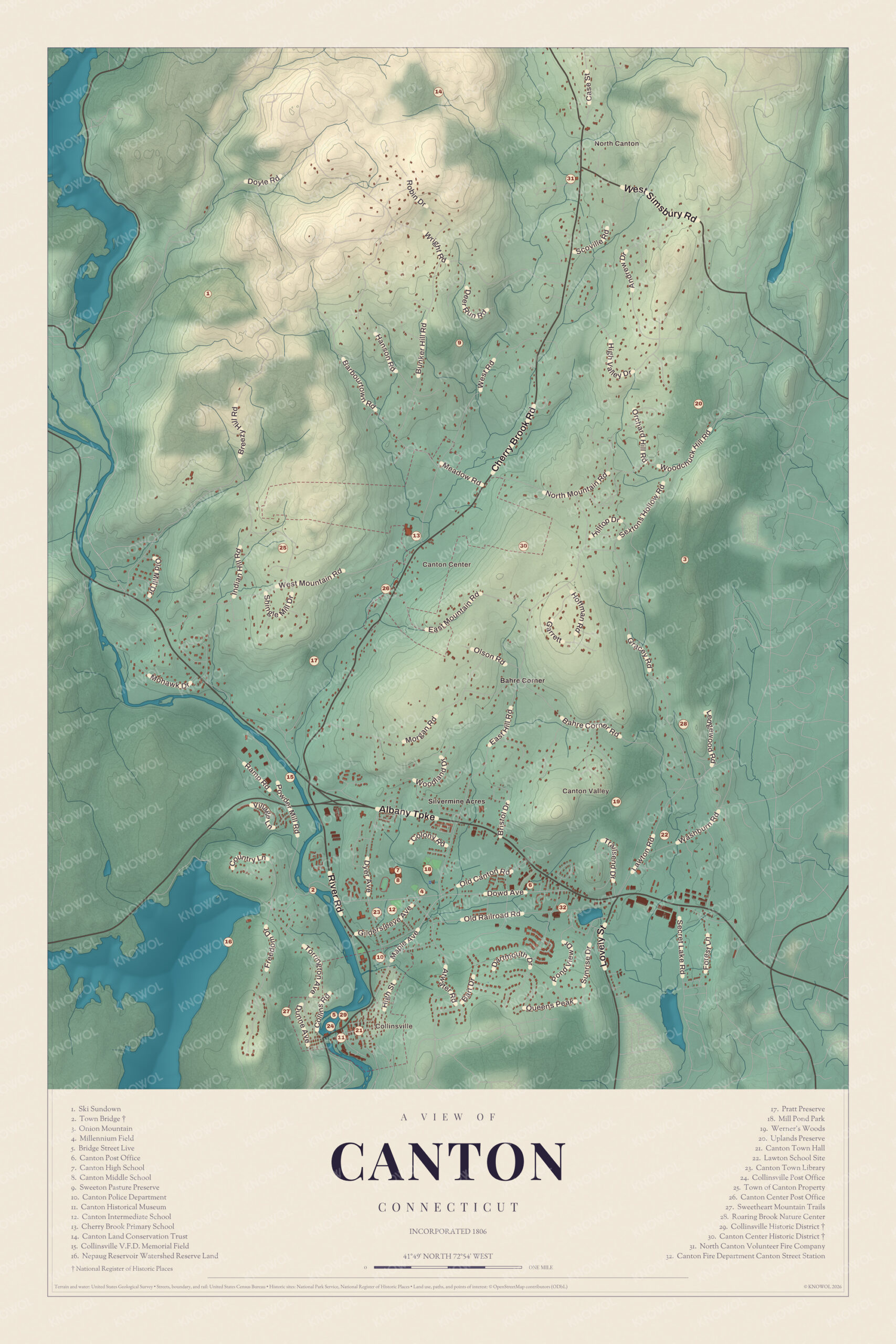
Canton today
By KNOWOL
Shaded hills from North Canton down to Collinsville and the Farmington River, every street, the four villages and the Nepaug Reservoir, and a guide of 32 numbered landmarks with the National Register sites marked.6
The story of Canton
Eight axes a day
Before 1826, an axe was hammered out by a blacksmith and sold without an edge, so a farmer spent half a day grinding it. David C. Collins, a clerk in a Hartford store, tried making axes ground and polished and ready to use. That year he, his brother Samuel W. Collins and a cousin bought the Humphrey grist mill site on the Farmington River in the south part of Canton. In the first factory, eight forged axes were a day's work. By 1836 the village made 700 to 800 axes a day, and its workers lived in matching white houses on the hill. By 1886 the works made over three thousand tools a day and wore six hundred tons of grindstones to dust each year. The company closed in 1966, but its buildings still line the river.7289
Powder, brandy and the flood of 1801
Long before the axe works, Canton's streams kept small mills busy. The first iron forge started in 1774, and a second went up in 1792 in the south part of town. The flood of 1801 carried both of them off. Joseph Segur ran a grist mill near the spot where the Collinsville covered bridge later stood, and he crossed the river to it every day by canoe. At one time there were seven sawmills in town. In 1825 Canton had at least forty distilleries. Jared Mills and Edmund Fowler built the first powder mills on the Nepaug, near where it meets the Farmington, and in sixty years at least thirty people were killed in their explosions. Powder making ended in town about 1865.103
Old Cherry's brook and the plain of Suffrage
Before anyone lived here year round, families from Simsbury came out to plant corn on a river bottom called the Hopyard, at the mouth of Cherry Brook, and their boys stood by with guns while they hoed. Richard Case moved out in 1737 and is remembered as the first settler. The brook took its name from a chief named Waquaheag, known in Simsbury as Old Cherry. The east village was called Suffrage, a name said to recall one settler's hard first years, and the first post office in old Simsbury opened there in 1798. Owen Brown, father of the famous John Brown, lived at what became Canton Center, and his first child was born in Canton in 1794.111213141516
Through the years
25 moments from 1737 to today.
- 1737Richard Case moves out from the old Simsbury parish and becomes the first settler of West Simsbury.12
- 1747Benjamin Dyer, a schoolmate of Benjamin Franklin, builds the house later called the Page Place.17
- 1750West Simsbury becomes its own parish.18
- 1752Tryphene Barber is the first burial in the old south burying ground, under the oldest gravestone in town.11
- 1774Canton's first iron forge starts up beside the river.10
- 1785Rev. Jeremiah Hallock begins a ministry that lasts until his death in 1826.15
- 1789Frederick Humphrey builds what will be one of the oldest houses in Collinsville.19
- 1794Salmon Brown, first child of Owen Brown and older brother of the famous John Brown, is born in Canton.16
- 1798The first post office in old Simsbury opens at Suffrage, now Canton Village.15
- 1801A flood carries off both of the town's iron forges.10
- 1806Canton is set off from Simsbury and incorporated as a town.1
- 1814The Congregational church at Canton Center is built.18
- 1825Canton has at least forty distilleries.3
- 1826Collins & Co. buys the Humphrey grist mill site on the Farmington River and starts making axes.7
- 1829The axe works begins burning Lehigh coal, said to be a first for any edge tool works.20
- 1831In December the Collinsville post office opens at what had been South Canton.7
- 1832E. K. Root becomes superintendent of the enlarged axe factory.20
- 1854The Collinsville High School building is dedicated on March 3.21
- 1865Gunpowder making, carried on in town for decades, comes to an end.3
- 1867The Collins Company begins its granite dam, 300 feet long and 18 feet high.8
- 1869Baker & Tilden publish their landowners map of Canton.5
- 1873About one eighth of Canton is set off to Simsbury.22
- 1895The Berlin Iron Bridge Company builds the Town Bridge over the Farmington River.23
- 1966The Collins Company closes its doors.9
- 2007Budget Travel names Collinsville one of the ten coolest small towns in America.1
Places to see
The numbers match the landmark guide printed on the 2026 map.
- 2Town BridgeNorth of Collinsville. Iron truss bridge of 1895.
- 11Canton Historical MuseumCollinsville. In the Collins Company's 1865 shop.Visit their website
- 13Cherry Brook Primary SchoolCanton Center. The primary school in Canton Center.
- 18Mill Pond ParkNorth of Collinsville. A town park north of Collinsville.
- 21Canton Town HallCollinsville. Town offices in the old village.
- 23Canton Town LibraryToward Collinsville. The town's public library.Visit their website
- 27Sweetheart Mountain TrailsNear Collinsville. Trails close to Collinsville.
- 28Roaring Brook Nature CenterSoutheast, near Canton Valley. Nature center in the southeast.Visit their website
- 29Collinsville Historic DistrictCollinsville. The old axe company village.
- 30Canton Center Historic DistrictRoute 179, Canton Center. The town's old rural center.
On the National Register
All 3 places in Canton on the National Register of Historic Places that still stand today, oldest first, and why each one matters.4
-
Canton Center Historic District
The town's old rural center grew up along today's Route 179 beside Cherry Brook, which powered small sawmills and tanneries. Its 84 historic buildings include the Congregational church of 1814, a general store, a blacksmith's shop and the Caleb Case House of 1785, and it has changed little since about 1920.18
-
Collinsville Historic District
The village was built around the Collins Company axe factory, whose axes, machetes and picks went all over the world. The old factory buildings still ramble along the Farmington River among their sluices, and Main Street keeps its early 1900s look.9
-
Town Bridge
Built by the Berlin Iron Bridge Company as part of a town program to improve every crossing of the swift, flood prone river. It's one of only two pin connected Parker truss bridges left in Connecticut, about 172 feet long, with iron cresting over its entrances.23
In their words
“Canton has continuously produced a race of men among whom character has been the chiefest of earthly possessions.”
The Connecticut quarterly, 189515
“The axes produced by this company have a world-wide reputation for superior quality and finish.”
The historical, statistical and industrial review of the state of Connecticut, 1884, on the Collins Company24
“These houses are painted white, and when contrasted with the deep green foliage in the immediate vicinity, present a novel and beautiful appearance.”
Connecticut historical collections, 1837, on the axe makers' houses in Collinsville2
Nearby towns
Sources
- Canton, Connecticut, Wikipedia
- Connecticut historical collections (1837), on Collinsville, Internet Archive
- The Memorial History of Hartford County, Connecticut, 1633-1884 (1886), on distilleries and powder mills, Internet Archive
- National Register of Historic Places listings in Hartford County, Connecticut, Wikipedia
- Landowners map of Canton, Connecticut from 1869, restored by KNOWOL
- Map of Canton, Connecticut in 2026, KNOWOL (USGS elevation, Census Bureau roads)
- The Memorial History of Hartford County, Connecticut, 1633-1884 (1886), on the beginning of the Collins axe works, Internet Archive
- The Memorial History of Hartford County, Connecticut, 1633-1884 (1886), on the Collins Company dam, Internet Archive
- Collinsville, Connecticut, Wikipedia
- The Memorial History of Hartford County, Connecticut, 1633-1884 (1886), on Canton's forges and mills, Internet Archive
- History of Simsbury, Granby, and Canton: from 1642 to 1845 (1845), on the Hopyard and the old south burying ground, Internet Archive
- History of Simsbury, Granby, and Canton: from 1642 to 1845 (1845), on the first settlers, Internet Archive
- The Connecticut quarterly (1895), on Cherry Brook, Internet Archive
- Connecticut historical collections (1837), on Canton and Suffrage, Internet Archive
- The Connecticut quarterly (1895), on Canton's ministers and Suffrage, Internet Archive
- History of Norfolk, Litchfield County, Connecticut (1900), on Owen Brown, Internet Archive
- The Connecticut quarterly (1895), on the Page Place, Internet Archive
- Canton Center Historic District, Wikipedia
- Celebration of the one hundredth anniversary of the incorporation of the town of Canton, Connecticut (1906), on the early settlers, Internet Archive
- The Memorial History of Hartford County, Connecticut, 1633-1884 (1886), on Lehigh coal and E. K. Root, Internet Archive
- Celebration of the one hundredth anniversary of the incorporation of the town of Canton, Connecticut (1906), on the schools, Internet Archive
- The Memorial History of Hartford County, Connecticut, 1633-1884 (1886), on Canton's area and population, Internet Archive
- Town Bridge, Wikipedia
- The historical, statistical and industrial review of the state of Connecticut (1884), on Canton, Internet Archive