
A river town of three villages, once the Potapaug Quarter of Saybrook, where shipyards built the warship Oliver Cromwell, British raiders burned the fleet in 1814, and Ivoryton turned African tusks into piano keys.
Then and now
The same town 145 years apart. Click either map to look closer.
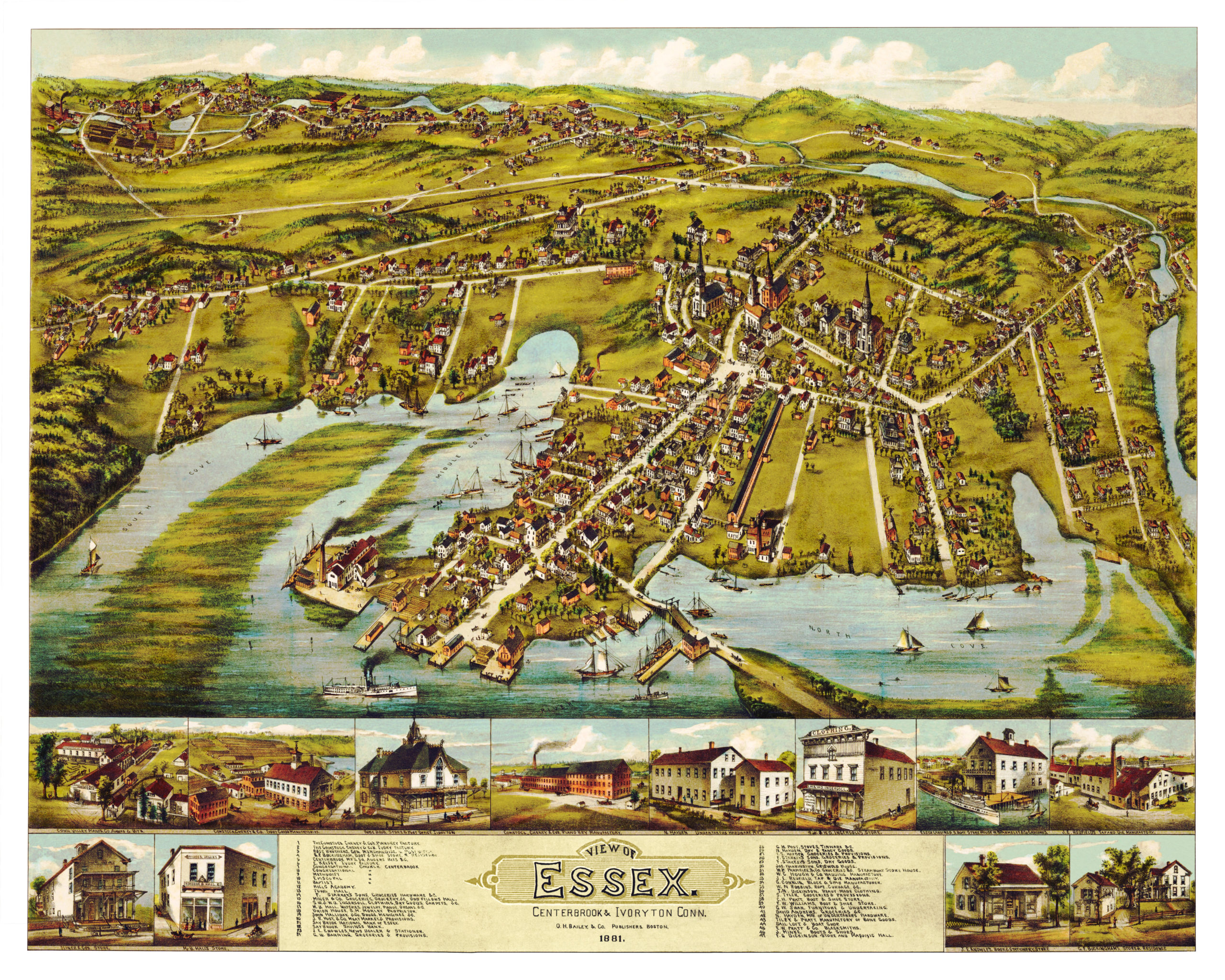
The bird's-eye view
By O.H. Bailey
Essex drawn as if from the sky toward the end of the 1800s, with Hills Academy, John Halliday's Drug and Medicine, J.R. Post Meat Market, the Saybrook Savings Bank, the Griswold House, Pratt Blacksmiths, F.G. Dickinson Store and the Masonic Hall.5
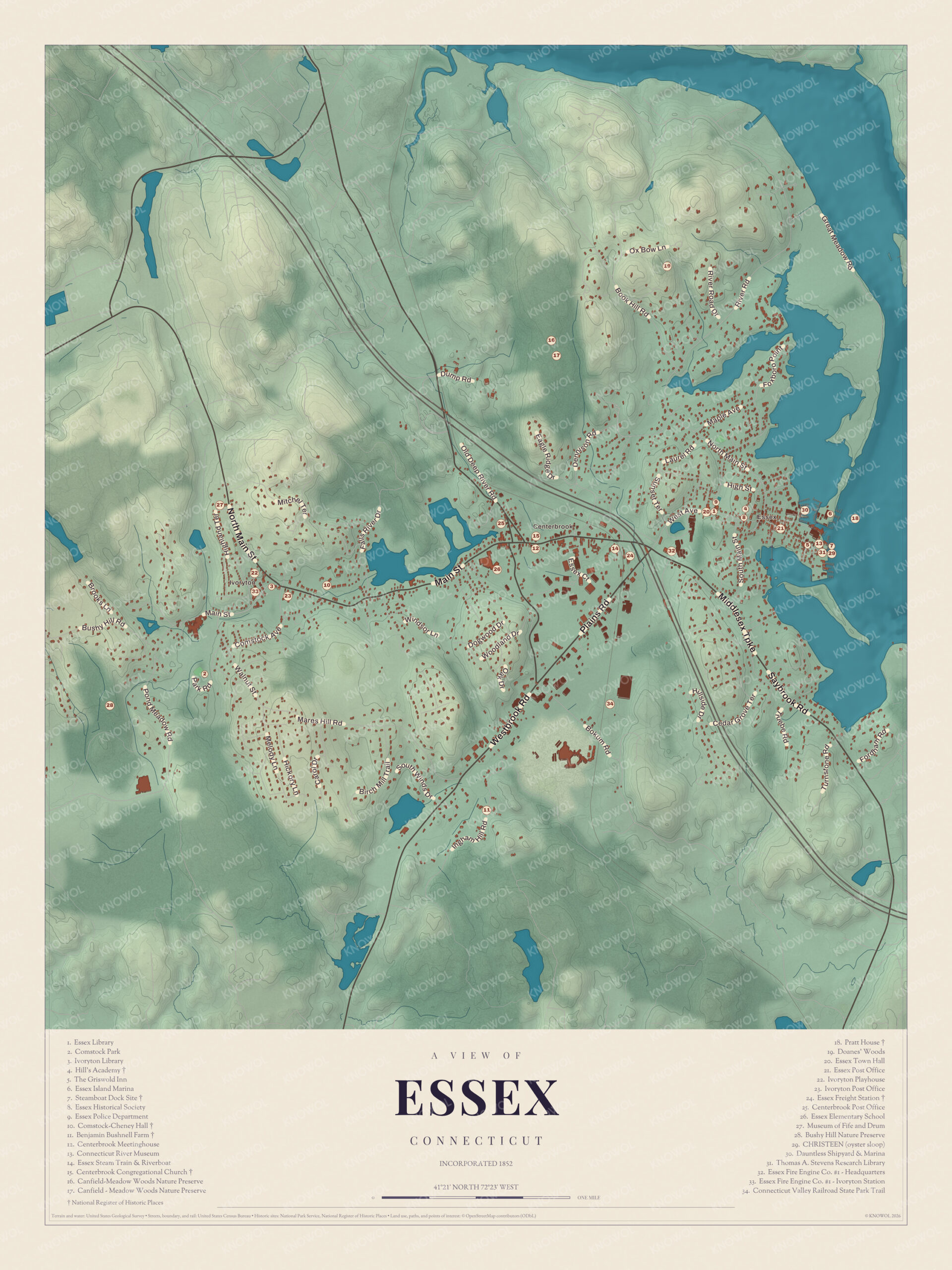
Essex today
By KNOWOL
Shaded hills from Ivoryton down to the river at Essex Village, every street, the Falls River and the three villages by name, and a guide of 34 numbered landmarks with the National Register sites marked.2
The story of Essex
The night the ships burned
Before dawn on April 8, 1814, about 136 British marines and sailors rowed six boats up the Connecticut River and landed at the foot of Main Street, in what was then the Pettipaug part of Saybrook. The town fired its one cannon, and the militia promised not to resist if the British left homes and people alone. The raiders marched to the Bushnell Tavern, now the Griswold Inn, and spent about six hours burning the new privateers and merchant ships in the harbor. An 1847 almanac counted 4 ships, 4 brigs, 4 schooners and 9 sloops. One old man, David Williams, whose son had a ship nearly finished on the stocks, went after the invaders with a hoe. The soldiers just laughed at him.167
Tusks from Zanzibar
Ivoryton started with combs. A 1906 history says Phineas and Abel Pratt, father and son, invented the first machine in the United States for cutting the teeth of combs, and began making combs in Essex just before 1800. About 1847 Samuel M. Comstock bought an old carding mill on the Falls River, moved it 200 feet down the stream and started making combs and ivory goods. By 1884 his company made keyboards for pianos, and a village of about 500 people had grown up around the factories, named for the material they worked. The tusks came mostly from Zanzibar and averaged 170 pounds. Ivoryton and Deep River took in three-fourths of the best ivory shipped from there, and nothing went to waste. Even the dust was sold as fertilizer.8910
Rum, rope and ship launches
For more than a century Essex lived off the river. Uriah and Ann Hayden kept a tavern near the water, and their sign of 1766, carved with the British arms on one side and a full-rigged ship on the other, was in the Connecticut Historical Society's care by 1922. Uriah Hayden also built the Oliver Cromwell, a 24-gun warship for the colony. A warehouse of 1753 near the river was often filled to the roof with rum, sugar, molasses and tobacco from the West Indies, and from about 1800 a ropewalk made cables and rigging for the ships. In 1851 Nehemiah Hayden launched the Middlesex, 1,400 tons, the biggest ship ever built here. A visitor that year guessed a launch drew out two-thirds of the neighborhood.1112313
Through the years
25 moments from 1701 to today.
- 1701The Pratt family settles into the house on West Avenue, where six generations will live.14
- 1705Ensign William Pratt and Sergeant Nathaniel Pratt build the first sawmill, on the Falls River.8
- 1720About this year Caleb and Mary Pratt begin their saltbox farmhouse on what's now Gates Road.15
- 1722About this year the Second Parish of Saybrook is organized for the whole Potapaug Quarter.16
- 1753Abner Parker builds a riverside warehouse, soon owned by the Haydens and later packed with West Indies goods.3
- 1766Uriah and Ann Hayden's tavern sign is made, carved with the British arms and a full-rigged ship.11
- 1775Uriah Hayden builds the 24-gun Oliver Cromwell for the colony of Connecticut.12
- 1776Saybrook craftsmen, among them the ship's carpenter Phineas Pratt, help David Bushnell build the Turtle, the first American submarine.17
- 1790The Centerbrook meetinghouse is built. It still stands.18
- 1800About this year a ropewalk opens to make cables and rigging for Essex ships.3
- 1800Just before this year Phineas and Abel Pratt start making combs, using the first comb-cutting machine in the country.8
- 1805About this year the two-story Great School House is built for advanced pupils.19
- 1814On April 8 British raiders row up the river and burn the ships in the harbor.1
- 1832Hill's Academy's brick building is finished on Prospect Street.20
- 1846The Baptist church, one of three Egyptian Revival churches in the country, is built.1
- 1847About this year Samuel M. Comstock buys a carding mill on the Falls River and starts making combs and ivory goods.9
- 1851Nehemiah Hayden launches the Middlesex, 1,400 tons, the largest ship built at Essex.3
- 1852Essex becomes a town, separate from Saybrook.2
- 1854The town takes the name Essex.2
- 1872The Comstock, Cheney Company is organized with $250,000 in capital.9
- 1878The steamboat warehouse at the foot of Main Street is built.21
- 1881O.H. Bailey publishes his bird's-eye view of Essex.5
- 1884Ivoryton and Deep River take in three-fourths of the prime ivory shipped from Zanzibar.10
- 1911Comstock, Cheney builds a hall for its workers that becomes the Ivoryton Playhouse.22
- 1971Steam excursion trains start running from the Essex depot.23
Places to see
The numbers match the landmark guide printed on the 2026 map.
- 4Hill's AcademyProspect Street. Brick academy finished in 1832.Visit their website
- 5The Griswold InnMain Street. The old Bushnell Tavern of 1814.
- 7Steamboat Dock SiteFoot of Main Street. Where the British landed in 1814.
- 10Comstock-Cheney HallIvoryton. The ivory company's 1911 hall.Visit their website
- 11Benjamin Bushnell FarmIngham Hill Road. Farmhouse of about 1790, cranberry house.
- 13Connecticut River MuseumSteamboat Dock. In the steamboat warehouse of 1878.Visit their website
- 14Essex Steam Train & RiverboatCenterbrook. Steam excursions since 1971.
- 15Centerbrook Congregational ChurchCenterbrook. Meetinghouse built in 1790.Visit their website
- 18Pratt HouseWest Avenue. Six generations of Pratts lived here.Visit their website
- 22Ivoryton PlayhouseIvoryton. Summer theater where Katharine Hepburn played.Visit their website
On the National Register
All 9 places in Essex on the National Register of Historic Places that still stand today, oldest first, and why each one matters.4
-
Ivoryton Historic District
A well-preserved nineteenth-century company village built around Comstock, Cheney and Company, one of the two largest American ivory makers. It keeps the executives' Victorian houses, the workers' homes and tenements, the company store, library and churches, though some factory buildings and the bleach houses are gone.24
-
Caleb Pratt House
A timber-framed saltbox farmhouse begun about 1720 by Caleb and Mary Pratt, grandson of one of Potapaug's first English settlers. It stayed in the Pratt family until 1817 and keeps a high level of its early materials and craftsmanship.15
-
Pratt House
One of Connecticut's oldest surviving buildings, with a rear ell believed to date to the mid-1600s. Six generations of William Pratt's family lived here from 1701 to 1915, and it's now a house museum of the Essex Historical Society.14
-
Benjamin Bushnell Farm
A Federal farmhouse built by Benjamin Bushnell, with a rare 19th-century cranberry house. William Sisson, who bought the farm in 1879, is credited with bringing cranberry growing to the area.25
-
Centerbrook Congregational Church
The oldest known church in Middlesex County and one of the oldest in the state. It was given Greek Revival features in 1839 and its tower in 1889.18
-
Hill's Academy
John Hill founded the academy in 1831, one of the first secondary schools in southern Connecticut, drawing students from as far as the South. It later served as a lodge hall and is now home of the Essex Historical Society.20
-
Steamboat Dock Site
The steamboat warehouse of 1878, now the only one of its type left on the river, at the landing where the British came ashore in 1814. It has housed the Connecticut River Museum since 1975.21
-
Comstock-Cheney Hall (Ivoryton Playhouse)
Built as a recreation hall for the ivory factory's workers, with silent movies, dances and town meetings. From 1930 it became a summer theater, believed to be the first self-supporting one in the country.22
-
Essex Freight Station
Built by the New Haven railroad on the old Connecticut Valley line. Since 1971 it has been a station for the steam excursion trains.23
In their words
“Brass door-knockers and heavy green doors indicate the age of the dwellings, which were built when Essex was a great shipbuilding center.”
The historical, statistical and industrial review of the state of Connecticut, 188426
“When the West India trade was the greatest this old warehouse was never empty.”
Historic towns of the Connecticut River valley, 19063
“The famous Hills Academy, an institution then with a reputation for erudition that reached over many States.”
Commemorative biographical record of Middlesex County, 190327
Nearby towns
Sources
- Essex, Connecticut, Wikipedia
- Map of Essex, Connecticut in 2026, KNOWOL (USGS elevation, Census Bureau roads)
- Historic towns of the Connecticut River valley (1906), on Essex shipbuilding, Internet Archive
- National Register of Historic Places listings in Middlesex County, Connecticut, Wikipedia
- Bird's-eye view of Essex, Connecticut in 1881, restored by KNOWOL
- The Connecticut register (1847), on the 1814 raid, Internet Archive
- Commemorative biographical record of Middlesex County, Connecticut (1903), on David Williams, Internet Archive
- Historic towns of the Connecticut River valley (1906), on Essex taverns and mills, Internet Archive
- History of Middlesex County, Connecticut (1884), on the Comstock, Cheney factories, Internet Archive
- History of Middlesex County, Connecticut (1884), on ivory from Zanzibar, Internet Archive
- A modern history of New London County, Connecticut (1922), on the Hayden tavern sign, Internet Archive
- History of Windham County, Connecticut (1889), on the Oliver Cromwell, Internet Archive
- Connecticut Common School Journal, October 1851, Internet Archive
- Pratt House (Essex, Connecticut), Wikipedia
- Caleb Pratt House, National Register nomination, Connecticut State Historic Preservation Office (2023)
- History of Middlesex County, Connecticut (1884), on the Potapaug parish, Internet Archive
- Turtle (submersible), Wikipedia
- Centerbrook Congregational Church, Wikipedia
- History of Middlesex County, Connecticut (1884), on the Great School House, Internet Archive
- Hill's Academy, Wikipedia
- Connecticut River Museum, Wikipedia
- Comstock-Cheney Hall (Ivoryton Playhouse), Wikipedia
- Essex Freight Station, Wikipedia
- Ivoryton, Connecticut, Wikipedia
- Benjamin Bushnell Farm, Wikipedia
- The historical, statistical and industrial review of the state of Connecticut (1884), on Essex, Internet Archive
- Commemorative biographical record of Middlesex County, Connecticut (1903), on Titus C. Mather and Hills Academy, Internet Archive