
The old mother town of the Farmington Valley, where a Main Street of colonial houses grew rich on West India trade before the turnpikes passed it by, and Unionville's river dam turned out screws, furniture, nuts and paper.
Farmington on the map
Click the map to look closer.
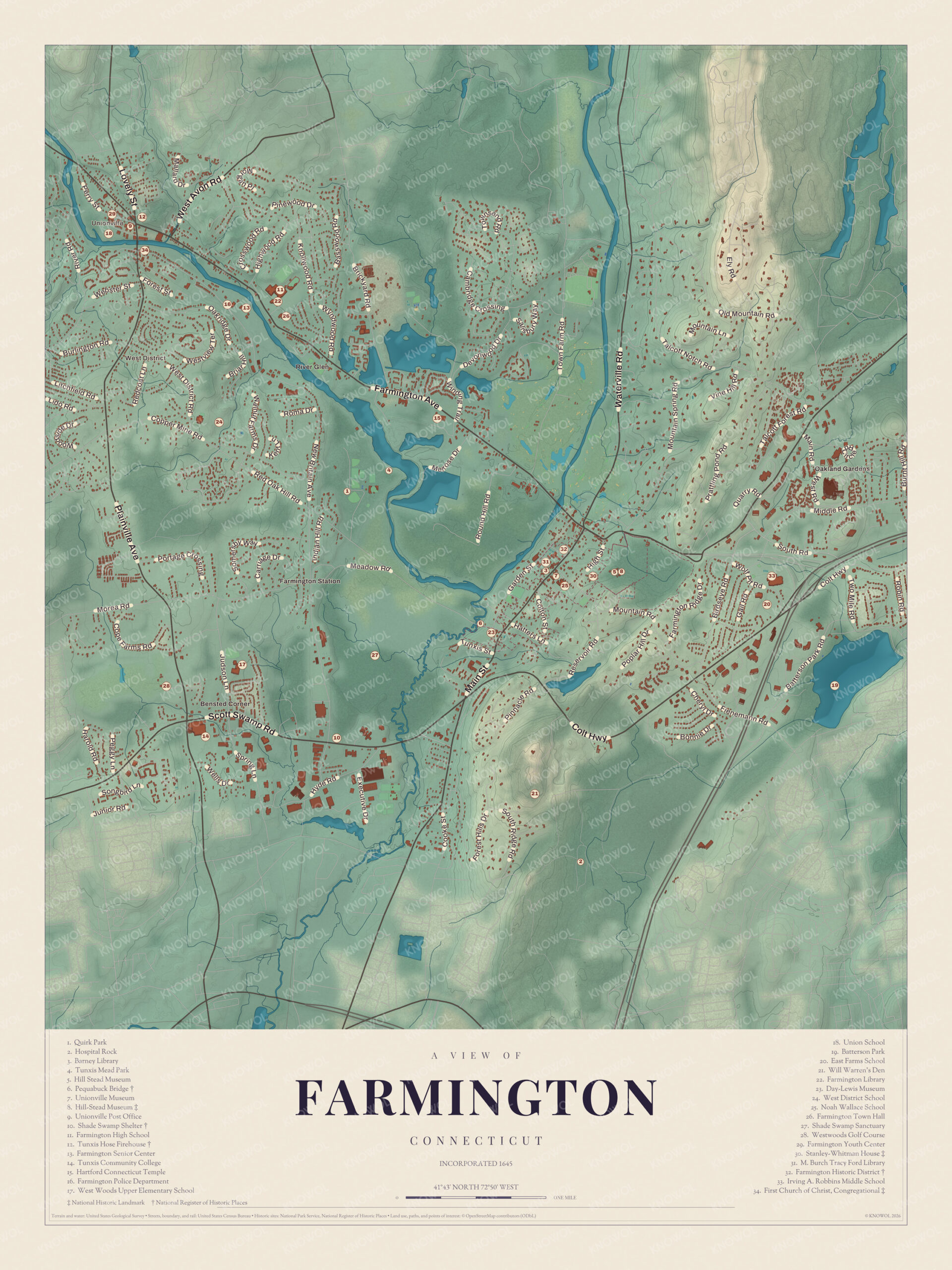
Farmington today
By KNOWOL
Shaded hills from the traprock ridges on the east side of town down to the Farmington River, every street, Farmington, Unionville, Farmington Station and Batterson Park, and a guide of 34 numbered landmarks with the National Historic Landmark and National Register sites marked.5
The story of Farmington
West India goods on Main Street
After the Revolution, Farmington village became a trading town. The Deming and Cowles merchants sold to the new settlements growing up to the west and north, and signs on the stores advertised West India and East India goods. At one time three West India vessels were owned in Farmington, and at least one sailed to China and came back with silks, teas and china marked with the owners' initials. In 1802 Governor John Treadwell wrote that more capital was in trade here than in any inland town in the state. The boom faded after about 1825. The merchants had backed the turnpikes over Talcott Mountain, and those roads made it just as easy for their customers to shop in Hartford. Main Street kept its old houses partly because the railroad later passed it by.36
The head of the canal
Unionville grew up where the Farmington Canal met the river. In 1828 the first canal boat at Farmington was launched to bell ringing, cannon fire and music. A few years later a dam and power canal were built at Unionville, and in 1832 a factory went up there to make patent wood screws. The screws lasted about three years, but the building went on to make clocks, spoons, oyster tongs, mouse traps and gunstocks. Lambert Hitchcock made furniture near the river bridge from 1844, and David Keyes said he made the first mincing knives in America here. In 1861 the Union Nut Company was formed, later the Upson Nut Company, and by the 1880s the same water power also ran five paper mills.789
Farmington in 1704
In 1904 Julius Gay asked the Village Library Company to picture Farmington two hundred years earlier. The town was then a rectangle fifteen miles long and eleven wide, measured from Round Hill, and beyond the main street the land was mostly woods where wolves were common. Many chimneys were wood lined with clay, so the town had voted in 1656 that every house keep a ladder reaching the roof, and it chose chimney viewers every year until 1712. Hard money was scarce and trade ran on wheat, and Deacon Thomas Bull once sold four acres of land for three pairs of shoes. To cross the river, the town agreed in 1705 to keep a canoe with ropes at the landing place.2
Through the years
25 moments from 1640 to today.
- 1640Settlers from Hartford begin a community on the Tunxis lands by the river.1
- 1645The town and the river take the name Farmington.1
- 1652The Farmington church is organized.10
- 1656The town orders every householder to keep a ladder reaching the roof by his chimney.2
- 1673The road now called High Street is laid out. For years it's known as Back Lane.2
- 1674Deacon Thomas Bull sells four acres of land for three pairs of shoes.2
- 1687The town votes to build a schoolhouse eighteen feet square.2
- 1705The town agrees to keep a canoe with ropes for crossing the river at the landing place.2
- 1720About this year the Stanley-Whitman House goes up on High Street.11
- 1771Judah Woodruff builds the meetinghouse that still stands on Main Street.10
- 1774Townspeople hold a mock trial of the Boston Port Act and burn a copy of it.1
- 1802Governor John Treadwell writes that more capital is in trade here than in any inland town in the state.3
- 1803Solomon Cowles builds a brick Federal house on Main Street for his son George.12
- 1810The American Board of Commissioners for Foreign Missions is organized in Rev. Noah Porter's study.13
- 1828The first canal boat at Farmington is launched to bell ringing, cannon fire and music.7
- 1832A patent wood screw factory goes up on the new water power at Unionville.8
- 1833The brownstone Pequabuck Bridge is finished on Meadow Road.14
- 1840A red sandstone monument to the Tunxis people is set on the riverbank.15
- 1841The Mende captives freed after the Amistad revolt come to live and study in Farmington.16
- 1843Sarah Porter founds Miss Porter's School.1
- 1844Lambert Hitchcock begins making furniture near the river bridge in Unionville.8
- 1861The Union Nut Company, later the Upson Nut Company, is formed in Unionville.8
- 1893Unionville's Tunxis Hose Company builds its brick firehouse.17
- 1901Hill-Stead is finished for Alfred Atmore Pope to his daughter Theodate's design.18
- 1917The West End Library opens in Unionville, built partly with Carnegie money.19
Places to see
The numbers match the landmark guide printed on the 2026 map.
- 3Barney LibraryFarmington village. The library of the old village.Visit their website
- 6Pequabuck BridgeMeadow Road. Brownstone arch of 1832 and 1833.
- 7Unionville MuseumSchool Street, Unionville. In the old West End Library.Visit their website
- 8Hill-Stead MuseumMountain Road. Theodate Pope Riddle's house and Impressionists.Visit their website
- 12Tunxis Hose FirehouseUnionville. Brick Queen Anne firehouse of 1893.
- 21Will Warren's DenSouth of the village. Farther south, past Hospital Rock.
- 23Day-Lewis MuseumSouth of the village. Just south of the old village.
- 30Stanley-Whitman HouseHigh Street. Saltbox of about 1720.Visit their website
- 32Farmington Historic DistrictMain Street. 115 buildings, mostly before 1835.
- 34First Church of Christ, Congregational75 Main Street. Judah Woodruff's meetinghouse of 1771.Visit their website
On the National Register
All 10 places in Farmington on the National Register of Historic Places that still stand today, oldest first, and why each one matters.4
-
Stanley-Whitman House
National Historic Landmark
A well-kept saltbox with a framed overhang and carved drop pendants, one of the oldest houses in Farmington. Solomon Whitman's lean-to addition gave it its saltbox shape, and it's now a house museum.11
-
Gridley-Parsons-Staples Homestead
The oldest surviving house in northwestern Farmington, a Georgian house probably built by Elnathan Gridley, with fine 18th-century carving around its fireplaces. It's home to the Farmington Historical Society.20
-
First Church of Christ, Congregational
National Historic Landmark
Judah Woodruff's meetinghouse, one of the state's few surviving colonial churches, with a slender steeple seen for miles. It was named a National Historic Landmark for sheltering the Mende captives of the Amistad, who attended services here in 1841.10
-
Gen. George Cowles House
A brick Federal house that the merchant Solomon Cowles built for his son George around the time of George's marriage. Its side has a pair of raised Palladian windows, and a portico faces the garden.12
-
Farmington Historic District
About 275 acres of the old town center with 115 buildings, mostly houses built before 1835, including the brick Union Hotel of about 1830 that served canal travelers. Main Street kept its look partly because the railroad bypassed the village.6
-
Pequabuck Bridge
A single brownstone arch with a 22-foot span, paid for in part by the Farmington Canal's operators, a rare cost for a town bridge then. It's one of the state's only surviving early 19th-century stone arch bridges and now carries a trail.14
-
Austin F. Williams Carriagehouse and House
National Historic Landmark
The abolitionists Austin and Jennet Williams put up a dormitory here in 1841 for the Mende men freed after the Amistad revolt, now part of the carriage house, and built their Greek Revival house in 1842. It's a private home.16
-
Tunxis Hose Firehouse
Built after fires at major Unionville employers in 1890 and 1892, a brick Queen Anne firehouse with a three-story tower, laid up by the local mason Joseph Jetner. It was the village's only firehouse until 1960.17
-
Hill-Stead
National Historic Landmark
A Colonial Revival country house built from 1898 to 1901 for Alfred Atmore Pope to designs by his daughter Theodate Pope Riddle, one of the country's first women architects, with McKim, Mead and White. It keeps the family's Impressionist paintings as a museum.18
-
West End Library
Edward Tilton designed this stucco library on the model of Boston's McKim Building, and Andrew Carnegie gave $8,500 toward it. It has been the Unionville Museum since 1984.19
In their words
“These were the days of prosperity and pride for this always beautiful village.”
The Memorial History of Hartford County, 1886, on Farmington's merchant years21
“They have been content to eat their bread in the sweat of their brow; and it was honor enough to be esteemed the first among equals.”
Governor John Treadwell on the people of Farmington, quoted in Historic Towns of the Connecticut River Valley, 190622
“The beautiful spire of the Farmington Congregational church for more than a century has gracefully held its position at the top of praise among all church spires of its chaste style of beauty.”
The Hartford Magazine, 1906, quoted in Some Old Time Meeting Houses of the Connecticut Valley, 191113
Nearby towns
Sources
- Farmington, Connecticut, Wikipedia
- Farmington two hundred years ago, an historical address by Julius Gay (1904), Internet Archive
- The memorial history of Hartford County, Connecticut, 1633-1884 (1886), on Farmington's merchants and manufactures, Internet Archive
- National Register of Historic Places listings in Hartford County, Connecticut, Wikipedia
- Map of Farmington, Connecticut in 2026, KNOWOL (USGS elevation, Census Bureau roads)
- Farmington Historic District (Farmington, Connecticut), Wikipedia
- History of Connecticut in monographic form (1925), on the Farmington Canal, Internet Archive
- The memorial history of Hartford County, Connecticut, 1633-1884 (1886), Unionville chapter by James L. Cowles, Internet Archive
- History of New Britain, with sketches of Farmington and Berlin, Connecticut, 1640-1889 (1889), on Unionville, Internet Archive
- First Church of Christ, Congregational (Farmington, Connecticut), Wikipedia
- Stanley-Whitman House, Wikipedia
- Gen. George Cowles House, Wikipedia
- Some old time meeting houses of the Connecticut Valley (1911), on the Farmington church, Internet Archive
- Pequabuck Bridge, Wikipedia
- The history of the old town of Derby, Connecticut, 1642-1880 (1880), on the Tunxis monument at Farmington, Internet Archive
- Austin F. Williams Carriagehouse and House, Wikipedia
- Tunxis Hose Firehouse, Wikipedia
- Hill-Stead Museum, Wikipedia
- West End Library, Wikipedia
- Gridley-Parsons-Staples Homestead, Wikipedia
- The Memorial History of Hartford County Connecticut 1633-1884 (1886), on Farmington village, Internet Archive
- Historic towns of the Connecticut River Valley (1906), on Farmington, Internet Archive