
A high farming town in the Litchfield hills, named for the Land of Goshen, where the dairies made pineapple cheese famous, rain on East Street once split between two rivers, and an eighty-ton boulder rocks at the push of a hand.
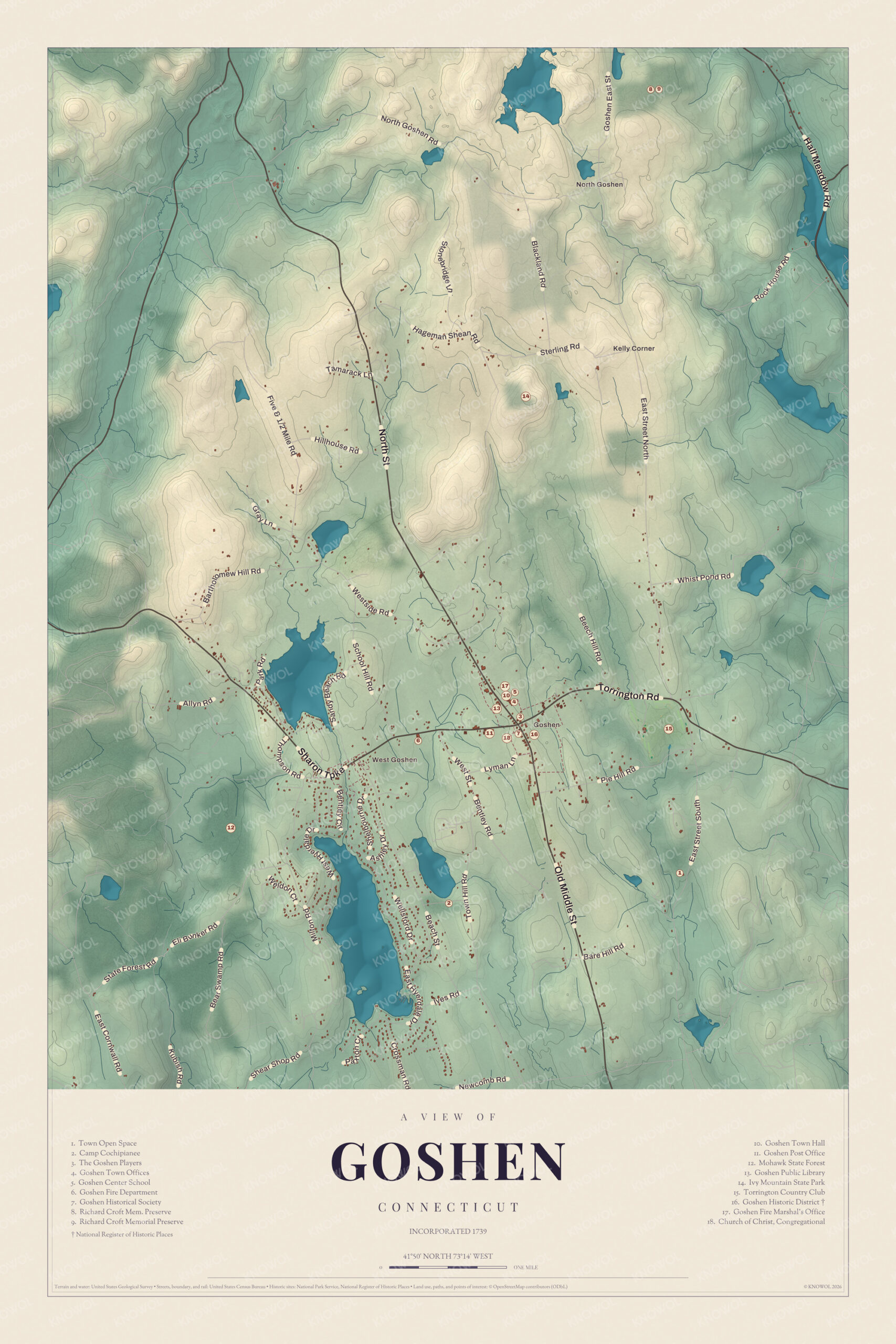
Goshen on the map
Click the map to look closer.
Goshen today
By KNOWOL
Shaded hills from North Goshen and Ivy Mountain across to the Mohawk State Forest, every road from East Cornwall Road to Bare Hill Road, Goshen Center at the crossing of Routes 4 and 63, and a guide of 18 numbered landmarks with the National Register site marked.5
The story of Goshen
Pineapple cheese and Goshen butter
For most of the 1800s Goshen lived on its dairies. A 1917 county history says the cheese business grew from 1807 and for many years came to about 270,000 pounds a year. Annatto, the orange coloring, was first used for cheese here. Timothy Collins brought it from Albany, and Alexander Norton's wife rubbed it through a cloth into the milk, and the colored cheese sold for several cents more a pound. A Goshen cheese trader's casks and round boxes were said to be the first of their kind. In 1809 Lewis M. Norton began making pineapple cheese, copied from a sample from Holland, with tools of his own invention. By 1897 it sold from Boston to the Pacific coast, and the town's butter was called far-famed.367
A rock that rocks and a street that splits the rain
Goshen sits high in the Litchfield hills, and its old writers loved its heights. In 1818 Benjamin Trumbull noticed something odd about East Street. Rain falling on the front of the houses ran down to the Housatonic River, and rain off the back ran to the Waterbury River. Ivy Mountain, two miles north of the center, was measured in 1897 at 1,642 feet, the highest ground in town, with views on a clear day to the hanging rocks at Meriden and the Catskills. Up near North Pond and the Norfolk line sits Tipping Rock, a boulder said to weigh more than eighty tons. It's balanced so finely that one hand can rock it slowly back and forth.829
Muskets, smallpox and a church that blew away
Goshen's Revolution was felt at home. Benoni Hills, a gunsmith from Durham, came about 1740 and trained John Doud, who went into business with Ebenezer Norton Jr. making muskets through the war and until 1783. Doud made the locks and barrels and Norton stocked them, and they tried the guns on an old oak stump. In June 1776 ninety-eight townspeople asked the Assembly to let them set up a pest house a mile from any road and inoculate against smallpox, which soldiers were bringing home from the north. Both houses said no. The town's little Episcopal church faded during the war. It was dragged to the northeast parish in 1792, and a great storm blew it down in 1796.101112
Through the years
24 moments from 1737 to today.
- 1737The township is sold at New Haven on the first Tuesday in December.8
- 1738The proprietors of New Bantam meet at Deacon John Buel's house in Litchfield and organize the town of Goshen.13
- 1739Goshen is incorporated, a year after settlement of the center began.1
- 1740Rev. Stephen Heaton is settled as Goshen's first minister.14
- 1740About this year Benoni Hills, a gunsmith from Durham, comes to Goshen.10
- 1741Ebenezer Hill Jr. builds the house called the oldest in town in 1838. He and Jonathan Buel take turns keeping tavern.15
- 1753The first school is built.1
- 1767A plain Episcopal church goes up at the south end of the East Street graveyard.12
- 1776Ninety-eight townspeople ask leave to open a smallpox pest house. The Assembly says no.11
- 1783John Doud and Ebenezer Norton Jr. end the musket making they kept up through the Revolution.10
- 1792The old Episcopal church is dragged to the northeast parish at the start of winter.12
- 1796A great March storm blows the old church down.12
- 1807Goshen's cheese business begins to grow, in time reaching about 270,000 pounds a year.3
- 1809Lewis M. Norton begins making pineapple cheese with tools of his own invention.3
- 1810A woolen mill in West Goshen starts a small mill village.16
- 1812Dr. Elisha North, an early champion of vaccination, leaves his Goshen practice for New London.17
- 1814The West Goshen Store is built.16
- 1819A seminary for young women opens.1
- 1832The Congregational church in the center is built.18
- 1838Rev. Grant Powers gives the address at Goshen's first centennial on September 28.15
- 1877Goshen-born astronomer Asaph Hall discovers the two moons of Mars.19
- 1895The Shingle style town hall goes up at the main crossroads.18
- 1930sCivilian Conservation Corps crews build roads and plant trees in the Mohawk State Forest.20
- 1982The Goshen Historic District is listed on the National Register.18
Places to see
The numbers match the landmark guide printed on the 2026 map.
- 2Camp CochipianeeSouth of center. A camp south of town.
- 3The Goshen PlayersGoshen Center. Community theater, premieres included.Visit their website
- 7Goshen Historical SocietyGoshen Center. The town's history close at hand.Visit their website
- 9Richard Croft Memorial PreserveNear North Goshen. Preserved land in the north.
- 12Mohawk State ForestWest of center. Over 4,000 acres, CCC plantings.Visit their website
- 13Goshen Public LibraryTown complex. Where Scoville's carriage factory stood.
- 14Ivy Mountain State ParkNorth of center. The town's highest ground.
- 16Goshen Historic DistrictGoshen Center. The turnpike crossroads village, listed 1982.
- 18Church of Christ, CongregationalGoshen Center. Home of the August Blueberry Festival.Visit their website
On the National Register
All 3 places in Goshen on the National Register of Historic Places that still stand today, oldest first, and why each one matters.4
-
Goshen Historic District
The town center grew up where the Torrington to Sharon and Litchfield to Canaan turnpikes crossed. It keeps houses from as early as 1760, the Goshen Academy, the 1832 Congregational church and the Shingle style town hall of 1895.18
-
Hervey Brooks Pottery Shop and Kiln Site
The site of Hervey Brooks's 19th-century pottery, known for his careful records. The shop building went to Old Sturbridge Village, but the ground in Goshen still shows how he laid out his work and what clays he used.21
-
West Goshen Historic District
An early 1800s mill village that grew around a woolen mill of 1810 built to process Goshen's wool. It keeps worker houses, the West Goshen Store of 1814 and a carding mill of 1818.16
In their words
“Its sons and daughters returning, after travels in all lands, are accustomed to say, "There is no place like Goshen!"”
History of the town of Goshen, Connecticut, 18977
“There is a wonderful attractiveness in the rocky hills, the swiftly running brooks, the laurel thickets, the lovely lakes, the delightful drives and the grand and extended prospects.”
History of the town of Goshen, Connecticut, 18977
“There is this rare and peculiar circumstance, with respect to what is called the east street, in Goshen; that, the rain which falls on the front of the houses descends into the Housatonick river.”
Benjamin Trumbull, A complete history of Connecticut, 18188
Nearby towns
Sources
- Goshen, Connecticut, Wikipedia
- History of the town of Goshen, Connecticut (1897), on Ivy Mountain, Internet Archive
- Rural life in Litchfield County (1917), on Goshen cheese, Internet Archive
- National Register of Historic Places listings in Litchfield County, Connecticut, Wikipedia
- Map of Goshen, Connecticut in 2026, KNOWOL (USGS elevation, Census Bureau roads)
- History of the town of Goshen, Connecticut (1897), on the cheese trade, Internet Archive
- History of the town of Goshen, Connecticut (1897), on the Goshen of today, Internet Archive
- A complete history of Connecticut, civil and ecclesiastical, by Benjamin Trumbull (1818), on Goshen, Internet Archive
- History of the town of Goshen, Connecticut (1897), on Tipping Rock, Internet Archive
- History of the town of Goshen, Connecticut (1897), on the gunsmiths, Internet Archive
- A historical collection of the part sustained by Connecticut during the war of the revolution (1842), on the Goshen smallpox petition, Internet Archive
- History of the town of Goshen, Connecticut (1897), on the old Episcopal church, Internet Archive
- Sketches and chronicles of the town of Litchfield, Connecticut (1859), on the founding of Goshen, Internet Archive
- Memorials of the families of Mr. James Thompson and of Dea. Augustus Thompson of Goshen, Connecticut (1854), Internet Archive
- An address delivered to the people of Goshen, Connecticut, at their first centennial celebration, September 28, 1838, by Rev. Grant Powers (1839), Internet Archive
- West Goshen Historic District, Wikipedia
- A modern history of New London County, Connecticut (1922), on Dr. Elisha North, Internet Archive
- Goshen Historic District (Goshen, Connecticut), Wikipedia
- Asaph Hall, Wikipedia
- Mohawk State Forest, Wikipedia
- Hervey Brooks Pottery Shop and Kiln Site, Wikipedia