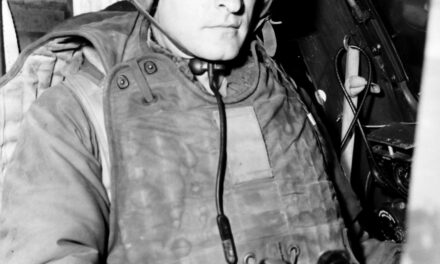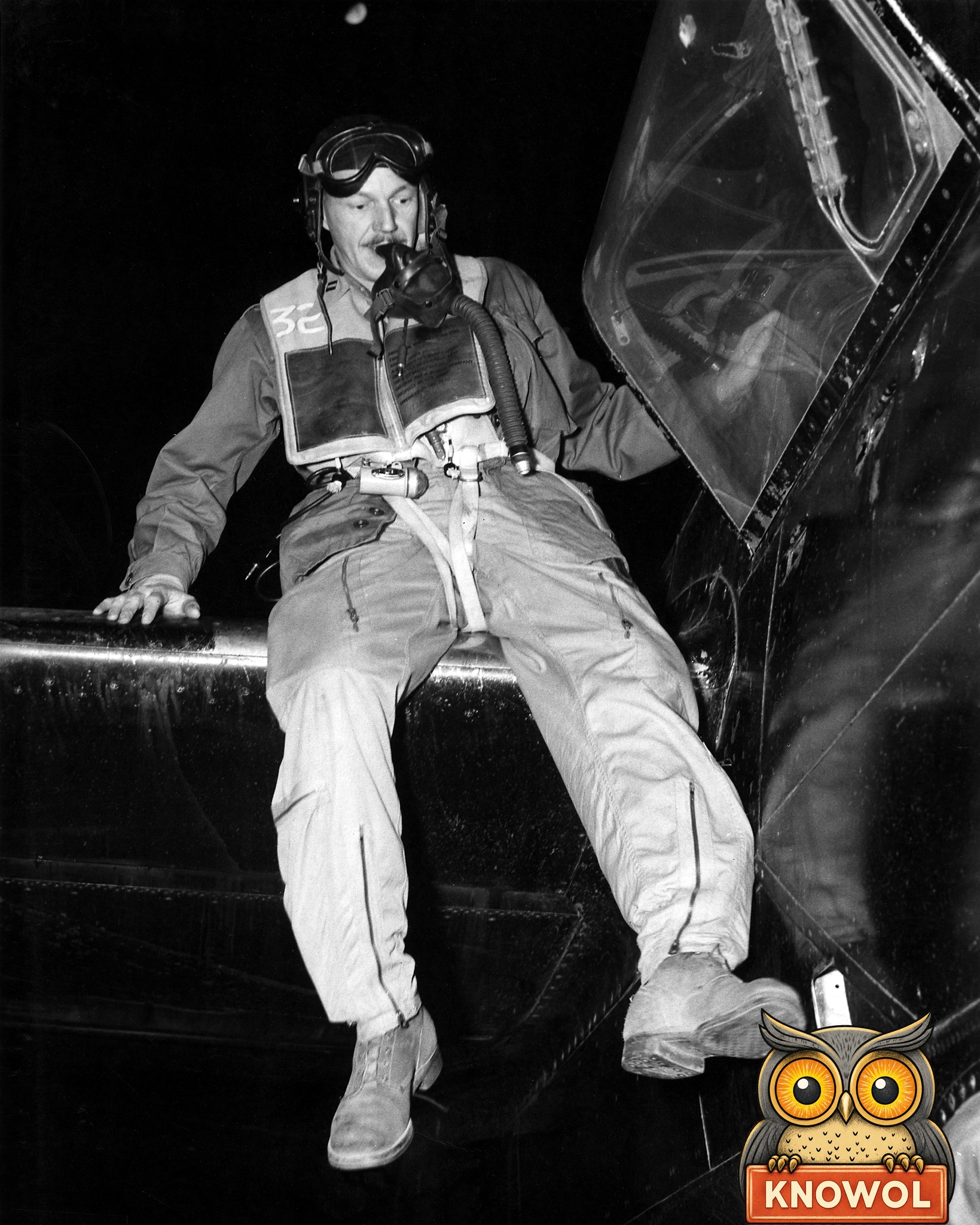
Capt. Donald R. DeFoe of Detroit climbs down from his B-26 after his second combat mission over Korea, 1951. U.S. Air Force, National Archives. Click the photo to see it larger. The KNOWOL logo doesn’t appear on prints.
Capt. Donald R. DeFoe has just come back from his second combat mission over Korea, and he’s climbing down from his B-26 bomber in the dark. The Air Force caption gives his home as 21519 Kingsville in Detroit, Michigan. DeFoe flew with the 3rd Bombardment Wing of the Fifth Air Force, which flew its B-26s at night. The caption calls the wing “a veteran U.S. Air Force outfit with over 13,000 Korean combat sorties.” The National Archives dates the photo October 1951.
What to Look For
The photographer’s flash lights DeFoe against a black night sky. He sits on the edge of the plane with his legs over the side, one hand flat on the metal and the other holding the open canopy. His goggles are pushed up on a leather flying helmet with earphones built in. He has a mustache, and his rubber oxygen mask still hangs at his mouth, with its ribbed hose running down his chest. You can see a captain’s double bars on his collar.
Over his flight suit he wears a life vest with the number 32 painted on it in white, and printed lettering on one of its front panels. A flashlight is clipped at his waist, and long zippers run down the legs of his suit to his boots. The clear canopy behind him has swung up and open. The skin of the bomber is painted a glossy black, with rows of rivets along its seams.
Hunting in the Dark
Gen. Earle E. Partridge, who led the Fifth Air Force, called “our inability to effectively seek out and destroy the enemy at night” the “paramount deficiency of the USAF today.” He still held that view on April 15, 1951. The Chinese and North Korean armies moved their supplies by train and truck after dark, and they hid them before dawn. Night crews could see three to five trains and as many as 2,000 vehicles on the move in a single night. Hunting that traffic had been the 3rd Bombardment Group’s main job since August 1950.
For most of the war’s first year, the 3rd Wing kept its B-26s at Iwakuni, Japan, and flew its missions from Taegu, in South Korea. The pierced steel runway at Taegu was wearing out, and it shredded the B-26s’ tires. In the spring of 1951, the Fifth Air Force asked the wing for 48 sorties every night. The crews met it by flying each plane twice a night.
The Move to Kunsan
Air Force engineers built a new airfield at Kunsan, called K-8, on the southwest coast of Korea. The site was close to the mud flats of the Yellow Sea, on gray-blue clay that farmers had flooded for rice for a long time. The engineers finished 5,000 feet of asphalt runway in the middle of July 1951, and the 3rd Wing set up there on August 22. That month the Fifth Air Force split Korea between its two B-26 wings. The 3rd Wing at Kunsan covered the enemy’s main supply routes in western Korea, and the 452nd Wing covered the east from Pusan.
Life at Kunsan was rough on the planes. The wing did its repairs in the field, and the share of its B-26s ready to fly fell from 78 percent in July to 65 percent in December 1951. On December 11, a fully loaded B-26 caught fire on the field at Kunsan and blew up. It destroyed three more B-26s and badly damaged six F-84 jets parked nearby.
How a Night Intruder Flew
The B-26 night intruders hunted alone. The wings sent single planes out one after another all night long, 30 minutes apart in winter and 15 minutes apart on shorter summer nights. Each flight lasted about four hours and covered the supply roads or railways it was assigned from dusk to dawn. On dark nights, the crews searched from about 2,000 feet above the ground. Enemy truck drivers were supposed to drive without lights, but most of them used their headlights and counted on guards along the road to warn them of a plane. The lights rarely stayed on more than 10 to 15 seconds after a bomber came near.
In those few seconds, the crew had to fix the trucks’ place against a landmark they could find again. A plane carrying flares dropped one to burn about 3,500 feet above the road, and the pilot flew figure-eight turns to make two or three strafing runs before it burned out. Crews in “hard-nose” B-26s, which carried guns in the nose, wanted the flares most. Crews in “glass-nose” B-26s carried a bombardier up front, and they liked to bomb the trucks instead.
Korea’s mountains made all of this dangerous, and the maps of them weren’t always right. B-26 crews usually pulled up from an attack at least 1,000 feet above the highest hill marked on the map. One pilot said the safe height was really that, plus 500 more feet for each married man on the crew. Flying alone in the dark, the crews could rarely tell how much damage they had done.
About This Photo
- Archive title: “Returning from his 2nd combat mission over Korea, Capt. Donald R. DeFoe, pilot from 21519 Kingsville, Detroit, Mich., climbs down from his B-26 night intruder bomber. Capt. DeFoe is assigned to the night flying Fifth Air Force 3rd Bombardment Wing in Korea, a veteran U.S. Air Force outfit with over 13,000 Korean combat sorties.”
- Date: October 1951, the date the National Archives gives the photo
- Place: Korea. The caption doesn’t name the airfield; the 3rd Bombardment Wing flew from Kunsan Airfield (K-8) from August 22, 1951.
- Photographer: U.S. Air Force (the record doesn’t give a name)
- Collection: Photographs of Activities, Facilities and Personnel, Records of U.S. Air Force Commands, Activities, and Organizations (Record Group 342), National Archives at College Park, Maryland
- Photo number: Archives number 342-FH-4A(29093), National Archives Identifier 542353
- Also in this series: Capt. Melvin E. Jarvis at the controls of his B-29 on Okinawa, 1951
- Rights: Public domain, a work of the U.S. government
- Restoration: KNOWOL, 2026, from the Archives’ scan of the print
KNOWOL prints this restored photo on luster photo paper in 8 x 10 and 16 x 20 inch sizes, plain or in a black or white wood frame. Click here to get your copy of the B-26 night intruder pilot photo.

Sources
- National Archives catalog, “Returning from his 2nd combat mission over Korea, Capt. Donald R. DeFoe…”
- Robert F. Futrell, The United States Air Force in Korea, 1950-1953, revised edition (Office of Air Force History, 1983), pp. 325-329, 397-400 and 454-455 (Defense Technical Information Center copy)
- A. Timothy Warnock, ed., The United States Air Force in Korea: A Chronology, 1950-1953 (Air Force History and Museums Program, 2000), December 11, 1951 (Defense Technical Information Center copy)