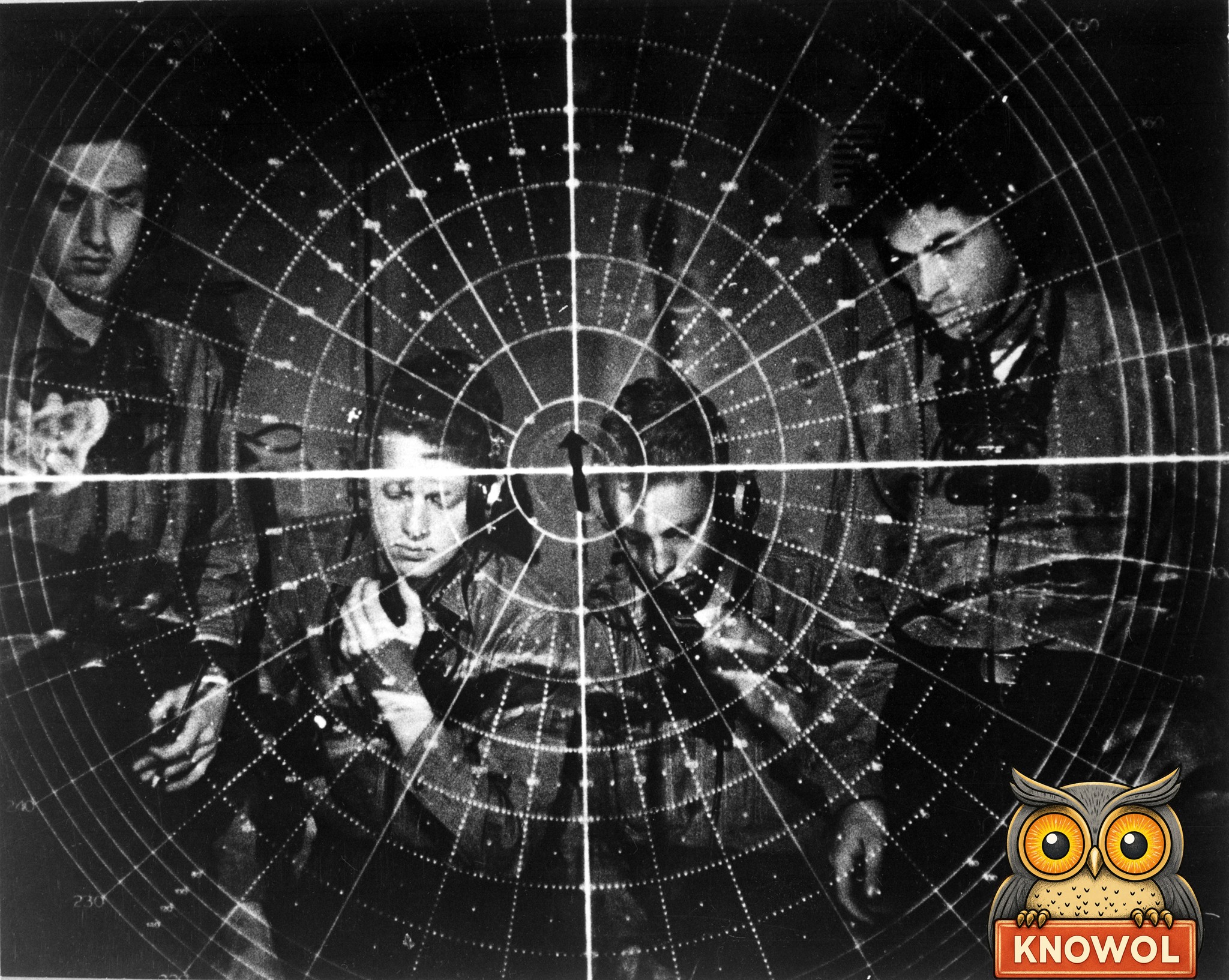
A Navy radar screen and the men who read it, about 1944 to 1945. U.S. Navy, National Archives. Click the photo to see it larger.
At first it’s hard to tell what you’re seeing. Circles and spokes of tiny dots spread across the whole picture, and behind them, four young men in headsets lean over their work. Two of them hold telephone handsets. A pencil rests in a hand at the lower left. The National Archives calls this photo simply “Radar scope.” It’s two images in one frame: the round screen of a Navy radar set, laid over the faces of the men whose job was to read it. The Archives dates it to about 1944 or 1945.
Reading the Screen
This kind of round screen is called a plan position indicator, or PPI. The radar’s antenna sits at the very center. The rings around it mark distance, so a dot on an outer ring is farther away than a dot near the middle. The spokes and the numbers around the edge mark direction. As the antenna turned, a bright line swept around the screen with it, and anything the radar’s pulse bounced off showed up as a spot of light. A ship, a plane or a stretch of coastline could all appear as echoes on the screen.
The men in the photo wear headsets, and two of them hold handsets to their mouths. Reading the screen was only half the job. What they saw had to be passed on, fast, to the officers who decided what the ship would do next.
From Radar Plot to Combat Information Center
Early in the Pacific war, the U.S. Navy lost ships in a string of hard naval battles off Guadalcanal. When the Navy studied those losses, it found that many came from poor procedure and disorganization. Its answer was the Combat Information Center, a room where the ship’s information, from radar and other sources, came together and went to the commanding officer. The Naval Historical Center traces the CIC back to a space first called “radar plot.” In 1942, radar, the way it was used and the rooms where it was read all grew up together, as crews learned from battle and the training spread through the fleet.
Where the Round Screen Came From
The PPI was first used just before World War II, in an experimental German radar system outside Berlin. The first PPI made for regular use was designed at Britain’s Telecommunications Research Establishment and went into service in the H2S radar, which helped British bombers find their targets at night. The idea worked so well that it never went away. The round PPI screen is still the most common radar display today.
About This Photo
- Archive title: “Radar scope.”
- Date: About 1944 to 1945, the date range the National Archives gives on DocsTeach. The catalog record itself gives no date.
- Place: Not given in the record
- Photographer: U.S. Navy (the record doesn’t give a name)
- Collection: General Photographic Files, General Records of the Department of the Navy (Record Group 80), National Archives at College Park, Maryland
- Photo number: Archives number 80-G-343666, National Archives Identifier 520692
- Also shown on: DocsTeach, the National Archives’ site for teachers
- Rights: Public domain, a work of the U.S. government
- Restoration: KNOWOL, 2026, from the Archives’ scan of the print
Sources