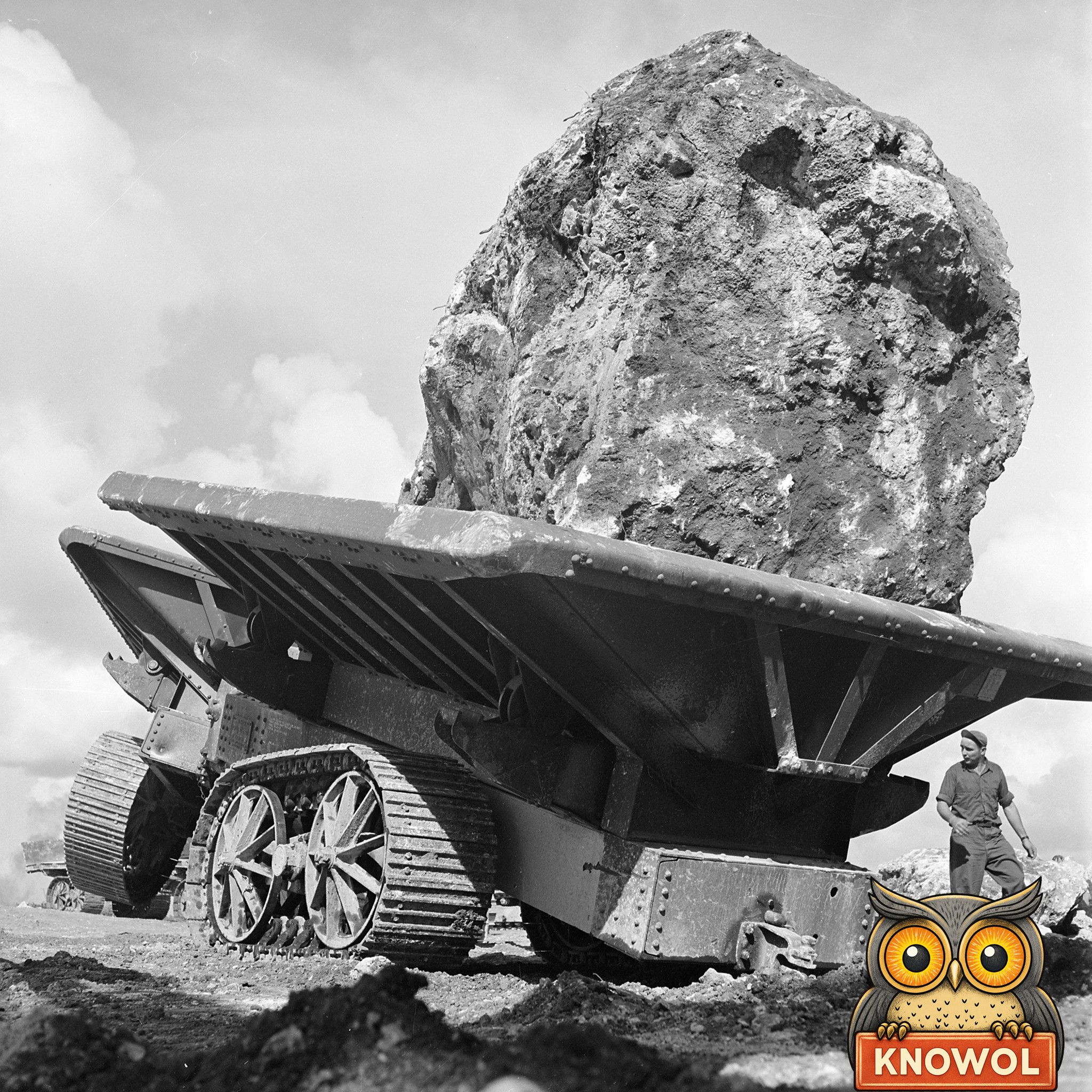
A 30-ton boulder is hauled to the seawall at Apra Harbor, Guam, by Seabees of the 76th Construction Battalion, August 1945. U.S. Navy, National Archives. Click the photo to see it larger.
Shot from low on the ground, the boulder fills the sky. It rides on the steel bed of a crawler wagon, and the Seabee standing beside the tracks barely comes up to the wagon’s edge. The Navy’s caption, from August 1945, says what it’s for: “Giant seawall under construction by Seabees of the 76th Construction Battalion at Apra Harbor, Guam. When completed the two mile breakwater will contain 1, 760, 000 cubic yards of earth and stone. A 30-ton boulder is hauled to dumping spot.” Stone by stone, the Seabees were building a wall in the sea to shelter the harbor.
A Wall Two Miles Long
Apra Harbor lies on the west side of Guam, and it’s one of the best natural harbors in the Pacific. On its north side, Luminao Reef and a shallow bank called Calalan Bank run out from Cabras Island. The breakwater was built on top of that reef and bank. During the war, the Navy extended it 3,260 feet along Calalan Bank to a width of 32 feet. From the main island, across Cabras and out to Spanish Rocks at the breakwater’s tip, the harbor’s northern arm measured 17,000 feet, more than three miles.
Begun Before the War
Work on a breakwater at Guam started in August 1941. Workers quarried limestone blocks on Cabras Island and skidded them along the reef to a derrick. By the time Japan invaded Guam in December 1941, they had built one mile of breakwater, 36 feet wide and five feet above sea level. Guam was nearly defenseless, and Japan held the island until American forces took it back in the summer of 1944.
The bombardment before the landings leveled the harbor towns of Piti and Sumay, and very few harbor works survived. Seabees of the 301st Naval Construction Battalion began clearing it in the first days of August 1944, even before the island was fully secure. A typhoon that fall wrecked the floating pontoon piers they had built, and they built again. By July 1945, Apra Harbor had 14 berths along new quay walls, nine pontoon piers, two fueling piers, ten berths for landing ships and a submarine pier. The 76th Battalion’s boulders went into the wall that kept the sea off all of it.
Named for Henry Glass
The wall is called the Glass Breakwater, after Captain Henry Glass of the U.S. Navy. On June 20, 1898, during the Spanish-American War, Glass sailed into Apra Harbor to claim Guam for the United States. He had heard the harbor was well defended, but he met no resistance at all.
The Glass Breakwater still guards Apra Harbor today. The Port of Guam on Cabras Island, which it shelters, handles more than 90 percent of the civilian cargo shipped into Guam. The breakwater’s outer shore is one of the most popular surfing spots on the island.
About This Photo
- Archive title: “Giant seawall under construction by Seabees of the 76th Construction Battalion at Apra Harbor, Guam. When completed the two mile breakwater will contain 1, 760, 000 cubic yards of earth and stone. A 30-ton boulder is hauled to dumping spot.”
- Date: August 1945
- Place: Apra Harbor, Guam
- Photographer: U.S. Navy (the record doesn’t give a name)
- Collection: General Photographic Files, General Records of the Department of the Navy (Record Group 80), National Archives at College Park, Maryland
- Photo number: Archives number 80-G-413414, National Archives Identifier 520745. The negative number TR-14601 is written along the left edge of the print.
- Rights: Public domain, a work of the U.S. government
- Restoration: KNOWOL, 2026, from the Archives’ scan of the print
Sources
- National Archives catalog, “Giant seawall under construction by Seabees of the 76th Construction Battalion at Apra Harbor, Guam…”
- “Apra Harbor,” citing Building the Navy’s Bases in World War II (1947)
- Naval History and Heritage Command, Building the Navy’s Bases in World War II, Volume II, Chapter 26