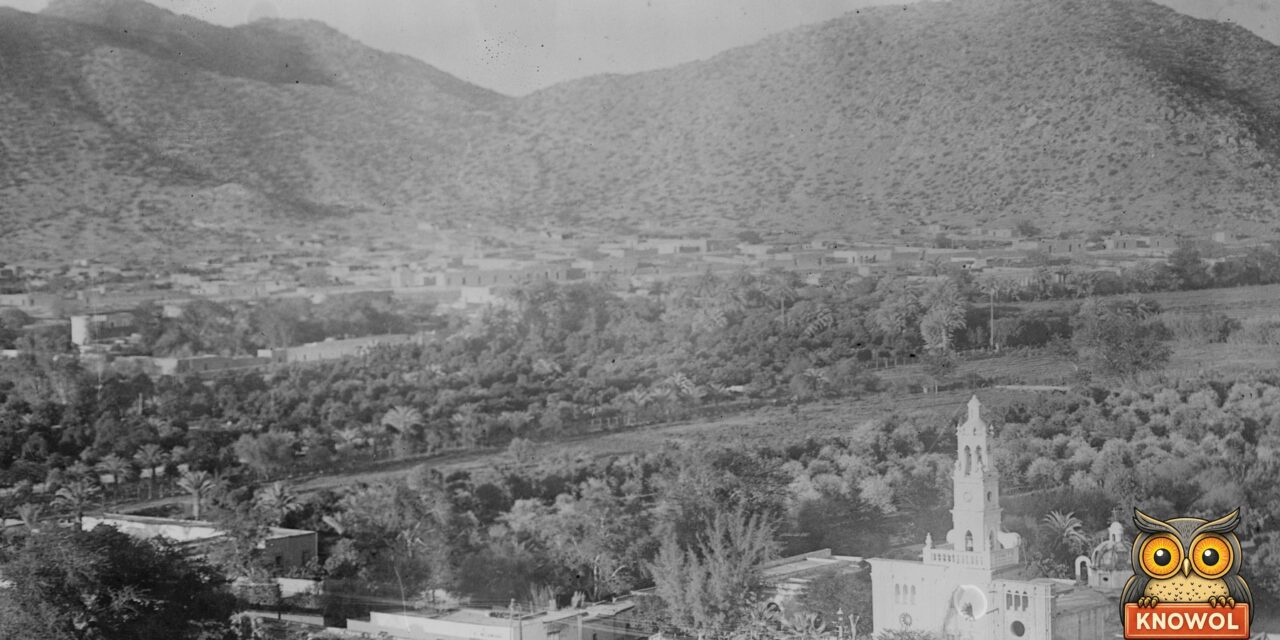
In December 1910, a car rolled into Moctezuma, an old town in the hills of Sonora, Mexico. It was the first one the town had ever seen, and people came running to look. “The people flocked out in crowds, filled with wonder, at their first sight of an automobile,” a mining man there wrote. One old woman had a question. She “wanted to know if it was the ‘revolution.'”
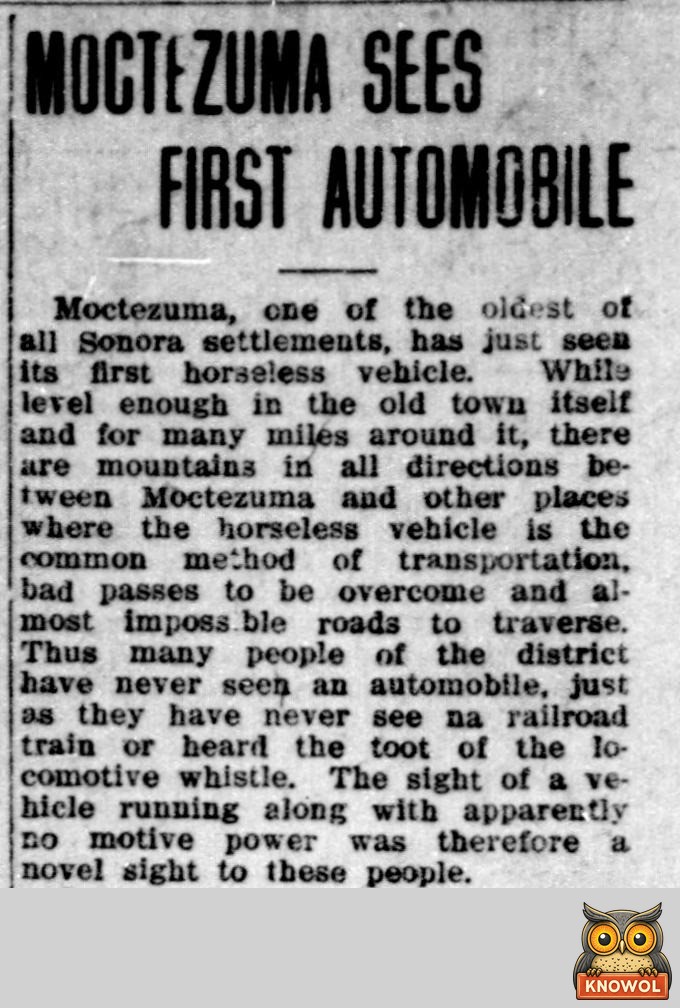
“Moctezuma Sees First Automobile.” The Bisbee Daily Review, Bisbee, Arizona, December 18, 1910, page 11. Library of Congress, Chronicling America. Click the clipping to read it full size.
A town behind the mountains
Moctezuma lies south of the Arizona border, in the hills of Sonora. An 1882 book about northern Mexico says the town, once called Oposura, lies on a big, flat plain beside a river. The Bisbee Daily Review called it “one of the oldest of all Sonora settlements.”
Getting there was the hard part. There were “mountains in all directions,” the paper said, with “bad passes to be overcome and almost impossible roads to traverse.” Without a railroad or good roads, travel was slow. Many people in the district had never seen a railroad train, either, or heard a steam whistle blow.
Picture what that first car looked like to them. It was a wagon with no horse in front, moving all by itself. The paper put it in its own old-time words: a vehicle “running along with apparently no motive power.” Motive power means whatever makes a thing go.
The letter from Moctezuma
We know about that day because of a mining man named George Woodward. He knew the Moctezuma country well. That May, the Bisbee paper reported that he had sold his half of one mine near the town and was still working another. On December 12, 1910, he wrote a letter to the International, a newspaper in Douglas, Arizona, and six days later the Bisbee paper printed it.
The car came from outside. Two visitors, “Attorney McReynolds and Mr. Dave Green,” had driven it over from Cananea, a big copper-mining town to the north. They came “via Bacuachi, Santa Rosa, Shermans and Cumpas,” little places strung along the way like beads. Woodward was pleased. “The roads were good and a safe, speedy trip was accomplished,” he wrote.
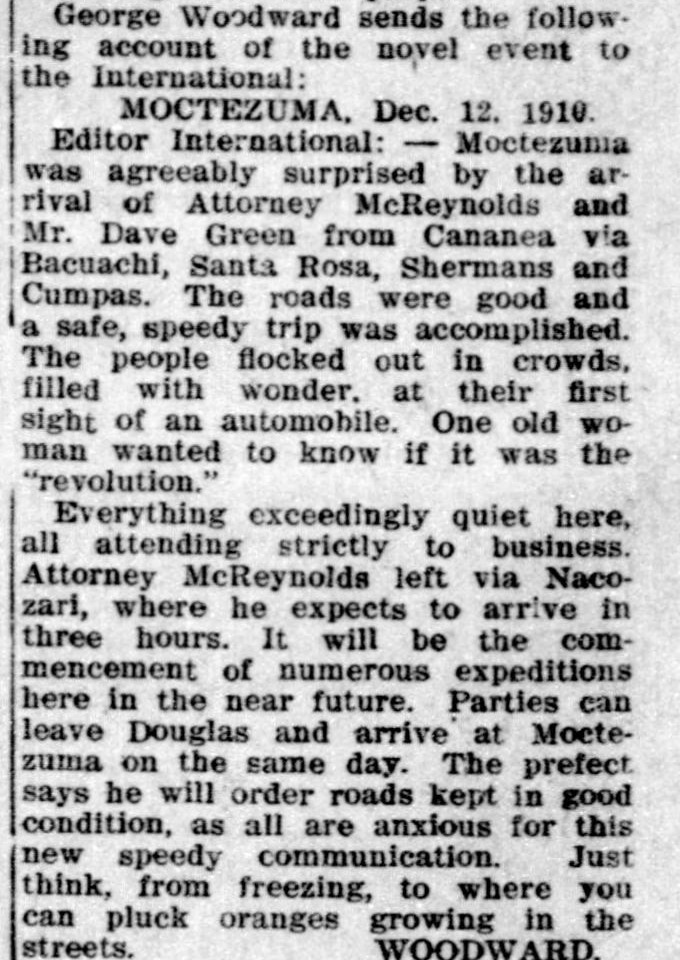
George Woodward’s letter from Moctezuma, dated December 12, 1910. The Bisbee Daily Review, Bisbee, Arizona, December 18, 1910, page 11. Library of Congress, Chronicling America. Click the clipping to read it full size.
That old woman’s question made more sense than it sounds. A few weeks before, on November 20, 1910, a revolution had started in Mexico against its longtime president, Porfirio Díaz. So when something new and strange came rolling into town, she wanted to know if this was it. Woodward’s very next line was “Everything exceedingly quiet here, all attending strictly to business.”
From freezing to oranges
To Woodward, the car meant a new kind of trip. Attorney McReynolds drove on to the mining town of Nacozari, and he expected to get there in three hours. “Parties can leave Douglas and arrive at Moctezuma on the same day,” Woodward wrote. The prefect, the top official for the district, promised to keep the roads in good shape, “as all are anxious for this new speedy communication.”
Then Woodward ended his letter with the line that made the whole thing sound like a dream. “Just think, from freezing, to where you can pluck oranges growing in the streets.” In other words, you could leave a cold Arizona morning behind and reach a warm town with oranges growing right in the streets, all in one day.
Woodward’s old dream
This wasn’t a brand-new idea for Woodward. The Bisbee paper said that three or four years before, he had planned an “automobile stage service” between Nacozari and Moctezuma. A stage line was like a bus line. Stagecoaches pulled by horses had carried riders for years, and an automobile stage did the same job with a motor.
His plan stalled. The road “through the Nacozari canyon” was bad, and then fewer people traveled that way, so the cost didn’t seem worth it.
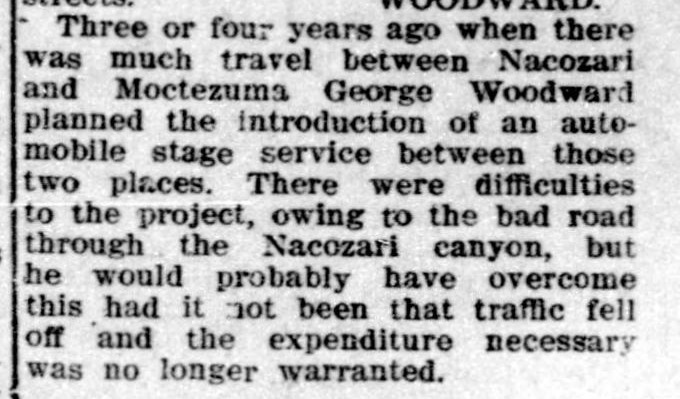
The Bisbee Daily Review on George Woodward’s earlier plan for an automobile stage. December 18, 1910, page 11. Library of Congress, Chronicling America. Click the clipping to read it full size.
Other people had the same idea, though. Less than a year later, in October 1911, a wedding notice from the Douglas Dispatch was reprinted in the Duncan Arizonian, the paper in Duncan, Arizona. The bride, Edna Fay Caywood, had been living in Nacozari “with her brother who conducts an automobile stage line between Nacozari and near by points.” The groom’s name, by chance, was Dewitt Bisbee.
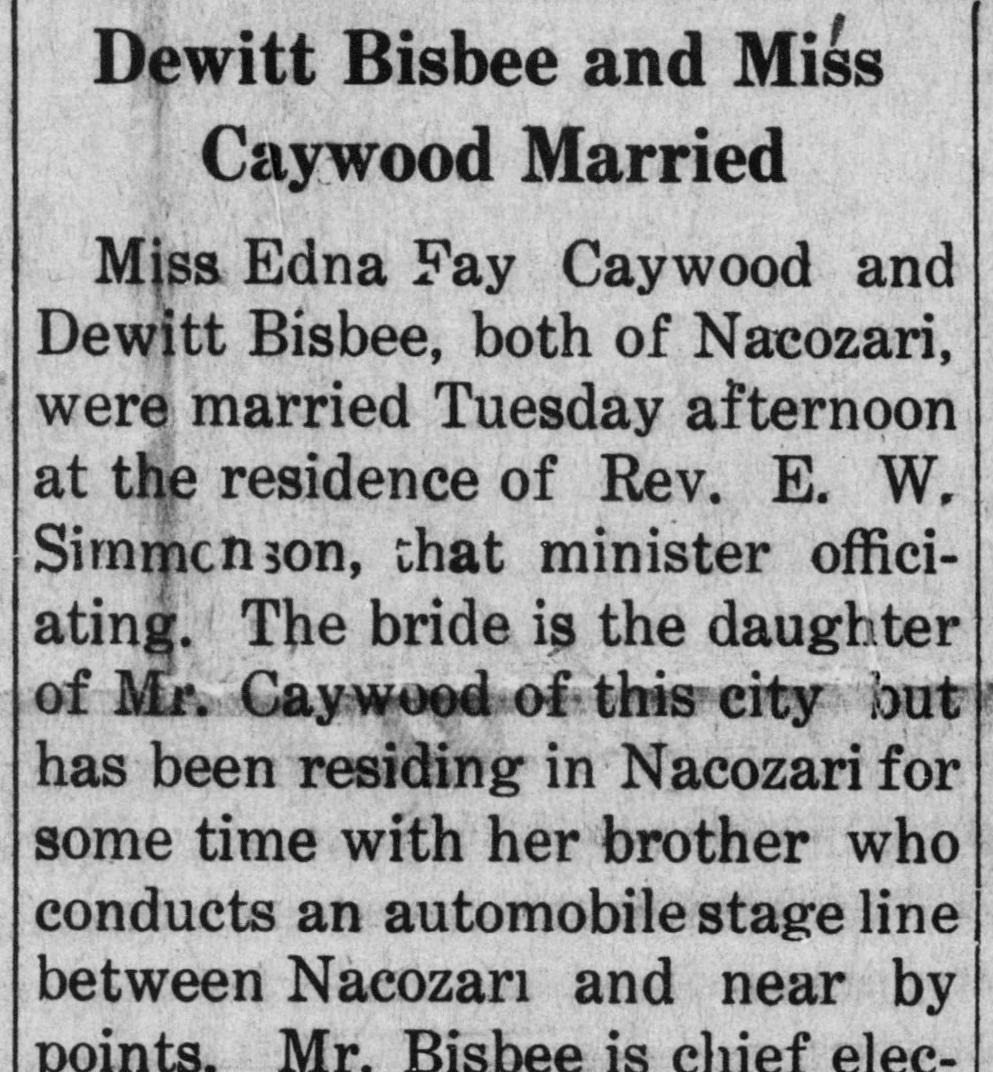
“Dewitt Bisbee and Miss Caywood Married.” The Duncan Arizonian, Duncan, Arizona, October 11, 1911, page 1, from the Douglas Dispatch. Library of Congress, Chronicling America. Click the clipping to read it full size.
Meanwhile, in chilly Bisbee
Woodward wasn’t kidding about freezing. On the very same page as the Moctezuma story, the light and power company in Bisbee, Arizona, was selling gas heaters. Its ad began, “From a Comfy Bed to An Icy Room B-U-R-R Makes One Shiver to Think of It.”
The ad had a plan for cold mornings. Ten minutes before getting-up time, “jump out of bed, light the heater, pull down the windows and crawl back in bed.” The ad takes for granted that the windows were open all night. Many people back then slept that way, for fresh air. After ten more minutes under the covers, the ad promised, “your room is as warm as toast.”
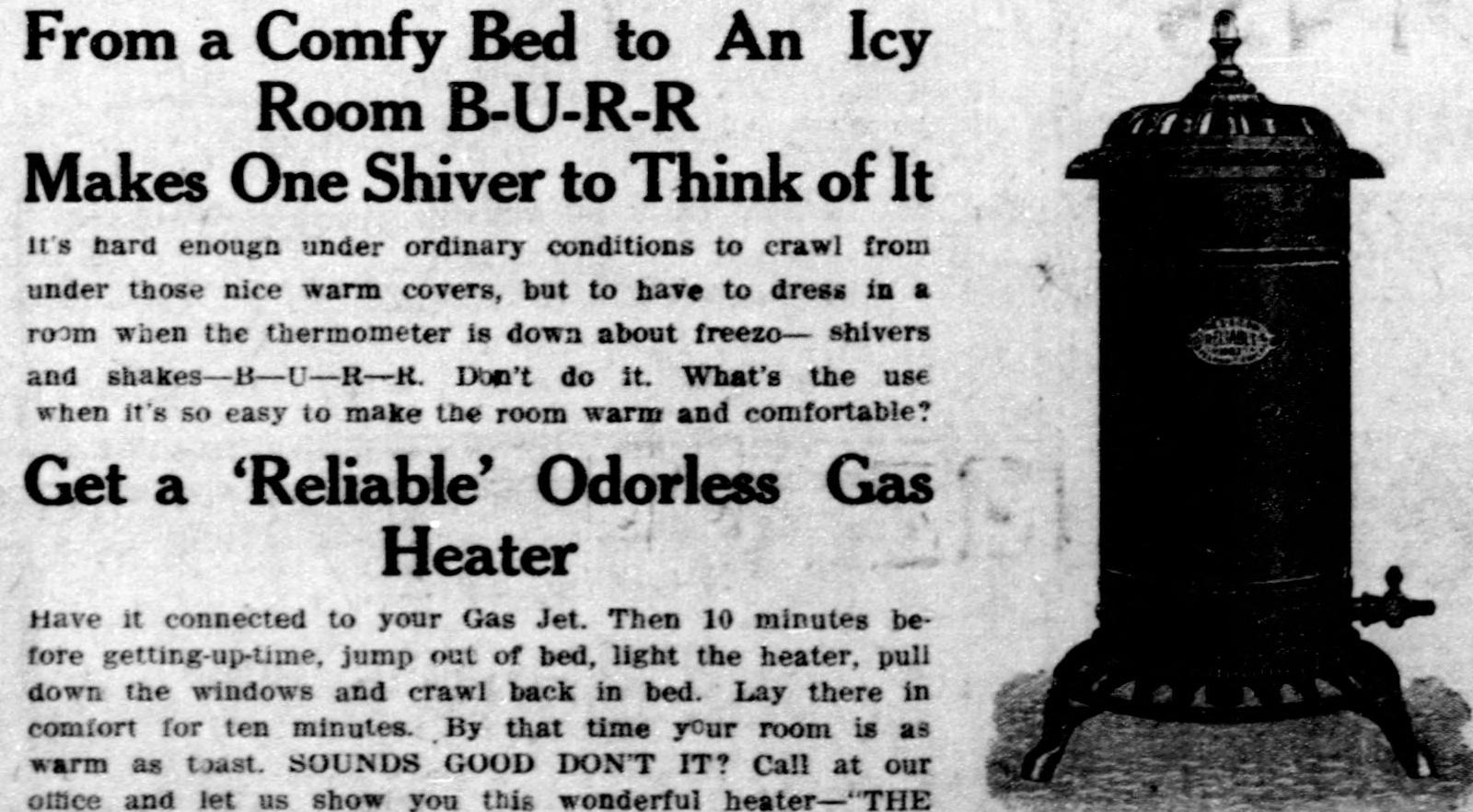
Ad for a “Reliable” gas heater, Bisbee Light and Power Co. The Bisbee Daily Review, Bisbee, Arizona, December 18, 1910, page 11. Library of Congress, Chronicling America. Click the clipping to read it full size.
About the pictures
We could not find a photograph of Moctezuma’s first car. The picture at the top of this story shows Hermosillo, the capital of Sonora, in the years around 1910 to 1915. It is a different and bigger town, but it gives a feel for Sonora in those years: flat-roofed houses, palm trees, and dry mountains close by. The picture below shows Douglas, Arizona, in 1909. It was the border town where Woodward’s travelers could start their one-day trip.

“Birds eye view of Douglas, Ariz.” West Coast Art Co., 1909. Library of Congress, Panoramic Photographs. Click the picture to see it full size.
Sources
- The Bisbee Daily Review (Bisbee, Arizona): December 18, 1910, page 11 (“Moctezuma Sees First Automobile,” with George Woodward’s letter to the Douglas International; also the Bisbee Light and Power Co. gas heater ad) and May 29, 1910, page 3 (George Woodward’s mines near Moctezuma).
- The Duncan Arizonian (Duncan, Arizona): October 11, 1911, page 1 (“Dewitt Bisbee and Miss Caywood Married,” from the Douglas Dispatch).
- Leonidas Hamilton, Border States of Mexico (1882), Internet Archive (Moctezuma, or Oposura, on a large plain beside the river).
- Bain News Service, “Hermosillo, Mexico,” glass negative, between about 1910 and 1915, Library of Congress, no known restrictions on publication.
- West Coast Art Co., “Birds eye view of Douglas, Ariz.,” 1909, Library of Congress, no known restrictions on publication.
- All newspaper images: Library of Congress, Chronicling America. Published 1910 and 1911.