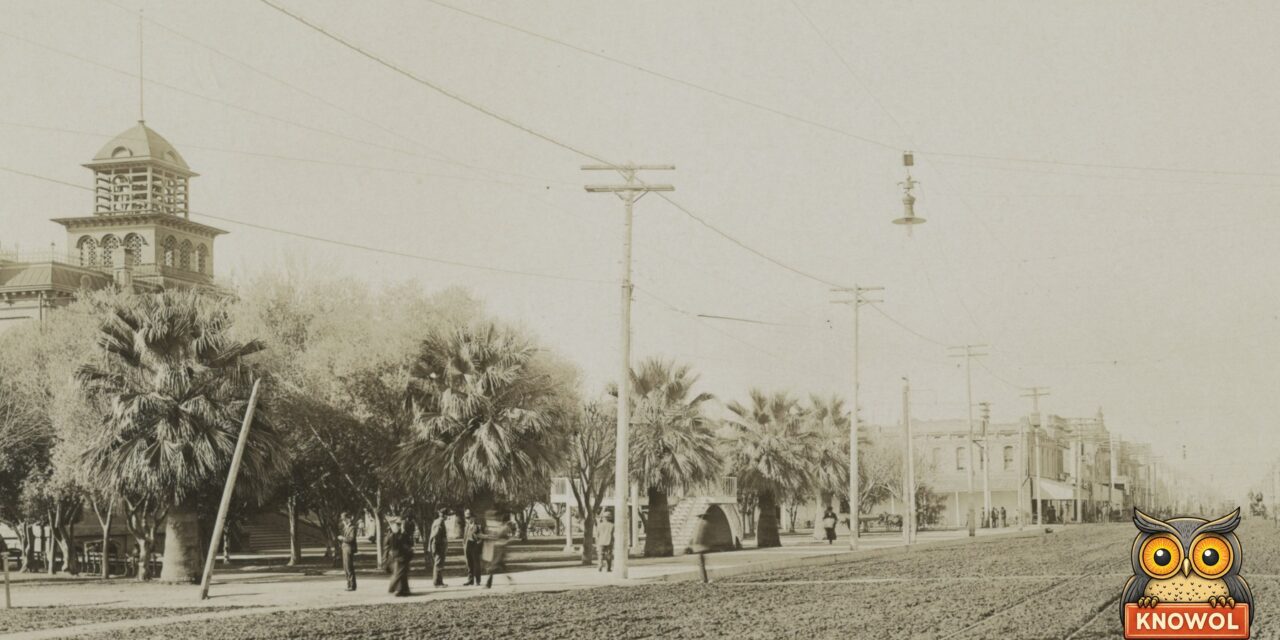
In 1905, Phoenix, Arizona, didn’t pay to light its streets every night. Like a lot of American towns, it ran its arc lamps on something called the Philadelphia moonlight schedule. On nights when the almanac said the moon would be bright enough, the streetlights stayed dark and the moon did the job for free.
That works fine until the moon goes behind a cloud. In early November 1905 a storm rolled into Phoenix on a Friday, and by Monday the weather office had measured nine-tenths of an inch of rain. The dirt streets turned to mud. On Monday night, November 6, the light company finally gave in, and the next morning The Arizona Republican told the town about it.
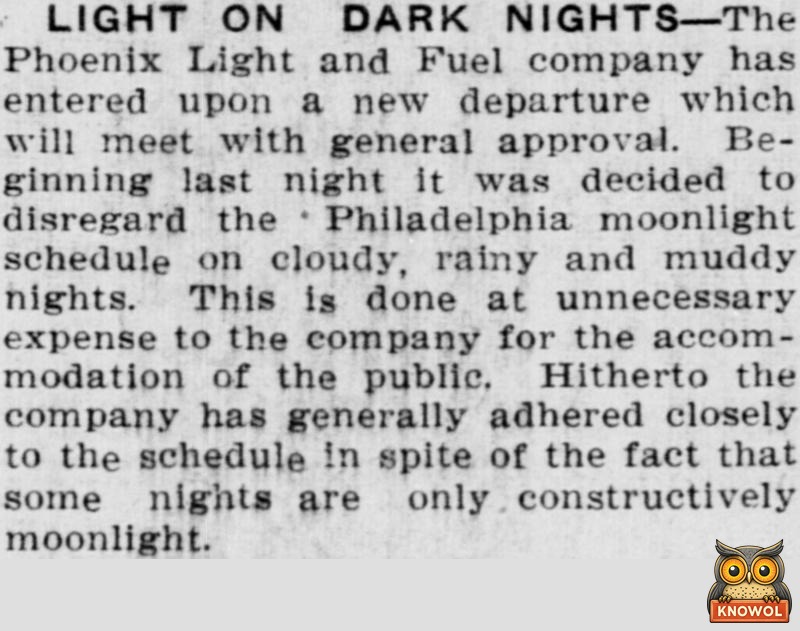
“Light on Dark Nights.” The Arizona Republican, Phoenix, Arizona, November 7, 1905, page 5. Library of Congress, Chronicling America. Click the clipping to read it full size.
“The Phoenix Light and Fuel company has entered upon a new departure which will meet with general approval,” the item began. “Beginning last night it was decided to disregard the Philadelphia moonlight schedule on cloudy, rainy and muddy nights.” The company wanted some credit for it, too: “This is done at unnecessary expense to the company for the accommodation of the public.” Then came the best line of all. Until now, the paper said, the company “has generally adhered closely to the schedule in spite of the fact that some nights are only constructively moonlight.” In other words, the moon had been shining on paper.
How do you light a town by the moon?
Even people in the electric business weren’t always sure. In 1909 a reader wrote to Electrical World, a weekly journal for the trade: “Various companies in the West, in giving information on their lighting circuits, state that they operate on the Philadelphia moonlight schedule. I have been unable to find out exactly what this schedule is.” The editors printed the rule as it was “usually expressed”: “Light one-half hour after sunset and one hour before moonset. Extinguish one hour after moonrise and one hour before sunrise.”
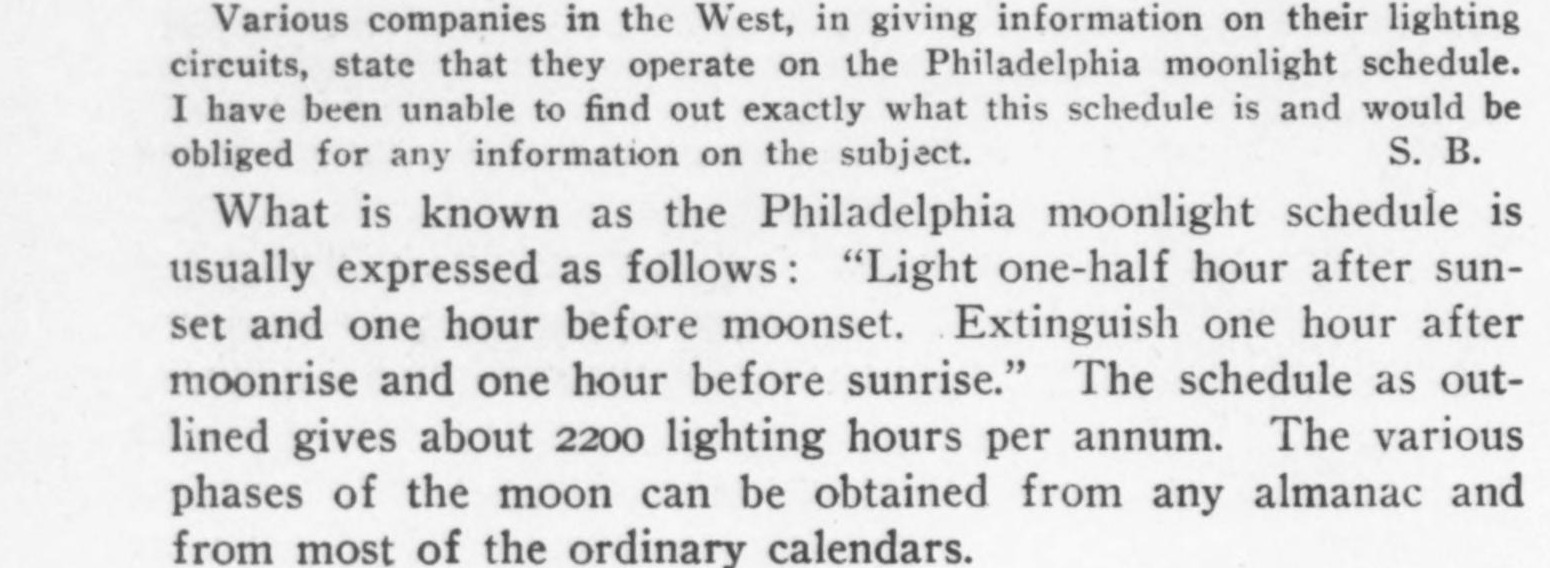
A reader asks what the Philadelphia moonlight schedule is, and the editors answer. Electrical World, October 7, 1909. Internet Archive scan. Public domain. Click the picture to see it full size.
So the lamps came on half an hour after sundown, unless the moon was already up. Then they waited until an hour before it set. If the moon came up in the middle of the night, the lamps went off an hour later. Around a full moon, which rises near sunset and sets near sunrise, they hardly burned at all. The editors put the total at “about 2200 lighting hours per annum.” By the magazine’s own tables, a lamp that burned every night from dusk to dawn ran about 3,830 hours a year. A moonlight town paid for a little more than half of the dark.
That Monday in Phoenix, the moon was a little past half full and already in the sky at sunset. It was exactly the kind of evening the schedule left to the moon, and the moon was behind the clouds.
Everybody had an opinion
In 1905 the moonlight schedule was written into contracts from Arizona to Pennsylvania. That spring a new light franchise for Clifton, Arizona, capped an arc lamp at $108 a year “on the standard moonlight schedule, namely: Twenty One Hundred and Seventy-Nine (2179) hours per year.” In Danville, Pennsylvania, the Montour American made the case for it: “There are several nights of each month, approximating a week, when the streets of every town are much better lighted up by the moon than by any system of lighting that can be devised by man.”
The man running the light plant in Topeka, Kansas, had his doubts. “The moonlight schedule system of trying to light a city’s streets keeps you guessing all right,” H. K. Goodrich told the Topeka State Journal that October. “It may say moonlight on the calendar and then cloud up.” His fix was to hand the streetlights over to Weather Observer Jennings, since “he could telegraph every afternoon to Washington and find out what we are going to have.”
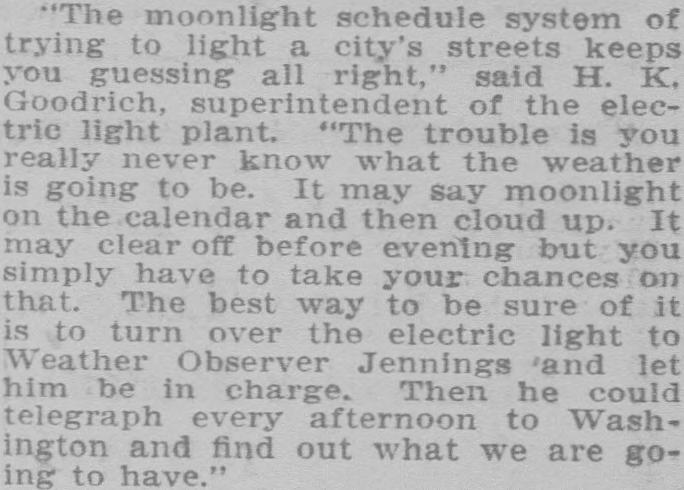
H. K. Goodrich on the moonlight schedule. Topeka State Journal, Topeka, Kansas, October 17, 1905, page 5. Library of Congress, Chronicling America. Click the clipping to read it full size.
Albuquerque, New Mexico, had a problem no almanac could fix. “On account of the trees in many districts of the city the light of the moon is obscured and the strets are virtually dark,” the Albuquerque Evening Citizen reported on September 16, 1905, as a petition for dusk-to-daylight lights went around town. It didn’t stick. In January 1907 a council committee recommended that the city’s all-night lights be “abolished and a moonlight schedule be adopted for all lights” except one, under the viaduct at St. John street and Railroad avenue. The council adopted the report, and the Albuquerque Morning Journal called it the “Moonshine Schedule.”
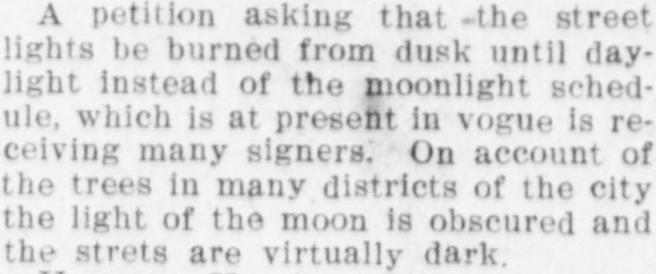
The tree petition. Albuquerque Evening Citizen, Albuquerque, New Mexico, September 16, 1905, page 5. Library of Congress, Chronicling America. Click the clipping to read it full size.
Brattleboro, Vermont, went the other way. That summer the village hired an electrical expert, a Mr. Adams, to look over its streetlights. His report made headlines in Brattleboro’s own paper, which happened to be called the Vermont Phoenix: “Moonlight Schedule Should Be Dispensed With” and “Village Paying for More Light Than It Receives.” The lamps, he said, “should be operated every night in the year, whether the moon is supposed to shine or not.” In August the village signed a new five-year contract, and the paper reported, “Hereafter the lights will burn every night in the year.” The prices went down at the same time.
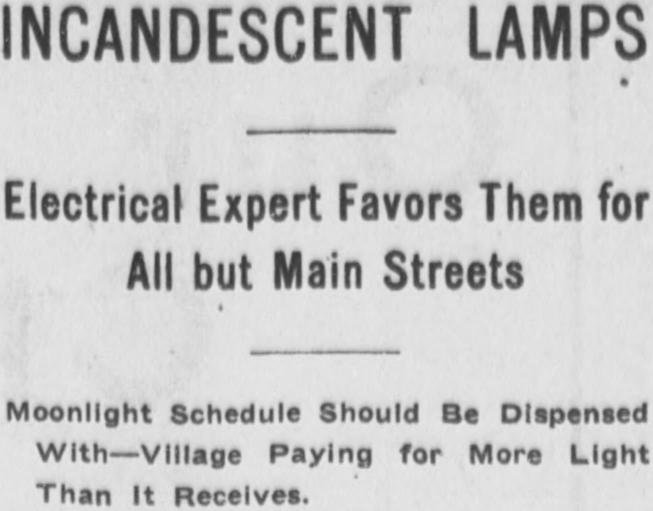
The expert’s report makes the headlines. Vermont Phoenix, Brattleboro, Vermont, July 28, 1905, page 6. Library of Congress, Chronicling America. Click the clipping to read it full size.
Phoenix and the bugs
Phoenix had been joking about the schedule for years. In 1901 the Republican reported that City Marshal Kinney, “regardless of the Philadelphia moonlight schedule, Ayer’s almanac or any other authority except a democratic city council, issued a manifesto that hereafter dark shall come at 8 o’clock until further orders.” It was a warning to bicycle riders about when to light their lamps.
In the late summer of 1905, just weeks before the rainy-night change, the town tried darkness on purpose. Bugs had swarmed the arc lamps two nights running, so on Thursday, August 24, the authorities had the streetlights turned off. It backfired. With the street lights dark, “the business houses were overrun with the annoying insects,” the paper said the next day. A week later the town was still dark, and the Republican had had enough. “Darkness has no deleterious effect on bugs,” it wrote. The bugs had moved into the restaurants “at a rate calculated to destroy the appetite,” and for two nights “they practically took possession of The Republican office for a time bringing operations to a stand still.” Its advice was simple: “Why not let the bugs enjoy the arc lights?”
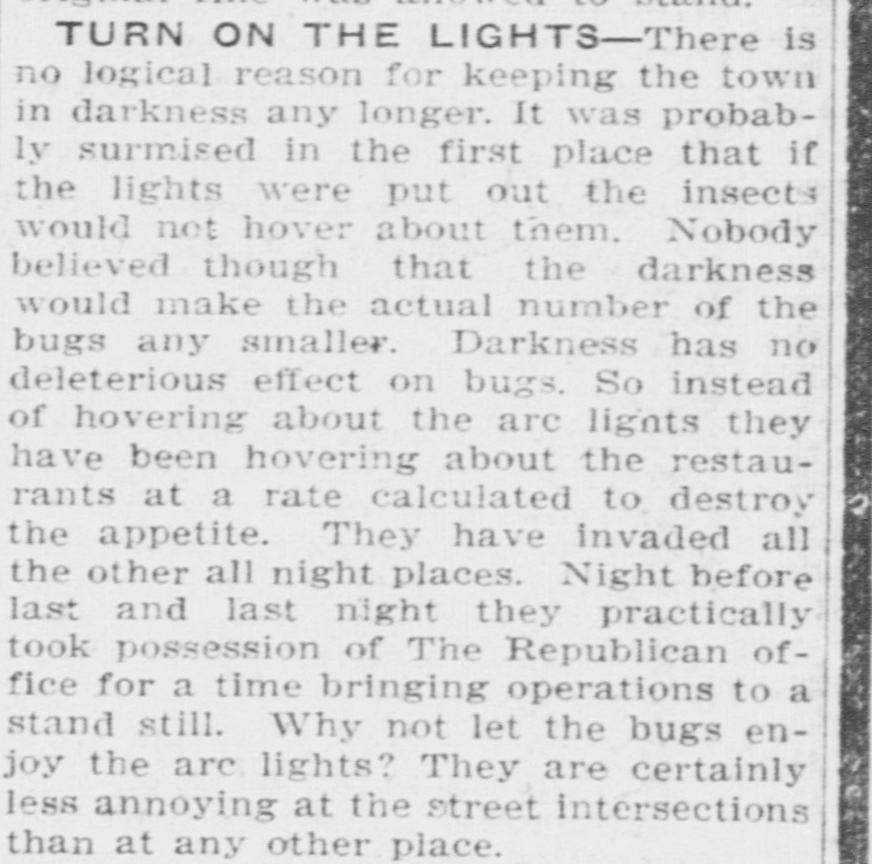
“Turn On the Lights.” The Arizona Republican, Phoenix, Arizona, September 1, 1905, page 6. Library of Congress, Chronicling America. Click the clipping to read it full size.
The light company had a rival that fall, too. On the same Monday the lamps stayed on in the rain, the city council received an application from L. M. Hoghe for an electric light and gas franchise, with arc lights at “fifty cents from dark to daylight.” There was no moon in his rates at all. A month later the same paper reported that Leo M. Hoghe, “who owns the formula for the concocting of the famous Hoghe hamburger,” had sold the recipe and Hoghe’s Chop House for $1,500. The paper didn’t connect the two, but it was very likely the same man. We found no sign he ever got his franchise.
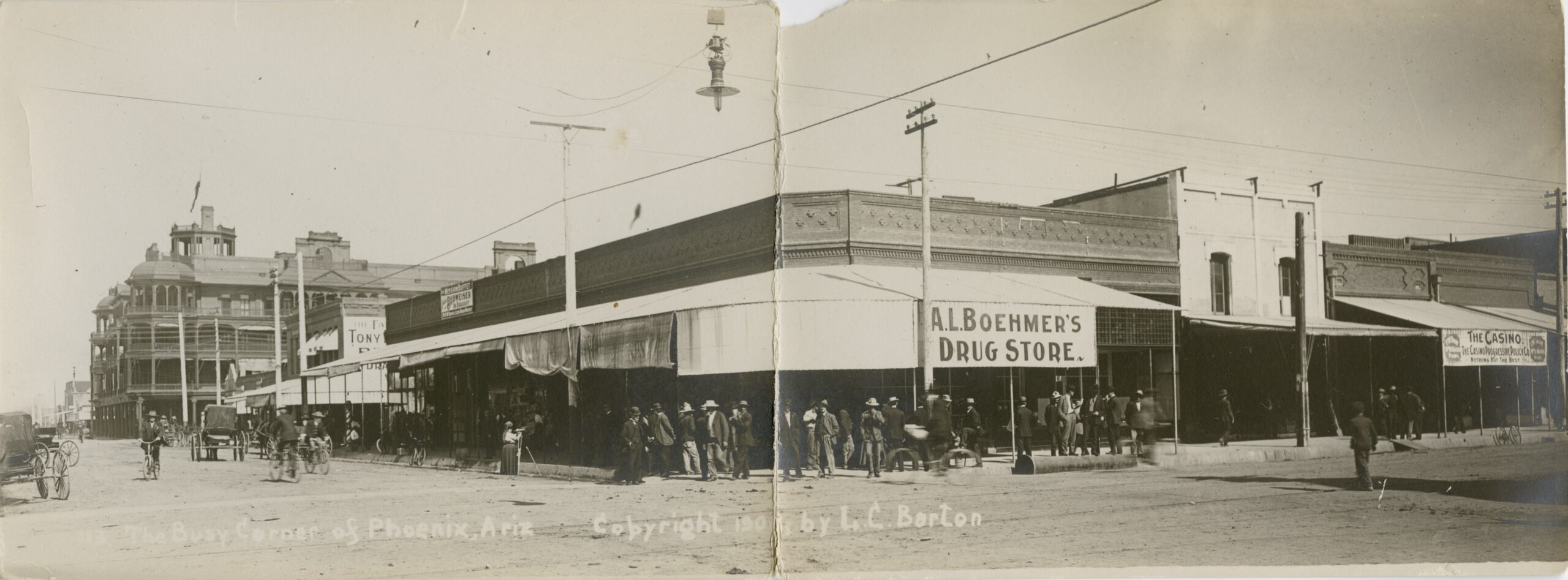
An arc lamp hangs on a wire over “The busy corner of Phoenix, Arizona,” on a photo postcard by Lester Clement Barton, made in 1907. Library of Congress, Prints and Photographs Division. Click the picture to see it full size.
The almanac kept its job
The rainy-night rule didn’t end the moonlight schedule in Phoenix. On a Friday night in July 1908 the lights went out again, and the Republican wrote that the company “exhibted a beautiful confidence in the accuracy of the almanac.” Then it added, “There may have been a moon all right but there is not a man in Phoenix who would swear that he saw the slightest trace of one.” In December 1911 the paper reported that the city’s light contract had run out that October, “the rate being $7 per month per light under the Philadelphia moonlight schedule.”
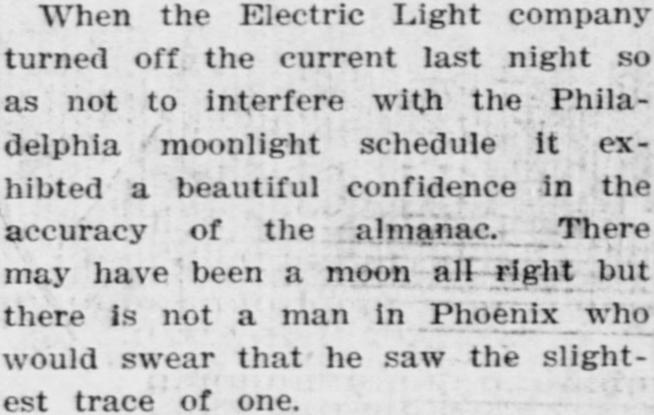
The Arizona Republican, Phoenix, Arizona, July 18, 1908, page 2. Library of Congress, Chronicling America. Click the clipping to read it full size.
Austin built its own moons
One Texas city came at the problem from the other side. In 1894 and 1895, Austin, Texas, put up 31 towers, each 165 feet tall, with carbon-arc lamps on top. The Fort Wayne Electric Company built them, and people called them moonlight towers. Seventeen were still standing in the early 1990s, according to the Handbook of Texas, and they’re on the National Register of Historic Places.
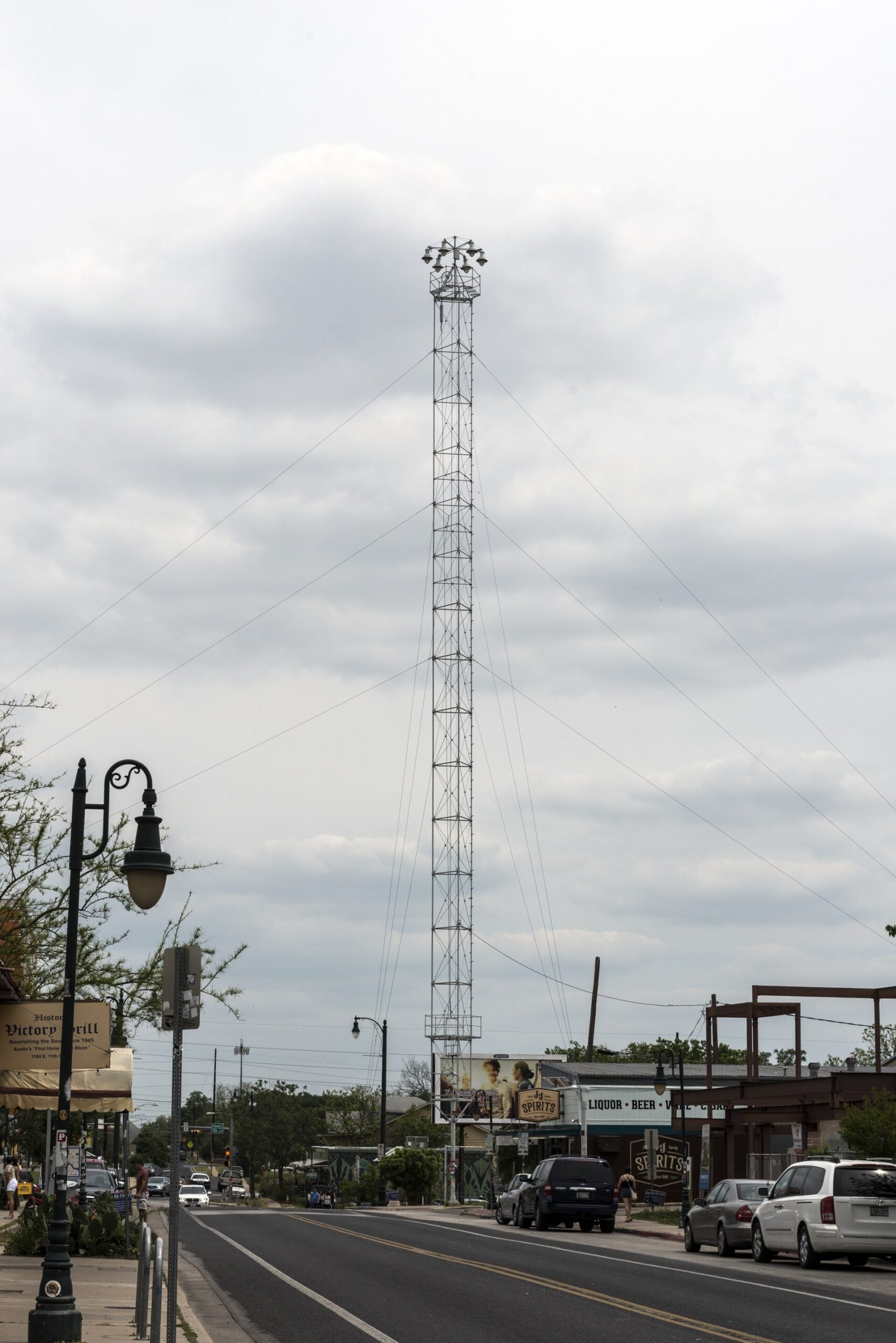
A moonlight tower near the Victory Grill in Austin, Texas, photographed by Carol M. Highsmith in 2014. Library of Congress, Prints and Photographs Division. Click the clipping to read it full size.
So for a few years in a lot of American towns, whether your street was lit at night came down to a timetable, a calendar and the weather. In Phoenix, after November 6, 1905, a muddy night at least got its lamps.
Sources
- The Arizona Republican (Phoenix, Arizona): November 7, 1905, page 5 (“Light on Dark Nights” and the storm summary), November 7, 1905, page 4 (city council, the Hoghe franchise), August 25, 1905, page 6 (“The Town in Darkness”), September 1, 1905, page 6 (“Turn On the Lights”), December 5, 1905, page 5 (“Hoghe’s Chop House Sold”), May 19, 1901, page 4 (Marshal Kinney), July 18, 1908, page 2 and December 16, 1911, page 2.
- Albuquerque Evening Citizen (Albuquerque, New Mexico): September 16, 1905, page 5. Albuquerque Morning Journal (Albuquerque, New Mexico): January 22, 1907, page 7.
- Vermont Phoenix (Brattleboro, Vermont): July 28, 1905, page 6 and August 18, 1905, page 2.
- Copper Era (Clifton, Arizona): April 27, 1905, page 2. Montour American (Danville, Pennsylvania): March 9, 1905, page 2. Topeka State Journal (Topeka, Kansas): October 17, 1905, page 5.
- All newspaper images: Library of Congress, Chronicling America. Published 1901 to 1911, public domain.
- Electrical World: October 7, 1909 (the reader’s question and the rule) and December 23, 1909 (the yearly lighting tables), Internet Archive. Public domain.
- Moon phases for November 1905: Fred Espenak, Moon Phases: 1901 to 2000, AstroPixels.
- Christopher Long, “Moonlight Towers,” Handbook of Texas Online, Texas State Historical Association.
- Photographs: “The busy corner of Phoenix, Arizona,” Lester Clement Barton, Library of Congress, no known restrictions. Moonlight tower near the Victory Grill, Austin, Texas, Carol M. Highsmith, 2014, Lyda Hill Texas Collection of Photographs in Carol M. Highsmith’s America Project, Library of Congress, no known restrictions.
- Cover: “City Hall, Washington Street, Phoenix, Ariz.,” Lester Clement Barton, 1908, Library of Congress, no known restrictions.