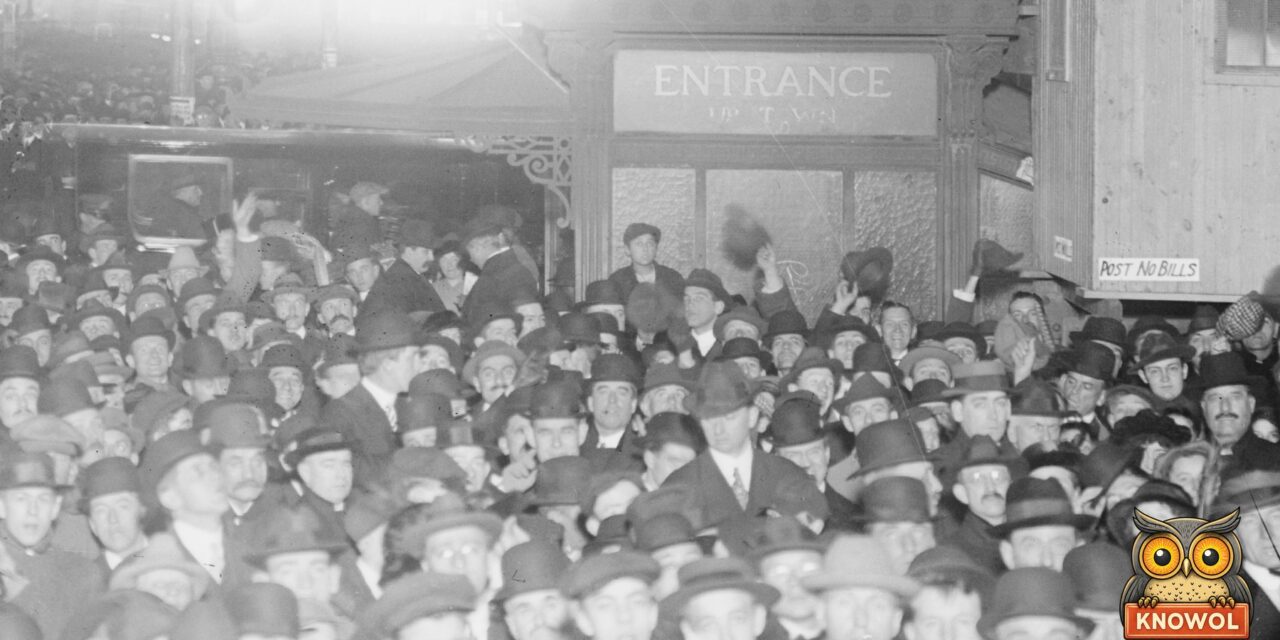
On the night of Wednesday, March 27, 1912, a big canvas hung in front of the Orpheo Theater in Pine Bluff, Arkansas. Between 2,000 and 3,000 people stood in the street and looked up at it. Arkansas had voted that day, and nobody knew yet who had won. There was no radio to turn on and no television. The news was going to show up on that canvas, a few lines at a time.
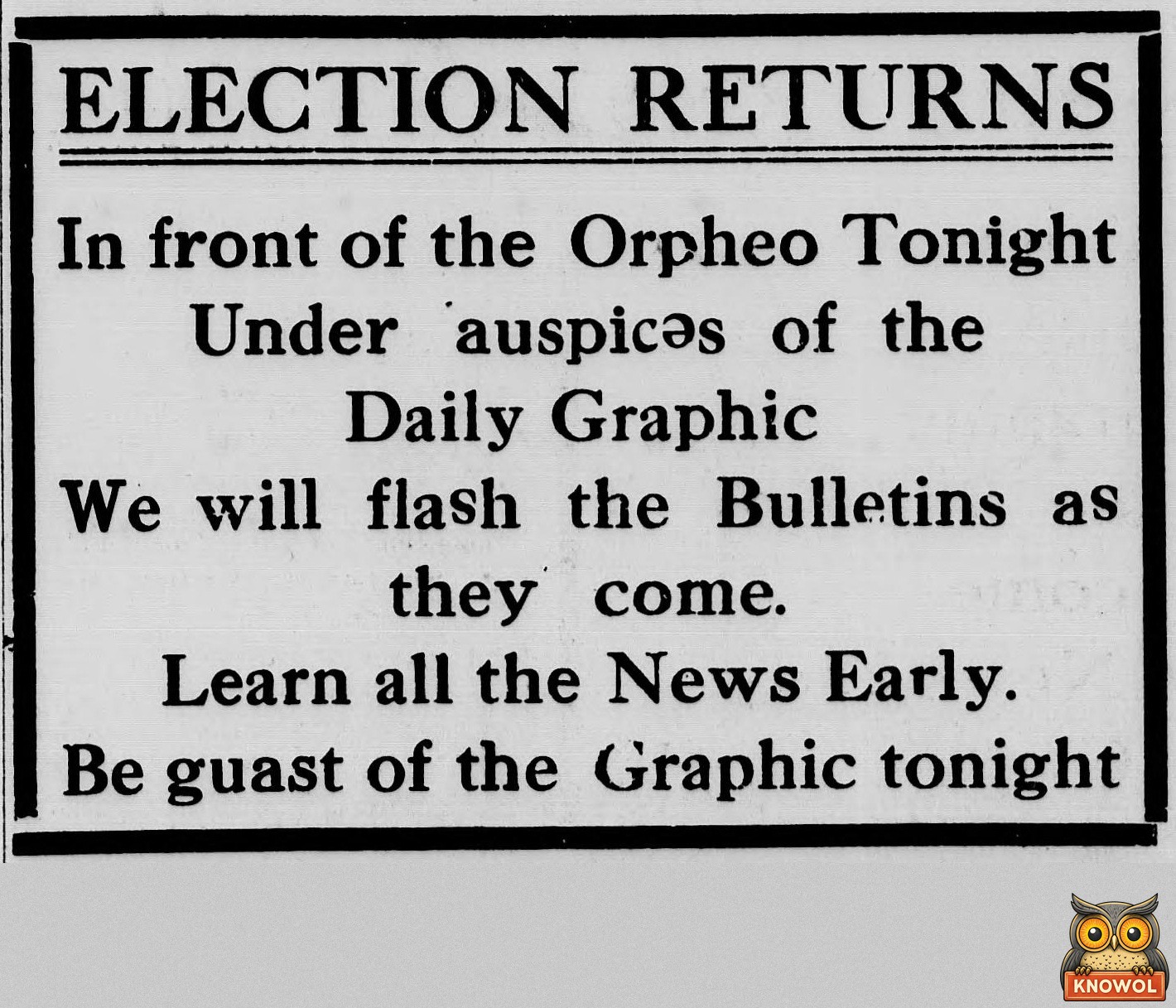
The invitation on the front page: “Election Returns. In front of the Orpheo Tonight.” The last line has a printer’s slip, “guast” for guest. Pine Bluff Daily Graphic, Pine Bluff, Arkansas, March 27, 1912, page 1. Library of Congress, Chronicling America. Click the clipping to read it full size.
An invitation on the front page
That morning the Pine Bluff Daily Graphic printed an invitation in a big box on its front page. “ELECTION RETURNS,” it said. “In front of the Orpheo Tonight.” Returns are the vote counts that come in after the voting stops. “We will flash the Bulletins as they come,” the paper promised.
Democrats all over Arkansas were picking their man for governor that day. Governor George W. Donaghey wanted a third term, and Congressman Joe T. Robinson wanted his job. Senator Jeff Davis of Arkansas was fighting to keep his seat, too.
How the news reached the canvas in Pine Bluff
The Orpheo in Pine Bluff was a vaudeville theater, a house for live variety acts. That week its stage had a pair of jugglers and a singing and dancing act. For election night its manager, S. E. Wilhoit, set up a stereopticon on the veranda, the porch at the front of the theater. A stereopticon was a slide projector with a strong lamp. People also called it a magic lantern.
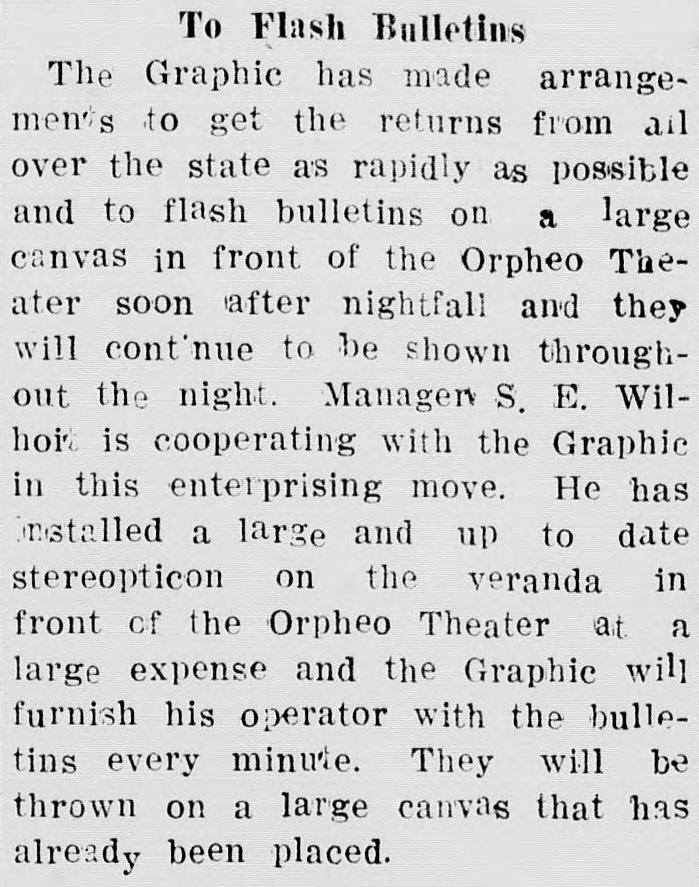
“To Flash Bulletins.” The plan for the canvas and the stereopticon, from the front-page story. Pine Bluff Daily Graphic, Pine Bluff, Arkansas, March 27, 1912, page 1. Library of Congress, Chronicling America. Click the clipping to read it full size.
The numbers had a long trip first. When a place finished counting, somebody telephoned the count in. The returns “came in constantly by long distance phone” to the Graphic’s office, the paper said. From there they went “by private phone” to the man running the lantern. Then they were “flashed upon the canvas” for the whole street to read.
The operators who stayed up past bedtime
Pine Bluff’s canvas needed help from every corner of Arkansas. In those days most telephone calls did not connect themselves. A call went through an exchange, an office where operators sat at a switchboard and plugged in a cord for each one. In a small town that office closed for the night.
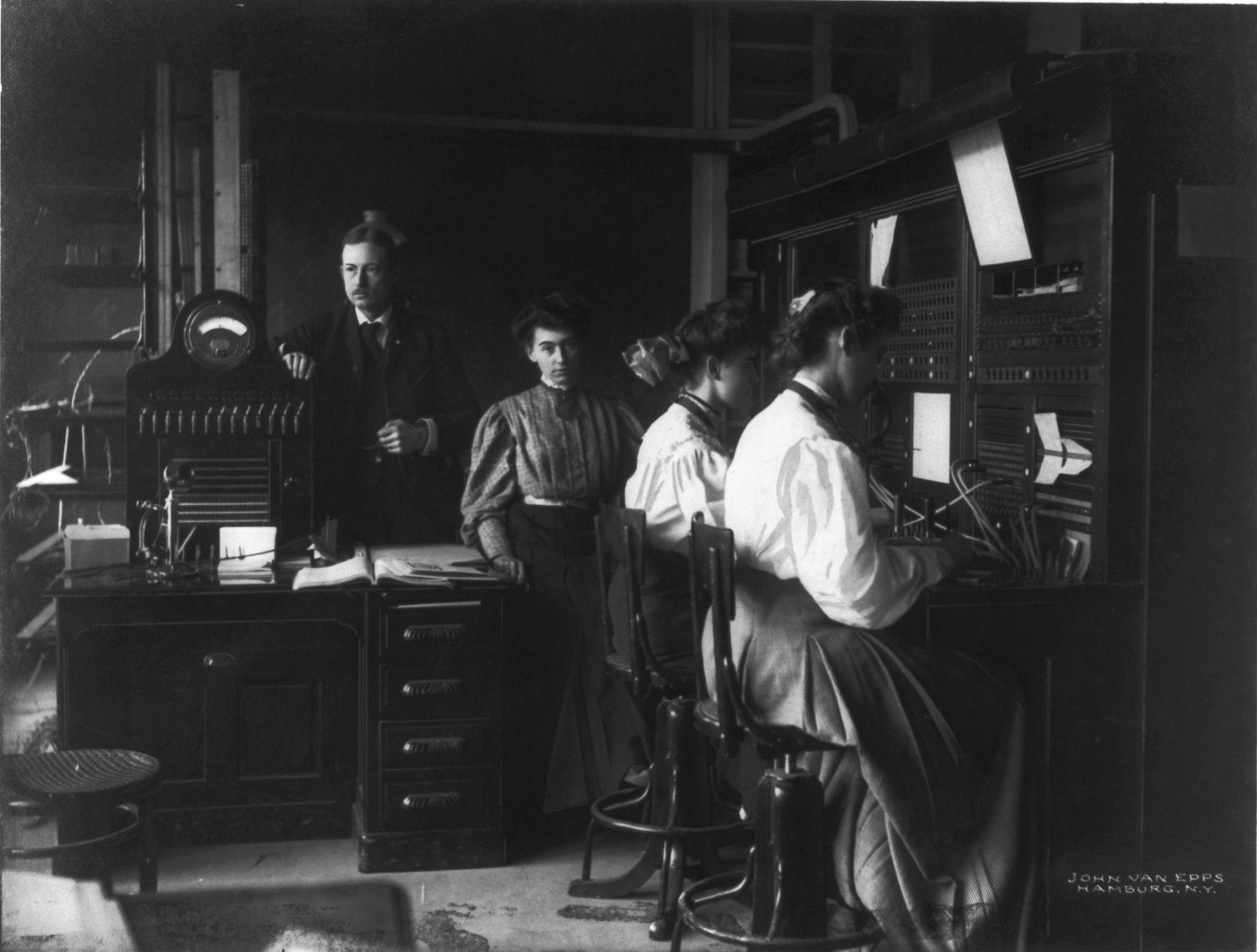
A small-town telephone office of those years. Two operators work the switchboard at the Bell Telephone office in Hamburg, New York, between about 1900 and 1910. We found no photo of an Arkansas exchange from that night. Photo by John Van Epps. Library of Congress. Click the picture to see it full size.
So the Graphic passed along a promise: “Every telephone exchange in Arkansas in all of the smaller towns, where the operators usually go to bed with the chickens, will be kept open all night.” To go to bed with the chickens is to turn in at sundown. For one night, small-town Arkansas stayed up late.
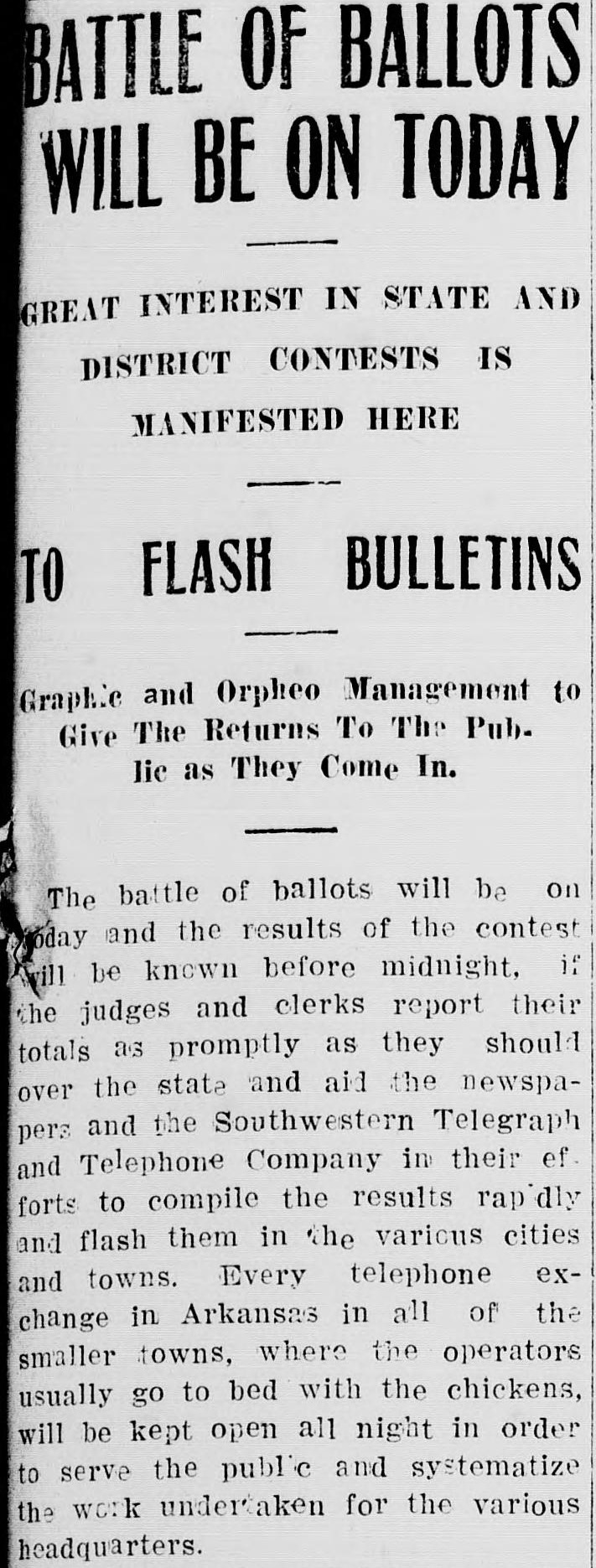
“Battle of Ballots Will Be On Today.” The top of the front-page story, down to the operators who “go to bed with the chickens.” Pine Bluff Daily Graphic, Pine Bluff, Arkansas, March 27, 1912, page 1. Library of Congress, Chronicling America. Click the clipping to read it full size.
Three guesses printed in Pine Bluff that morning
The same morning paper in Pine Bluff carried three guesses about the day. The first was the weatherman’s, and he called for rain. It was late March, and on a dry day farmers would stay in their fields, “getting in some much needed work if the day is clear.” Senator Davis counted on farm votes. He “prayed last night that the prediction come true.”
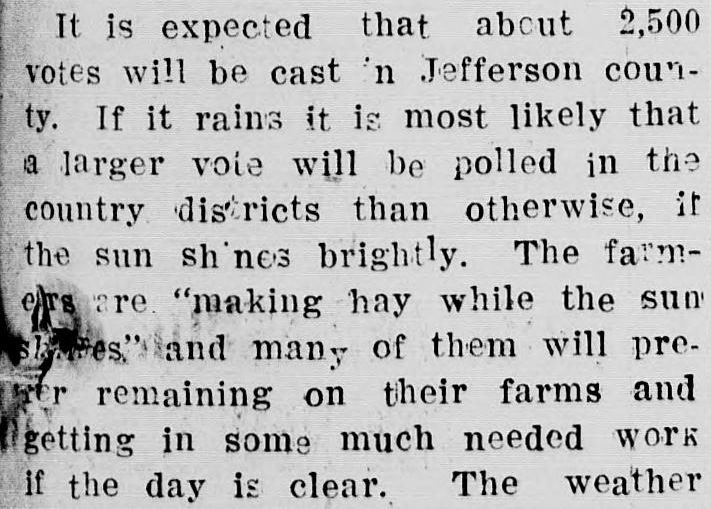
Why rain mattered on election day. The clip stops where the next sentence begins. Pine Bluff Daily Graphic, Pine Bluff, Arkansas, March 27, 1912, page 1. Library of Congress, Chronicling America. Click the clipping to read it full size.
The second guess was the Graphic’s own. It liked Robinson, and it said hardly anybody in town would bet on the governor: “Donaghey money is hard to find.” The third guess said the opposite. It sat on page six, in a paid ad signed by Arthur Murray, editor of another Pine Bluff paper, the Press-Eagle. He told of a Robinson man who walked into the Jefferson Hotel with a thousand dollars to bet and found a taker right away. Then he made his call: “From this place it looks like a landslide for Donaghey next Wednesday.” A landslide is a win by a mile.
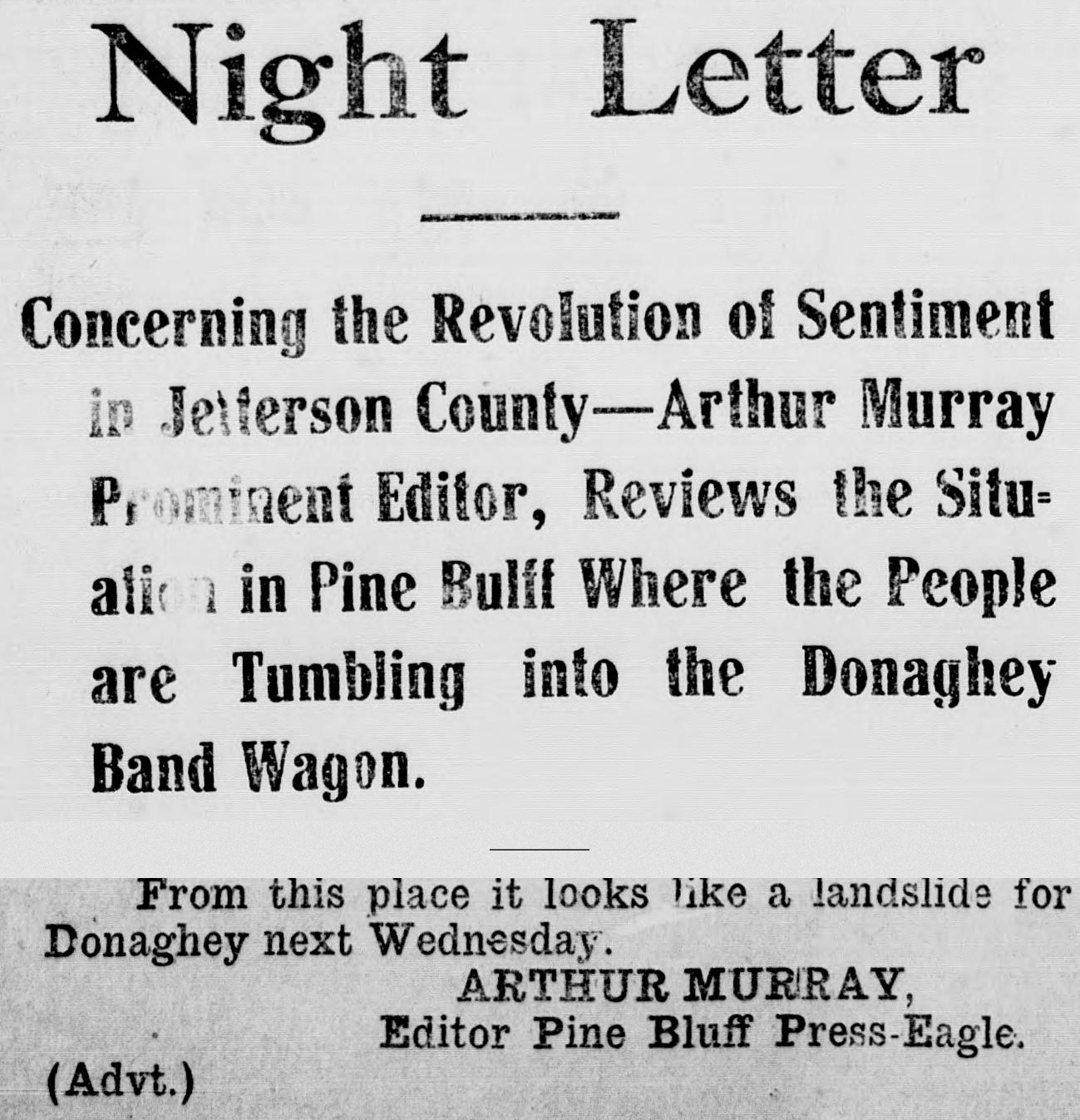
The paid ad on page six: its heading and its last lines, joined. “(Advt.)” marks it as an advertisement. Pine Bluff Daily Graphic, Pine Bluff, Arkansas, March 27, 1912, page 6. Library of Congress, Chronicling America. Click the picture to see it full size.
What the crowd in front of the Orpheo saw
The rain never came to Pine Bluff. The day was fair, and many farmers stayed in their fields. After dark the crowd filled the street in front of the Orpheo, and the lantern went to work. “For the first time in the history of Pine Bluff,” the Graphic said the next morning, “the citizens of the city were kept informed every minute.” When a favorite pulled ahead, “cheer after cheer went up from the big crowd, which was estimated at between 2,000 and 3,000.”
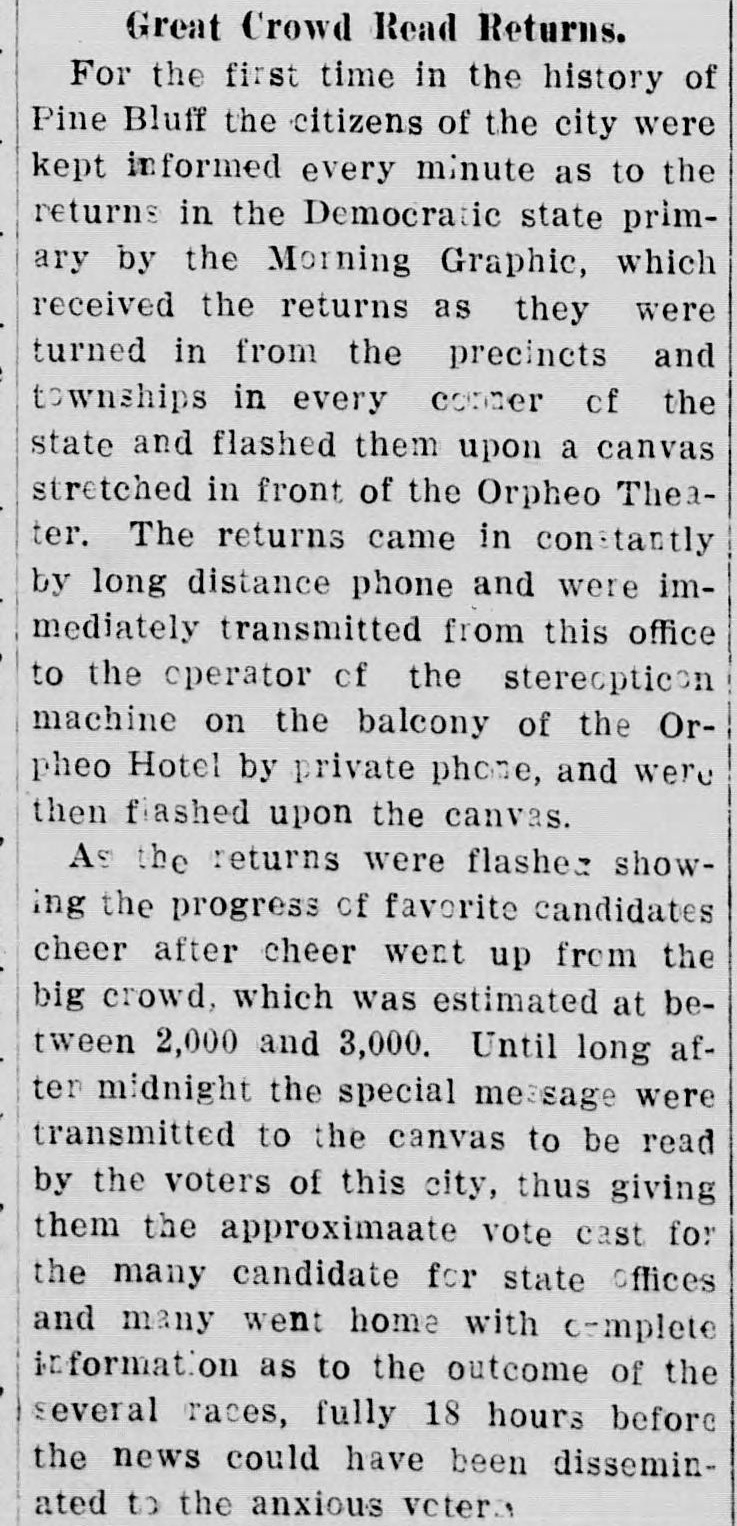
“Great Crowd Read Returns.” The Graphic’s own report of the night. Pine Bluff Daily Graphic, Pine Bluff, Arkansas, March 28, 1912, page 4. Library of Congress, Chronicling America. Click the clipping to read it full size.
The Senate race kept them guessing. For a while that night, Senator Davis looked beaten. Then counts from the farm districts came in “at a late hour” and “turned the tables.” The bulletins kept going up until “long after midnight.”
The landslide went the other way
Pine Bluff’s canvas settled all three guesses. The weatherman missed, and the vote was small, “the smallest recorded in a state election for many years.” Senator Davis, who had prayed for rain, lost the county. He won the state anyway.
There was a landslide, too. It just went to the other man. Robinson carried Jefferson County, where Pine Bluff is, with 1,304 votes to the governor’s 482. The governor “lost every ward in the city,” the paper said, “being snowed under three to one in Pine Bluff.” The next morning’s front page called Robinson “OUR NEXT GOVERNOR.” If the ad had its story right, the man who took that bet at the Jefferson Hotel was out a thousand dollars.
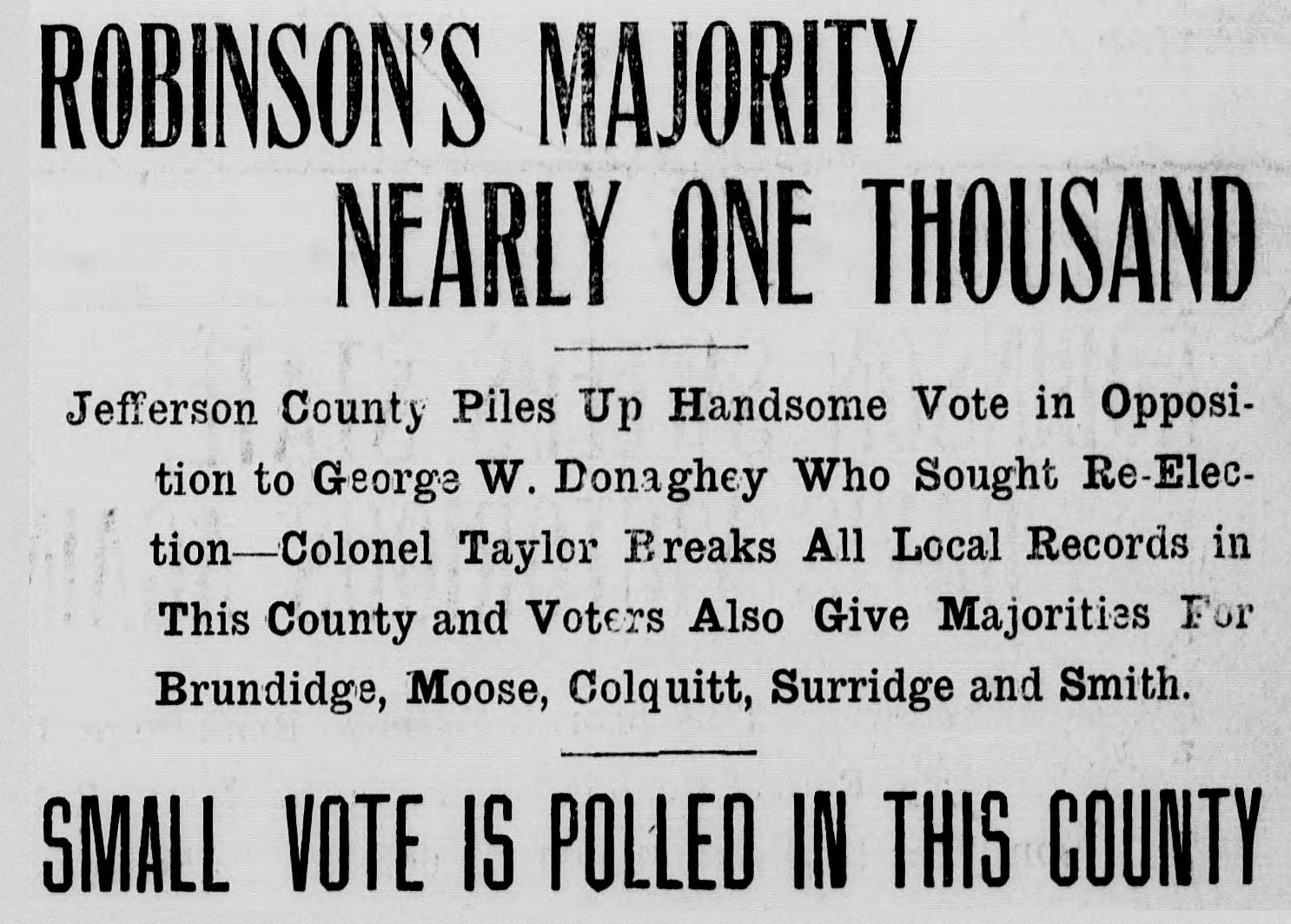
The morning after: “Robinson’s Majority Nearly One Thousand” and “Small Vote Is Polled in This County.” Pine Bluff Daily Graphic, Pine Bluff, Arkansas, March 28, 1912, page 1. Library of Congress, Chronicling America. Click the picture to see it full size.
Not all the news moved at telephone speed. The ballot box from Spring township did not reach town until the next day. It held 34 votes, and the two men running for governor had split them, 17 and 17.
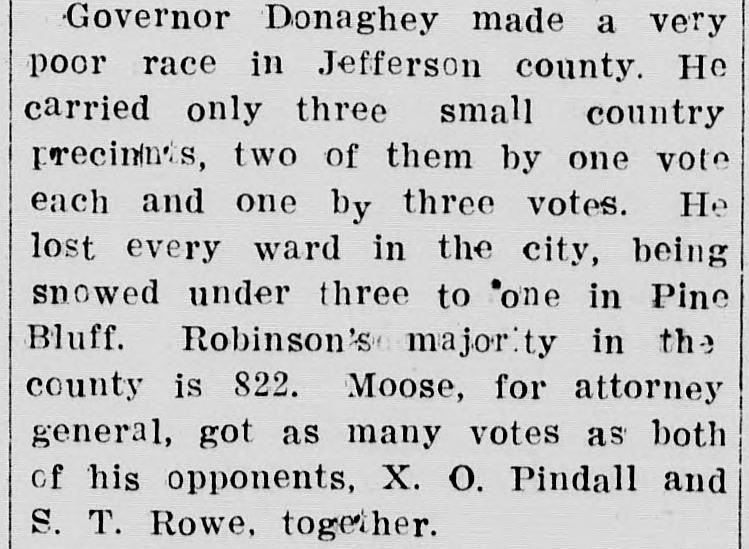
“Snowed under three to one in Pine Bluff.” From the final county count. Pine Bluff Daily Graphic, Pine Bluff, Arkansas, March 29, 1912, page 1. Library of Congress, Chronicling America. Click the clipping to read it full size.
What became of the winner on Pine Bluff’s canvas
Joe T. Robinson, the name that won on Pine Bluff’s canvas, had a busy winter. The National Governors Association gives the dates. He left Congress on January 14, 1913, and was sworn in as governor two days later. On January 28 he was elected to the United States Senate. That made three big jobs in two weeks.
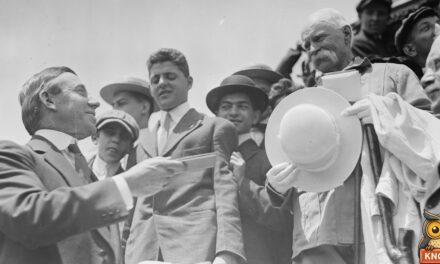
The photo at the top of this story is not Pine Bluff. We found no picture of the crowd at the Orpheo. It shows the same kind of night in New York City in 1913: an election-night crowd packed into the street, hats in the air, faces turned up. Today the count comes to each of us alone, on a screen in a pocket. In 1912 Pine Bluff got the news together, standing in the street, one cheer at a time.
Sources
- “Battle of Ballots Will Be On Today” and the “Election Returns” notice, Pine Bluff Daily Graphic (Pine Bluff, Arkansas), March 27, 1912, page 1. Library of Congress, Chronicling America.
- “Night Letter,” a paid advertisement signed by Arthur Murray, Pine Bluff Daily Graphic, March 27, 1912, page 6. Library of Congress, Chronicling America.
- Pine Bluff Daily Graphic, March 28, 1912: the results on page 1, “Great Crowd Read Returns” on page 4 and the Orpheo’s acts for the week on page 5. Library of Congress, Chronicling America.
- “No Change in Final Returns,” Pine Bluff Daily Graphic, March 29, 1912, page 1. Library of Congress, Chronicling America.
- Joseph Taylor Robinson, National Governors Association (his dates in Congress, as governor and in the Senate).
- Cover photo: “Crowd- Election Night – N.Y., 1913”, Bain News Service, George Grantham Bain Collection, Library of Congress Prints and Photographs Division, no known restrictions on publication.
- Photo in the story: “The Bell Telephone office at Hamburg, N. Y.”, by John Van Epps, between about 1900 and 1910, Library of Congress Prints and Photographs Division, no known restrictions on publication.