On a Thursday afternoon in November 1882, four men sat down to play cards at the Cuvier Club in Cincinnati, Ohio. There was no money on the table. They took two used packs of cards out of the table drawer and played one plain hand. Then E. G. Webster shuffled, Jeremiah Kierstead cut, and Webster dealt thirteen cards to each man.
Nobody played. “Each player, as he arranged his cards, appeared to be laboring under some unusual excitement,” the Cincinnati Commercial reported the next day. Clay Culbertson was supposed to go first, and he was known as a fast player. He just sat there.
Alexander Starbuck broke the silence. “Gentlemen, I have the most remarkable whist hand I ever held,” he said. “I hold thirteen hearts.” Culbertson answered, “I have thirteen spades.” Kierstead spoke “nervously.” He had “the thirteen diamonds.” That left the clubs for the dealer. “Of course, I hold the thirteen trumps,” Webster said.
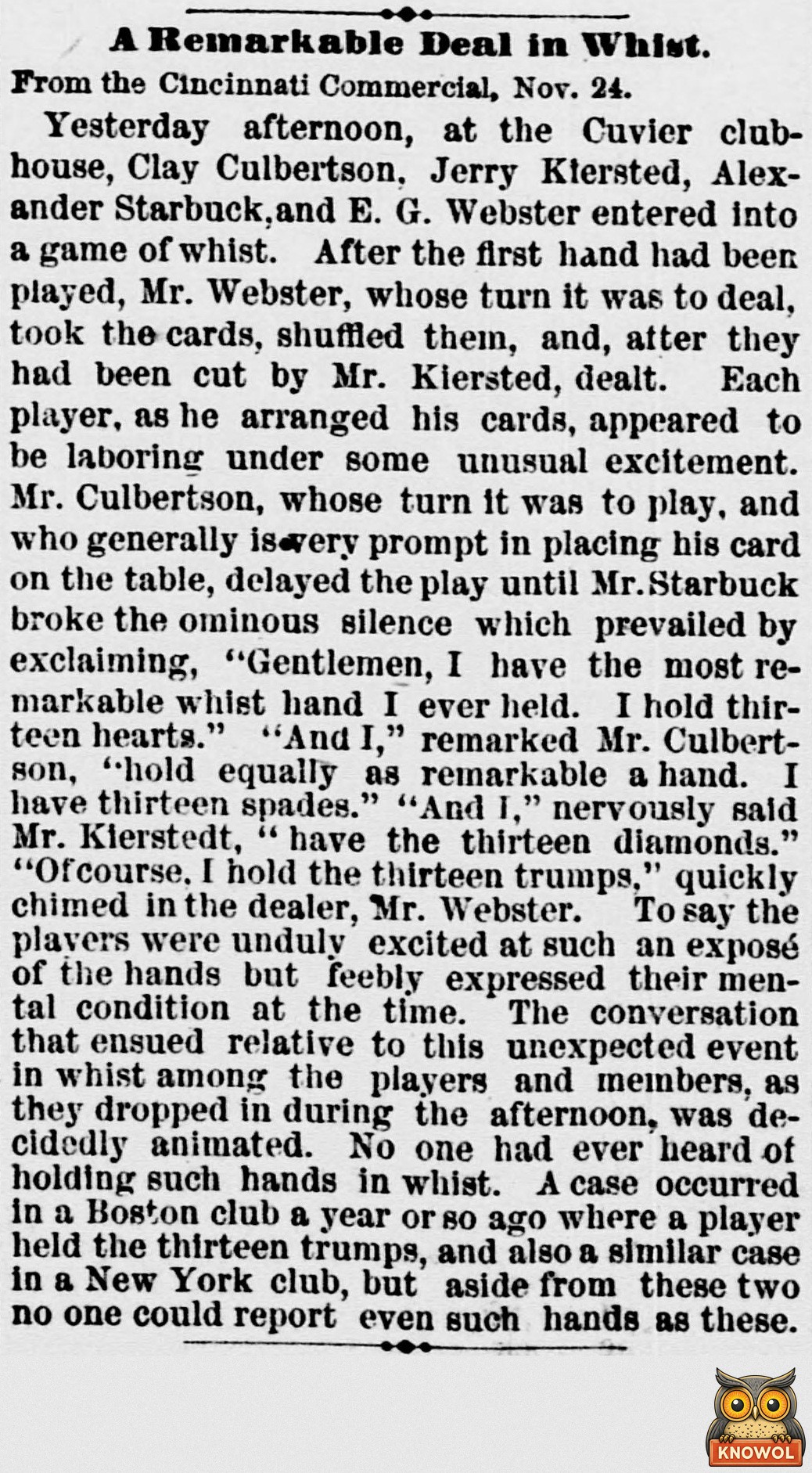
“A Remarkable Deal in Whist.” Evening Star, Washington, D.C., December 5, 1882, page 3, reprinted from the Cincinnati Commercial of November 24. Library of Congress, Chronicling America. Click the clipping to read it full size.
How whist works
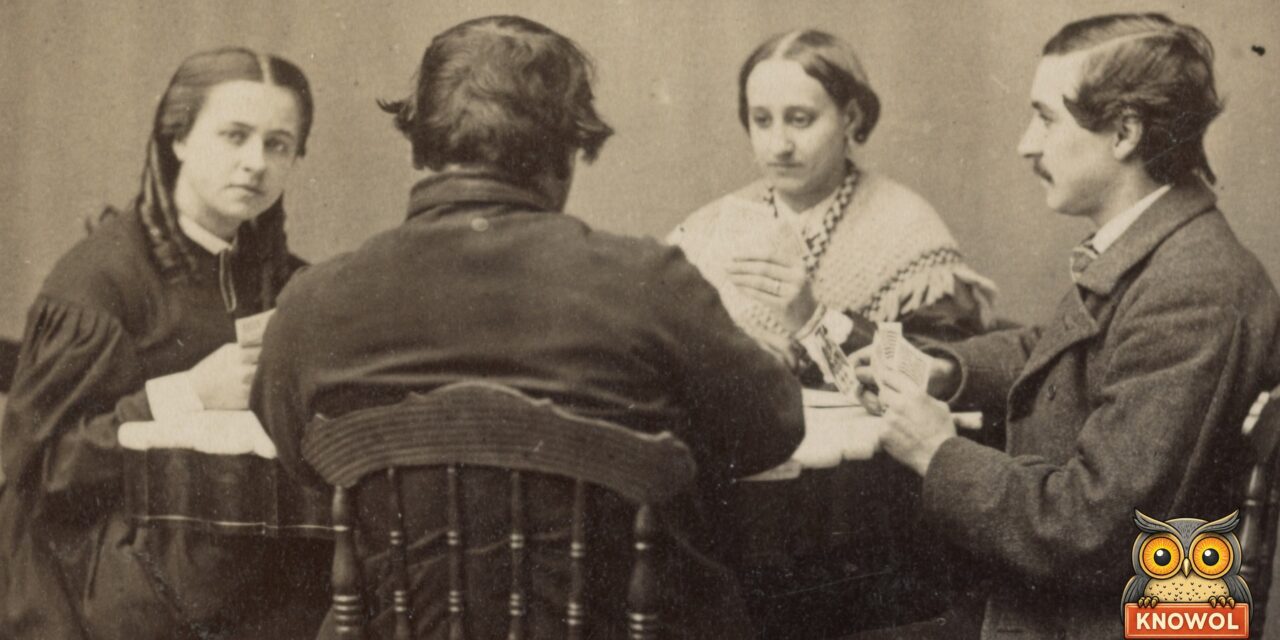
Whist, the game the four men were playing at the Cuvier Club in Cincinnati, is an old card game for four people, two against two. All 52 cards are dealt, 13 to a player, and one suit is trumps, the suit that beats the other three. A normal hand is a jumble of all four suits. On this deal each man held one whole suit and nothing else. Webster’s clubs were trumps, so he could not lose a single play. The picture at the top of this page is a whist party too. It is a staged scene from a stereograph card published in New York in the 1860s, with two men and two women at the table.
A Cincinnati club full of stuffed birds
The Cuvier Club of Cincinnati was not really a card club. It was a club for hunters and fishermen. A city guidebook from 1879 said it was “organized in 1874 for the protection of game and fish and for social purposes,” and that it owned “3,000 preserved specimens of birds and fish.” About 400 members paid $10 a year.
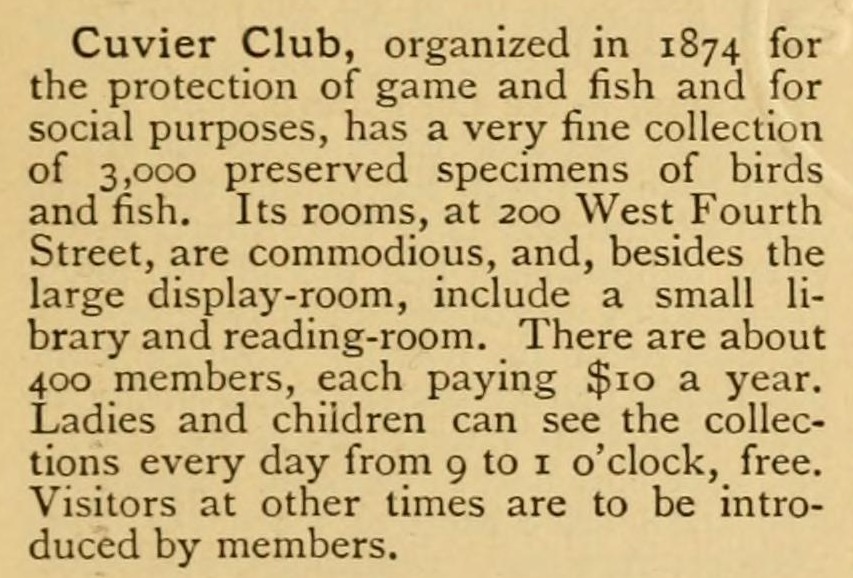
The Cuvier Club in King’s Pocket-book of Cincinnati, 1879. Internet Archive, public domain. Click the clipping to read it full size.
An 1875 guidebook said the club room held “cases filled with beautifully stuffed” game birds, wild turkey and grouse and quail among them. If the room still looked that way in 1882, the four card players had an audience with glass eyes.
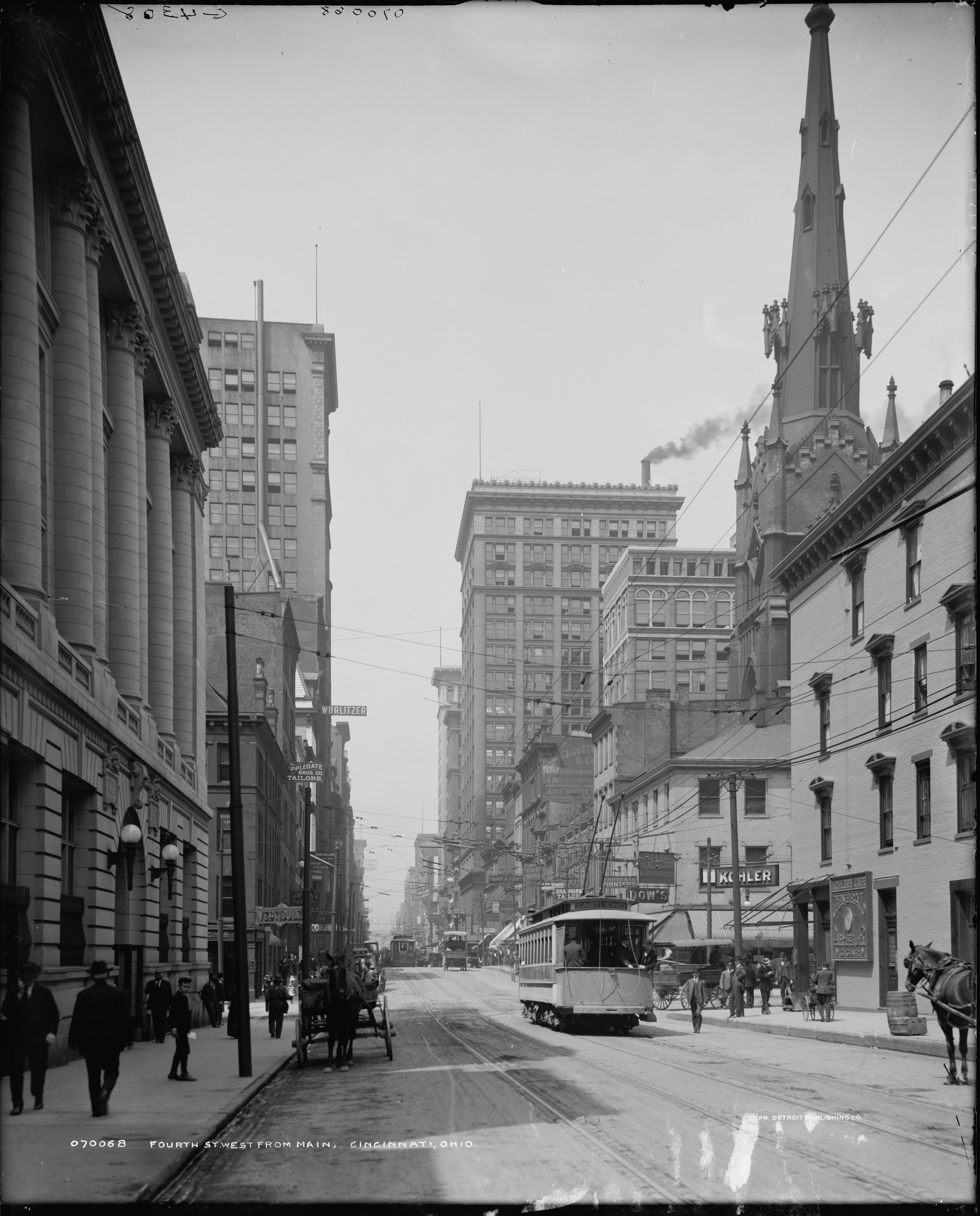
Fourth Street, looking west from Main Street, Cincinnati, Ohio, about 1907, some 25 years after the card game. The 1879 guidebook put the Cuvier Club’s rooms at 200 West Fourth Street. Detroit Publishing Co., Library of Congress. Click the picture to see it full size.
The old-timer’s guess
Members dropped in at the Cuvier Club in Cincinnati all that afternoon, and the talk, the Commercial said, “was decidedly animated.” Nobody had heard of four hands like these.
A Mr. Zanoni, “one of the old whist players in the city,” had an idea. He thought “some one had previously been playing a game of solitaire with the pack in question.” Solitaire is a card game for one, and many kinds of it end with the cards sorted into suits. Then, he guessed, the dealer “made but one or two shuffles,” and the cards kept their places.
Another member, Clement Olhaber, “was willing to make a handsome wager that it would occur again in a period of seven years,” and at the Cuvier Club, too. A wager is a bet. The newspaper doubted he would live long enough to see it.
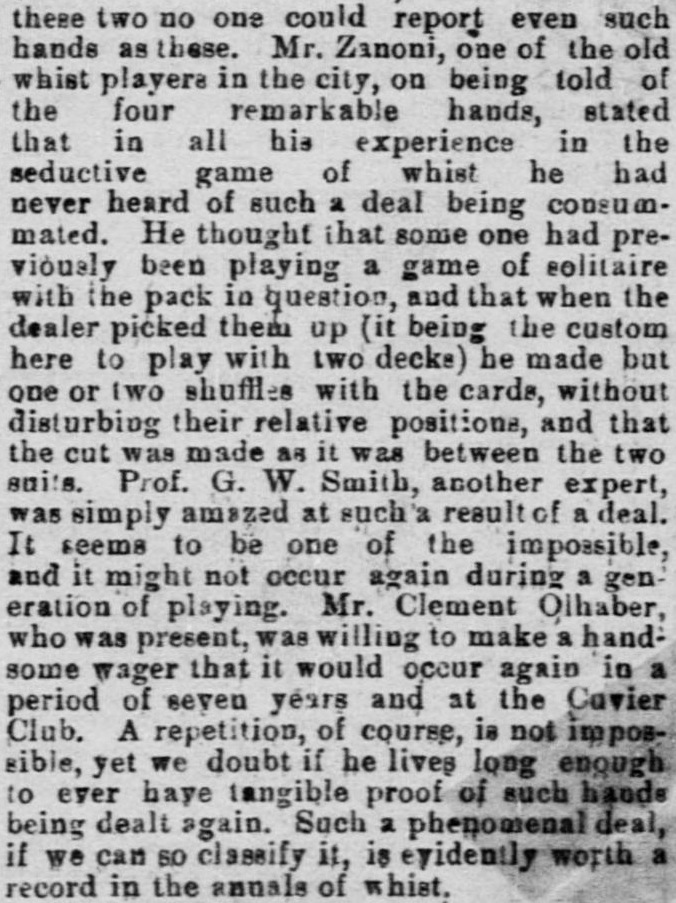
The end of the Commercial’s story: the solitaire guess and the seven-year bet. Memphis Daily Appeal, Memphis, Tennessee, November 28, 1882, page 4. Library of Congress, Chronicling America. Click the clipping to read it full size.
Too good to be true
The story of the Cincinnati card deal traveled fast. Within days it was in two papers in Memphis, Tennessee. Then it ran in Washington, D.C., and by January 1883 a London paper had told it. Plenty of people did not believe it. A Cincinnati paper said “considerable doubt was expressed as to the fairness and squareness of the deal.” So many letters came that the club thought it best “to present the facts in such a form as to constitute a record,” a member named G. W. Smith wrote.
Five men and a Cincinnati judge
On January 17, 1884, the four card players from the Cuvier Club went before Judge Judson Harmon of the Superior Court of Cincinnati and swore to their hands. They had played, their sworn paper said, “without any stake, and for no consideration except the pleasure of the play.” Nobody at the table knew what order the used packs were in. Webster split his pack in two and let the halves “fall within and upon each other, in a manner common with whist players.” He did that “several times.” There was “no design, contrivance, or collusion,” and his shuffle and deal “were fair and without trick.”
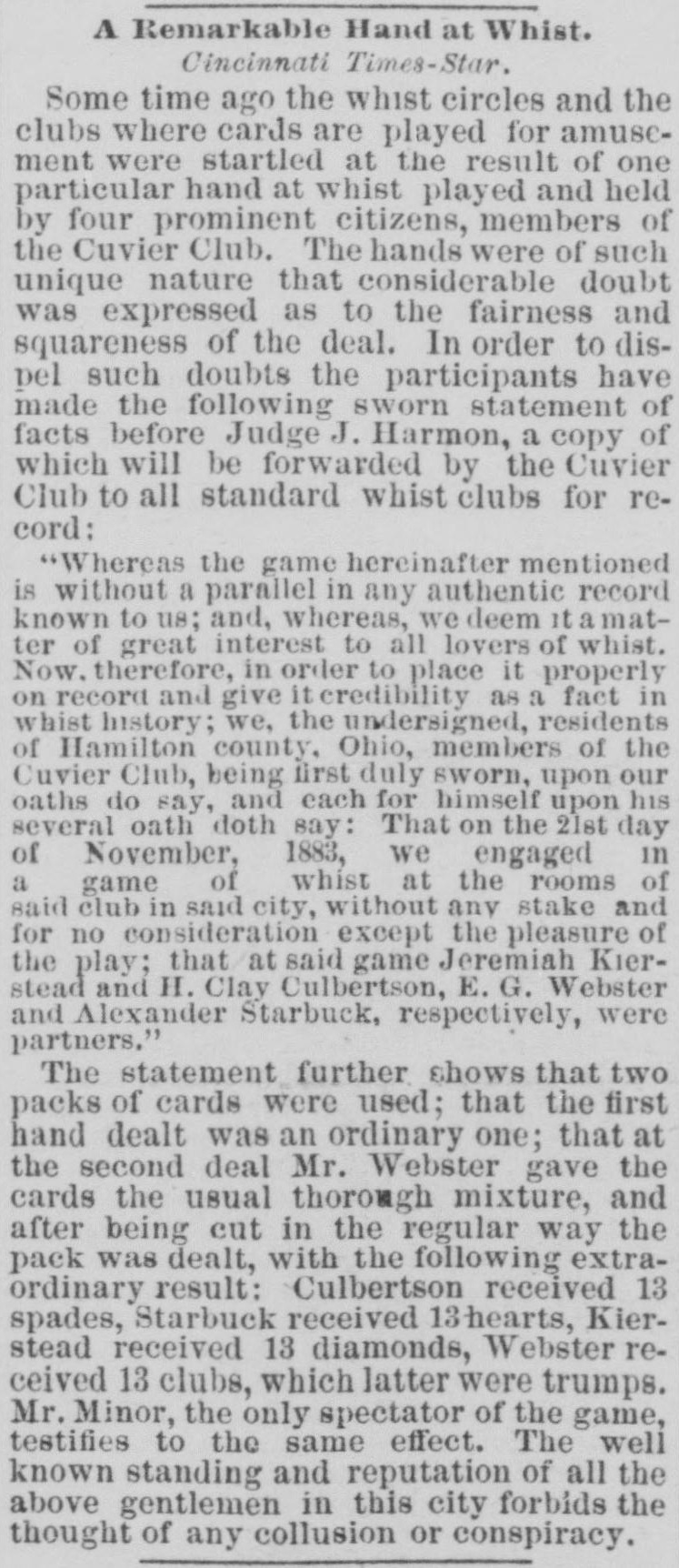
“A Remarkable Hand at Whist,” from the Cincinnati Times-Star. Savannah Morning News, Savannah, Georgia, March 20, 1884, page 2. This printing gives the year of the game as 1883. It was 1882. Library of Congress, Chronicling America. Click the clipping to read it full size.
A fifth man swore too. George G. Minor was the only other person present that afternoon, and he had been “at another table playing solitaire.” When the players called him over, he “saw in the hands of each thirteen cards of a suit.” The sworn paper puts the game on November 21, two days before the day the Commercial gave.
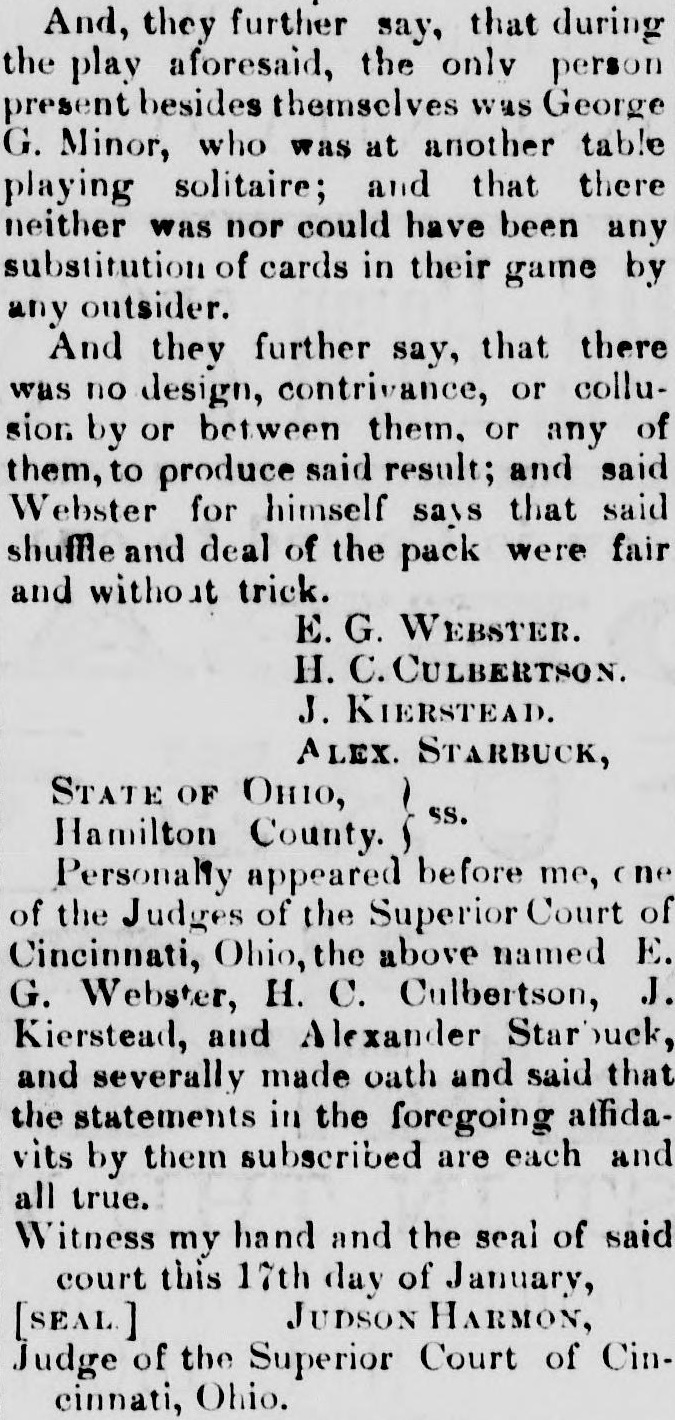
Part of the sworn statement: the solitaire player, the four signatures and the judge. Wood River Times, Hailey, Idaho, April 21, 1884, page 2. Library of Congress, Chronicling America. Click the clipping to read it full size.
The club sent copies “to all standard whist clubs for record,” and by April newspapers had printed them as far away as Savannah, Georgia, and Hailey, Idaho. Judge Harmon went on to be Attorney General of the United States, from 1895 to 1897, and Governor of Ohio, from 1909 to 1913.
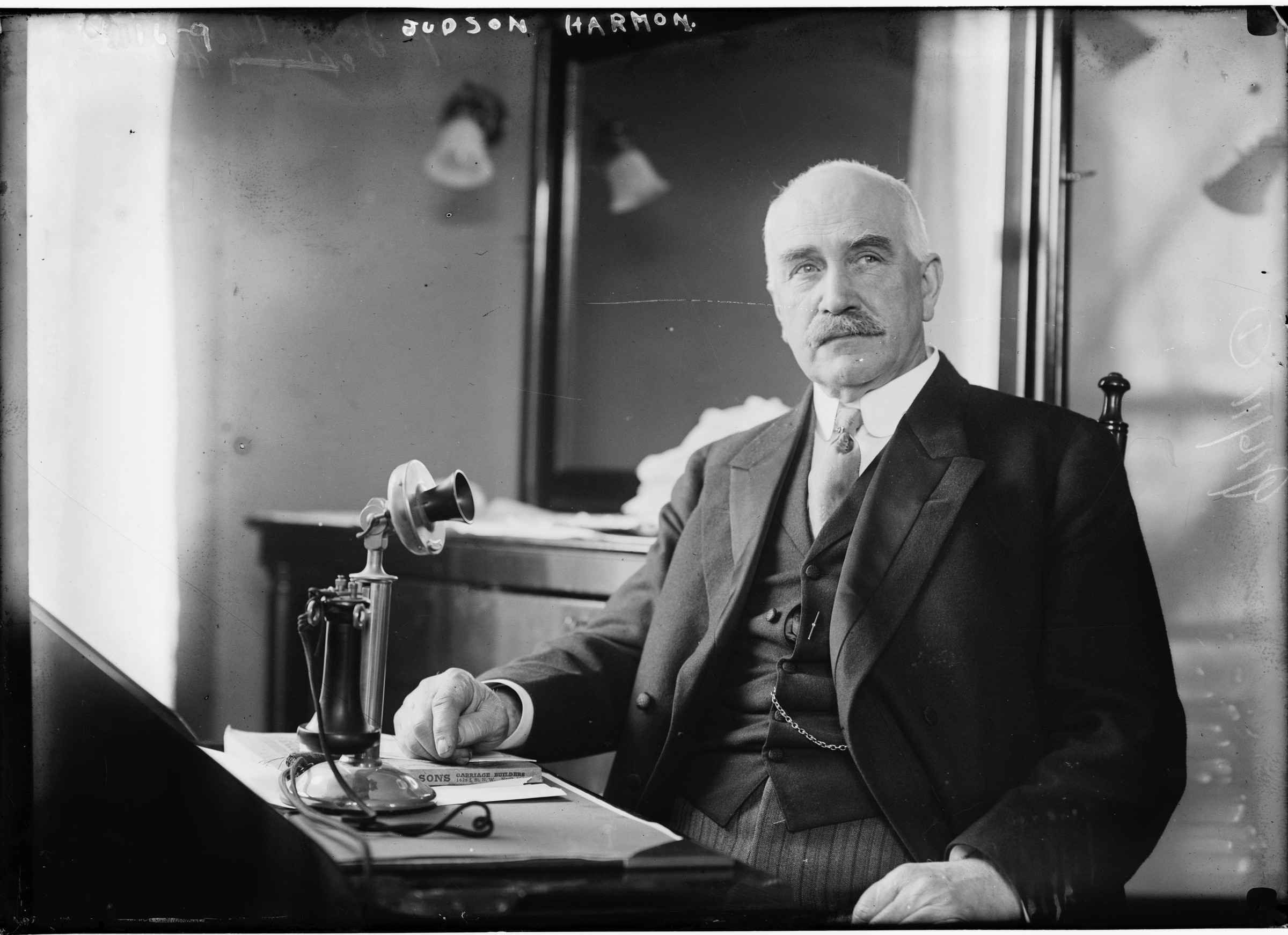
Judson Harmon at his desk, in an undated Bain News Service photo taken years after he heard the card players’ oaths. Library of Congress. Click the picture to see it full size.
Luck, or a neat shuffle
By luck alone, the Cincinnati deal of 1882 is almost beyond belief. There are 53,644,737,765,488,792,839,237,440,000 ways to deal a pack of cards to four players. Only 24 of them give every player one whole suit. That is about one chance in two octillion, a 2 with 27 zeros after it.
Old Mr. Zanoni’s idea needs no luck at all. Start with a pack sorted by suit, the way a finished game of solitaire can leave it. Split it exactly in half and weave the halves together, one card from the left, then one from the right. Do it twice. Now every fourth card is the same suit. Cut the pack anywhere and deal four hands, and each player gets one whole suit, every time.
Nobody can say that is what happened at the Cuvier Club. The four men swore they did not know how the cards lay in that drawer, and Webster swore his shuffle was fair. Both things can be true. A fair shuffle is not always a thorough one.
Mr. Olhaber’s bet
Clement Olhaber, the Cuvier Club member in Cincinnati, had offered to bet it would happen again within seven years. In October 1889, six years and ten months later, a report from the Philadelphia Record told of “the remarkable whist hands held at a table in the Hamilton club recently, when each player held a full suit.” It did not say what city that club was in. So Olhaber was half right. It came around again inside his seven years, just not at the Cuvier Club.
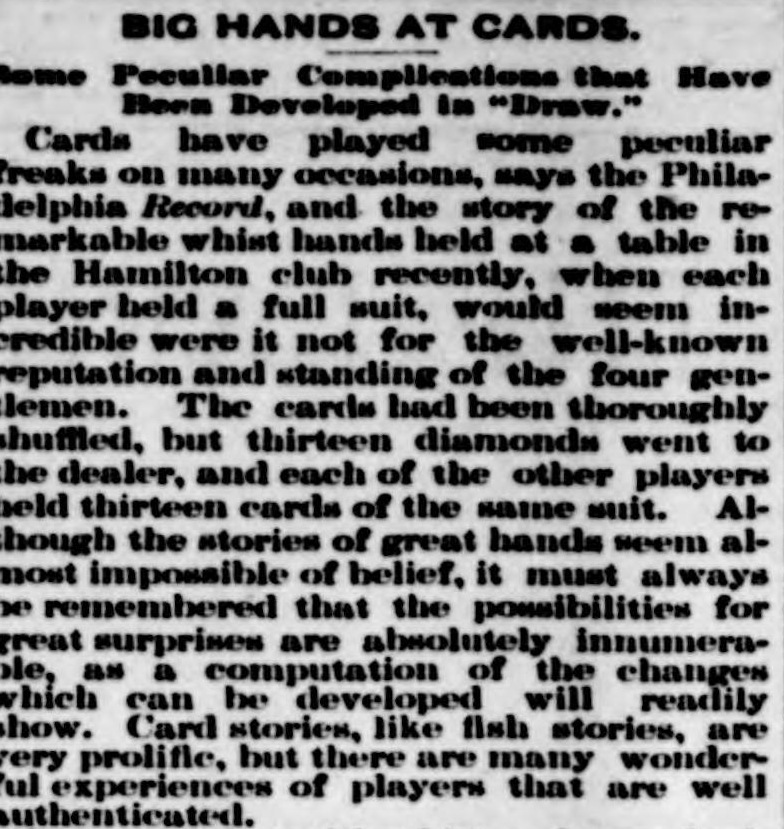
“Big Hands at Cards.” The Anaconda Standard, Anaconda, Montana, October 4, 1889, page 6. Library of Congress, Chronicling America. Click the clipping to read it full size.
The Record added a line that suits a club full of mounted fish. “Card stories, like fish stories, are very prolific,” it said, meaning there are a great many of them. The Cuvier Club kept its fish stuffed and behind glass, where anybody could count them. In January 1884 its card story got the same care. It was signed, sealed and sworn.
Sources
- Evening Star (Washington, D.C.): December 5, 1882, page 3 (“A Remarkable Deal in Whist,” from the Cincinnati Commercial of November 24).
- Memphis Daily Appeal (Memphis, Tennessee): November 28, 1882, page 4 (the Commercial’s whole story, with the solitaire guess and the bet).
- Public Ledger (Memphis, Tennessee): November 28, 1882, page 3 (the same story, printed the same day).
- The Indianapolis Journal (Indianapolis, Indiana): January 8, 1883, page 4 (the London Court Journal had told the story).
- Savannah Morning News (Savannah, Georgia): March 20, 1884, page 2 (“A Remarkable Hand at Whist,” from the Cincinnati Times-Star).
- Wood River Times (Hailey, Idaho): April 21, 1884, page 2 (“Unique Whist Hand,” G. W. Smith’s letter and the sworn statements).
- The Anaconda Standard (Anaconda, Montana): October 4, 1889, page 6 (“Big Hands at Cards,” from the Philadelphia Record).
- King’s Pocket-book of Cincinnati (1879), the Cuvier Club entry, and D. J. Kenny, Illustrated Cincinnati (1875), page 93, both at the Internet Archive.
- Judson Harmon’s later offices: U.S. Department of Justice and the National Governors Association.
- Photos: “Judson Harmon seated at desk,” Bain News Service, Library of Congress. “Fourth St., west from Main, Cincinnati, Ohio,” Detroit Publishing Co., about 1907, Library of Congress. Both: no known restrictions on publication.
- The card arithmetic is our own: 52 cards, 13 to each of four players, checked by computer.
- All newspaper images: Library of Congress, Chronicling America. Published 1882 to 1889.
- Cover: “The Whist party,” a stereograph card published by George Stacy, New York, between 1861 and 1866, Library of Congress, no known restrictions on publication. It is a staged scene of two men and two women, made about twenty years before the Cincinnati game.