On Tuesday, August 9, 1927, the roads into Hope, Arkansas, were jammed with cars long before the sun came up. Special trains brought hundreds more people. In all, about 25,000 visitors “from every part of Arkansas and from other states” had squeezed into town.
Bands from 11 cities played. Seventy-five decorated floats rolled slowly through the streets. People packed every inch of sidewalk and filled every window. The small boys “clung to precarious perches on window coping and lamp posts.” (Precarious means wobbly and risky. Coping is the stone ledge around a window.)
The whole party was for watermelons. Hope said it grew the biggest watermelons in the world, and its farmers had the scales to prove it.
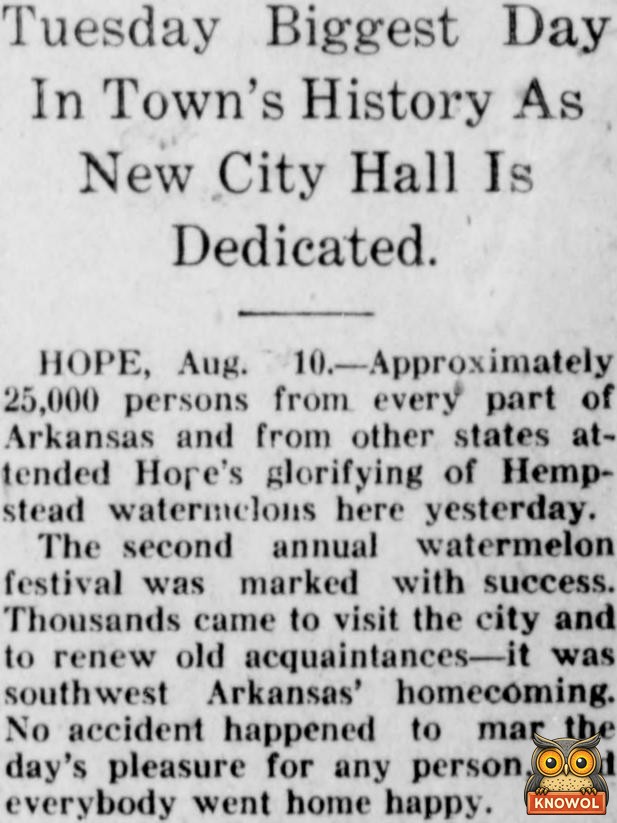
“Tuesday Biggest Day In Town’s History As New City Hall Is Dedicated.” Washington Telegraph, Washington, Arkansas, August 12, 1927, page 1. Library of Congress, Chronicling America. Click the clipping to read it full size.
The farmer who weighed his melons every day
The giant melon story starts with two brothers, Hugh and Edgar Laseter. They farmed near Hope.
In August 1925, a man named Sam Nutt carried two of Hugh’s melons to Fordyce, Arkansas. One weighed 78 pounds and was 33 inches long. The other weighed 101 pounds. A tape measure around its middle read five feet four inches. A newspaper there called Hugh “the state’s champion watermelon grower.” (That paper spelled his name Lester.)
Hugh had 10 acres of melons, and he had a system. The old way to tell if a melon was ripe was to thump it and listen. Hugh used a scale instead. “He weighs his large melons each day,” the paper said, “and when they stop gaining they are picked.”
One melon in his patch already weighed 128 pounds. It was still “gaining at the rate of two pounds a day.” Hugh was so sure of himself that he offered $50 for the seeds of any melon bigger than his.
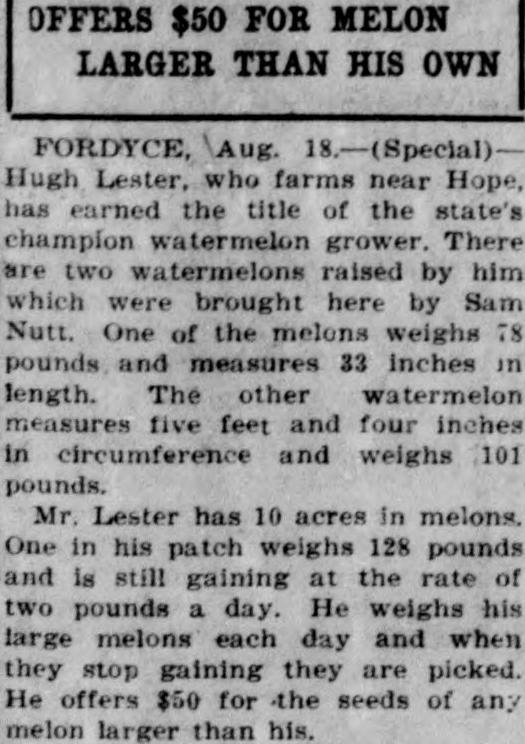
“Offers $50 For Melon Larger Than His Own.” El Dorado Daily News, El Dorado, Arkansas, August 19, 1925, page 1. Library of Congress, Chronicling America. Click the clipping to read it full size.
Where the giants went
A giant like that was too special to just eat. Edgar grew one that weighed 114 1/2 pounds. It went to Little Rock, Arkansas, the state capital, to the man in charge of farming for the whole state. There it got “special preserving treatment,” so it could stay on display with the state’s farm exhibits for good.
Edgar had a 125-pound melon, too. A 1925 report said it “will be sent to President Coolidge.” Five years later, another report said Hugh grew the biggest melon of 1925, at 136 pounds, and that “the 1925 champion was presented to President Coolidge.” The papers don’t agree on which melon he got. Either way, a giant from Hope went to the president.
By 1930, more than 500 prize melons over 100 pounds each were “crated up and expressed to every state in the union” every year. (Expressed means shipped fast by train.)
It started in a drugstore
It all began with John S. Gibson, who ran a drugstore in Hope. Around 1910, he ordered some carefully chosen watermelon seeds and started telling local farmers to grow melons to sell.
That was a hard sell. Farmers in Hempstead County grew fine cotton that sold as far away as Liverpool, England. But around 1920, melon shipments took off. By 1930, the county sent more than 500 carloads of melons north every year. A carload is one railroad boxcar, packed full.
A festival for a 143-pound melon
In 1926, Edgar grew a melon that weighed 143 pounds. Hope celebrated by starting its very first watermelon festival.
That summer, Hope also shipped a whole carload of melons to Fayetteville, Arkansas. Every melon weighed 40 pounds or more. They were free treats for visitors to Farmers’ Week at the University of Arkansas. The melons rode in a refrigerator car, a railroad car kept cold with ice. The festival’s secretary said that “a tracer will follow it through,” so the car wouldn’t get lost or held up on the way.
By the second festival in 1927, Hope had a plan for eating all those melons. A man named Cornelius was “chairman of the Armed Brigade.” He said he had “100 armed volunteers, with their knives, ready to carve the several odd car loads of melons that are being iced.” A newspaper in Arkadelphia, Arkansas, joked that it only needed one of Hope’s famous 100-pounders and “a convenient stump.” Then it could promise a stomachache.
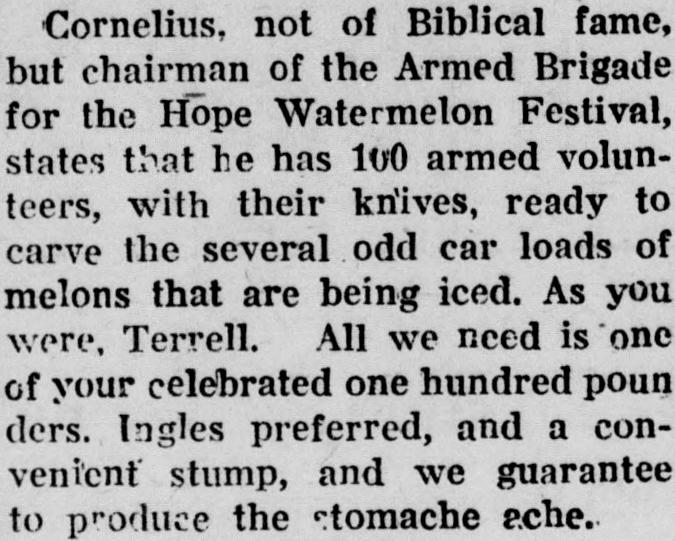
The “Armed Brigade” gets ready for the Hope Watermelon Festival. The Siftings Herald, Arkadelphia, Arkansas, August 6, 1927, page 2. Library of Congress, Chronicling America. Click the clipping to read it full size.
The 152-pound champion
Edgar’s best year was 1929. His champion weighed 152 pounds, about as much as a grown man. From the same family of seeds, he grew 15 melons in one patch that together weighed more than a ton. A ton is 2,000 pounds. At least 10 of those melons topped 130 pounds each, and six beat 140.
Edgar died in October 1929, soon after he showed off his record melon. A newspaper photo shows Miss Iva Hipp of the Hope Chamber of Commerce, a club of local business people, leaning over the giant with a long knife. The number on its rind reads 152 1/2.
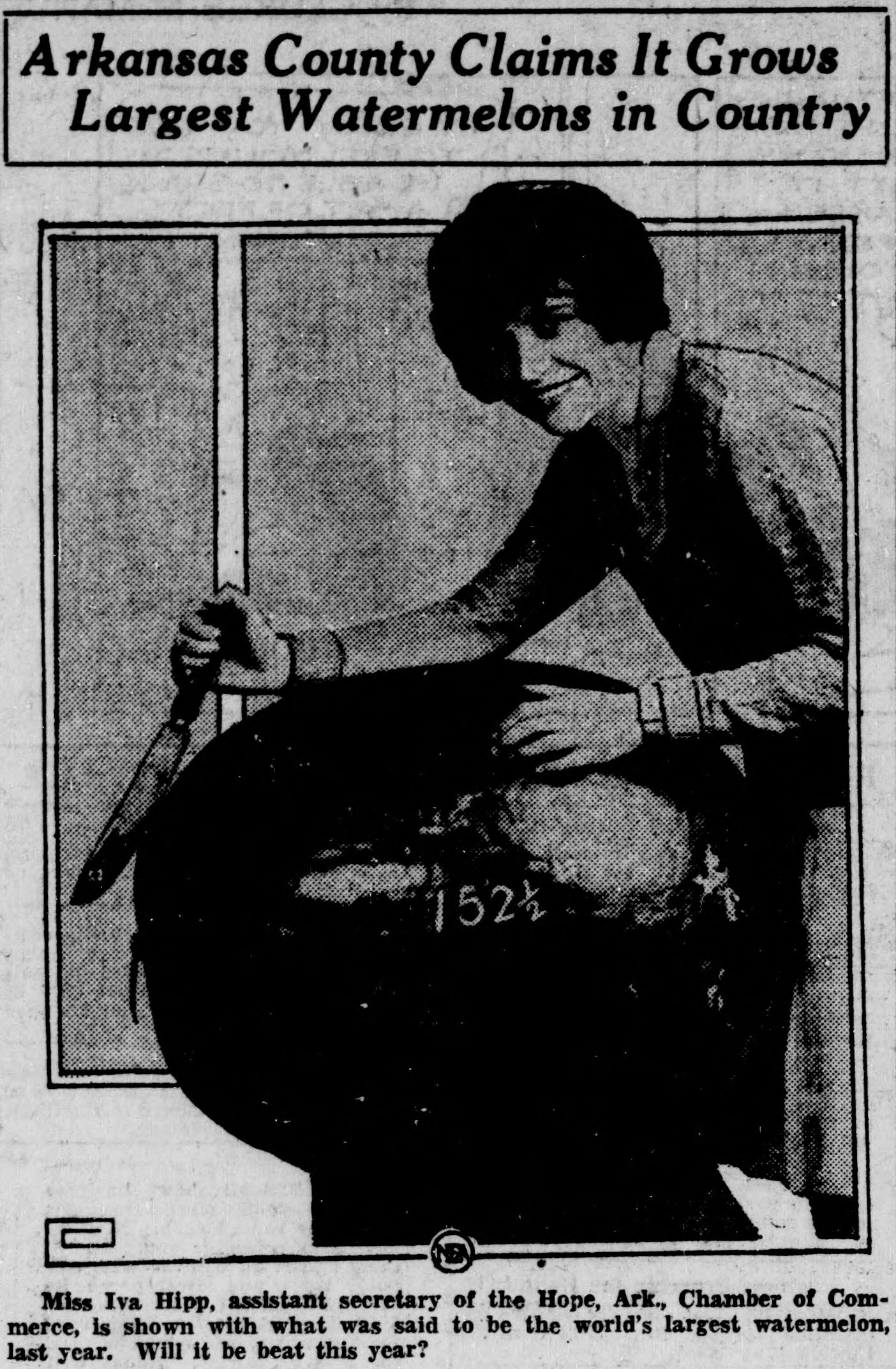
Miss Iva Hipp of the Hope Chamber of Commerce with “what was said to be the world’s largest watermelon,” grown in 1929. NEA Service, in the South Bend News-Times, South Bend, Indiana, August 4, 1930, page 12. Library of Congress, Chronicling America. Click the clipping to read it full size.
How to grow a giant
The champions were all Triumphs, a round kind of melon. The secret, one reporter wrote, was “merely in seed and care.” When a farmer spotted a “prospective big fellow,” he set it up on straw “to protect its hide from the ground.” Then he shaded it with newspapers. He watered the plants, but only a little.
In the old days, some farmers tried a trick. They split the vine and slipped in a wheat straw. The other end of the straw sat in a jug of water, so the melon could drink its way to extra weight. But those melons “were watery and unmarketable.” Nobody wanted to buy them.
In 1930, a reporter summed it up: “The world’s champion watermelon grower is dead, but the seed from his gigantic melons are multiplying in this garden spot of Arkansas.” That summer, Hope got ready for its fifth festival. The town still throws a watermelon festival every summer.
Fun extra: A giant garden at the fair
In October 1925, Arkansas got ready for a big fair in Little Rock. A state office planned an exhibit of the state’s farm products. On the list were “a 118-pound watermelon, a 23-pound cabbage a 12-pound turnip and a 16-pound sweet potato.” The report doesn’t say who grew them.
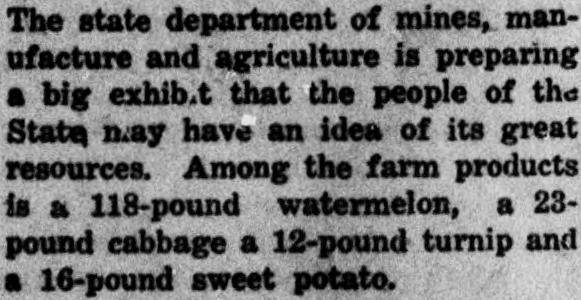
Giant farm products for the fair. Union Labor Bulletin, Little Rock, Arkansas, October 2, 1925, page 2. Library of Congress, Chronicling America. Click the clipping to read it full size.
Sources
- Washington Telegraph (Washington, Arkansas): August 12, 1927, page 1 (“Tuesday Biggest Day In Town’s History As New City Hall Is Dedicated,” datelined Hope, August 10).
- El Dorado Daily News (El Dorado, Arkansas): August 19, 1925, page 1 (“Offers $50 For Melon Larger Than His Own,” datelined Fordyce, August 18).
- Paris Express (Paris, Arkansas): September 24, 1925, page 6 (Little Rock item on the “biggest watermelon” contest).
- The Courier-Index (Marianna, Arkansas): July 29, 1926, page 4 (“Watermelon Feasts For Farmers’ Week”).
- The Siftings Herald (Arkadelphia, Arkansas): August 6, 1927, page 2.
- South Bend News-Times (South Bend, Indiana): August 4, 1930, page 12 (“Arkansas County Claims It Grows Largest Watermelons in Country,” NEA Service, datelined Hope).
- Union Labor Bulletin (Little Rock, Arkansas): October 2, 1925, page 2.
- All newspaper images: Library of Congress, Chronicling America. Published 1925 to 1930, public domain.
- Cover: “Watermelon time,” 1921, National Photo Company Collection, Library of Congress, no known restrictions.