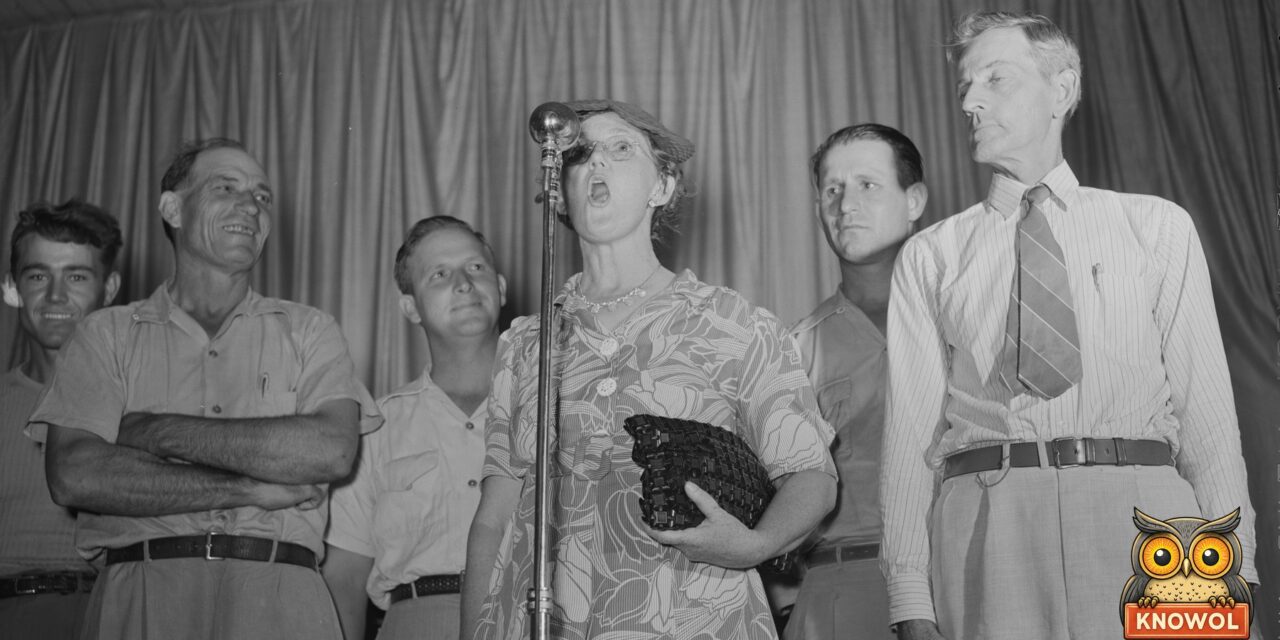
In September 1926, about 1,000 people in Madison, Nebraska, turned out to welcome home a farmer. The town’s brass band marched in front of him all the way to the center of town. Then he gave them a show.
Fred Patzel opened his mouth and let loose the “pooie” call. Just days before, that call had made him the world’s champion hog caller.
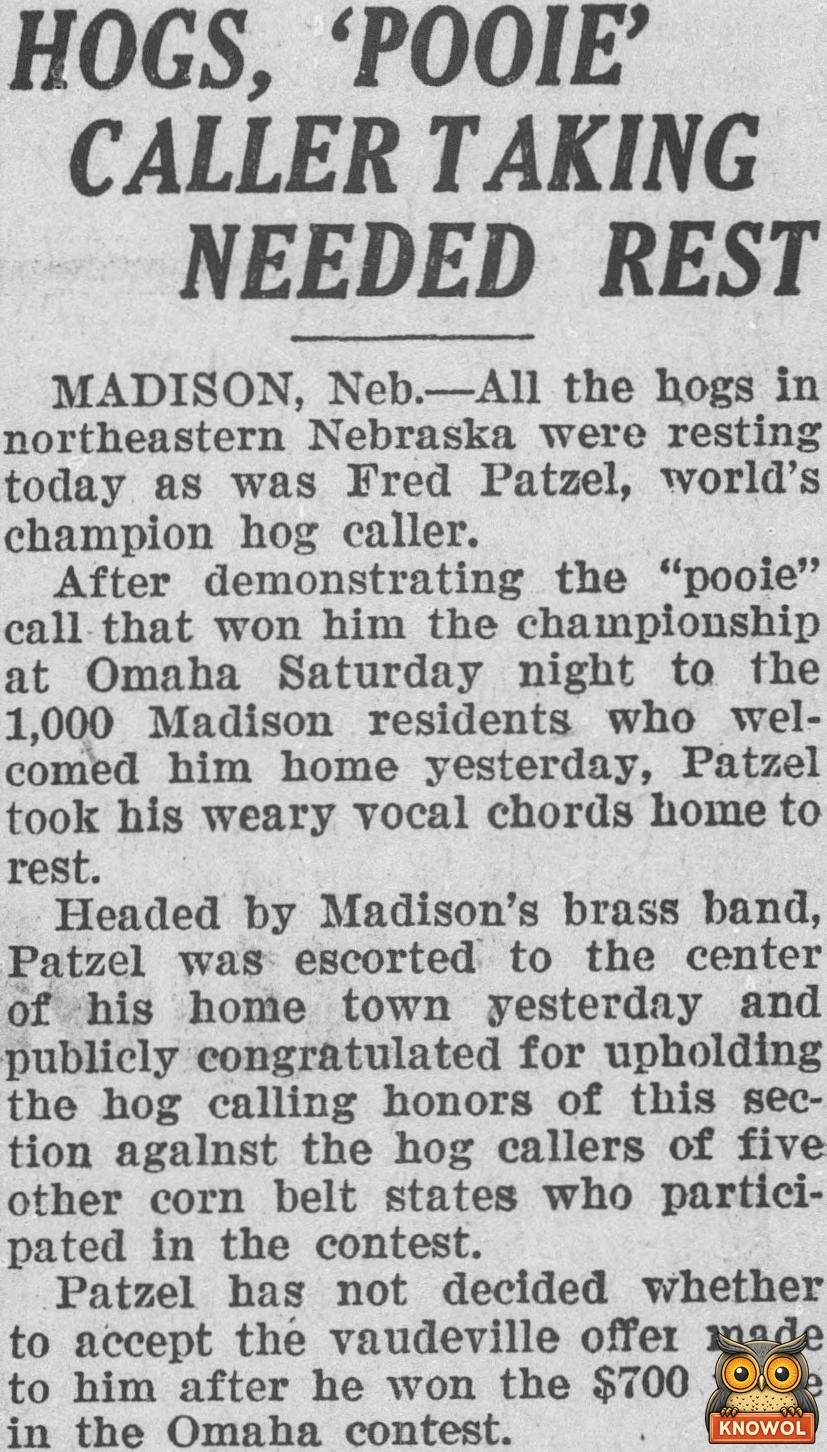
“Hogs, ‘Pooie’ Caller Taking Needed Rest.” The Milwaukee Leader, Milwaukee, Wisconsin, September 14, 1926, page 6. Library of Congress, Chronicling America. Click the clipping to read it full size.
Afterward, a news report said, “All the hogs in northeastern Nebraska were resting today as was Fred Patzel.” He took his “weary vocal chords” home to rest. (The paper meant vocal cords, the parts of your throat that make sound.)
How do you call a hog?
On many farms, hogs roamed the fields and woods. When it was time to eat, the farmer called them in. Every caller had his own sound, and the hogs learned it and came running.
In 1926, hog calling suddenly turned into a contest. Newspapers tried to spell the calls. One said the usual hog call was built around the word “Pigee.” For cattle it was “Sookie.” The best horse call was “Cope, cope, cope!”
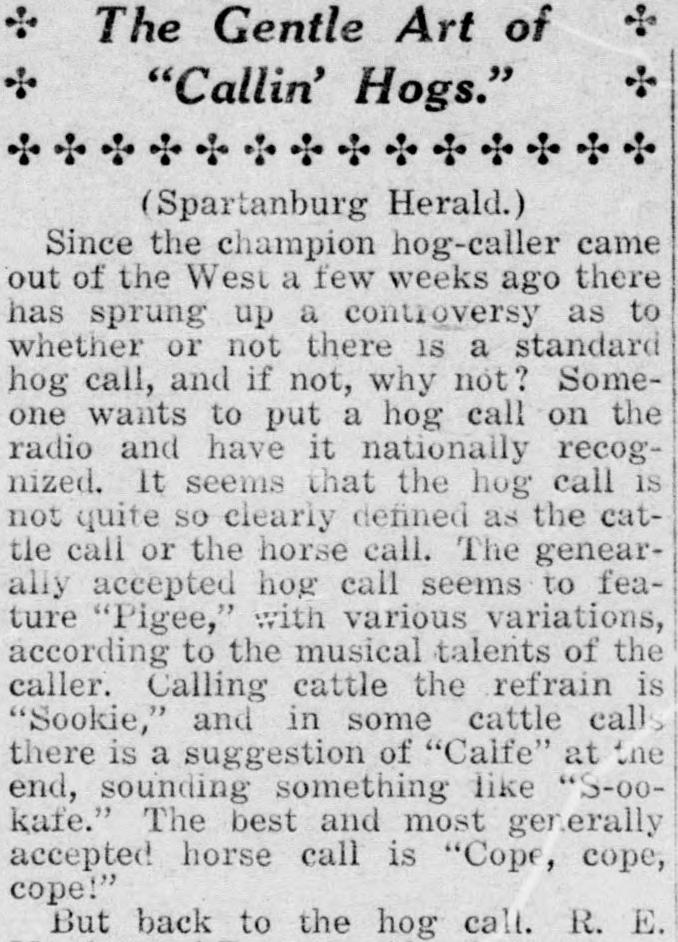
“The Gentle Art of ‘Callin’ Hogs.'” Keowee Courier, Walhalla, South Carolina, September 15, 1926, page 7, reprinted from the Spartanburg Herald. Library of Congress, Chronicling America. Click the clipping to read it full size.
Fred’s call was different. Papers spelled it “pooie,” “pooey” and “poogie-pooey.” One headline tried to show it getting longer and louder: “Poo-ee! Pooo-eee!! Poooo-eeee!!! Pooooo-eeeee!!!”
The man who almost started a stampede
Fred was a lean farmer, already the champion hog caller of Nebraska. That summer he showed off his voice in Omaha, Nebraska. Omaha had huge stockyards, the pens where farmers sold their animals. People asked him to stop, a Washington paper said, “for fear there would be a stampede among the 18,000 hogs in the stockyards, about a mile away.”
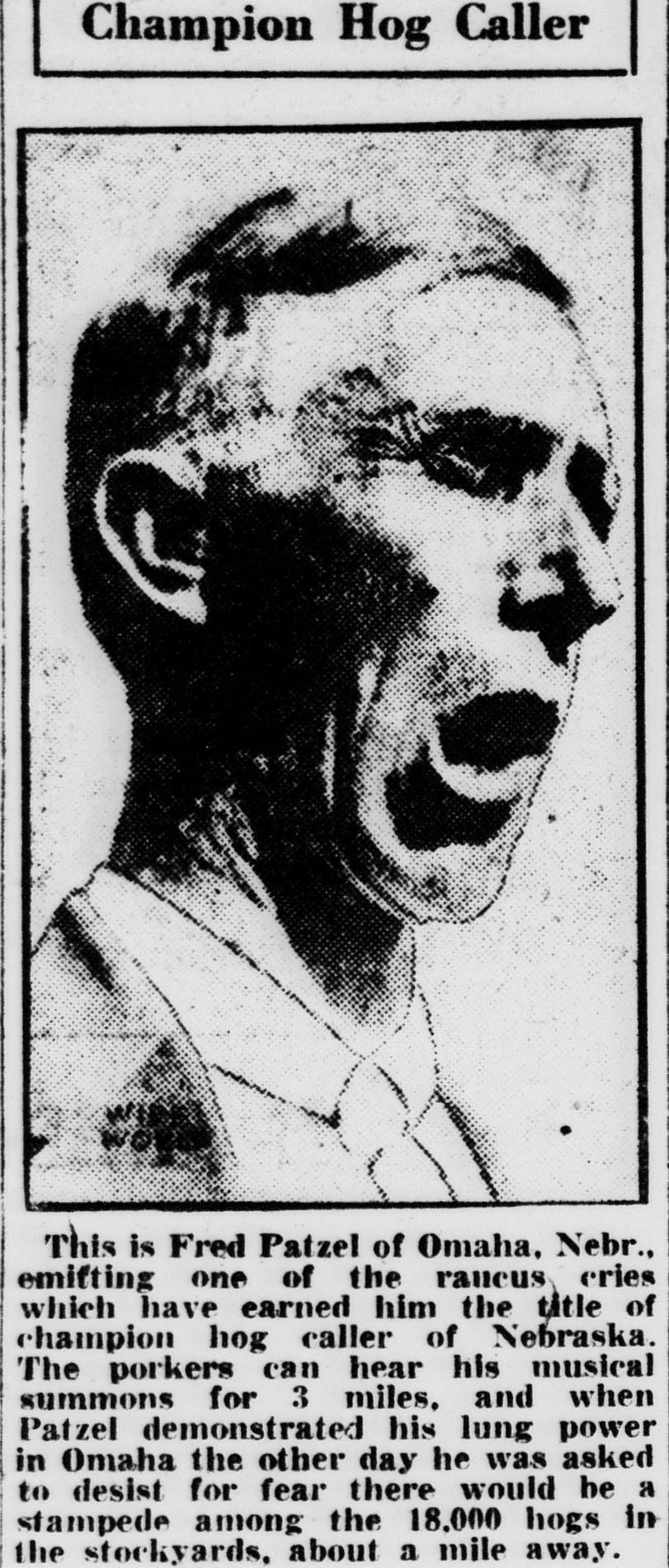
Fred Patzel calling. Evening Star, Washington, D.C., September 7, 1926, page 22. Library of Congress, Chronicling America. Click the clipping to read it full size.
How far did his voice carry? The papers didn’t agree. One said hogs could hear him 3 miles away. Another said two.
Fred said loud wasn’t enough. “You have got to have appeal, as well as power, in your voice,” he said. “You’ve got to convince the hogs you have something for them.”
The first world’s championship
In September 1926, Omaha held a radio show. Part of it was “the first world’s hog calling championship.” Champions came from Nebraska, Iowa, Illinois, Missouri and Minnesota. One paper called them “human dinner bells.”
There was one woman, Mrs. E. C. Warner of Norfolk, Nebraska. She said she would teach the men “something about this business of calling piggies to dinner.” Women kept at it, too. Years later, at a 1942 hog calling contest at the cotton carnival in Hayti, Missouri, a woman in a flowered dress stepped right up to the microphone and let loose.
Fred’s big rival was Hughie Henry from the stockyards in Kansas City, Missouri. Hughie used the Ozark call, “whoopeeee,” with a voice that “carries like a fog horn.” He also claimed an English ancestor, Sir Hugh Henry, who “called all hogs out of Palestine during the second crusade.” That was probably a joke.
On Thursday night, Fred led the first round with a score of 94 1/3. Friday was the semifinal. The final came on Saturday night, September 11.
The call that won
The contest was held inside a radio station. Fred started soft, a United News reporter wrote, “from far down in his diaphram.” (That’s the paper’s spelling of diaphragm, the muscle under your lungs that pushes out air.) Then the “pooey, pooey” got longer and louder, until it turned into “pooeeeey.”
“The very walls of the building trembled,” the reporter wrote. People “clapped hands to their ears.” Fred’s face turned purple. When he finished, he sat down, worn out.
Fred scored 562 points out of 600. Bob Warren of Waterloo, Nebraska, came in second with 515. Guy Bender of Alexander, Illinois, was third with 514. Hughie Henry didn’t win a cent.
Fred could barely talk. “As the score shows, I ain’t perfect,” he said in a husky, wheezing voice.
What he did with the prize
Fred won $700, and he knew what he wanted. He had two front teeth missing, and he planned to have a dentist fill the gaps with gold. He also hoped to buy “a few shoats,” which are young pigs, and a milk cow.
“You see I never got beyond the second grade in school,” he said, “and I’d like to do something to make it easier for the little woman and the kids on the farm.”
A vaudeville company offered him a job. Vaudeville was a traveling stage show with singers, comics and all kinds of acts. Fred said he’d rather take his money and go back to the farm.
A song for pigs
Fred had already gone to a studio and “had his summons set to music.” A newspaper feature printed his call as real sheet music, with the words “poo-ee” under the notes. It said his pigs knew “their F-sharp.” The caption said, “Try Fred’s music on your piano.”
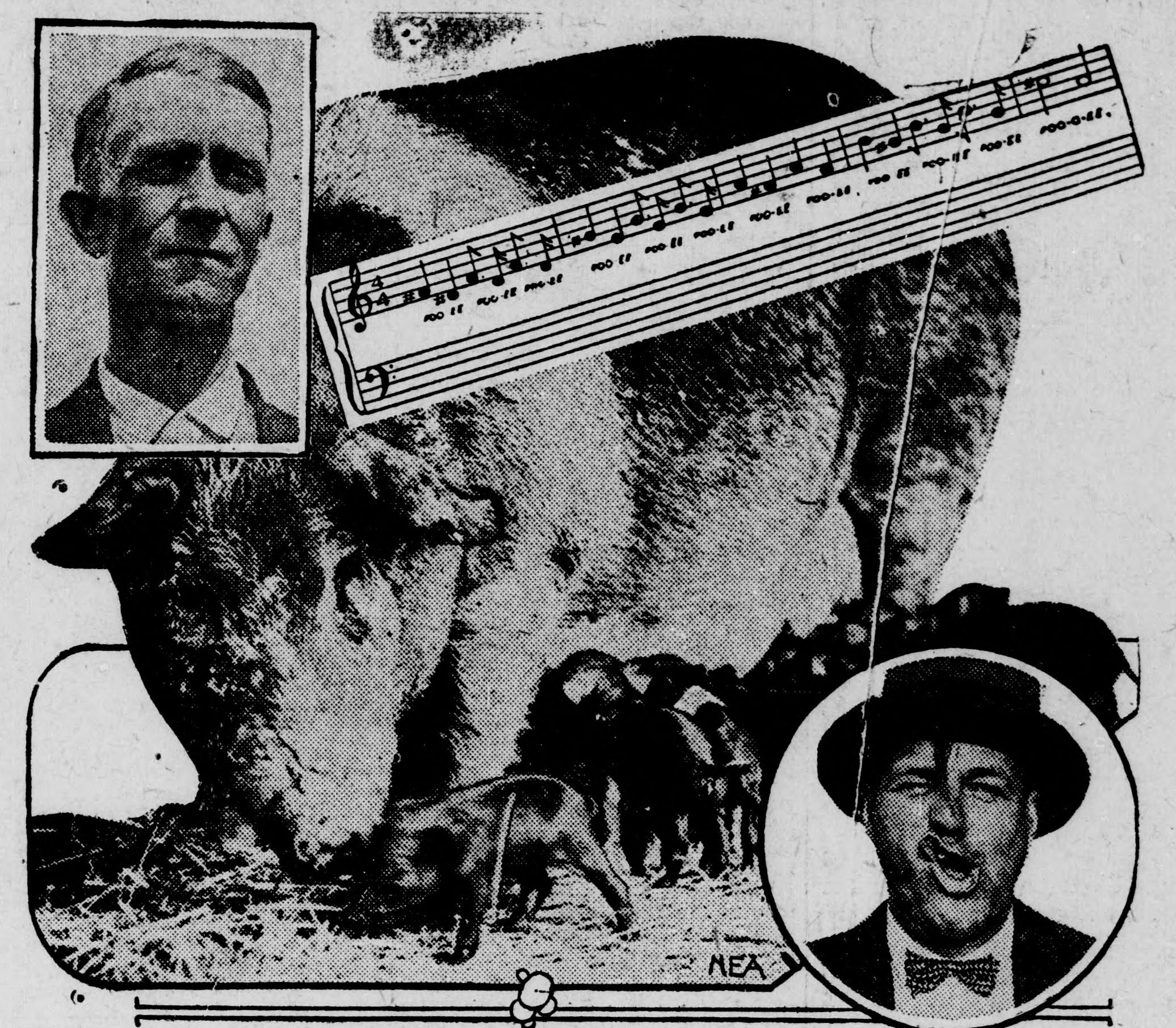
Fred Patzel (top left), his hog call written out as music, a mother pig named Bessie with her piglets, and Hughie Henry (bottom right). NEA Service, in the South Bend News-Times, South Bend, Indiana, September 11, 1926, page 19. Library of Congress, Chronicling America. Click the clipping to read it full size.
The champion goes to Washington
About a month later, Fred marched in a parade in Washington, D.C., with American Legion men from Nebraska. (The American Legion is a club for military veterans.) President Calvin Coolidge came out on the White House lawn to watch.
“There he is, Fred,” a marcher said. Fred looked at a policeman by the door and asked, “The feller in the uniform?” No, the man in the middle. “By golly, it’s him,” said Fred. “Looks just like his picture I got in a book at home.”
Fred loved the Capitol and the Washington Monument. The White House didn’t impress him much. “Looks more like a library than a house,” he said. “Must take a lot of coal to heat it.”
“I’m going to tell the wife and kids about this,” he said. Then he forgot the rest of his bag of apples at the foot of the Monument.
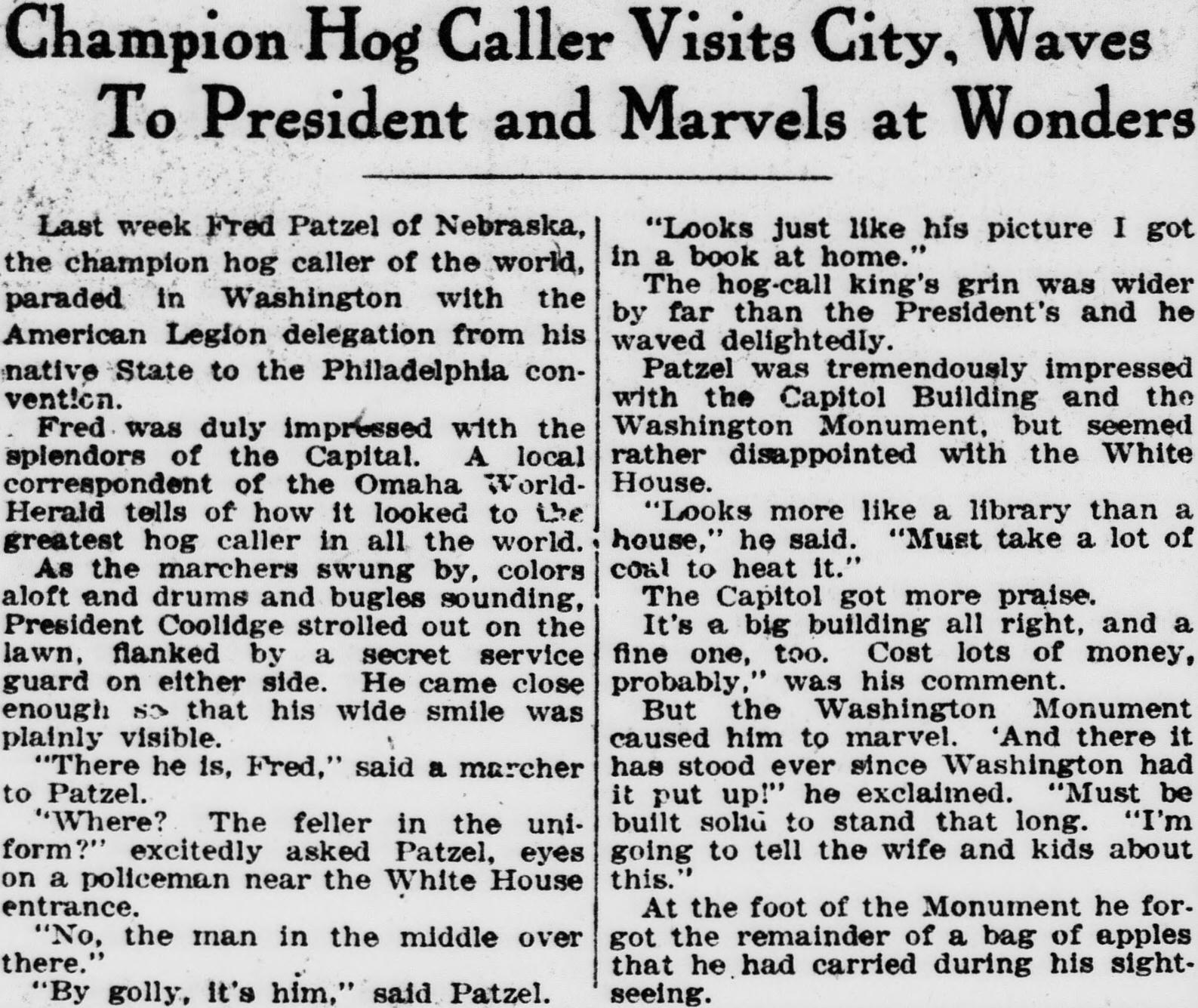
“Champion Hog Caller Visits City, Waves To President and Marvels at Wonders.” Evening Star, Washington, D.C., October 19, 1926, page 6. Library of Congress, Chronicling America. Click the clipping to read it full size.
Eight years later, Nebraska papers were still telling Fred stories. In 1934, one passed along a tale from another paper. It said one of Fred’s hog calls over radio station WJAG in Norfolk did about $500 worth of damage to the station’s equipment. The paper only said “a paper claims” it happened. But it was sure of one thing: “Fred is champion hog-persuader of the world.”
Sources
- The Milwaukee Leader (Milwaukee, Wisconsin): September 14, 1926, page 6 (“Hogs, ‘Pooie’ Caller Taking Needed Rest,” datelined Madison, Nebraska).
- South Bend News-Times (South Bend, Indiana): September 11, 1926, page 19 (NEA Service feature by W. M. Braucher), September 11, 1926, page 22 (“Hog Calling Tilt Becomes One Real Fight,” United News) and September 13, 1926, page 7 (“Fred Patzel Wins Hog Calling Title with Great ‘Pooey,'” United News).
- Evening Star (Washington, D.C.): September 7, 1926, page 22 and October 19, 1926, page 6.
- Keowee Courier (Walhalla, South Carolina): September 15, 1926, page 7 (“The Gentle Art of ‘Callin’ Hogs,'” from the Spartanburg Herald).
- The Thermopolis Independent (Thermopolis, Wyoming): September 10, 1926, page 8.
- The Frontier (O’Neill, Nebraska): May 31, 1934, page 2.
- All newspaper images: Library of Congress, Chronicling America. Published 1926, public domain.
- Cover: “Hayti, Missouri. Cotton carnival. Hog calling contest,” July 1942, U.S. Farm Security Administration/Office of War Information, Library of Congress, no known restrictions.