On the morning of Monday, August 8, 1910, about 400 people filled the auditorium of the Colorado School for the Deaf and Blind in Colorado Springs, Colorado. Nearly all of them were deaf. The Rev. J. W. Michaels opened the meeting with the Doxology, a short hymn of praise, with “all present joining in concerted signs.” Hundreds of hands moved together.
Then a woman from Seattle stood up. Agatha Tiegel Hanson “rendered in signs ‘America,'” the official record says, while Prof. A. L. Bohrer of the school’s Blind Department played the organ. Most of the room could not hear a note of the music. They didn’t need to. They could see the song.
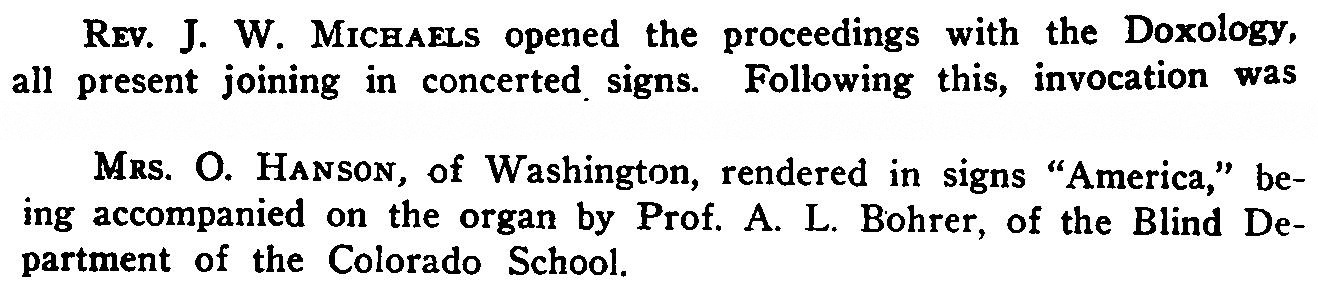
The Doxology and “America” in signs. Official record of the 1910 convention, pages 8 and 9. Internet Archive, public domain. Click the clipping to read it full size.
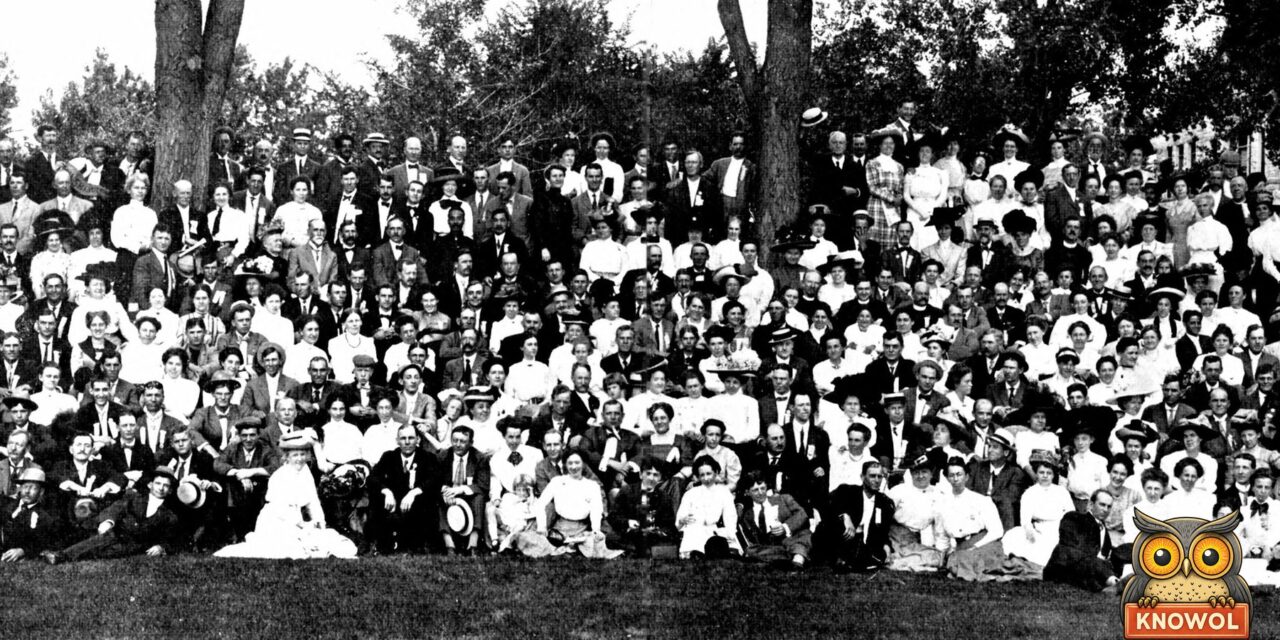
This was the opening of a week-long meeting, the ninth convention of the National Association of the Deaf and the third World’s Congress of the Deaf. Afterward, everyone went out to the terrace in front of the school to be photographed by A. L. Pach of New York, the official photographer. That picture is at the top of this page.
Under all the speeches and parties that week was one big worry. Deaf people feared their own language could be pushed out of the schools. That week they raised money to save it with a brand-new machine: the movie camera.
From Smiles to Interest in Colorado Springs
The Colorado Springs Gazette put the deaf visitors on its front page that Monday. One headline counted “Fully 500 Representatives From England, Canada, Austria, China and U. S.” Like most papers of its day, the Gazette used some old words for deaf people that nobody uses now.
Tourists and townspeople had been “somewhat inclined to smile at the lightning-like and strange gestures,” the paper said. But a look at what the visitors had done, and at their plans for the week, “turns the casual smiles to sympathetic interest.”
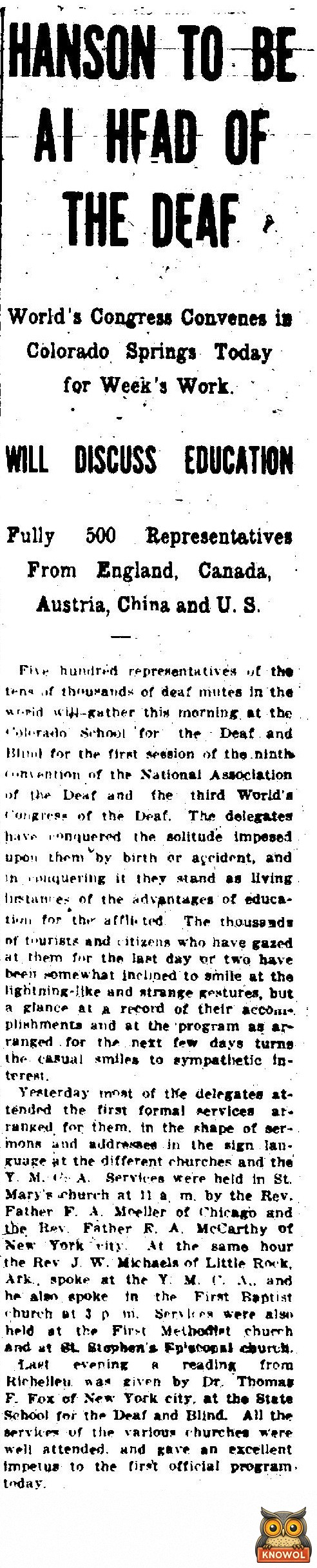
The Gazette’s front-page story on the opening day. The Colorado Springs Gazette, Colorado Springs, Colorado, August 8, 1910, page 1. Internet Archive, public domain. Click the clipping to read it full size.
The day before, the visitors had gone to church all over town. There were “sermons and addresses in the sign language” at four churches and the Y. M. C. A. A wire story that ran as far away as Salem, Oregon, said there was “not a sound arising from the gesticulating worshippers.”
Who Was Agatha Tiegel Hanson?
Agatha Tiegel Hanson, the woman who signed “America” in Colorado Springs, was already a pioneer. A 1911 story about her in The Silent Worker, a magazine for deaf readers, says she “lost her hearing at the age of seven and a half from spinal meningitis,” a serious illness. At barely 15 she entered Gallaudet College in Washington, D.C., a college for deaf students. She graduated at 19, “being the first woman to receive that degree from Gallaudet,” a Bachelor of Arts.
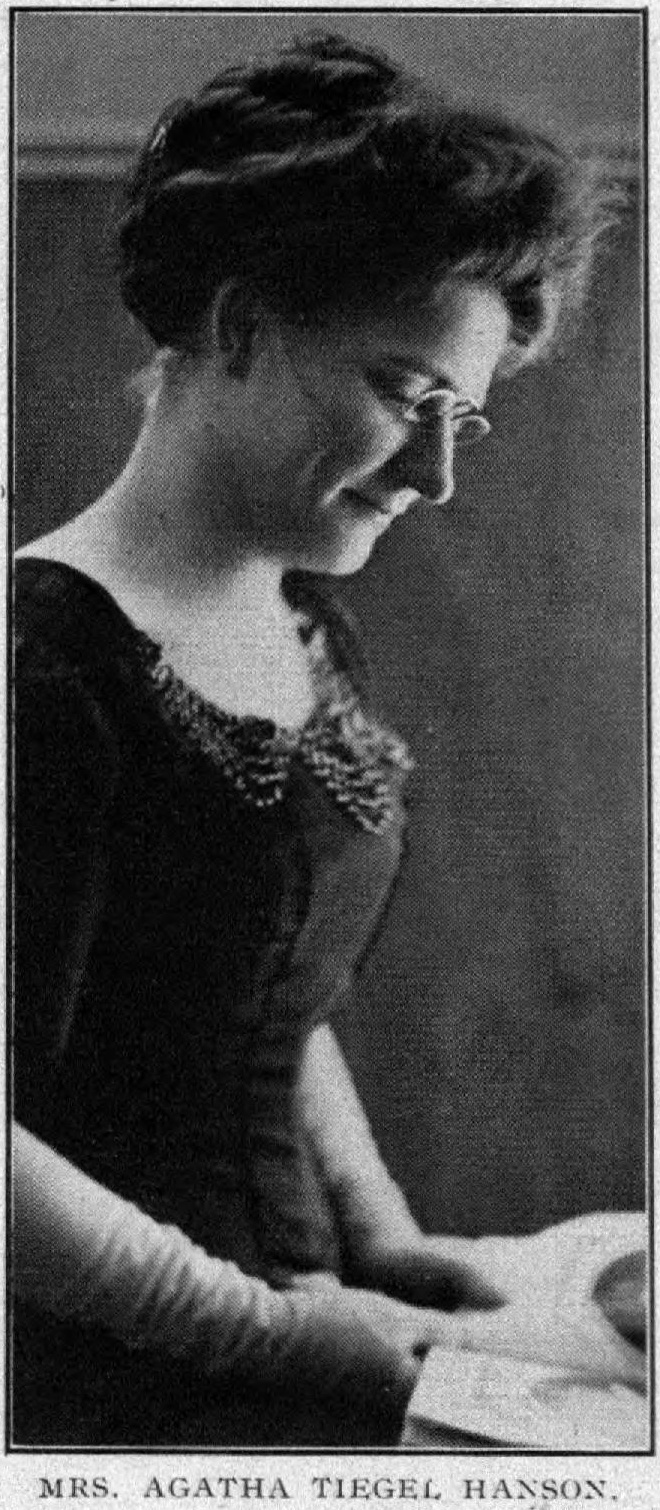
Agatha Tiegel Hanson, from The Silent Worker, June 1911, page 163. Internet Archive, public domain. Click the picture to see it full size.
She was a poet, too. At 15 she wrote a poem that begins, “Mine ears are wrapped in outward quiet, yet / My soul doth hear weird music from the glades.” In old poems, weird means strange and magical. A glade is a sunny opening in a forest. Later she married an architect, Olof Hanson, and moved to Seattle.
The Big Argument in Colorado Springs
George William Veditz ran the meeting in Colorado Springs, where he lived. He was the president of the National Association of the Deaf, and scarlet fever had taken his hearing when he was eight. On that first morning he said it was “the proudest moment of his life” to see the crowd. Then he gave his speech “in forceful and graphic signs,” while Percival Hall, the president of Gallaudet College, read it aloud.
Veditz had a fight on his hands. In 1910 many schools for deaf children taught only speech and lip-reading, and kept signs out of class. This was called the oral method. The association wanted the Combined System, “which adapts the method to the pupil, and not the pupil to the method.” Each child would learn in the way that worked best.
The most famous friend of the oral method was Alexander Graham Bell, the inventor of the telephone. Veditz had sent him the association’s plan, and he read Bell’s answer in his speech. “You advocate its use, and I do not,” he wrote about signs in the classroom. “I have nothing to urge against the use of this language by adult deaf persons in talking to one another if they so desire.” But children were different. “Our pupils come to us to learn English, not the sign language.”
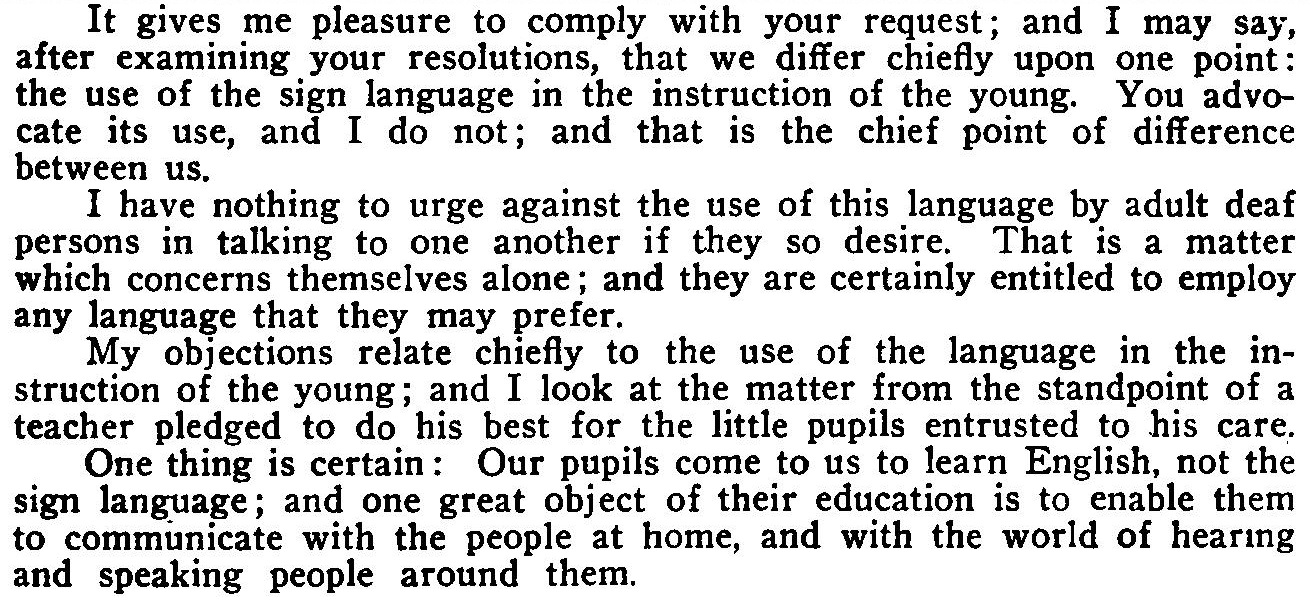
Alexander Graham Bell’s letter, read in George Veditz’s speech in Colorado Springs. Official record of the 1910 convention, page 29. Internet Archive, public domain. Click the clipping to read it full size.
Veditz called Bell’s answer “a confession of the failure of the oral method.” Deaf people, he said, are “first, last and all the time the people of the eye.”
Movie Night at the Colorado School
The deaf visitors in Colorado Springs spent Tuesday, August 9, on trips to “the wonderful scenic attractions in and around Colorado Springs.” That evening they came back to the school auditorium for a movie show. On the screen, Prof. William G. Jones signed Shakespeare’s “Seven Ages of Man” and “The Parson and the Monkey.”
English can be printed in a book. A sign language lives in moving hands and faces, and in 1910 no book could hold it. In his speech, Veditz had said the deaf were “now striving to fix and give a distinct literature of its own by means of the moving picture film.”
After the films, O. H. Regensburg, the treasurer of the Moving Picture Fund, gave a report. The money taken in over two days in Colorado Springs “amounted to over $1,800, bringing the total of the fund to date close to $4,000.” The record says the show proved what films could do “for the preservation of the sign language for the benefit of posterity.” Posterity means the people of the future.
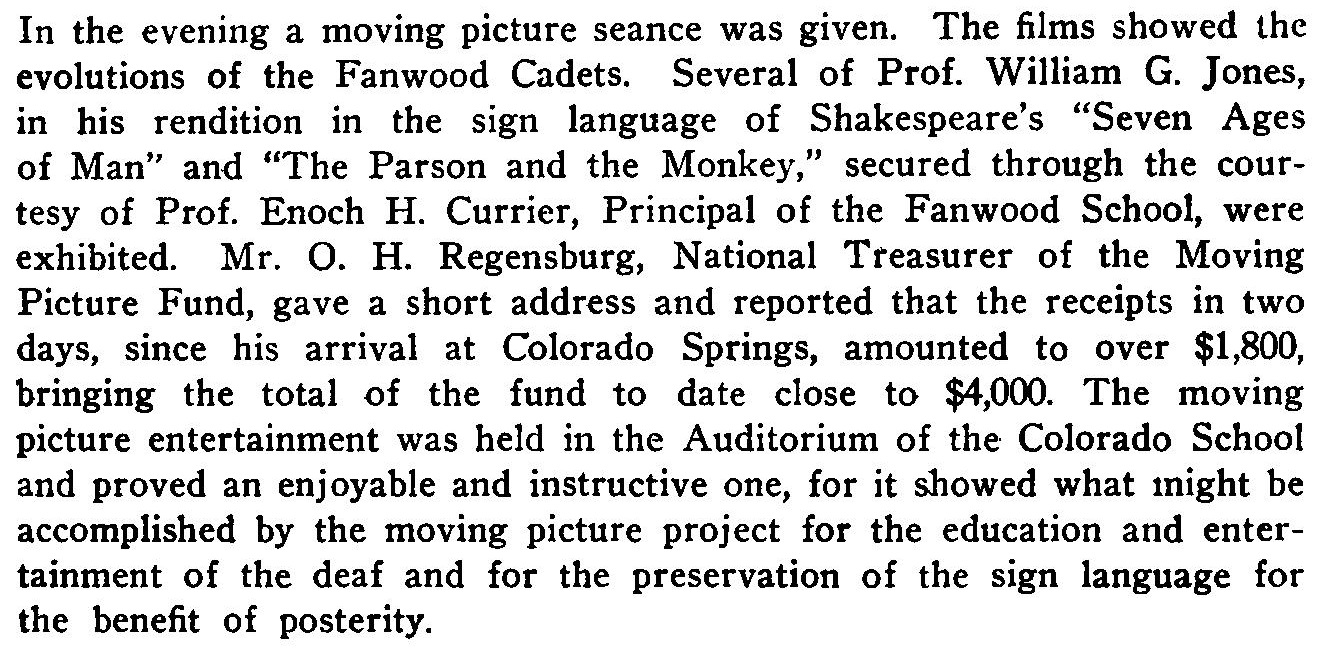
The movie night of August 9, 1910. Official record of the 1910 convention, page 32. Internet Archive, public domain. Click the clipping to read it full size.
That same day the Gazette said, “A $20,000 fund is now being collected by the deaf all over the United States.” On Friday night the visitors watched “a wrestling entertainment for the benefit of the Moving Picture Fund,” which the record calls “an exciting battle.”
Secrets and a Close Vote
The deaf women at the Colorado Springs meeting had a secret of their own. On Tuesday the Gazette said there would be a midnight meeting of “the order of ancient and awe-inspiring O. W. L. S.” Nobody would say what the letters stood for. The women in charge, the paper said, “have not deigned even to inform their own husbands.” Agatha Tiegel Hanson had helped start the O. W. L. S. as a society for women students at Gallaudet. That week she was elected secretary of its new national group.
On Saturday, August 13, the members chose a new president. The vote was close: 136 for Olof Hanson and 124 for Mr. Long. On the very first morning, the Gazette’s front page had guessed that Hanson would win. On closing day, the Silent Worker said, his wife signed “The Star Spangled Banner.”
Saving the Language on Film
The deaf Americans who met in Colorado Springs wanted their language saved for the future. Three years later, George Veditz stood in front of a movie camera in a dark suit and signed a speech called “The Preservation of the Sign Language.” The Library of Congress says he made the film for the association “specifically to record sign language for posterity.” He signed carefully, with big movements, so the camera would catch every word.
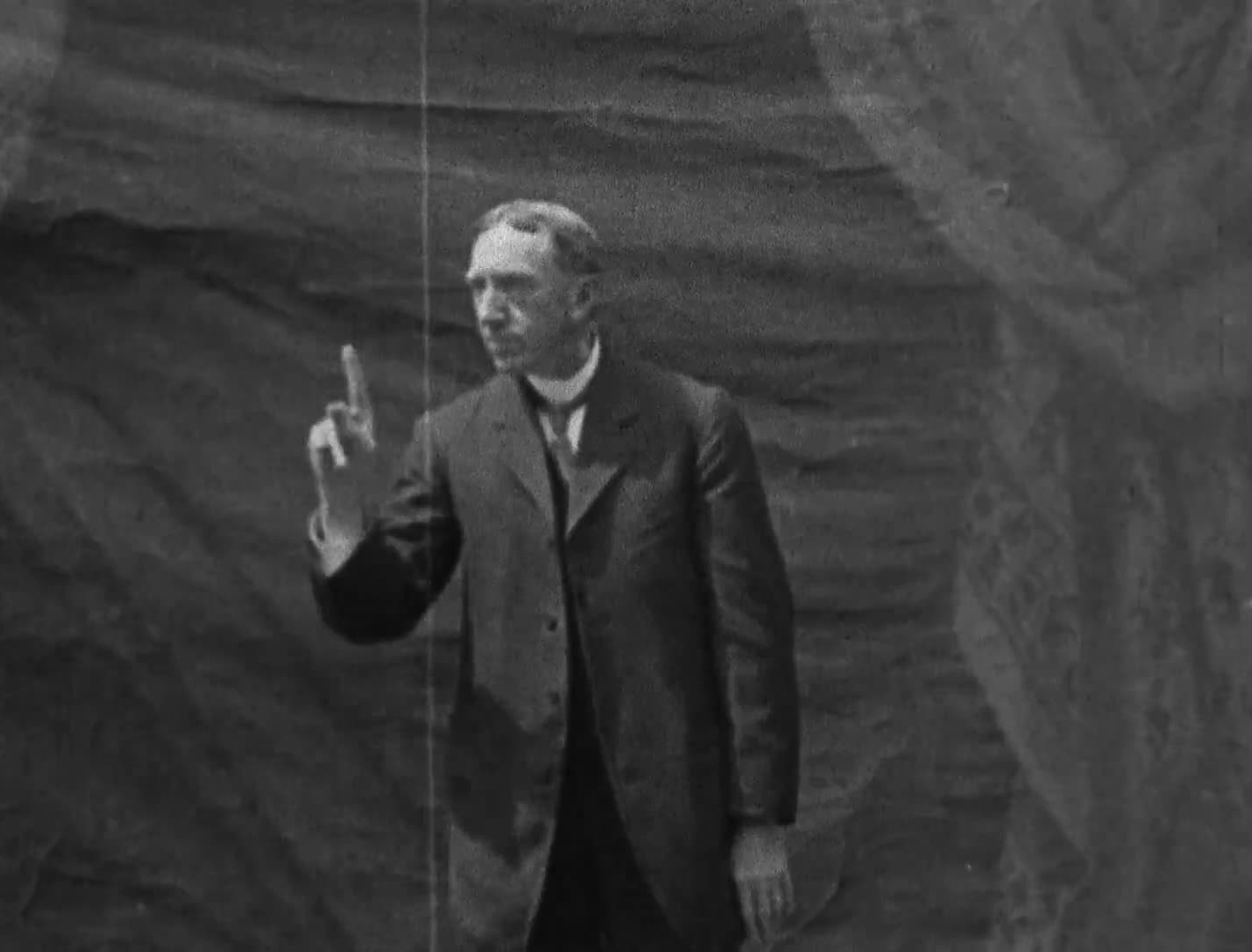
George William Veditz signing in “The Preservation of the Sign Language,” a 1913 film by the National Association of the Deaf. A frame from the Library of Congress copy. Click the picture to see it full size.
In 2010 the Library of Congress added the film to the National Film Registry, its list of American films to be saved for good. You can watch it free on the Library’s website. In 1910, a poet signed “America” in Colorado Springs to a room where most people could not hear the organ. In 1913, Veditz’s hands went on film. More than a hundred years later, they are still talking.
Sources
- “World’s Congress Convenes in Colorado Springs Today for Week’s Work,” The Colorado Springs Gazette (Colorado Springs, Colorado), August 8, 1910, page 1. Internet Archive.
- The films, the fund and the O. W. L. S., The Colorado Springs Gazette, August 9, 1910, page 7. Internet Archive.
- “A Quiet Congregation,” Daily Capital Journal (Salem, Oregon), August 8, 1910, page 4. Library of Congress, Chronicling America.
- “Proceedings of the Ninth Convention of the National Association of the Deaf and the Third World’s Congress of the Deaf, Colorado Springs, Colo., August 6 to 13, 1910,” printed 1912: the official photograph and pages 7 to 32, 77 and 80. Internet Archive, from the Gallaudet University Library.
- Augusta K. Barrett, story on Agatha Tiegel Hanson, The Silent Worker, June 1911, page 163. Internet Archive.
- “Preservation of the Sign Language,” George W. Veditz, 1913. Library of Congress.
- “Hollywood Blockbusters, Independent Films and Shorts Selected for 2010 National Film Registry,” December 28, 2010. Library of Congress.
- The newspapers, book, magazine and film were all published before 1931 and are in the public domain.