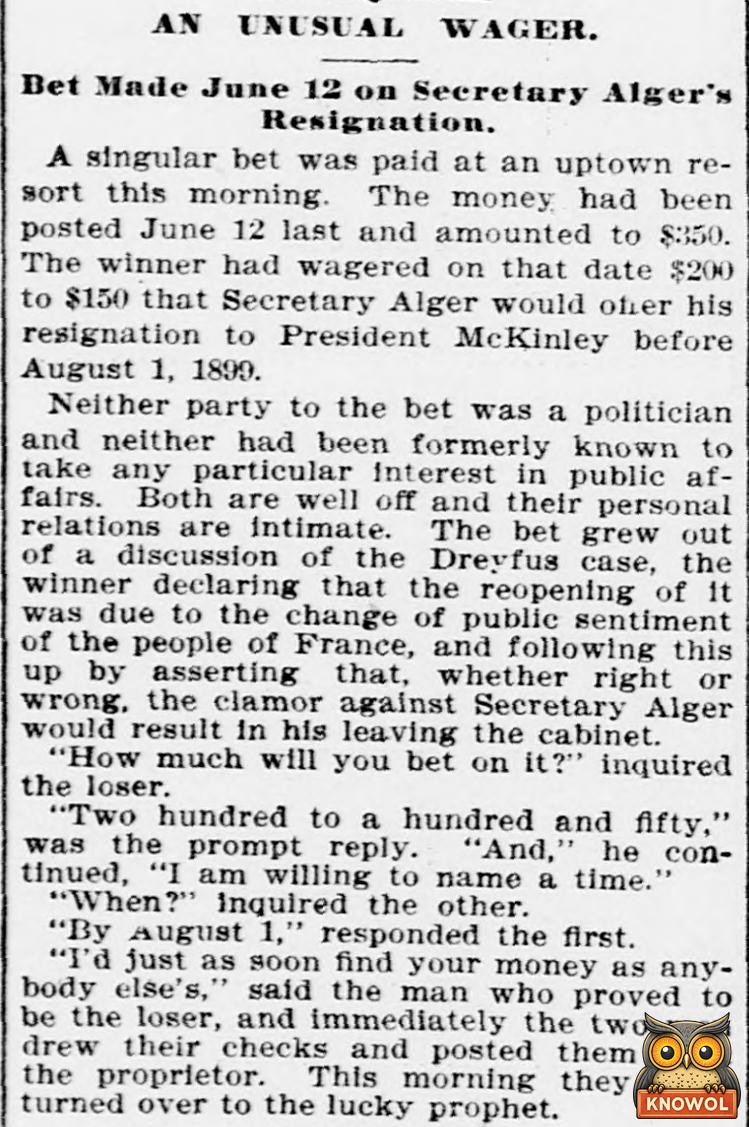
“An Unusual Wager.” Evening Star, Washington, D.C., July 20, 1899, page 12. Library of Congress, Chronicling America. Click the clipping to read it full size.
On the morning of Thursday, July 20, 1899, a man walked into a popular spot uptown in Washington, D.C., and the owner handed him two checks worth $350. He had won a bet he made more than five weeks earlier. He had bet his good friend that the Secretary of War, a member of the President’s cabinet, would quit his job before August 1. The day before, the Secretary did exactly that.
The Evening Star, Washington’s big afternoon paper, told the story that same day under the headline “An Unusual Wager.” It never printed the two men’s names. It only said that “neither party to the bet was a politician,” that “both are well off,” and that they were close friends. Two weeks later, the little story had traveled all the way to the Essex County Herald in Guildhall, Vermont, and to papers in other states.
How the Bet Started in Washington, D.C.
The two friends in Washington, D.C., were not even talking about American politics when the bet began. They were arguing about the Dreyfus case in France. Alfred Dreyfus was a French Army captain who had been sent to a prison island, called Devil’s Island, for a crime he did not commit. In early June 1899 his case was reopened, and the French government sent a navy cruiser to bring him home from the island.
The winner thought France had changed its mind because the people of France had changed theirs. Then he took the idea one step further, closer to home. Whether the complaints were fair or not, he said, “the clamor against Secretary Alger would result in his leaving the cabinet.” A clamor is a loud, angry noise, like a crowd that won’t stop shouting.
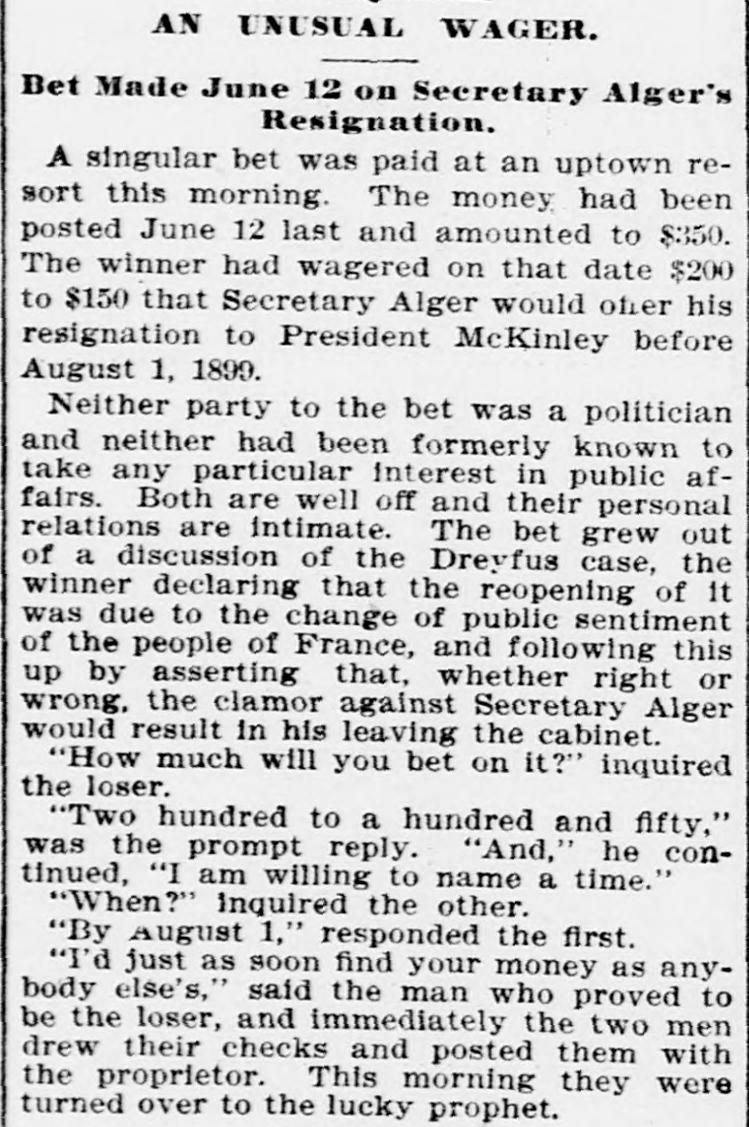
The whole story of the bet. Evening Star, Washington, D.C., July 20, 1899, page 12. Library of Congress, Chronicling America. Click the clipping to read it full size.
His friend didn’t believe it. “How much will you bet on it?” he asked.
“Two hundred to a hundred and fifty,” came the answer. That means the man who was sure Alger would go put up $200, and his friend put up only $150. He was so certain that he was willing to risk more money than he could win.
Then he made it even harder for himself. “I am willing to name a time,” he said.
“When?” asked his friend. “By August 1.” His friend took the bet on the spot. “I’d just as soon find your money as anybody else’s,” he said, which was a friendly way of saying he thought it was easy money.
Who Held the Money
The two men in Washington, D.C., did not just shake hands. They wrote out checks right there and gave them to the owner of the place, the person the paper called “the proprietor.” He was the stakeholder, someone both sides trusted to hold the money until the bet was settled. That way nobody could back out, and nobody could forget. The checks sat with him from June 12 until the morning the winner came to collect.
Secretary Alger, the Man in the Bet
Russell A. Alger was the Secretary of War, the man in charge of the United States Army. He was a former general from Michigan, and he had been in President William McKinley’s cabinet for more than two years. A cabinet is the President’s team of top helpers, each running one big part of the government.
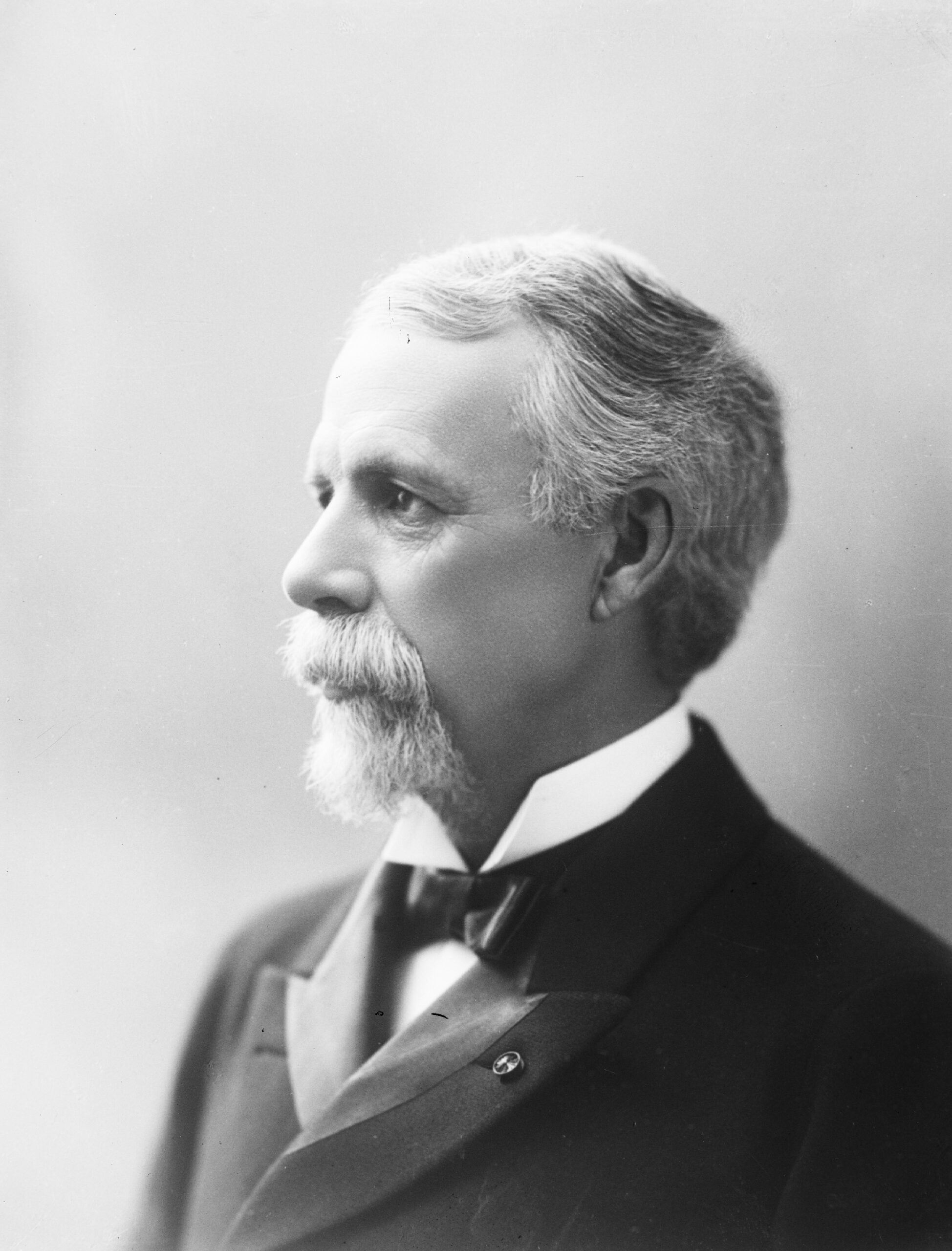
General Russell A. Alger, the Secretary of War in the bet. Detroit Publishing Co., Library of Congress. Click the picture to see it full size.
Those two years had been hard ones for Secretary Alger. In 1898 the United States fought a short war with Spain, and many people blamed the War Department for how the Army was supplied and cared for. One of the loudest complaints was about canned beef sent to the soldiers. A Montana paper that liked Alger called that complaint “such nonsense as ’embalmed beef.'” Embalmed means preserved with chemicals, so the nickname made the meat sound like something nobody should eat. Alger’s friends said the attacks were unfair. His enemies kept them coming.
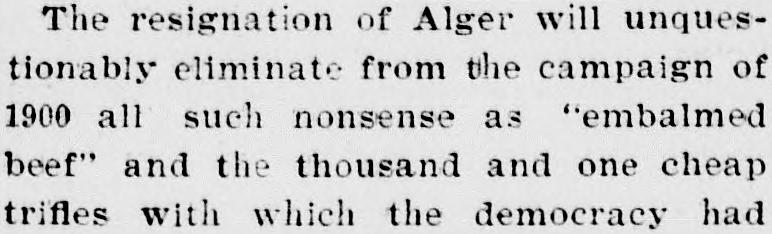
A friendly paper calls the “embalmed beef” complaints nonsense. The Daily Inter Mountain, Butte, Montana, July 20, 1899, page 2. Library of Congress, Chronicling America. Click the clipping to read it full size.
Why the Smart Money Said “Not Yet”
Here is why the friend in Washington, D.C., thought he would win. Lots of people expected Alger to leave someday, but not that summer. The Portland Daily Press in Maine reported that the date “generally set” for his leaving “was towards the close of the year.” Betting on August 1 was like betting on a snowstorm in October. It could happen, but most people would wait for winter.
July 19, 1899: Secretary Alger Quits
Then, on Wednesday, July 19, 1899, Secretary Alger went to the White House early in the morning and handed President McKinley his resignation. The Portland Daily Press said it “came suddenly and unexpectedly.” The papers said a fight over a Michigan seat in the United States Senate was a big reason. Alger wanted to run for that seat, and the papers said his plans had cooled things between him and the President.
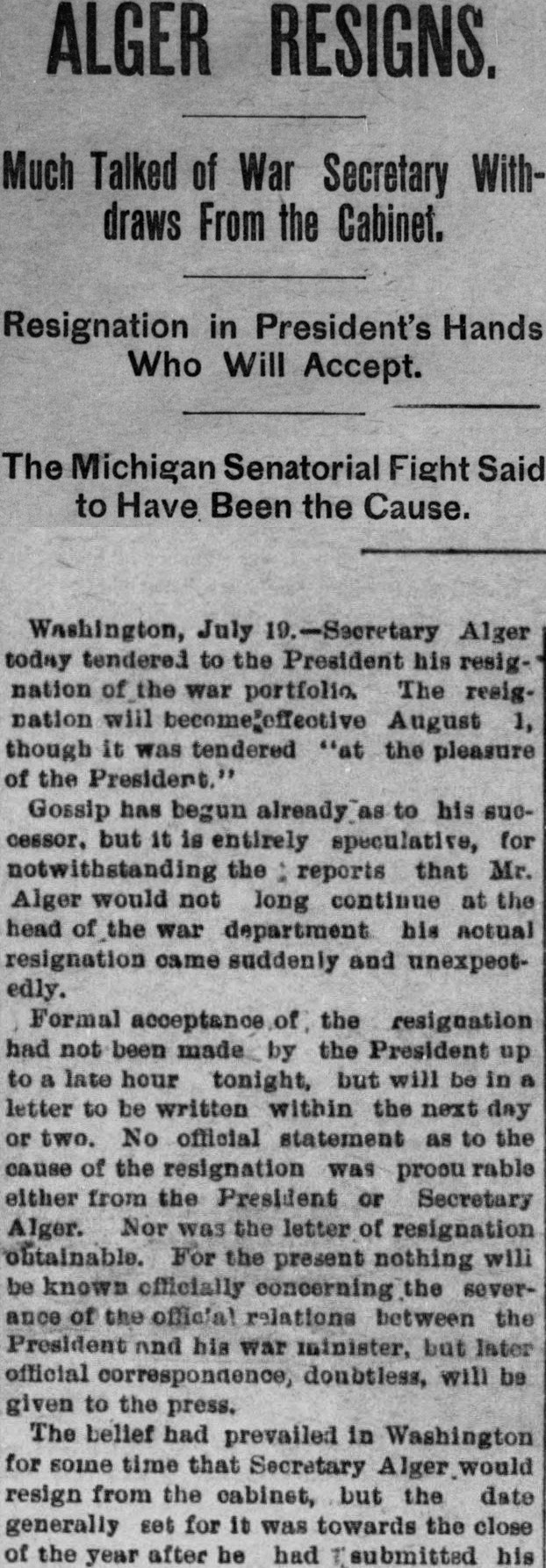
“Alger Resigns.” The Portland Daily Press, Portland, Maine, July 20, 1899, page 1. Library of Congress, Chronicling America. Click the clipping to read it full size.
The very next morning, the checks were turned over to the winner. The Evening Star called him “the lucky prophet.” A prophet is someone who tells the future, and this one had twelve days to spare.
The President Picked August 1
On the same front page of the Evening Star on July 20, 1899, Washington, D.C., readers found President McKinley’s letter to Alger, dated that day. It said the resignation “is accepted, to take effect on the 1st of August, 1899.” Out of every day on the calendar, the President had chosen the very date the winner named back in June.
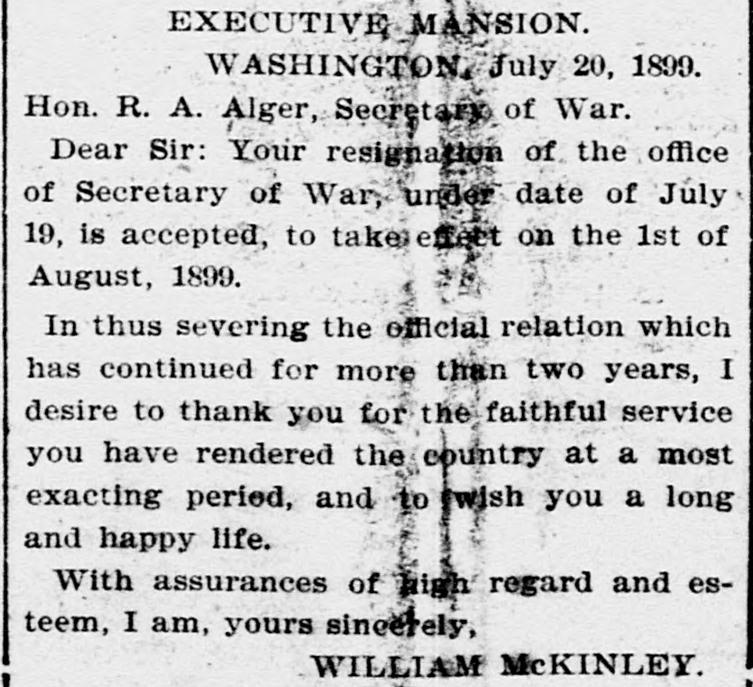
President McKinley’s letter accepting the resignation. Evening Star, Washington, D.C., July 20, 1899, page 1. Library of Congress, Chronicling America. Click the clipping to read it full size.
That morning Alger himself walked out of the White House smiling. A reporter asked if he felt relieved of a great burden. “Yes, I do,” Alger answered. “Hereafter I will only have my own burden to carry.”
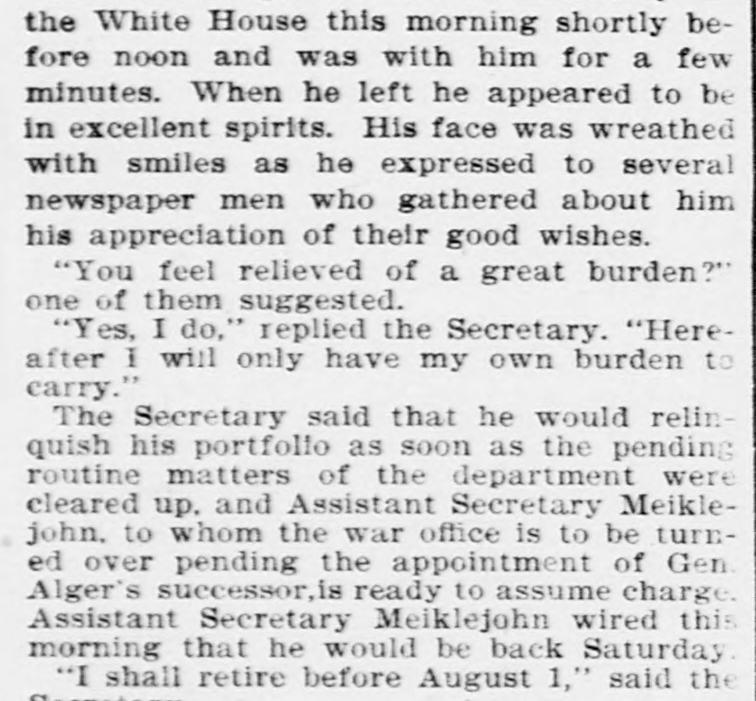
“Hereafter I will only have my own burden to carry.” Evening Star, Washington, D.C., July 20, 1899, page 1. Library of Congress, Chronicling America. Click the clipping to read it full size.
Two Friends in Washington, D.C., Still Friends
Nobody knows who the two friends in Washington, D.C., were. The Evening Star kept their secret, and the papers that copied the story did too. But we know the most important thing about them. They argued about the news, they disagreed, and they were still close friends after one of them lost $150.
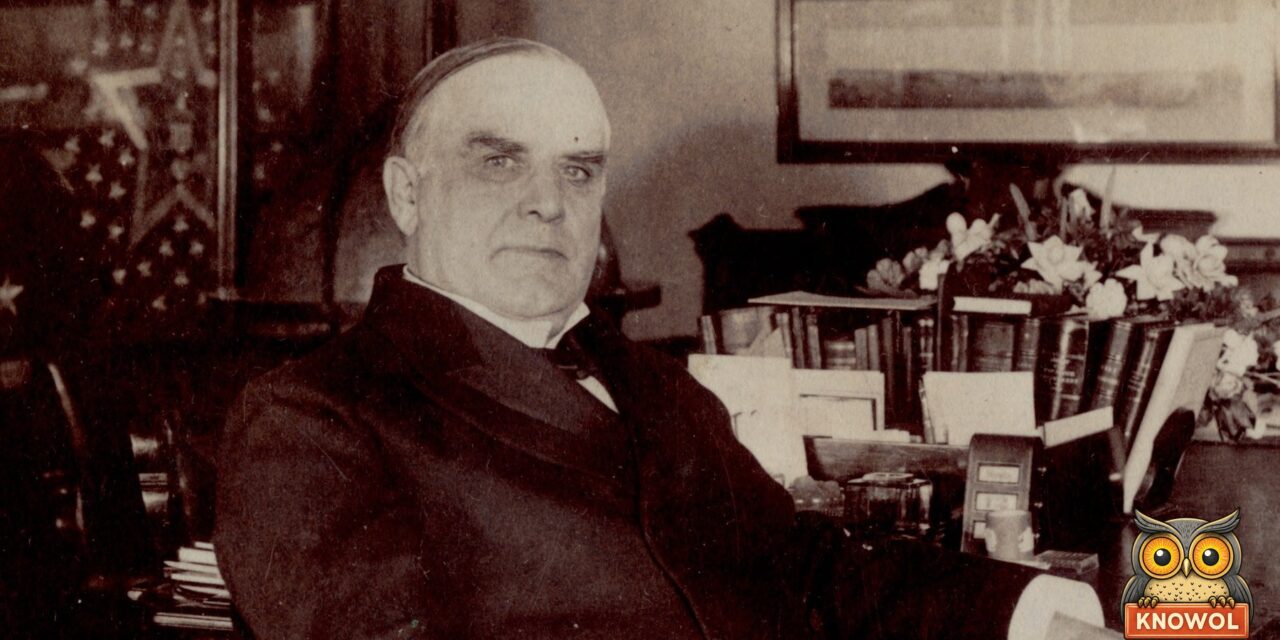
The cover photo shows President McKinley at the head of the table in the Cabinet Room at the White House, from a stereograph card made in 1900, the year after the bet. It was at a table like that one that Secretary Alger sat for more than two years. One man in Washington guessed he would be gone by August 1, and he was right, almost to the day.
Sources
- “An Unusual Wager,” Evening Star, Washington, D.C., July 20, 1899, page 12. Library of Congress, Chronicling America
- “An Unusual Wager” (reprinted from the Washington Star), Essex County Herald, Guildhall, Vermont, August 4, 1899, page 1. Library of Congress, Chronicling America
- “To Retire August 1” and the Alger and McKinley letters, Evening Star, Washington, D.C., July 20, 1899, page 1. Library of Congress, Chronicling America
- “Alger Resigns,” The Portland Daily Press, Portland, Maine, July 20, 1899, page 1. Library of Congress, Chronicling America
- Editorial on Alger’s retirement, The Daily Inter Mountain, Butte, Montana, July 20, 1899, page 2. Library of Congress, Chronicling America
- The Dreyfus news of June 1899, Alexandria Gazette, Alexandria, Virginia, June 5, 1899, page 2. Library of Congress, Chronicling America
- Photo: “[General R.A. Alger, head and shoulders portrait],” Detroit Publishing Co., glass negative. Library of Congress
- Cover photo: “President McKinley, at the head of the Council Table, Cabinet Room, White House, Washington, U.S.A.,” Underwood & Underwood stereograph, 1900. Boston Public Library, Digital Commonwealth
- Newspapers printed before 1931 are in the public domain. The Alger portrait: Library of Congress, no known restrictions on publication. The stereograph was published in 1900 (public domain); Digital Commonwealth lists no known copyright restrictions.