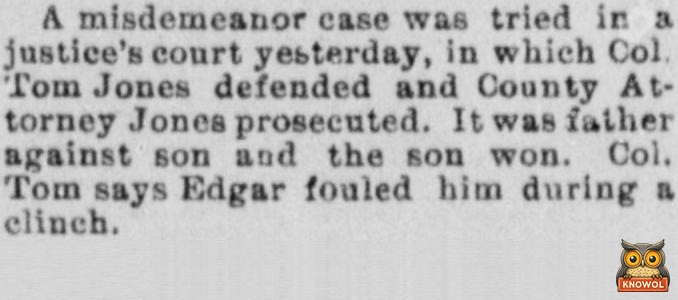
Father against son. The Guthrie Daily Leader, Guthrie, Oklahoma, January 14, 1899, page 4. Library of Congress, Chronicling America. Click the clipping to read it full size.
On Friday, January 13, 1899, two lawyers named Jones walked into a small courtroom in Guthrie, Oklahoma. One was Col. Tom Jones, a veteran lawyer who had once been a judge in Dodge City, Kansas. The other was Edgar Jones, the brand-new county attorney, and Edgar was his son.
The case was a misdemeanor, a small crime that usually ends with a fine. Edgar’s job was to prove the person on trial was guilty, and his father’s job was to stop him. The next day, the Guthrie Daily Leader told the whole story in four short lines:
A misdemeanor case was tried in a justice’s court yesterday, in which Col. Tom Jones defended and County Attorney Jones prosecuted. It was father against son and the son won. Col. Tom says Edgar fouled him during a clinch.
That last line is a boxing joke. In a clinch, two tired boxers grab each other and hang on, and a foul is a dirty move the rules don’t allow. So the old lawyer was telling the town, with a grin you can almost hear, that his boy had only won by cheating. It reads like a proud dad’s joke, not a real complaint.
A Judge From Dodge City, Kansas
Before Guthrie, Col. Tom Jones lived in Dodge City, Kansas, the cattle town famous for cowboys, saloons and gunfights. In April 1886, Dodge City voters chose a new mayor and a new police judge, the judge who handled the town’s fights, drunks and small crimes. The Dodge City Times was thrilled with the result. “Dodge City so long at the mercy of the baser elements, stands redeemed and disenthralled,” it said. In plain words, the rough crowd had run the town too long, and now the town was free of them.
Right under that cheer came the list of winners, and next to “Police Judge” it printed the name “T. S. Jones.” (Tom is short for Thomas.)
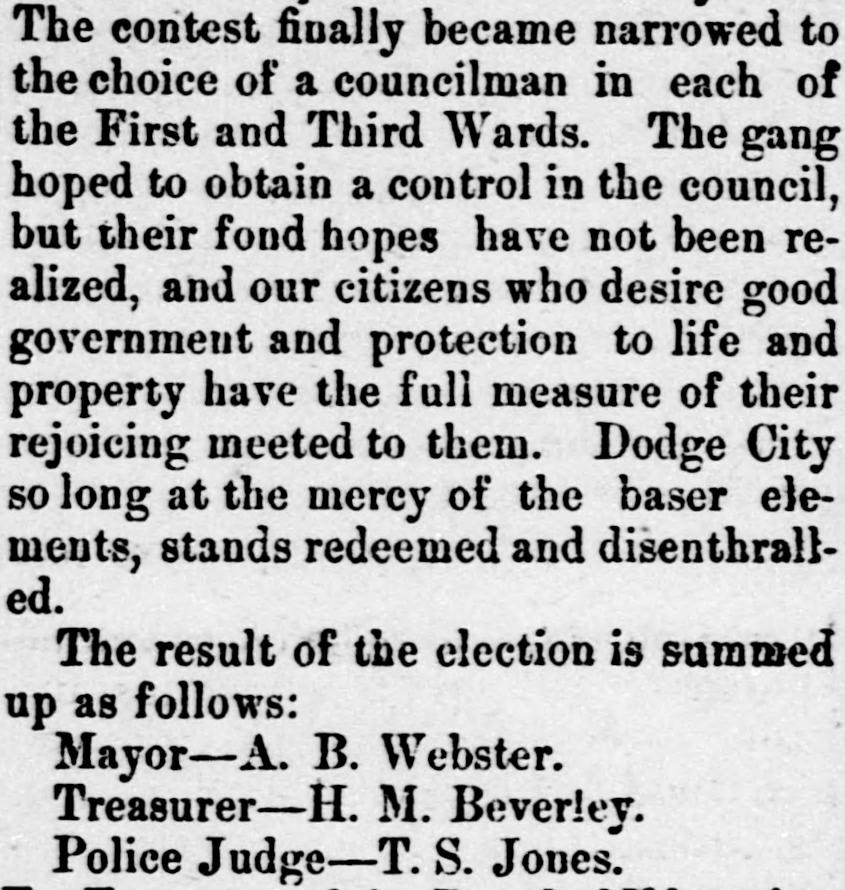
Dodge City’s 1886 election, with T. S. Jones as police judge. Dodge City Times, Dodge City, Kansas, April 8, 1886, page 4. Library of Congress, Chronicling America. Click the clipping to read it full size.
Being a police judge in Dodge City was not a quiet job. On January 12, 1899, just one day before the big trial, the Guthrie paper bragged about two of its lawyers who had held it. Bobby Burns, it said, “was shot at over a hundred times” in Dodge City in 1884. Then it added: “Col. Tom Jones, of this city, was a target fifty times while occupying the same position, and still they are both good lawyers yet.” Nobody can check that count now, and it may be a tall tale. But it shows how Guthrie saw the colonel: a tough man with a sense of humor.
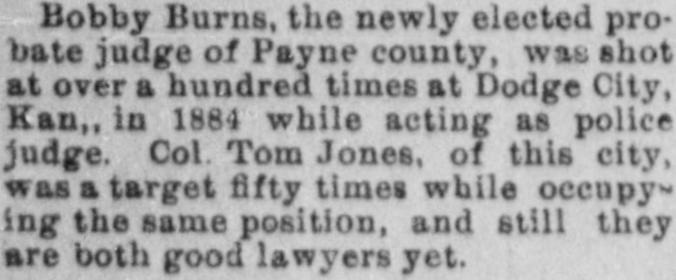
The Guthrie Daily Leader, Guthrie, Oklahoma, January 12, 1899, page 4. Library of Congress, Chronicling America. Click the clipping to read it full size.
The Land Run That Built Guthrie, Oklahoma
The Jones family came to Guthrie, Oklahoma, at the very start. On April 22, 1889, the government opened this land to settlers with a land run, a race for free land. At noon, thousands of people raced in on horses and wagons and on foot to claim a piece of land. By that night, empty prairie at Guthrie had turned into a city of tents.
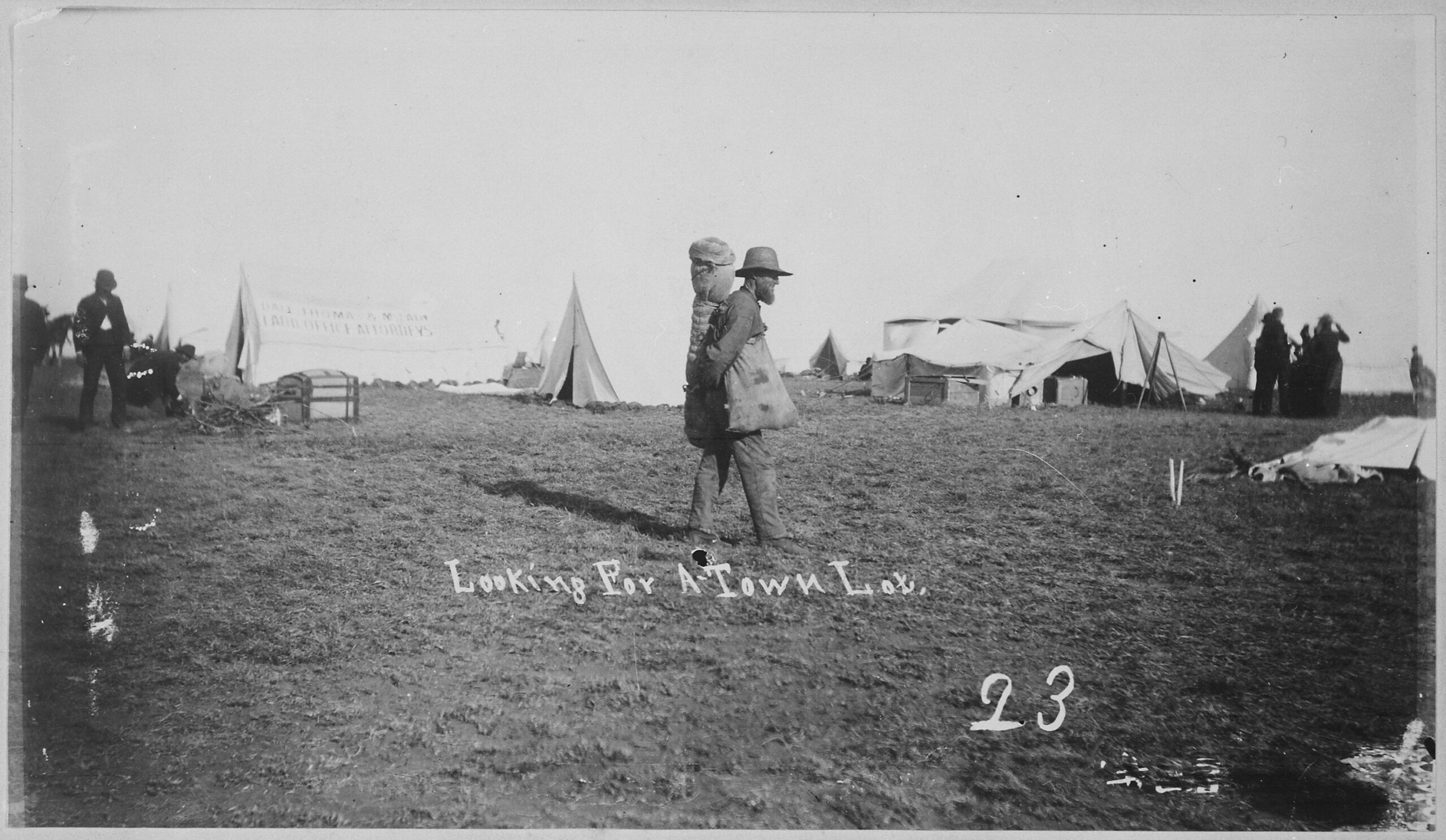
“Looking For A Town Lot,” Guthrie, about 1889. The sign on the tent at left says “Land Office Attorneys”: in the first days, even lawyers worked out of tents. National Archives, public domain. Click the picture to see it full size.
A Dodge City man named M. Collar wrote home to the Dodge City Times in June 1889 to tell everyone how it was going. “Kansas furnished this country with most of her settlers,” he wrote. Then came the news about his old neighbors: “Wm. Tilghman, James Arment and Tom Jones are elected members to prepare a charter for the city and laws for the city council.” A charter is a city’s rule book, so Col. Tom Jones helped write the very first rules for brand-new Guthrie.
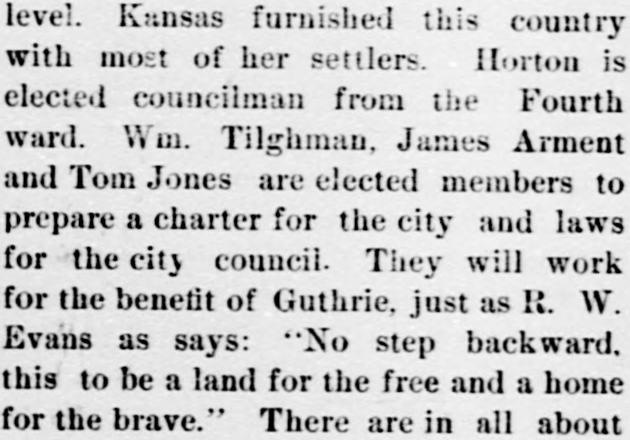
A letter from Guthrie. Dodge City Times, Dodge City, Kansas, June 20, 1889, page 3. Library of Congress, Chronicling America. Click the clipping to read it full size.
Edgar Jones Grows Up With Guthrie
Edgar Jones came to Guthrie with the land run too. The Leader later said “he came here at the opening,” meaning the day the land opened, and he grew up along with the town. He worked as the territory’s librarian and as a clerk of the Oklahoma supreme court. Oklahoma was still a territory then, not a state, and Guthrie was its capital.
In August 1898, Edgar went to Omaha, Nebraska, to marry Miss Lee White. The Leader called her “a highly accomplished musician” and said she “recently won a $1,000 Baby Grand piano in the students’ musical contest at Mexico, Mo.” It called Edgar “one of Guthrie’s most popular young men.”
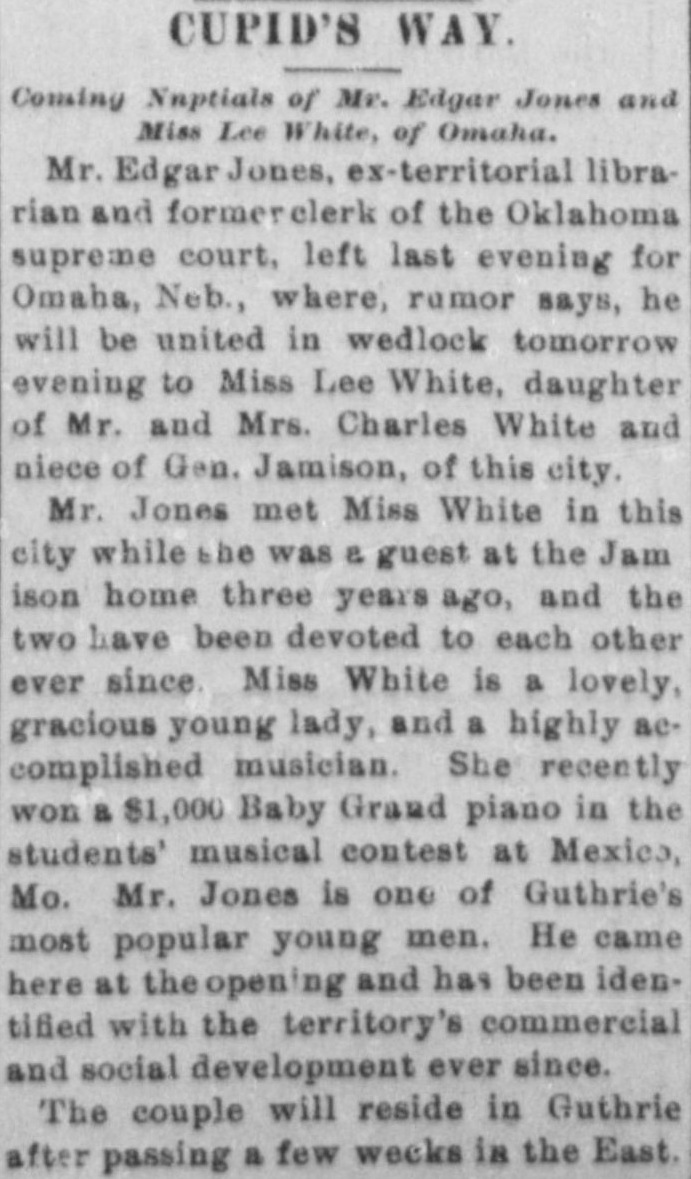
“Cupid’s Way.” The Guthrie Daily Leader, Guthrie, Oklahoma, August 9, 1898, page 4. Library of Congress, Chronicling America. Click the clipping to read it full size.
That November, voters elected Edgar W. Jones county attorney of Logan County. The county attorney is the lawyer who brings cases against people accused of crimes, for the whole county. A lawyer named J. C. Strang later sued to overturn the result, and in April 1899 a judge dismissed the suit. So when Edgar faced his father in January, he was new on the job and eager. On January 13, the same day as the trial, the Leader reported, “County Attorney Jones says business is rushing in his line.”
What a Justice’s Court in Guthrie Was Like
The trial took place in a justice’s court, the smallest kind of court in Guthrie. It was run by a justice of the peace, a local judge for small cases like unpaid bills and minor crimes, while bigger cases went to the district court.
Sadly, the Leader never said what the case was about or who was on trial. It only cared about the fun part: a father and a son on opposite sides of the same small courtroom, and the son walking out the winner.
The Busy Week Around the Trial
The trial came in a busy week for Guthrie, Oklahoma, because the territory’s lawmakers, called the legislature, had just come to town. One store invited them to “make our store headquarters,” and even the churches joined in. On the same page as the father-and-son story, the First M. E. church said its Sunday evening sermon would be “Republics and their law makers,” for the lawmakers. And the notice added: “Mrs. Edgar Jones will sing a solo at the evening service.”
So two days after Edgar beat his father in court, his new wife, the piano prize winner, sang at church. It is easy to picture the whole Jones family in the pews that night.
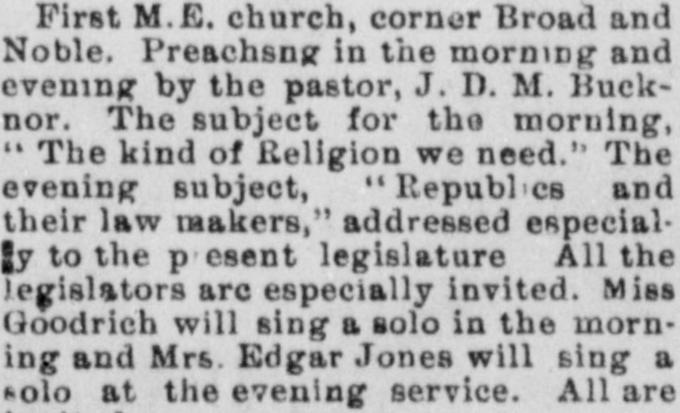
Sunday’s church notice. The Guthrie Daily Leader, Guthrie, Oklahoma, January 14, 1899, page 4. Library of Congress, Chronicling America. Click the clipping to read it full size.
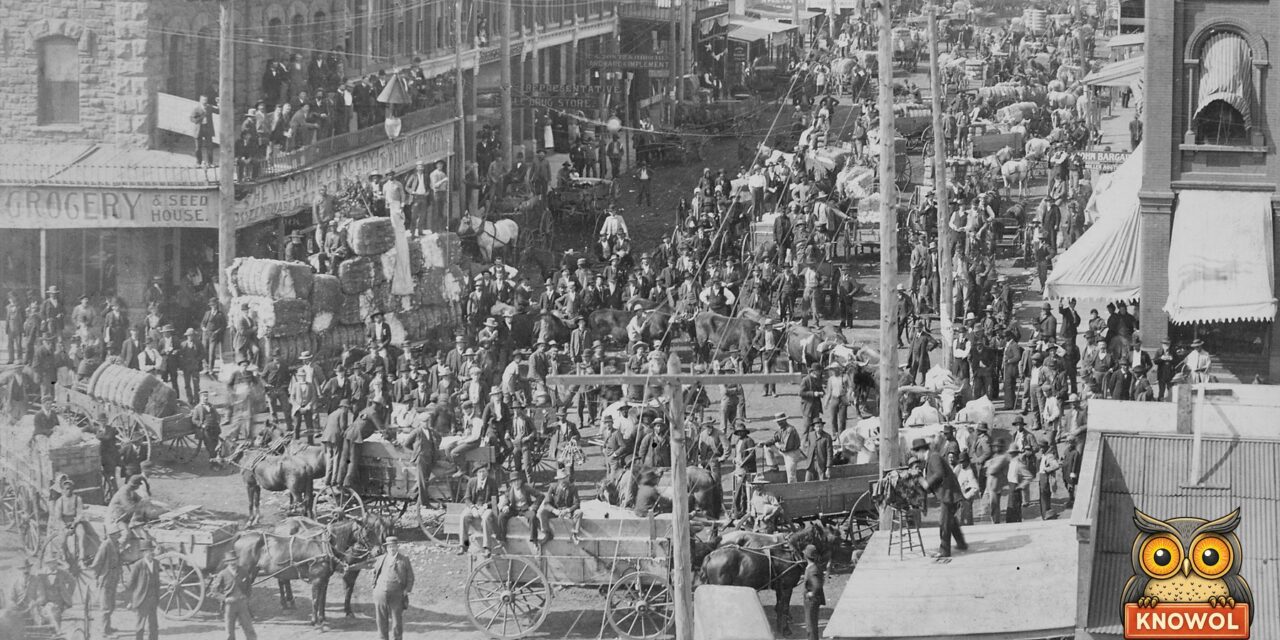
Farm business filled the same page too. A cotton buyer from Gainesville, Texas, paid 5 1/4 cents for cotton, the best price of the week, for twenty-three bales from a farmer who lived a mile and a half from town. Cotton was sold by the pound, and a bale is a giant bundle wrapped tight for shipping. The cover photo shows those days in Guthrie: wagons piled with cotton bales and crowds of farmers and buyers on Harrison Avenue, taken by the photographer Swearingen sometime after 1893.
Father and Son, Still a Team
The court fight did not split up the Jones family. By 1903, Edgar had moved up again, and the Leader now called him “Representative Edgar W. Jones,” a lawmaker for Logan County. That March, rumors flew around town that he had gone to Washington with papers from a lawmakers’ investigation. The Leader got its answer from his father: “Yes, sir, Edgar is out of town,” said Col. Tom Jones.
That is the last picture we have of them, and it is a good one. The former Dodge City judge who once lost a case to his son was still standing up for him, just like any proud dad would.
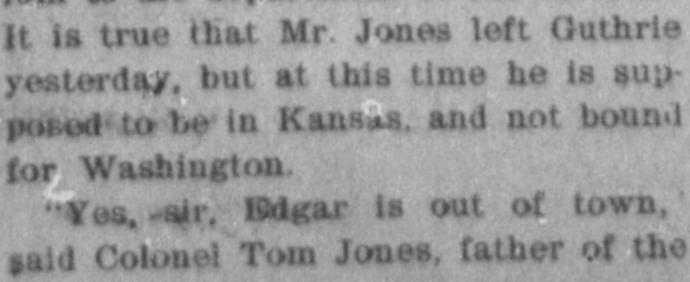
The Guthrie Daily Leader, Guthrie, Oklahoma, March 26, 1903, page 6. Library of Congress, Chronicling America. Click the clipping to read it full size.
Sources
- “Town Topics” (the father and son item, the cotton buyer and the church notices), The Guthrie Daily Leader, Guthrie, Oklahoma, January 14, 1899, page 4. Library of Congress, Chronicling America
- “Town Topics” (Bobby Burns and Col. Tom Jones), The Guthrie Daily Leader, January 12, 1899, page 4. Library of Congress, Chronicling America
- “County Attorney Jones says business is rushing in his line,” The Guthrie Daily Leader, January 13, 1899, page 4. Library of Congress, Chronicling America
- City election, Dodge City Times, Dodge City, Kansas, April 8, 1886, page 4. Library of Congress, Chronicling America
- “From M. Collar,” Dodge City Times, June 20, 1889, page 3. Library of Congress, Chronicling America
- “Cupid’s Way,” The Guthrie Daily Leader, August 9, 1898, page 4. Library of Congress, Chronicling America
- Edgar W. Jones elected county attorney, The Guthrie Daily Leader, November 16, 1898, page 2. Library of Congress, Chronicling America
- The election contest dismissed, The Beaver Herald, Beaver, Oklahoma, April 13, 1899, page 3. Library of Congress, Chronicling America
- “Mysterious Absence of Logan County Legislator,” The Guthrie Daily Leader, March 26, 1903, page 6. Library of Congress, Chronicling America
- Photo: “Looking For A Town Lot,” Guthrie, about 1889. National Archives, via Wikimedia Commons
- Cover photo: “Guthrie Cotton Market,” Harrison Avenue, by Swearingen, after 1893. National Archives, via Wikimedia Commons
- Newspapers printed before 1931 are in the public domain. Both photos are U.S. government records at the National Archives (Record Group 48), in the public domain.