On Saturday afternoon, January 27, 1917, the Star-Bulletin in Honolulu, Hawaii, came out 36 pages thick. It cost five cents, the same as any other day. But a line of big black type ran across the very top of page one, above the paper’s own name: “TODAY’S PAPER WRITTEN AND EDITED BY SPECIAL Y. W. C. A. STAFF.” For one day, the newsroom belonged to the women of the Young Women’s Christian Association. The men who worked there every other day had nothing to do.
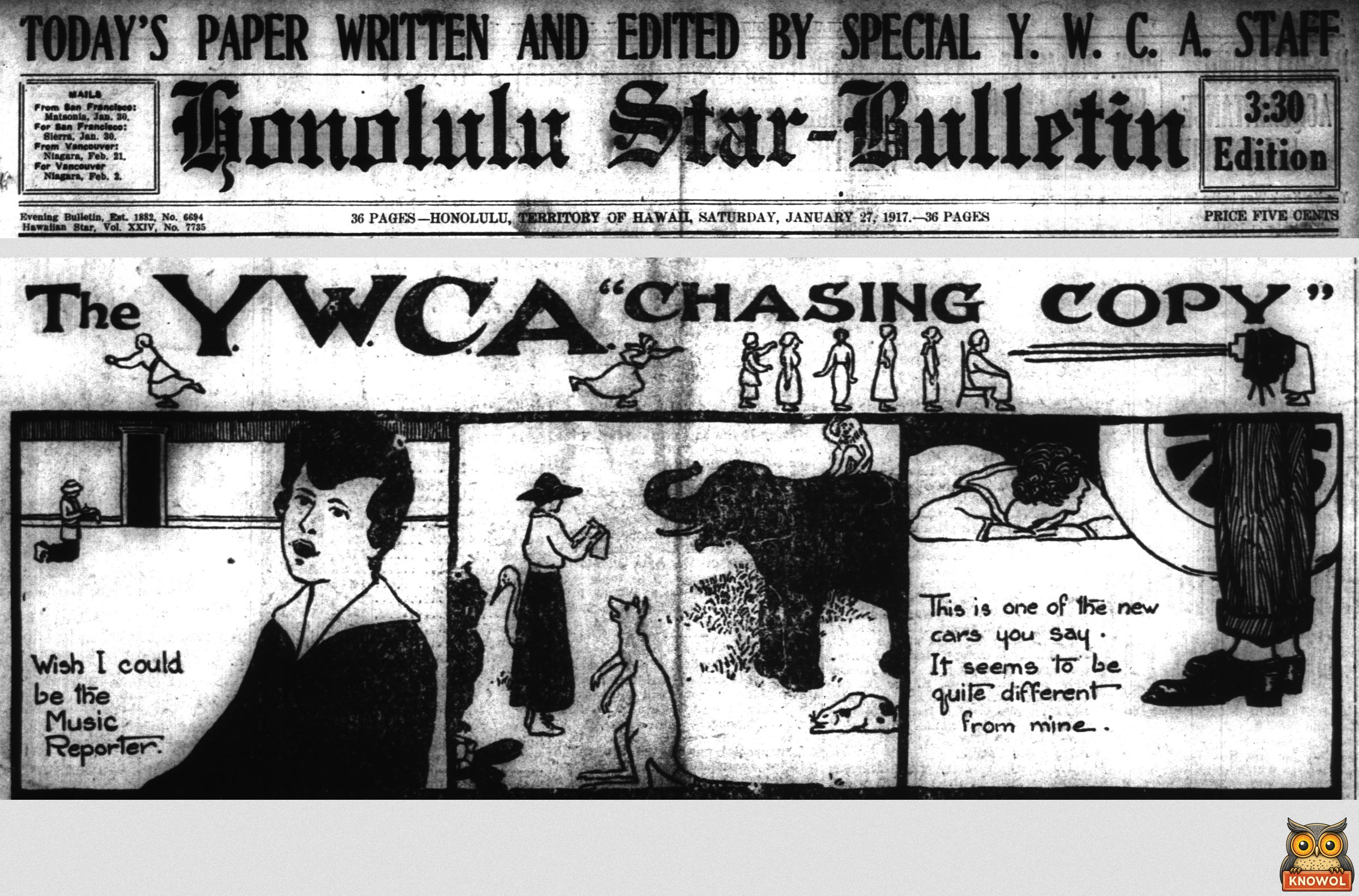
The top of page one, and the first row of the staff cartoon that ran under it, “The YWCA ‘Chasing Copy.'” Two pieces of the same page. Honolulu Star-Bulletin, Honolulu, Hawaii, January 27, 1917, page 1. Library of Congress, Chronicling America. Click the clipping to read it full size.
“The paper is theirs for the day”
The Y.W.C.A. was a club for women and girls. People called it the Y. In Honolulu it had its own building, with a gymnasium and a lunchroom. That cost money, so the Y planned a three-day drive to raise $17,000. The Star-Bulletin wanted to help, and it had a bold idea.
On January 20 the paper put the plan on page one. The headline said the Y would “Get Out” the Star-Bulletin the next Saturday. To get out a paper means to write it, edit it and send it to the printing press. The women would “write and edit the articles, hunt ‘scoops,’ ‘chase copy’ and send the paper to press.” A scoop is a story you print before the other paper gets it. Copy is a newsroom word for the stories themselves. “It is to be distinctively a Y. W. C. A. edition,” the paper said, “and the paper is theirs for the day.”
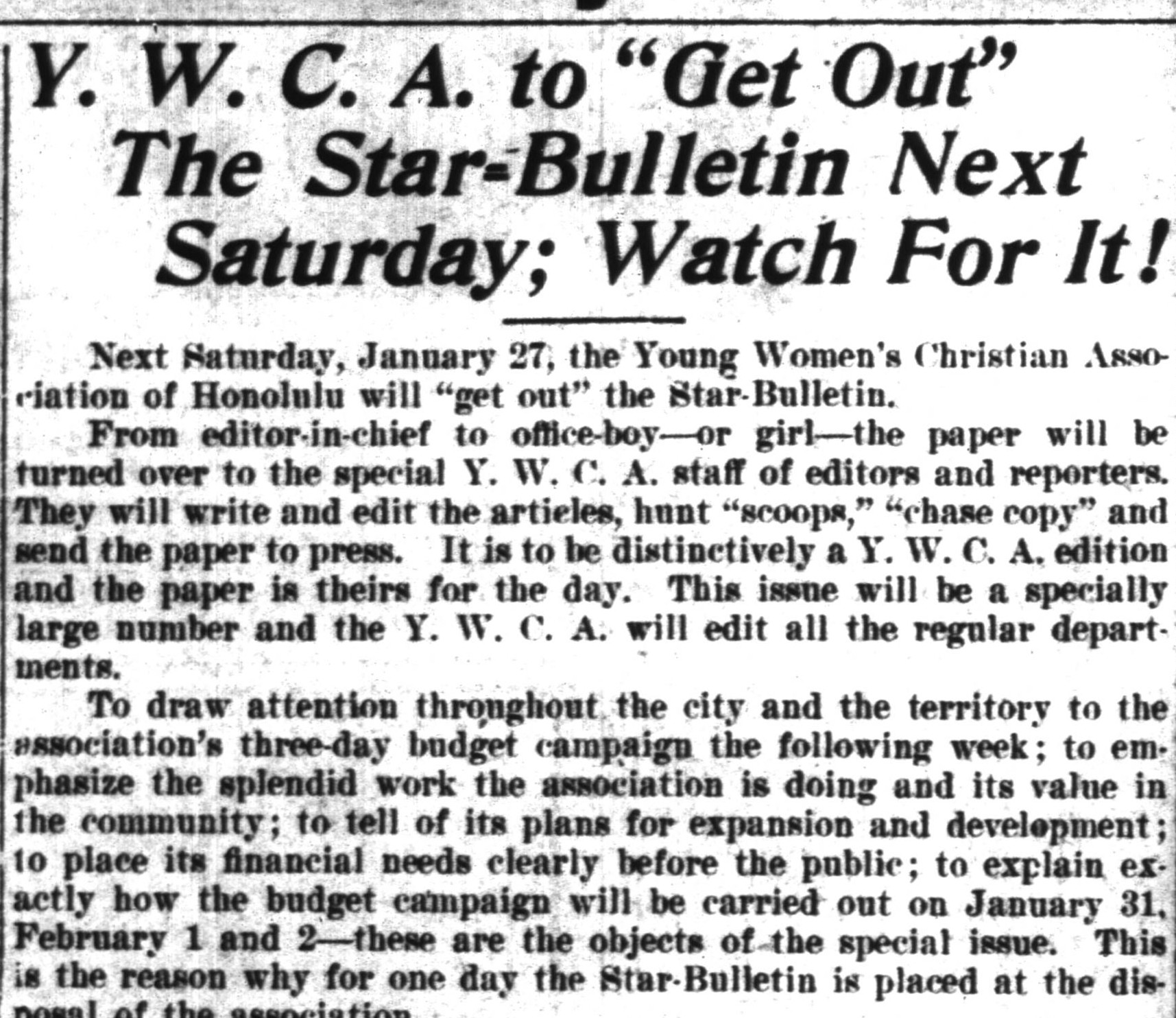
“Y. W. C. A. to ‘Get Out’ The Star-Bulletin Next Saturday; Watch For It!” Honolulu Star-Bulletin, Honolulu, Hawaii, January 20, 1917, page 1. Library of Congress, Chronicling America. Click the picture to see it full size.
The day before the big day, the paper warned the whole town. “Politicians, look out!” it began. “Public officials, tremble!” Then came a line for the Advertiser, the other big paper in town: “Gentlemen of the Advertiser, beware!” Officials, it joked, would be “trailed to their lairs and made to disgorge official secrets.” To disgorge is to cough something up.
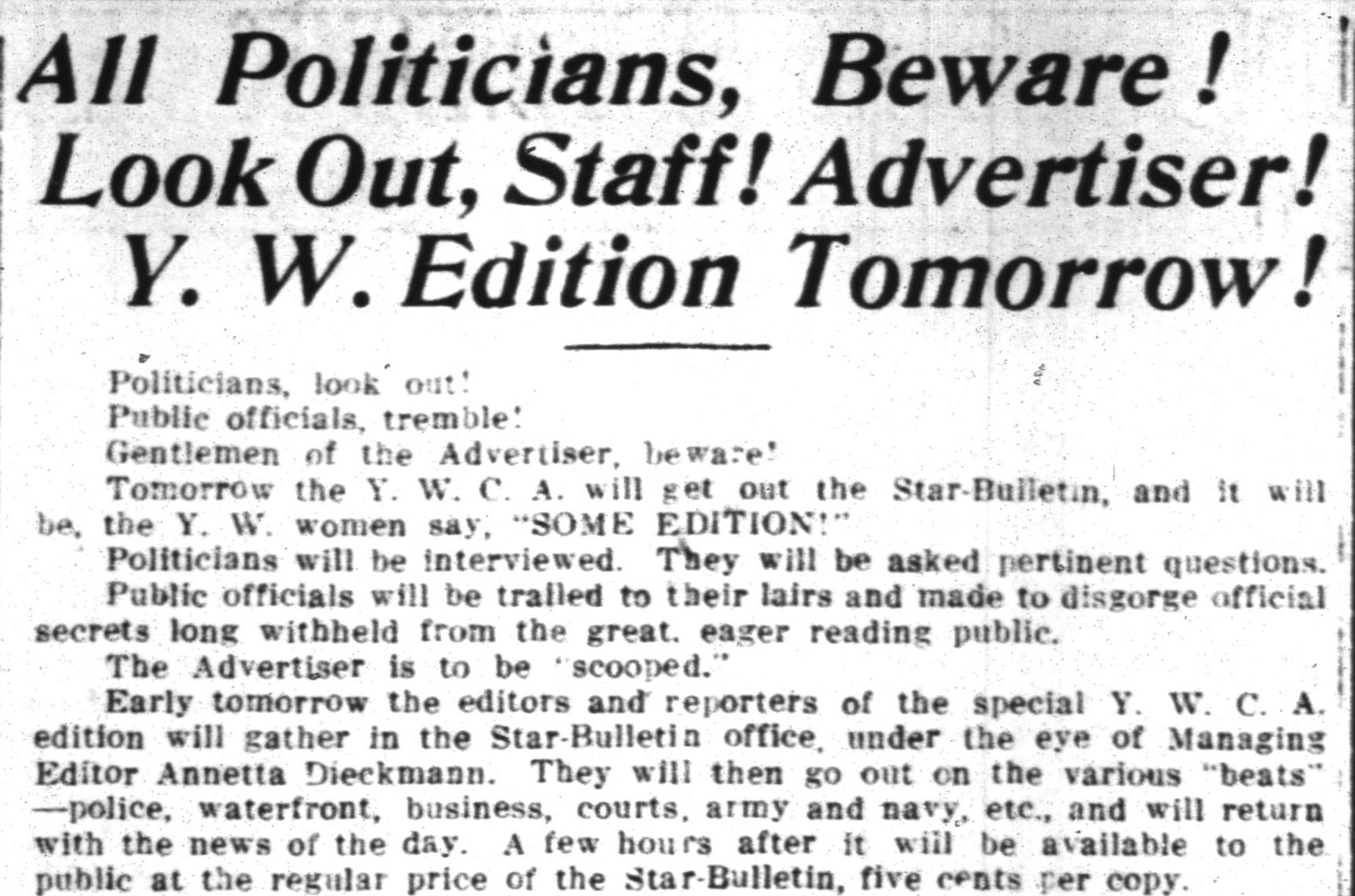
“All Politicians, Beware! Look Out, Staff! Advertiser! Y. W. Edition Tomorrow!” Honolulu Star-Bulletin, Honolulu, Hawaii, January 26, 1917, page 4. Library of Congress, Chronicling America. Click the picture to see it full size.
The gym teacher got the sports page
Miss Helen M. Salisbury was the acting head of the Y. She became editor-in-chief. Miss Annetta Dieckmann, the Y’s education secretary, became managing editor, the boss of the day’s news. The other jobs were handed out with care. Miss Leonora Andersen was the Y’s physical director, an old name for a gym teacher. She became sporting editor. Miss J. Pearl Cox kept the Y’s account books. She became financial editor.
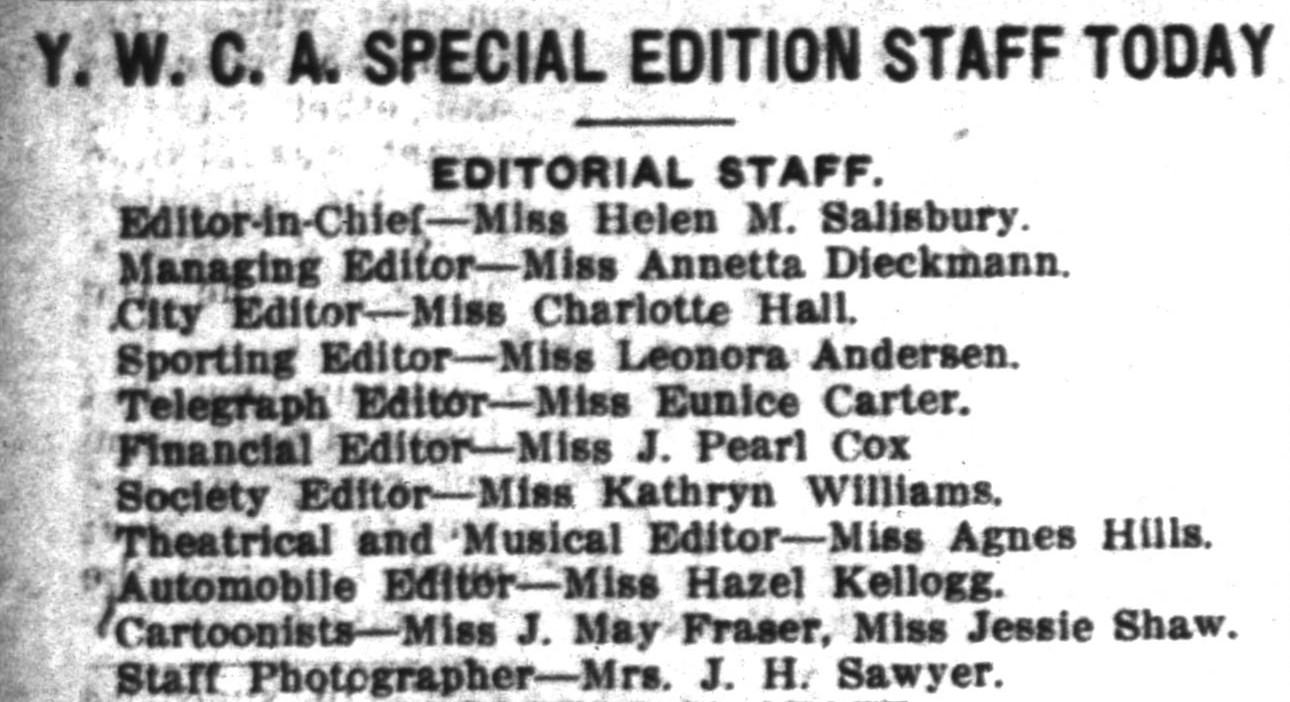
The first part of the staff list, “Y. W. C. A. Special Edition Staff Today.” Honolulu Star-Bulletin, Honolulu, Hawaii, January 27, 1917, page 4. Library of Congress, Chronicling America. Click the picture to see it full size.
The staff list named 30 women in all. Miss Inez Underhill was the police reporter. Others had city hall, the courts, the waterfront, and the Army and Navy. Eight women covered sports, one sport each: swimming, tennis, golf, bowling, polo, baseball, basketball and track. The staff even had two cartoonists and a photographer.
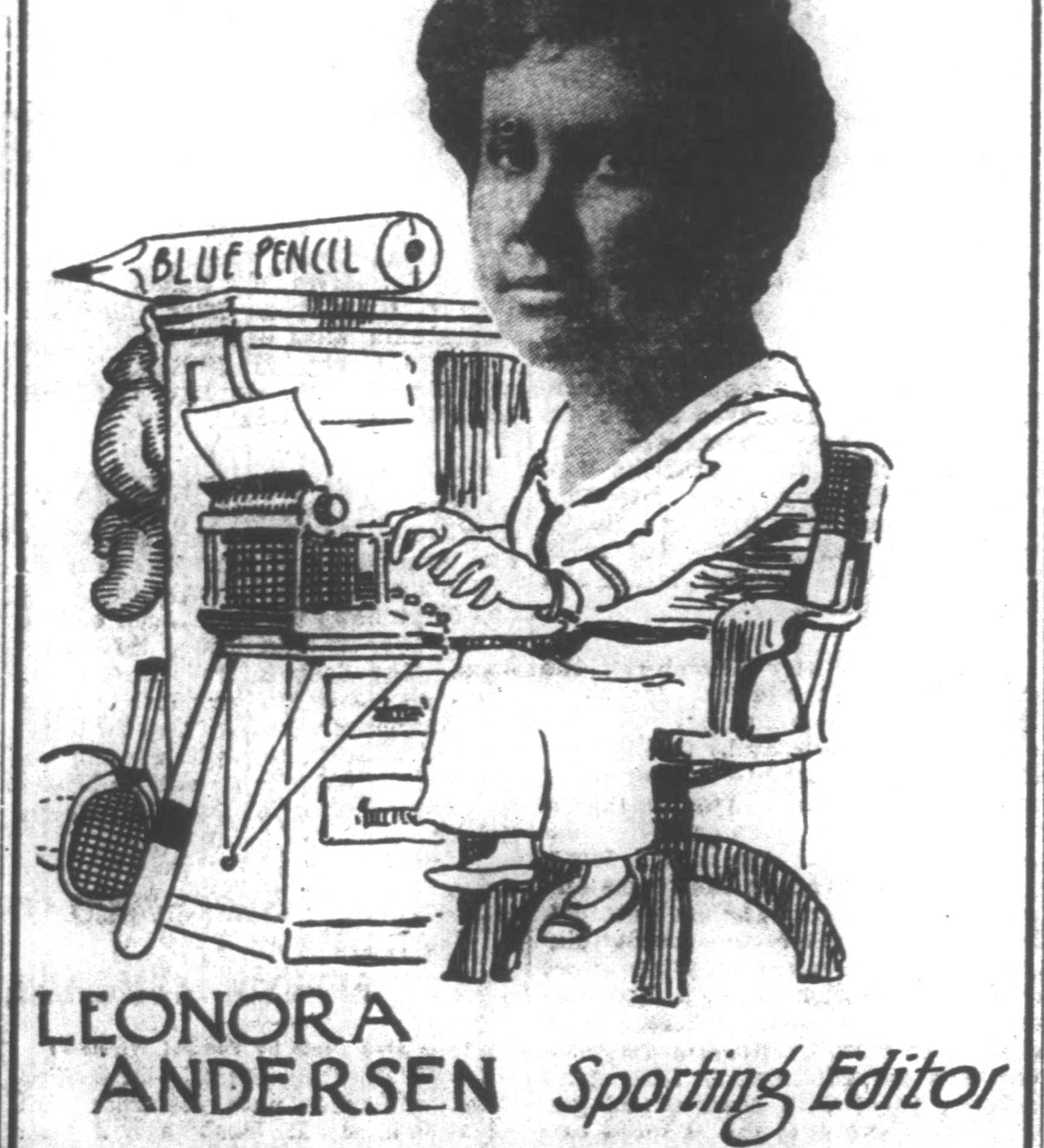
Leonora Andersen, “Sporting Editor,” drawn at her typewriter under a giant blue pencil, the tool editors used to mark up stories. Her face is a photograph set on a drawn body. Honolulu Star-Bulletin, Honolulu, Hawaii, January 27, 1917, page 15. Library of Congress, Chronicling America. Click the clipping to read it full size.
What the women printed
They did what they promised. Page one carried news stories signed by Emily V. Warinner, Violet Atherton, Grace Morgan and Ruth Richards. The sports page said it was “Edited by the Y. W. C. A. Staff of Experts in Every Line of Athletics.” The automobile pages printed a traffic officer’s tips for drivers. The last tip was the shortest: “When in doubt, go slow.”
Other women sent in columns. Inez Wheeler Westgate wrote about cooking in the islands. A malihini, a newcomer, had to learn to cook with island food by trial and error, she said. A kamaaina, a woman who had lived in the islands for years, had no good way to pass along what she knew. She put it like this: “Like the thirsty traveler at the well where the bucket has dropped in, the water is there, the bucket is there, the need is there, but alas, there is no rope!”
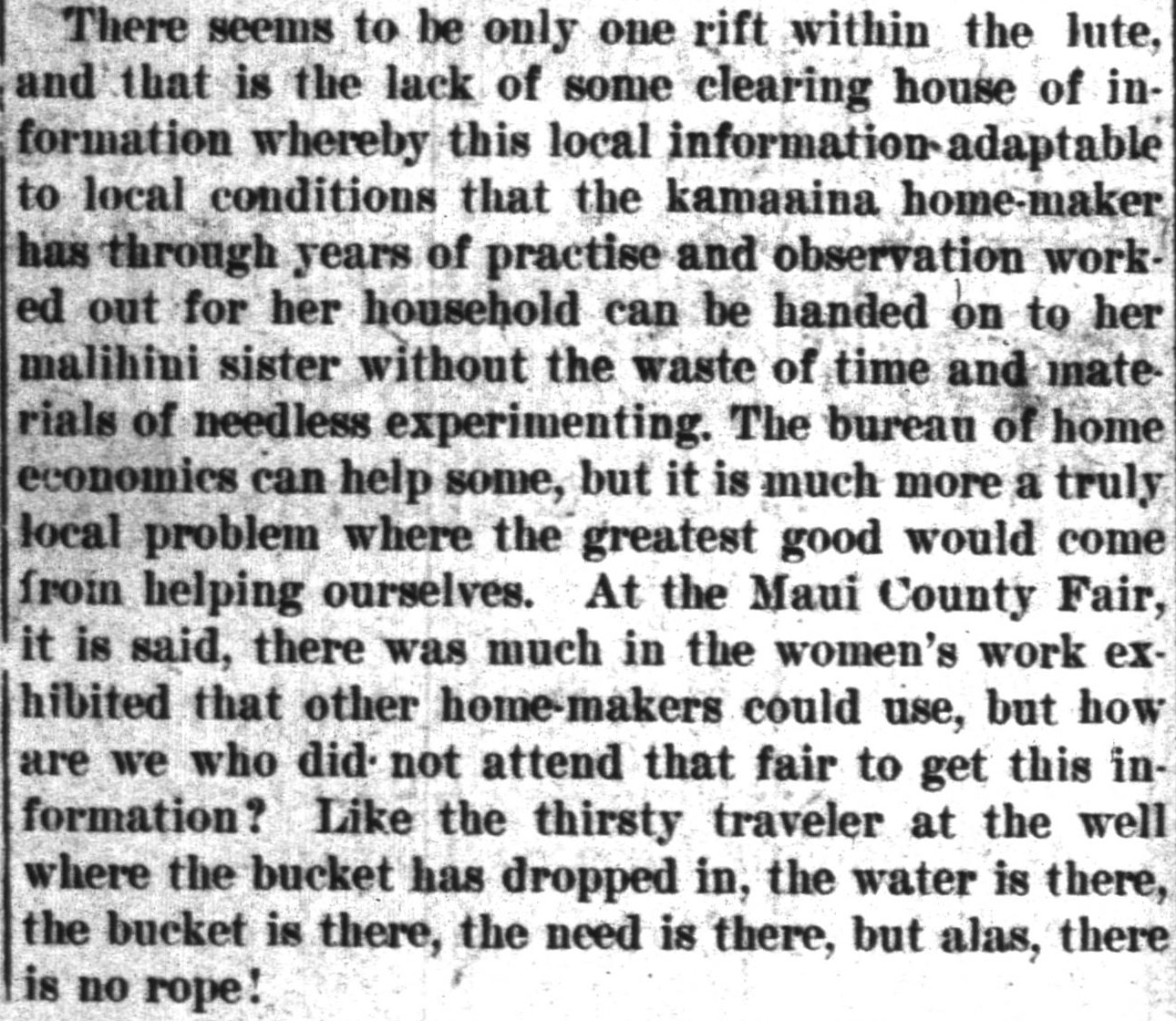
The end of Inez Wheeler Westgate’s column, “A Clearing House for Homemaking Ideas Needed.” Honolulu Star-Bulletin, Honolulu, Hawaii, January 27, 1917, page 4. Library of Congress, Chronicling America. Click the clipping to read it full size.
The two cartoonists, Juliette May Fraser and Jessie Shaw, drew the staff at work for page one. In one square a woman lies under an automobile, looking it over. The words beside her say, “This is one of the new cars you say. It seems to be quite different from mine.” In another, a tiny reporter looks up at the back of a huge policeman. The label says, “The Police Reporter finds it difficult to get an interview.” Along the bottom, the paper’s regular men sit around. Their label reads, “The regular staff of course enjoys a holiday.”
The regular reporters wrote a poem
The regular reporters did get one thing into the paper. It was a thank-you called “A Tribute to The ‘Y. W.’ Staff,” signed only H. D. C. It is printed like a plain paragraph. Read it out loud, though, and it rhymes:
All us regular reporters have just loafed around our quarters, for there hasn’t been a thing for us to do the whole day long. Someone said they couldn’t do it, but they’ve done it, and we knew it, and that’s the special reason why we sing this little song.
The poem asked readers to help the Y: “Drop a dollar in their basket.” And it closed with a grin. As “real newspaper women,” the men wrote, “we are sure they’d make a hit.” Then they owned up to something: “we must doff our hats, admitting we are jealous, just a bit.” To doff your hat is to tip it.
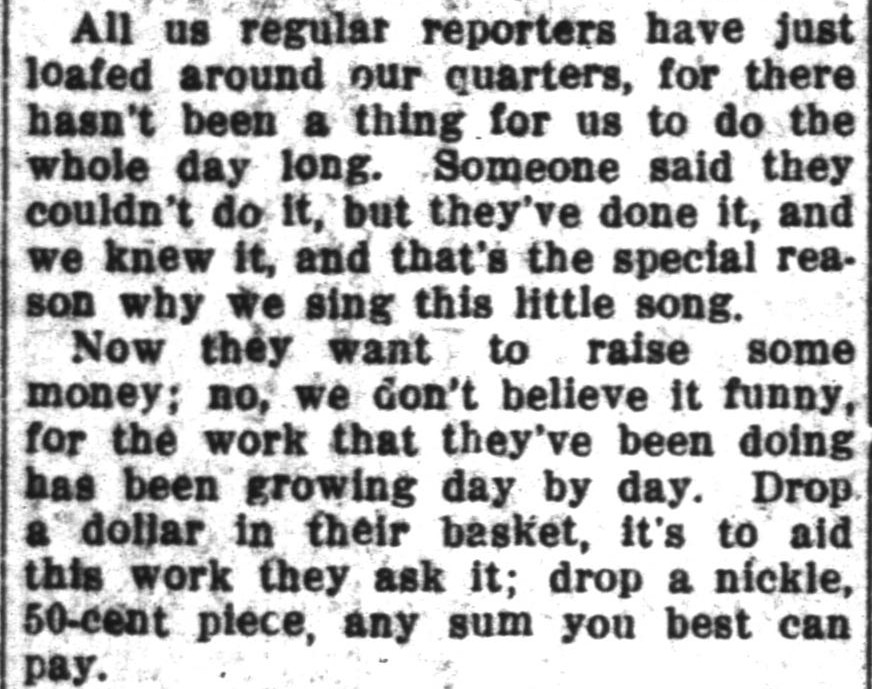
Two paragraphs of “A Tribute to The ‘Y. W.’ Staff.” Honolulu Star-Bulletin, Honolulu, Hawaii, January 27, 1917, page 24. Library of Congress, Chronicling America. Click the clipping to read it full size.
Did it work?
The money drive ran the next week. On February 8 the Star-Bulletin had the answer in a headline: “BUDGET FUND OF Y. W. PASSES MARK.” The afternoon before, the Y’s committee had “pulled the little paper ribbon from the adding machine.” An adding machine printed its sums on a narrow strip of paper, like a store receipt. The total on the strip was $17,481.75.
Miss Dieckmann said the Y could now think about a bigger kitchen for its cafeteria. One of the best parts, she said, was “the fact that 857 people contributed to the fund.”
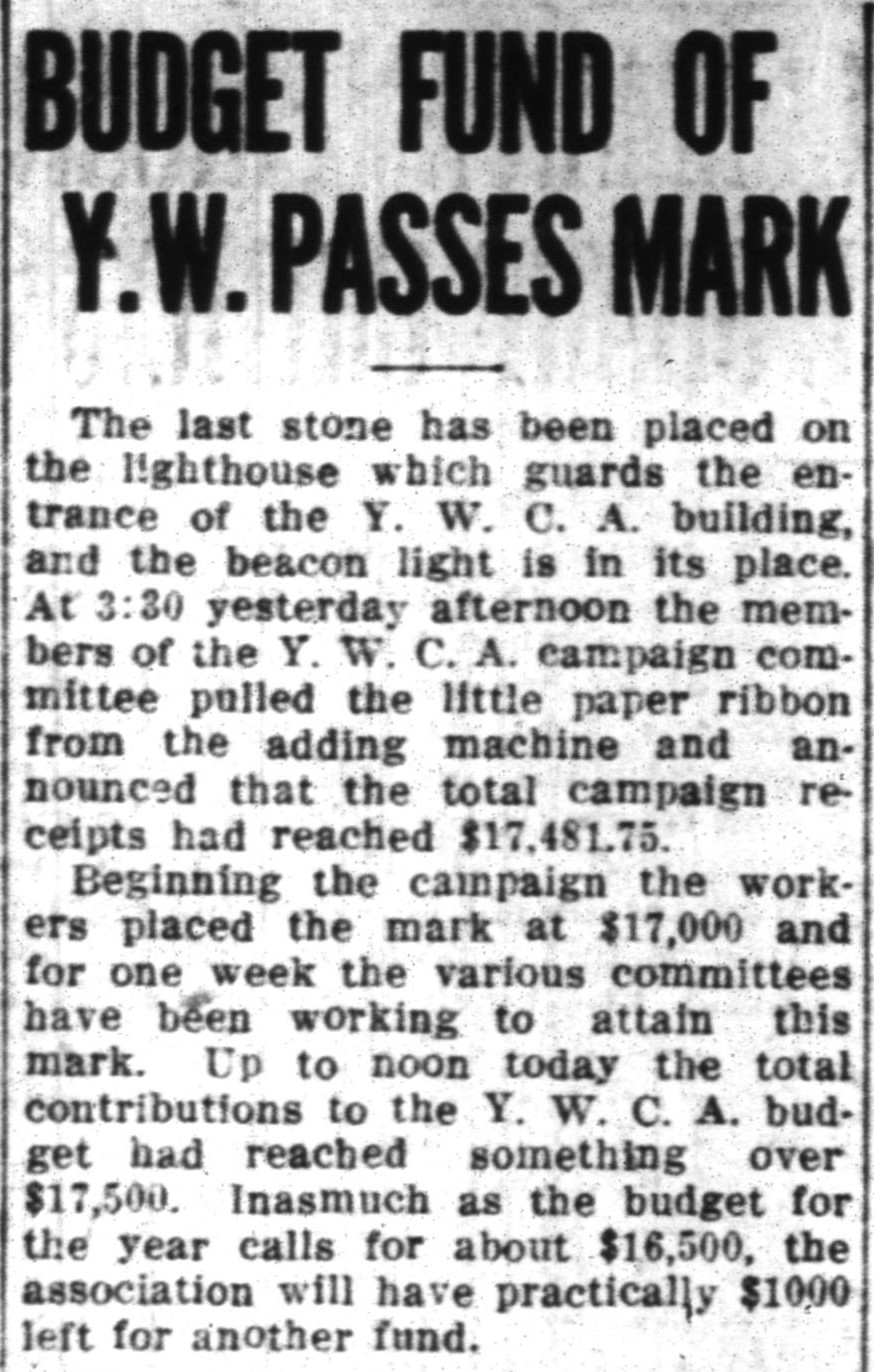
“Budget Fund of Y. W. Passes Mark.” Honolulu Star-Bulletin, Honolulu, Hawaii, February 8, 1917, page 3. Library of Congress, Chronicling America. Click the clipping to read it full size.
By the numbers
- 36: pages in the Y.W.C.A. edition
- 3 cents: the postage to mail a copy
- 30: women named on the staff list
- $17,000: what the Y set out to raise
- $17,481.75: the total on the adding machine strip on February 7
- 857: people who gave
Fort Street, and a half dollar
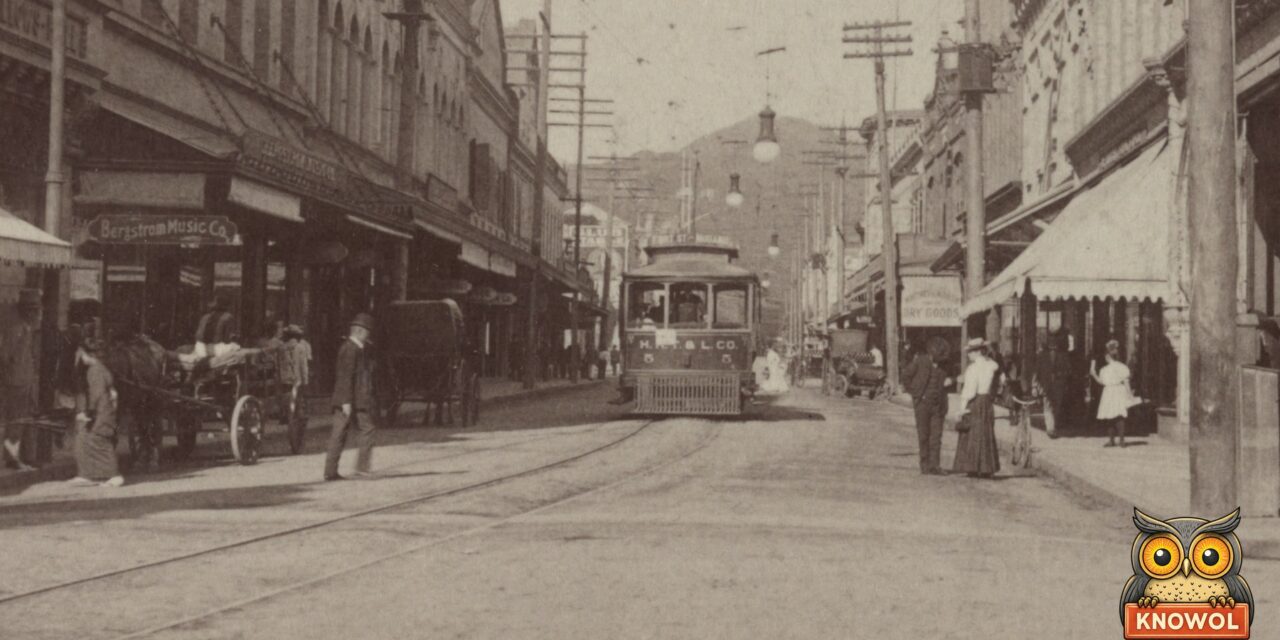
The photo at the top of this story shows Fort Street in Honolulu about 1910, seven years before the Y.W.C.A. edition. A streetcar is coming down the middle. The sign on the left reads Bergstrom Music Co. In the women’s paper, Bergstrom Music Co. of Fort Street ran a small ad for Victrolas, the record players of the day.
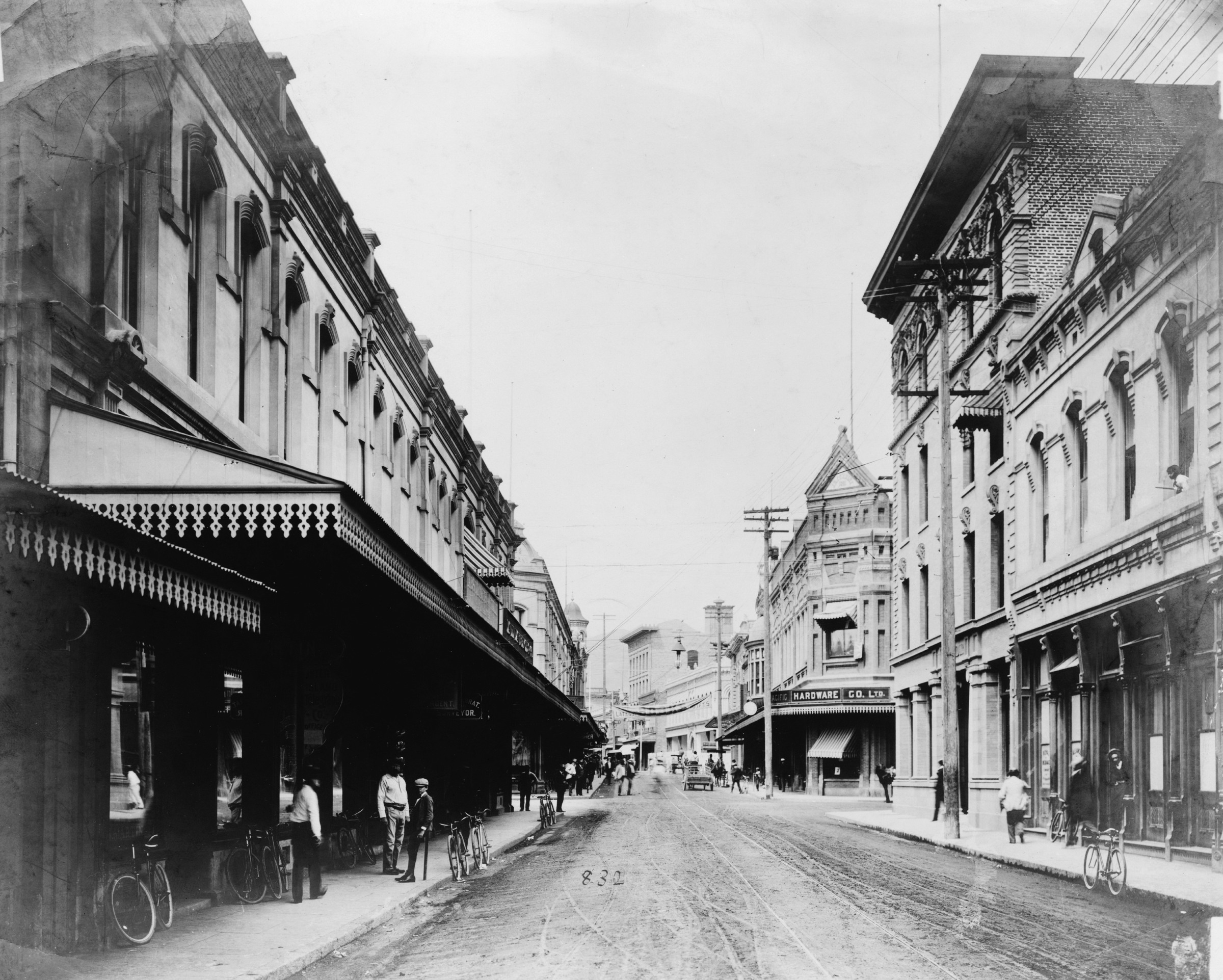
Stores on Fort Street, Honolulu, some time between 1900 and 1915. Men have parked their bicycles along the curb. Bain News Service, Library of Congress. Click the picture to see it full size.
One of the two cartoonists kept on drawing. In 1928 the United States made a special half dollar. It marked 150 years since Captain James Cook landed in Hawaii. The designs on both sides are credited to Juliette May Fraser and a sculptor named Chester Beach.
As for that Saturday in 1917, the regular reporters said it best. “Someone said they couldn’t do it, but they’ve done it, and we knew it.”
Sources
- Honolulu Star-Bulletin (Honolulu, Hawaii), the Y.W.C.A. edition of January 27, 1917: page 1 (the banner, the cartoon, the campaign facts and the women’s news stories); page 4 (the staff list, the Y’s own staff and Inez Wheeler Westgate’s column); page 15 (the sports page); page 24 (“A Tribute to The ‘Y. W.’ Staff”); page 30 (the traffic officer’s tips and the Bergstrom Music Co. ad).
- Honolulu Star-Bulletin: January 20, 1917, page 1 (“Y. W. C. A. to ‘Get Out’ The Star-Bulletin Next Saturday”); January 26, 1917, page 4 (“All Politicians, Beware!”); February 8, 1917, page 3 (“Budget Fund of Y. W. Passes Mark”).
- American Numismatic Association, 1928 Hawaiian Sesquicentennial Half Dollar (the coin’s purpose and its designers).
- Cover: Underwood & Underwood, “Everyday business on Fort St. – outlook N. to Pacific Heights, Honolulu, H. Is.,” stereograph, 1910, Library of Congress, no known restrictions on publication. It shows Fort Street seven years before the Y.W.C.A. edition.
- Bain News Service, “Stores on Fort Street, Honolulu, Hawaii” (the library’s title for an untitled print), between 1900 and 1915, Library of Congress, no known restrictions on publication.
- All newspaper images: Library of Congress, Chronicling America. Published 1917.