On Saturday, September 12, 1857, a circus was due in Morgantown, West Virginia, and it had made the town a promise in print. Its band would ride in a wagon pulled by forty horses. One man would drive them all. If he did not, the ad said, everybody would get into the show free. Morgantown was a small river town then, and still part of Virginia. It had eight days to wonder if one man could really handle forty horses.
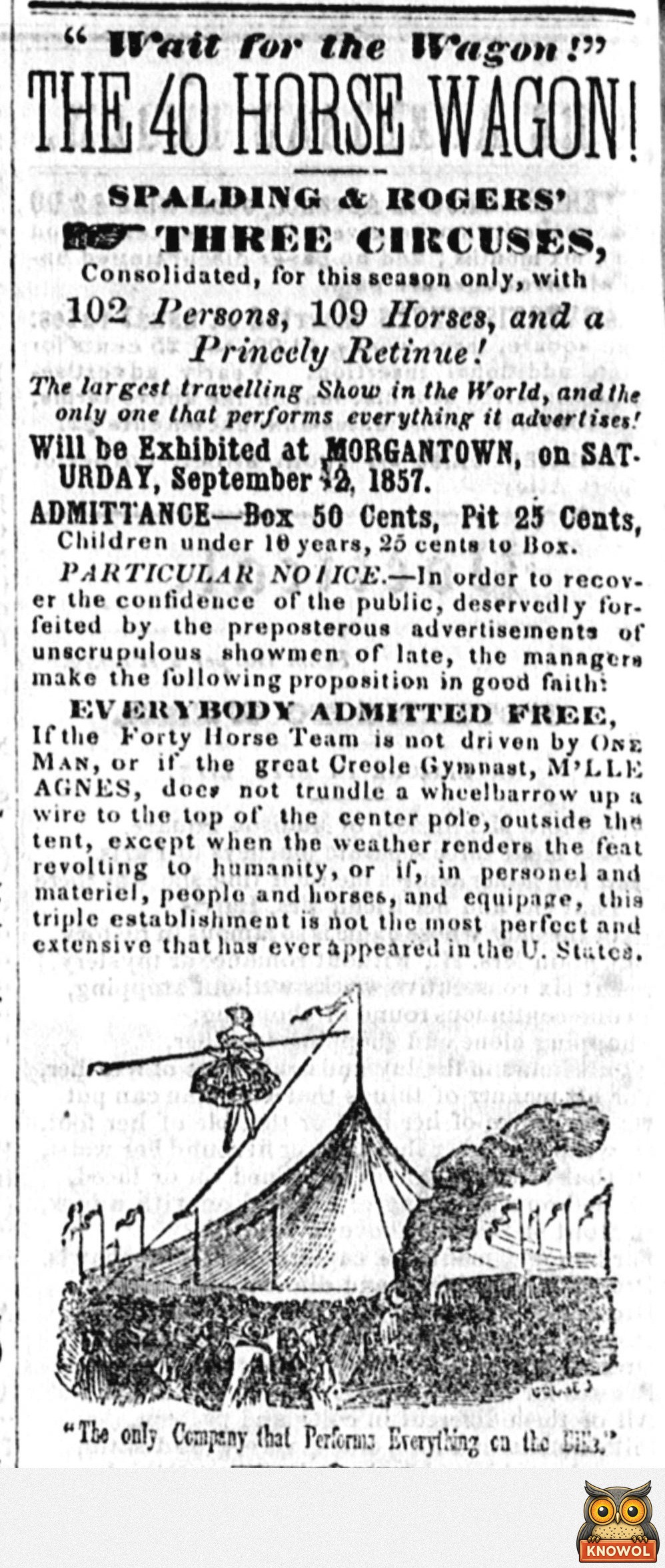
The top of the circus ad: “The 40 Horse Wagon!” American Union, Morgantown, Virginia (now West Virginia), September 4, 1857, page 2. Library of Congress, Chronicling America. Click the clipping to read it full size.
The promise in the paper
The circus belonged to two showmen named Spalding and Rogers. Their ad ran most of the way down a column in Morgantown’s weekly paper, the American Union, on September 4. It opened with a shout: “Wait for the Wagon!” Under that, in the biggest type in the ad, came “THE 40 HORSE WAGON!”
The show called itself “Three Circuses.” Spalding and Rogers said they had rolled three of their own companies into one for the season: one from New England, one that traveled by railroad, and the Floating Palace Circus, which worked the Mississippi and Ohio Rivers by steamboat. Together, the ad said, that made 102 people and 109 horses. It even named the trick horses, Bucephalus, Wild Fire and Tartar among them.
Then came a “PARTICULAR NOTICE.” Other showmen had bragged so wildly, the ad admitted, that people had stopped believing circus ads. So the managers put a promise in writing: “EVERYBODY ADMITTED FREE, If the Forty Horse Team is not driven by One Man.”
The promise covered a second act too. A performer called M’lle Agnes had to “trundle a wheelbarrow up a wire to the top of the center pole” outside the tent. To trundle is to roll something along. The wire was half an inch thick and 200 feet long. The only excuse the ad allowed was weather bad enough to make the feat “revolting to humanity.”
Forty horses, one driver
The ad said how the morning would go. Otto Kyle’s Bugle Band would be “Drawn in triumphal procession through the principal streets every morning.” The band rode in the wagon, the forty horses pulled, and one driver was to handle every one of them.
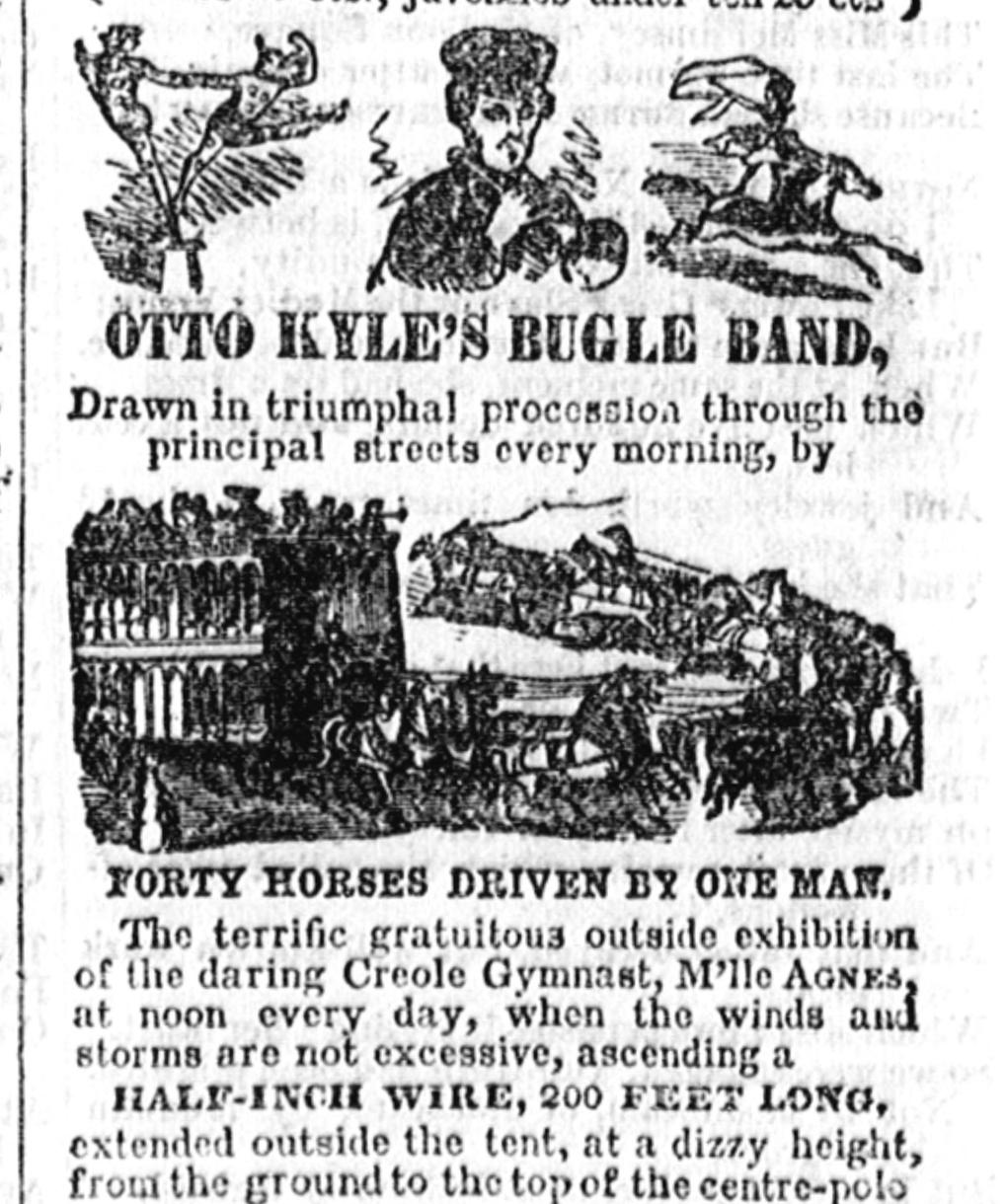
Lower in the same ad: the bugle band’s wagon, “Forty Horses Driven by One Man,” and the wire walk. American Union, Morgantown, September 4, 1857, page 2. Library of Congress, Chronicling America. Click the clipping to read it full size.
Think about the size of that. A farm wagon might have two horses out front. This one had forty, more than a third of all the horses in the show. The parade cost nothing to watch. It was also the best ad a circus could have, because a whole town could see it and hear it coming.
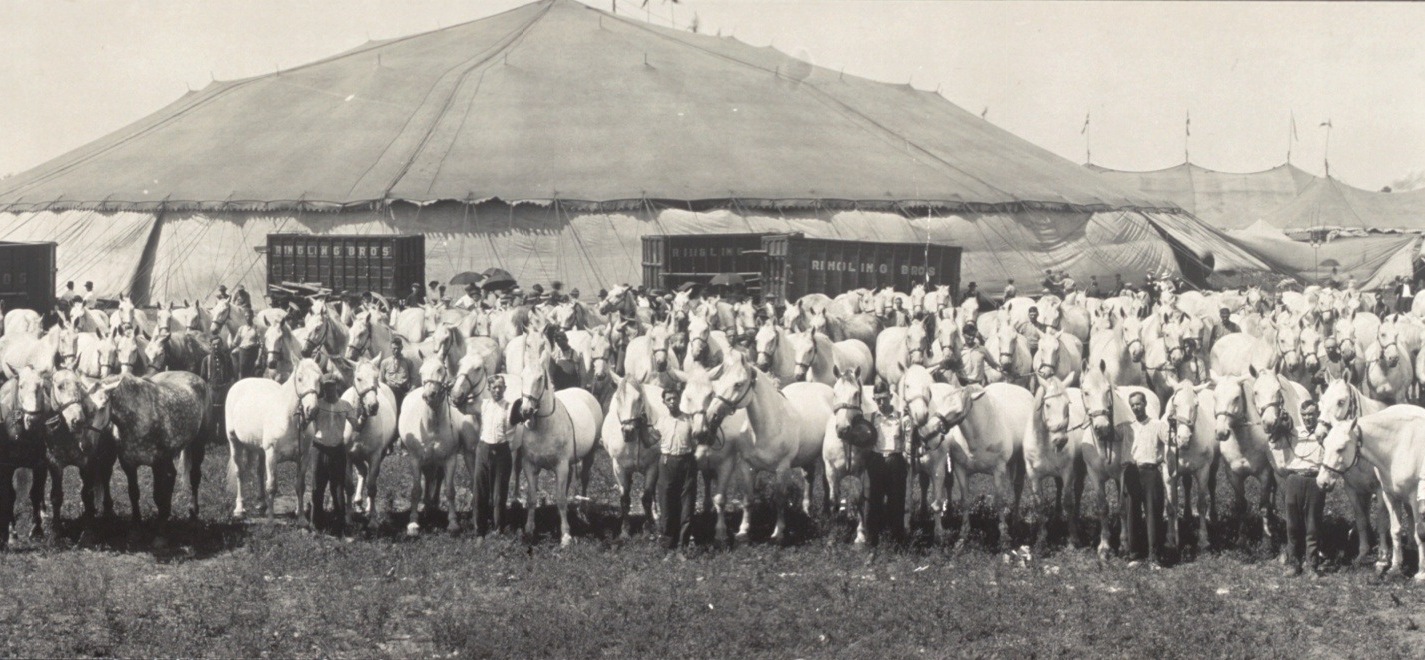
Work horses of the Ringling Bros. Circus in front of the big tent, 1914. This is a stand-in from a later circus, 57 years after Morgantown, to show what a big show’s horses looked like. Panoramic photograph, Kenneth Spencer. Library of Congress. Click the picture to see it full size.
The newspaper winks
The American Union knew what was going on. In the same issue as the ad, it told its readers: “We anticipate a big day in town, from the liberality with which the Company apply the printer’s ink. There’s nothing like it.” Liberality means spending freely. Printer’s ink meant paid advertising, and the paper was saying, with a grin, that this circus bought plenty.
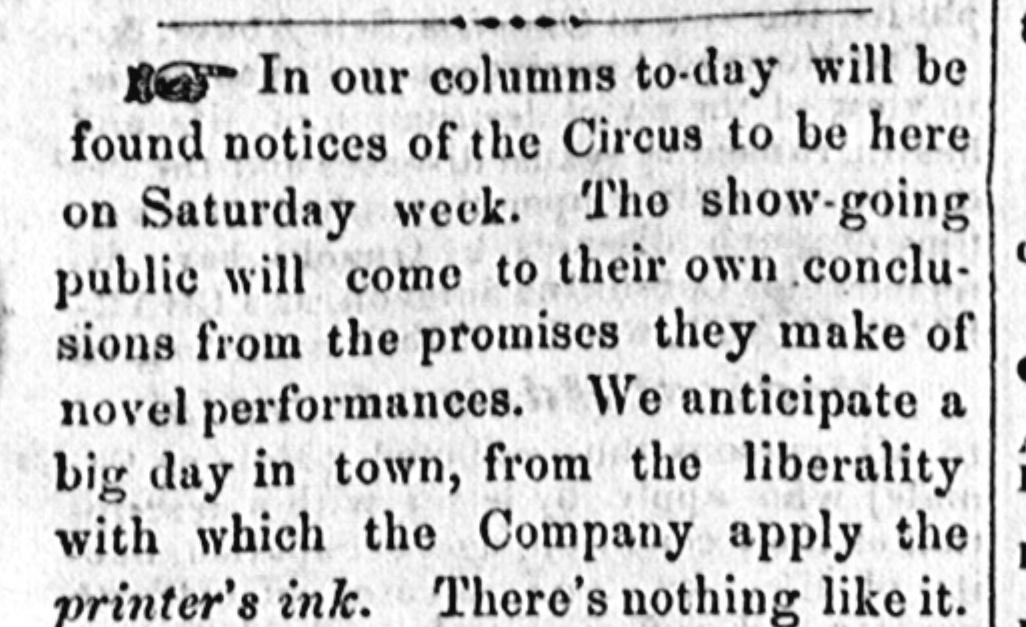
“There’s nothing like it.” American Union, Morgantown, September 4, 1857, page 3. Library of Congress, Chronicling America. Click the clipping to read it full size.
On September 11, the day before the show, the paper ran what looked like a news story. “This extraordinary triple combination which performs here to-morrow, has been causing considerable sensation all over the western country,” it began, and it went on to praise the wagon, the wire walk and the riders.
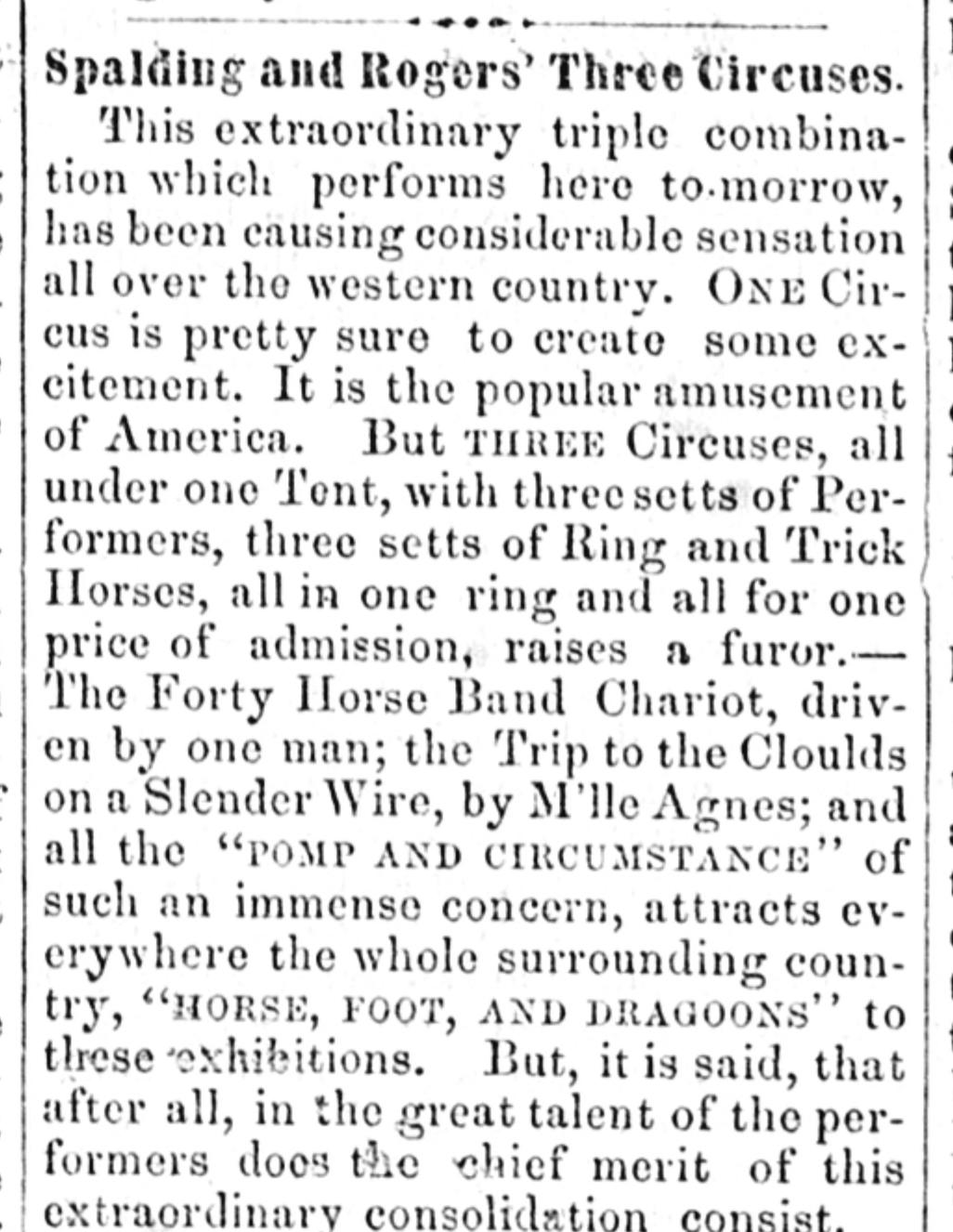
The start of the notice in Morgantown. American Union, September 11, 1857, page 2. Library of Congress, Chronicling America. Click the clipping to read it full size.
Those words were not written in Morgantown. Three months earlier the Mineral Point Tribune, far off in Wisconsin, had printed the same story. Its version began: “This extraordinary triple combination which performs here this week, Friday, is causing considerable sensation all over the Western country.” Almost nothing but the day was changed. The simplest answer is that the circus wrote its own praise and carried it from town to town.
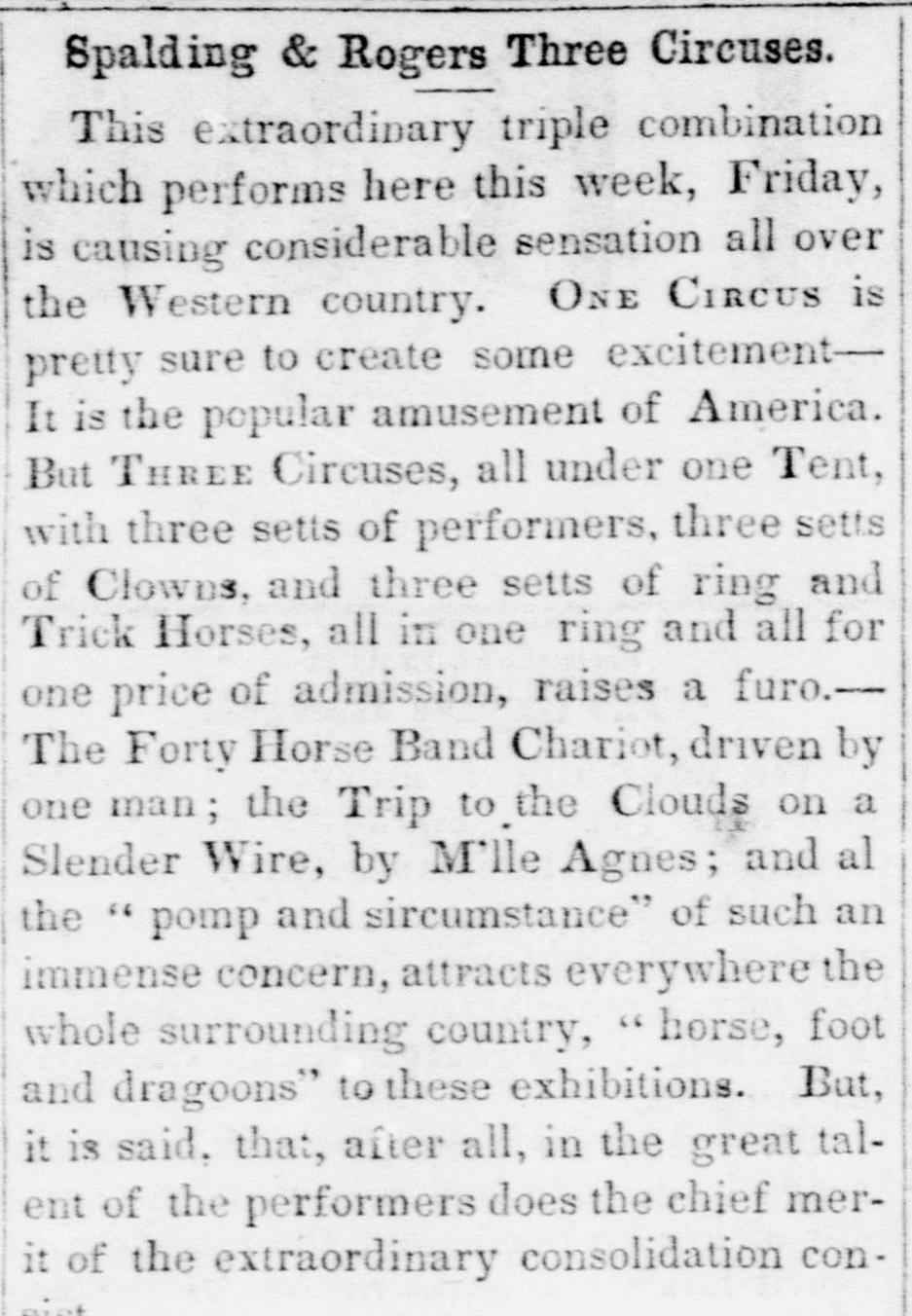
The same notice in Wisconsin, three months earlier. Mineral Point Tribune, Mineral Point, Wisconsin, June 16, 1857, page 2. Library of Congress, Chronicling America. Click the clipping to read it full size.
Circus day
The paper’s report the next week did not describe the parade. What it gave was the size of the crowd: “such a crowd of persons as the occasion called together, we had not often if ever witnessed before in this place.” Then came the numbers. “Thirty-five hundred tickets were sold for the day performance; and over two thousand for the evening.”
That is more than 5,500 tickets in one day. The 1860 census, three years later, counted 741 people living in Morgantown. So the circus sold about seven tickets for every person in town. Most of that crowd had to come in from the farms and villages around it.
Notice the word “sold.” The paper did not say that anyone got in free, or that the circus broke its word. Other papers that year tell the same story. In Iowa that June, the Muscatine Journal reported: “The forty-horse team and wire-walking ‘came off’ as advertised.” The week after Morgantown, the Wheeling Daily Intelligencer told of Agnes “trundling a wheelbarrow up a half-inch wire” in a town called Washington. While she climbed, it said, “some light fingered gentry” picked pockets in the crowd.
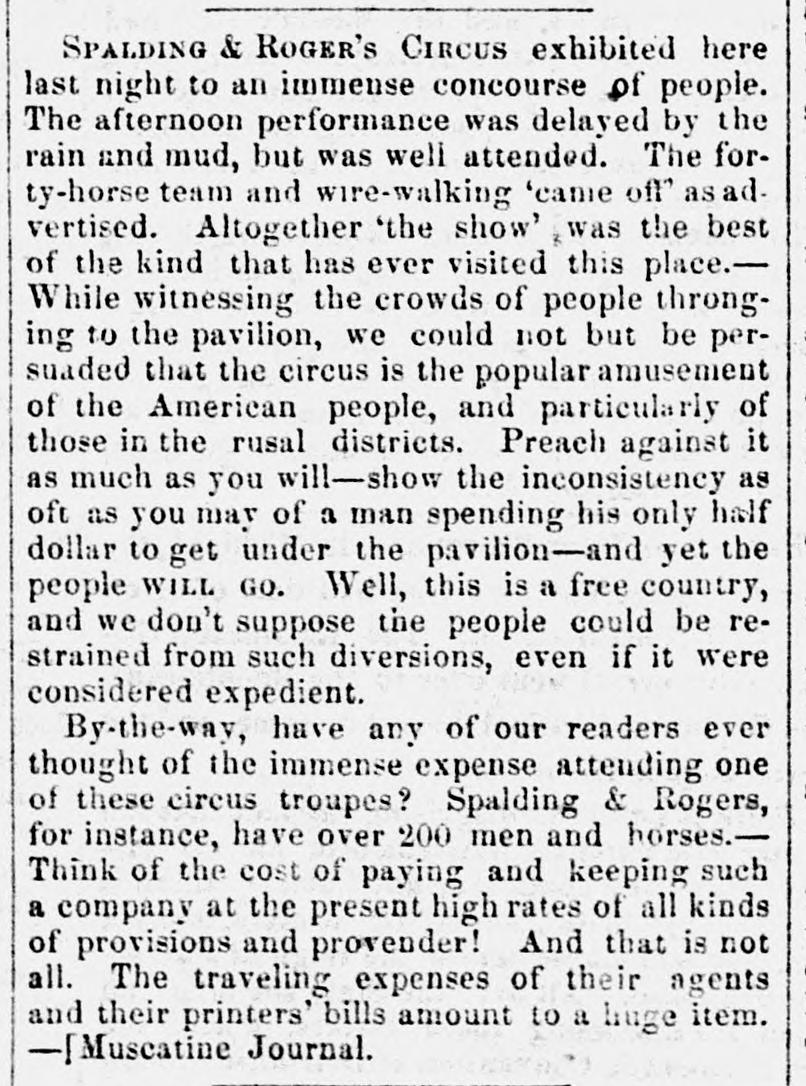
The Muscatine Journal’s report, as reprinted in the Weekly Hawk-Eye and Telegraph, Burlington, Iowa, June 3, 1857, page 2. Library of Congress, Chronicling America. Click the clipping to read it full size.
What it cost
- A box seat: 50 cents
- The pit, the cheaper section: 25 cents
- Children under 10: 25 cents, and they sat in the boxes
- A whole year of the American Union: $1.50, according to a county history printed in 1883
At those prices, 5,500 tickets came to somewhere between $1,375 and $2,750 for one day’s work. The paper had a tip for circus crowds, too. Fake money was going around, it warned on September 4: “On Show days, in crowds, and at all times, look twice before you take money once.”
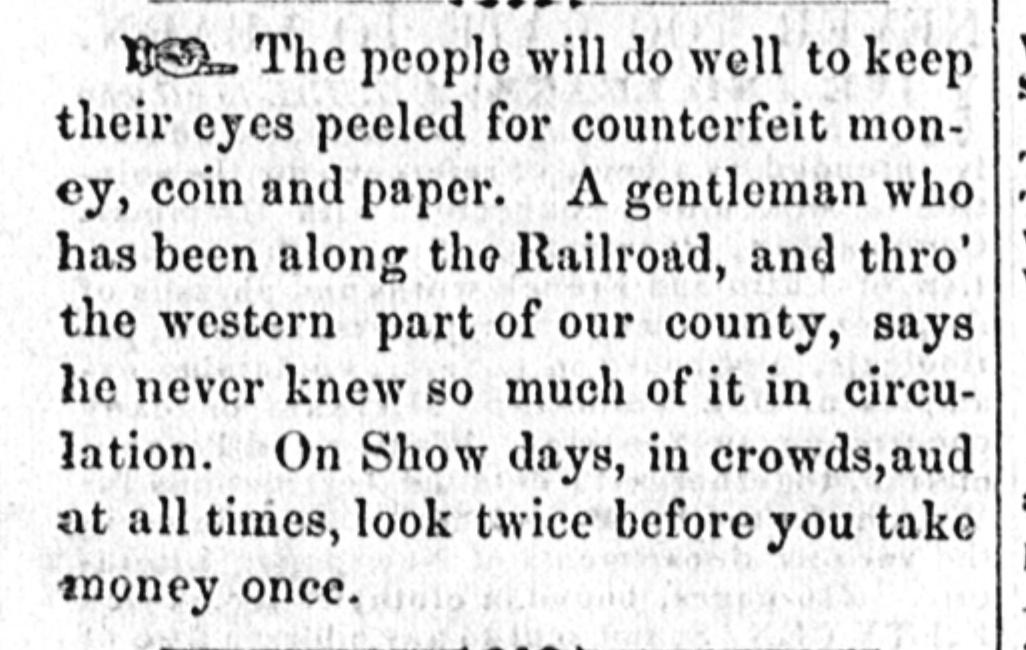
The paper’s warning about counterfeit money. American Union, Morgantown, September 4, 1857, page 3. Library of Congress, Chronicling America. Click the clipping to read it full size.
The paper’s honest review
Once the circus had moved on, the American Union said what it really thought. “Our private opinion is that it is a grand shaving institution of the keenest Yankee construction,” it wrote. “They are none of the whiskey bloats, but a set of wide-awake, unconscionable skinners. They are crack actors though.”
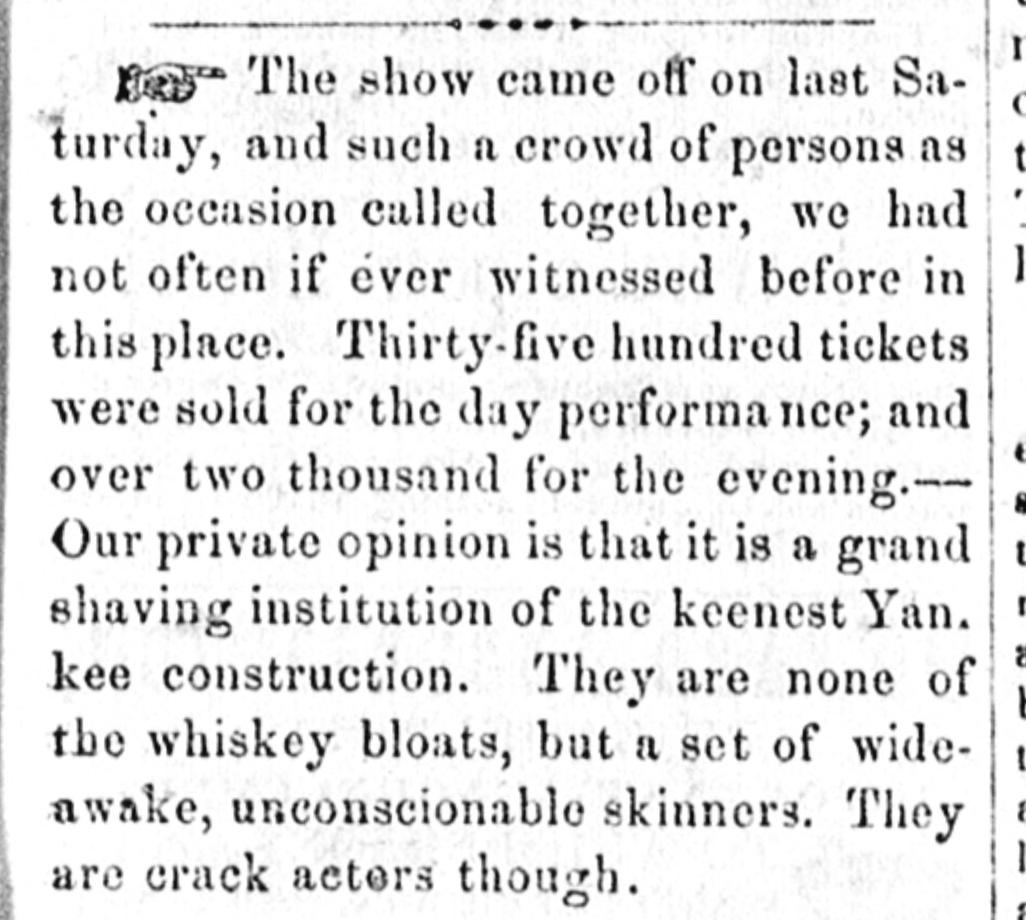
“They are crack actors though.” American Union, Morgantown, September 18, 1857, page 3. Library of Congress, Chronicling America. Click the clipping to read it full size.
That takes some unpacking. “Shaving” was old slang for trimming people of their money, and a Yankee was a Northerner with a name for driving a hard bargain. “Whiskey bloats” were drunks, which the paper said these showmen were not. “Crack” meant first-rate. In plain words: they got our money, and they were worth watching.
We can’t say who wrote it. The paper named Simeon Siegfried, Junior, as its editor. But the issue with the review said he had been away, held up on an Ohio River boat by low water, and got home after the week’s paper was ready.
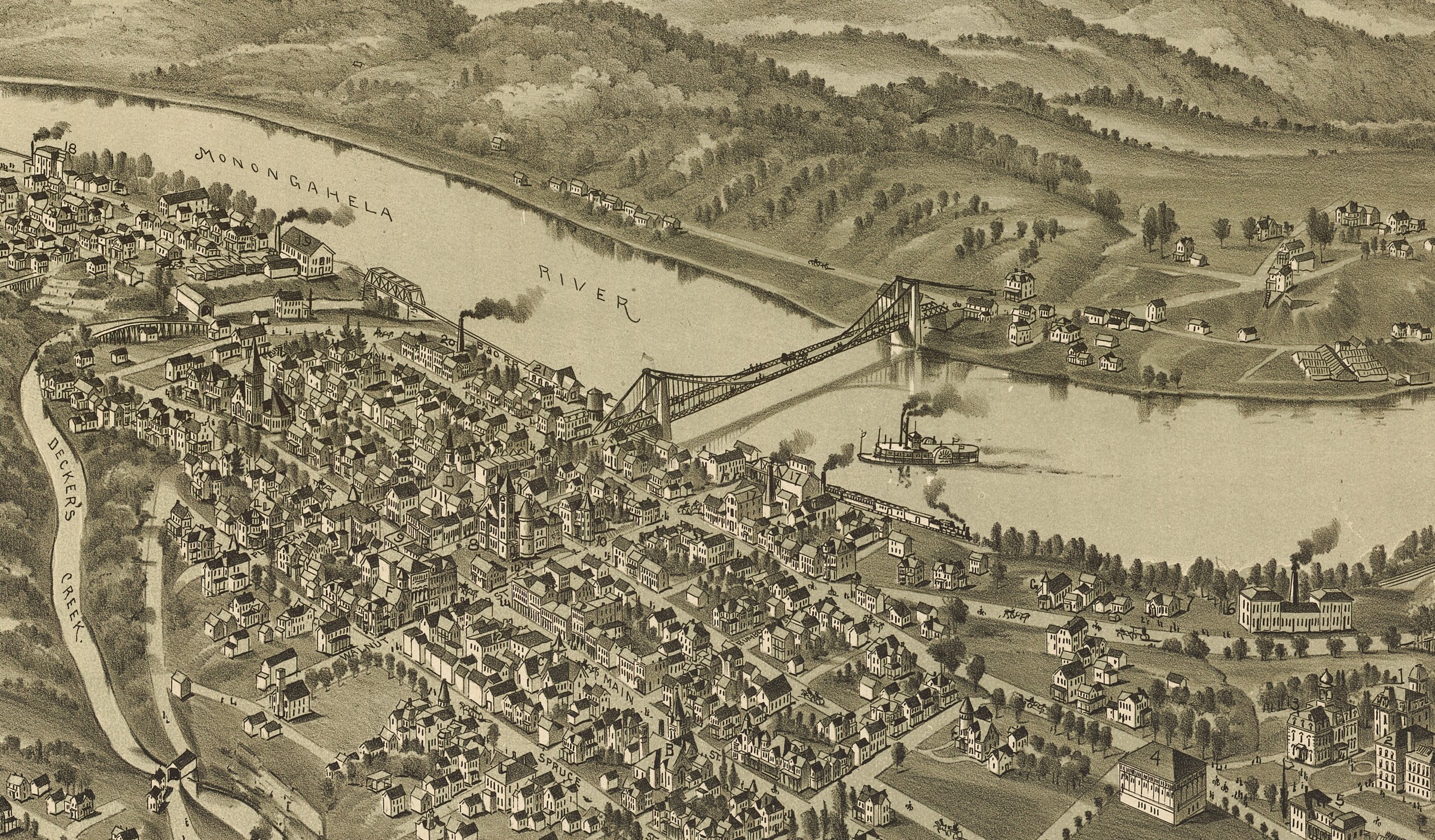
Morgantown in 1897, forty years after the circus: Main Street, Decker’s Creek and the Monongahela River. Part of a bird’s-eye view published by T. M. Fowler and James B. Moyer. Library of Congress. Click the picture to see it full size.
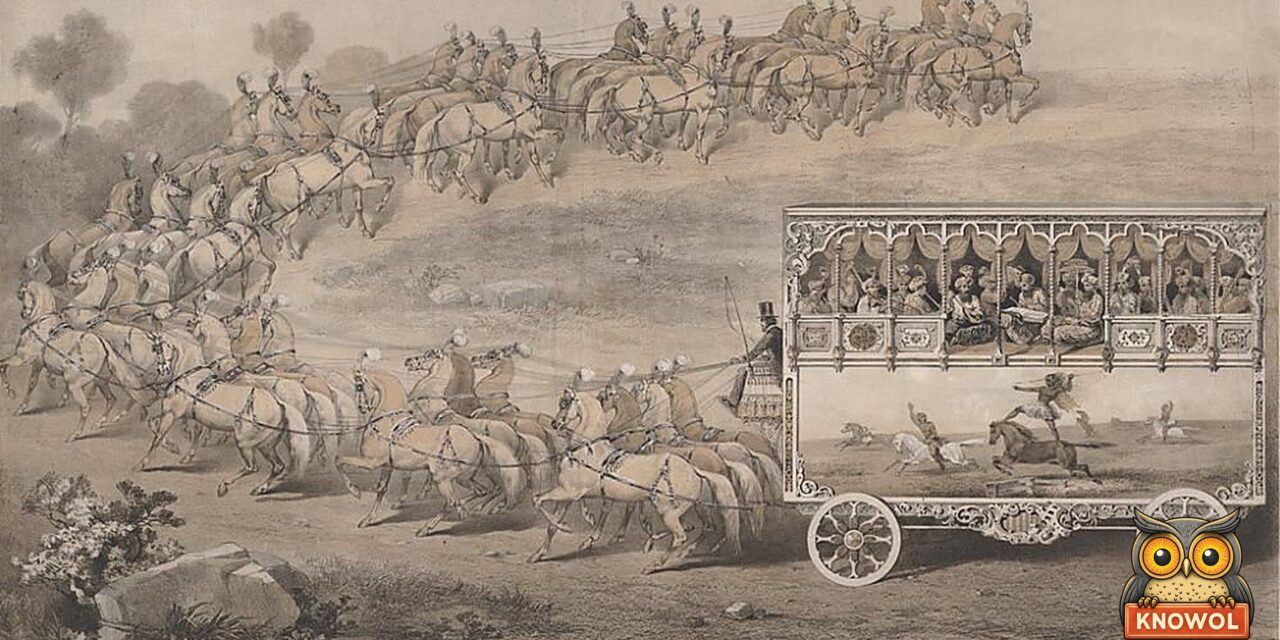
The picture at the top of this story is Spalding and Rogers’ own poster from about 1849, eight years before Morgantown. It calls the wagon “The Stupendous Apollonicon or Great Musical Chariot.” It shows the same idea: a music wagon full of players, a long line of horses, and one man in a top hat holding the reins. The circus promised Morgantown that sight or a free show, and Morgantown paid more than 5,500 times. As the paper said of printer’s ink, “There’s nothing like it.”
Sources
- American Union (Morgantown, Virginia, now West Virginia): September 4, 1857, page 2 (the circus ad, “The 40 Horse Wagon!”); September 4, 1857, page 3 (the printer’s ink note, the counterfeit money warning, and “Three Circusses at Once”); September 11, 1857, page 2 (“Spalding and Rogers’ Three Circuses”); September 18, 1857, page 3 (“The show came off on last Saturday” and the note that the editor was away).
- Mineral Point Tribune (Mineral Point, Wisconsin), June 16, 1857, page 2: “Spalding & Rogers Three Circuses.”
- Weekly Hawk-Eye and Telegraph (Burlington, Iowa), June 3, 1857, page 2: the Muscatine Journal’s report on the circus.
- Wheeling Daily Intelligencer (Wheeling, Virginia, now West Virginia), September 18, 1857, page 3: “Pick-Pockets.”
- Samuel T. Wiley, History of Monongalia County, West Virginia (1883): page 306 (Morgantown’s population in 1860) and page 436 (the American Union, its editor and its price).
- Cover: “Spalding & Rodgers Two Circus: The Stupendous Apollonicon,” circus poster, about 1849, Tibbals Circus Collection, The John and Mable Ringling Museum of Art, from the copy on Wikimedia Commons. Public domain.
- Kenneth Spencer, “[Work horses of Ringling Bros. Circus],” panoramic photograph, 1914, Library of Congress, no known restrictions on publication.
- T. M. Fowler and James B. Moyer, “Morgantown, West Virginia 1897,” bird’s-eye view, Library of Congress, Geography and Map Division.
- All newspaper images: Library of Congress, Chronicling America. Published 1857.