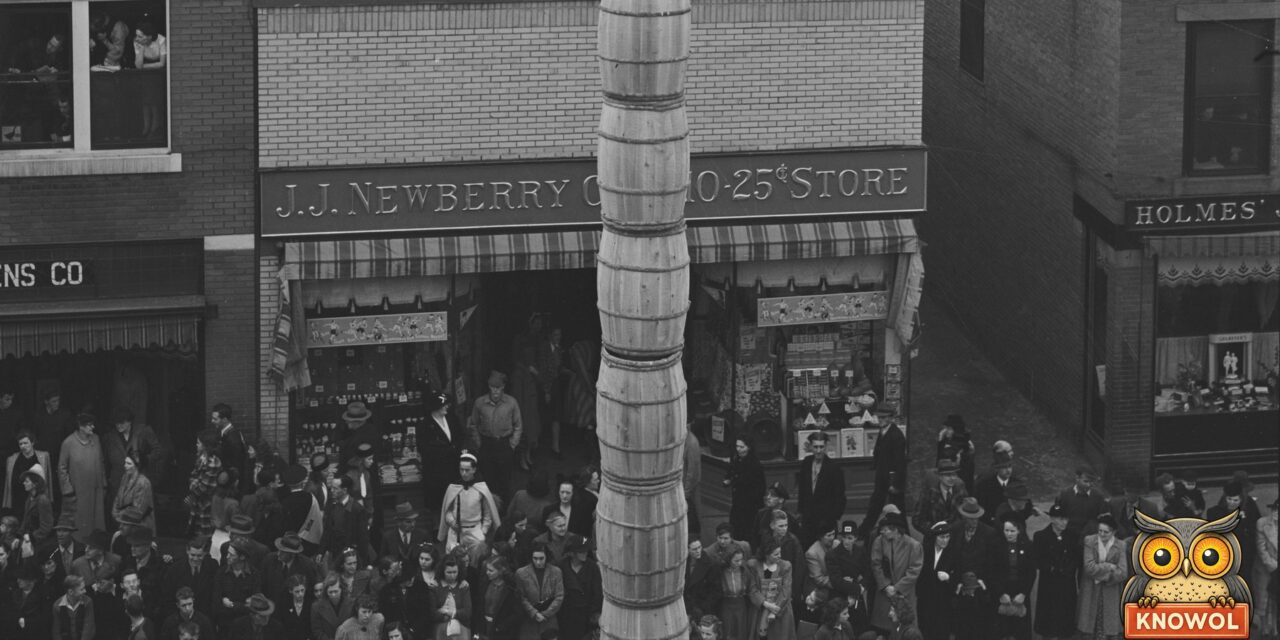
Look straight up from the crowd on Main Street. A pole made of wooden barrels, stacked one on top of the next, climbs past the J. J. Newberry Co. five-and-ten, past the flat roofs, past the hills on the edge of town. Wires run from it to the rooftops to keep it standing. At the very top, two cutout boys hold up potatoes almost as big as they are. It’s October 1940 in Presque Isle, Maine, and the town is about to hold a race. The racers will roll barrels of potatoes down the street.
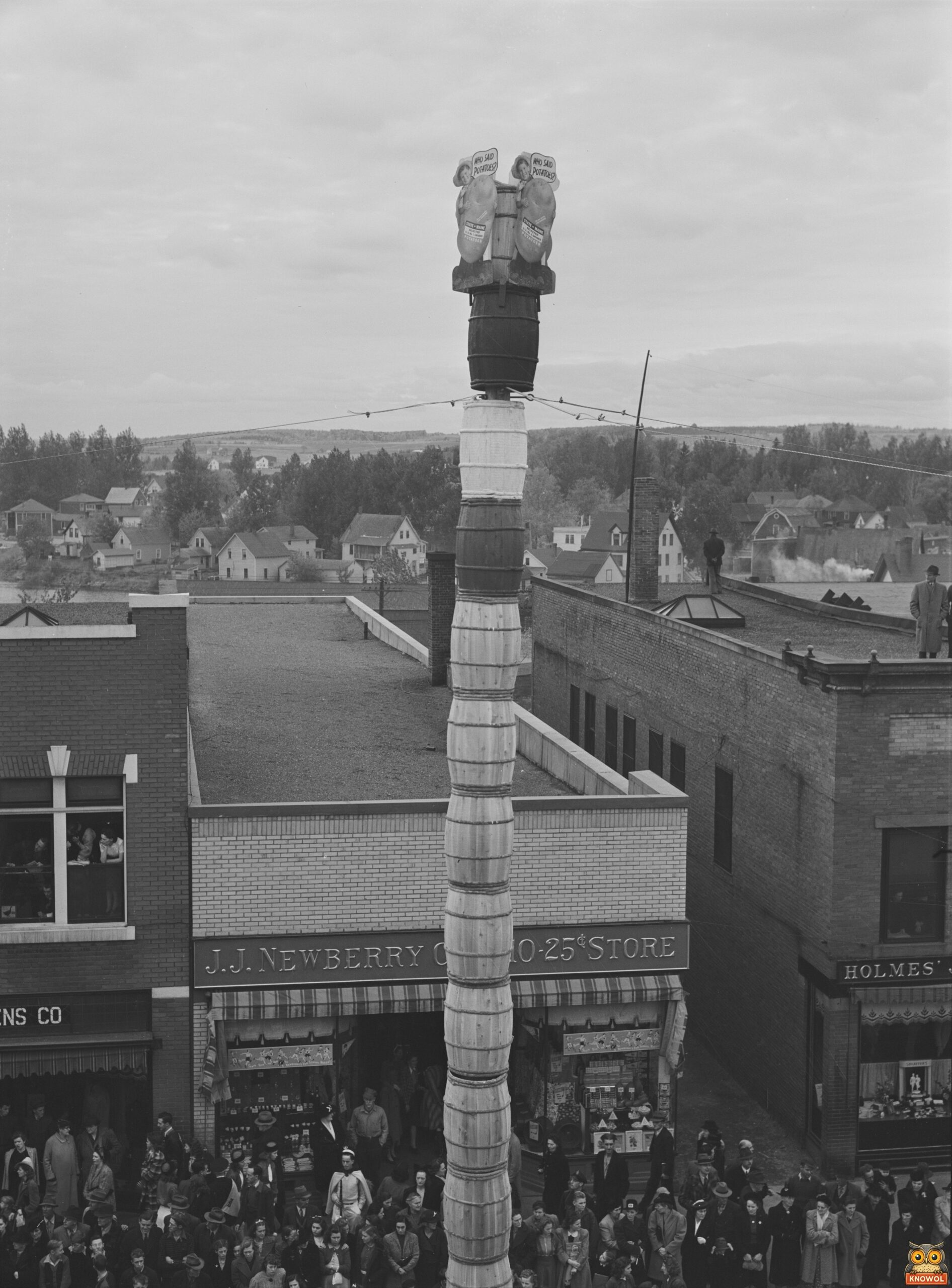
“The “Pototem” pole standing in the main street of Presque Isle, Maine, as an advertisement for the barrel rolling contest.” Photo by Jack Delano, October 1940. Library of Congress, Prints and Photographs Division, FSA/OWI Collection. No known restrictions. Click the picture to see it full size.
The Pototem Pole in Presque Isle, Maine
The man who took the picture, Jack Delano, wrote a caption card for it. He called it “The “Pototem” pole standing in the main street of Presque Isle, Maine, as an advertisement for the barrel rolling contest.” Pototem is a joke word: potato plus totem pole. On another card from the same day he called it “an advertising stunt.”
Count the barrels and you pass ten before the pole runs out the bottom of the picture. Most are pale new wood. A few are dark. The cutout boys at the top each wear a little sign that reads “STATE OF MAINE SELECTED U.S. No. 1 GRADED POTATOES.” That was a label for Maine’s top-grade potatoes.
Now look at the people. The street below is packed with hats and coats. Men stand on the roof at the right to get a better view. In an upstairs window at the left, a row of faces looks down. Everybody in Presque Isle seems to be waiting for something.
Why Potatoes Mattered in Aroostook County, Maine
Presque Isle sits in Aroostook County, at the top of Maine, and people there just call it “The County.” In 1940 it was potato country, plain and simple. Farm families planted potatoes in spring, and in the fall the whole county turned out to dig them, pick them and pack them.
Those potatoes left the farms in barrels. A full barrel was heavy. Delano’s cards from the race say it plainly: “Each barrel has 200 pounds of potatoes in it.” That’s about as much as a big grown man weighs. So a barrel race wasn’t a silly game made up for a festival. It was a contest in the same work the men did all fall, only faster, and with the whole town watching.
The Poster in Presque Isle, Maine
The potato growers sent posters all over Aroostook County. Delano photographed one tacked to a stack of barrels. It says, word for word: “FIRST INTERNATIONAL Potato Barrel Rolling CONTEST PRESQUE ISLE, MAINE THURSDAY – OCTOBER 3 2 P. M. ON MAIN STREET.”
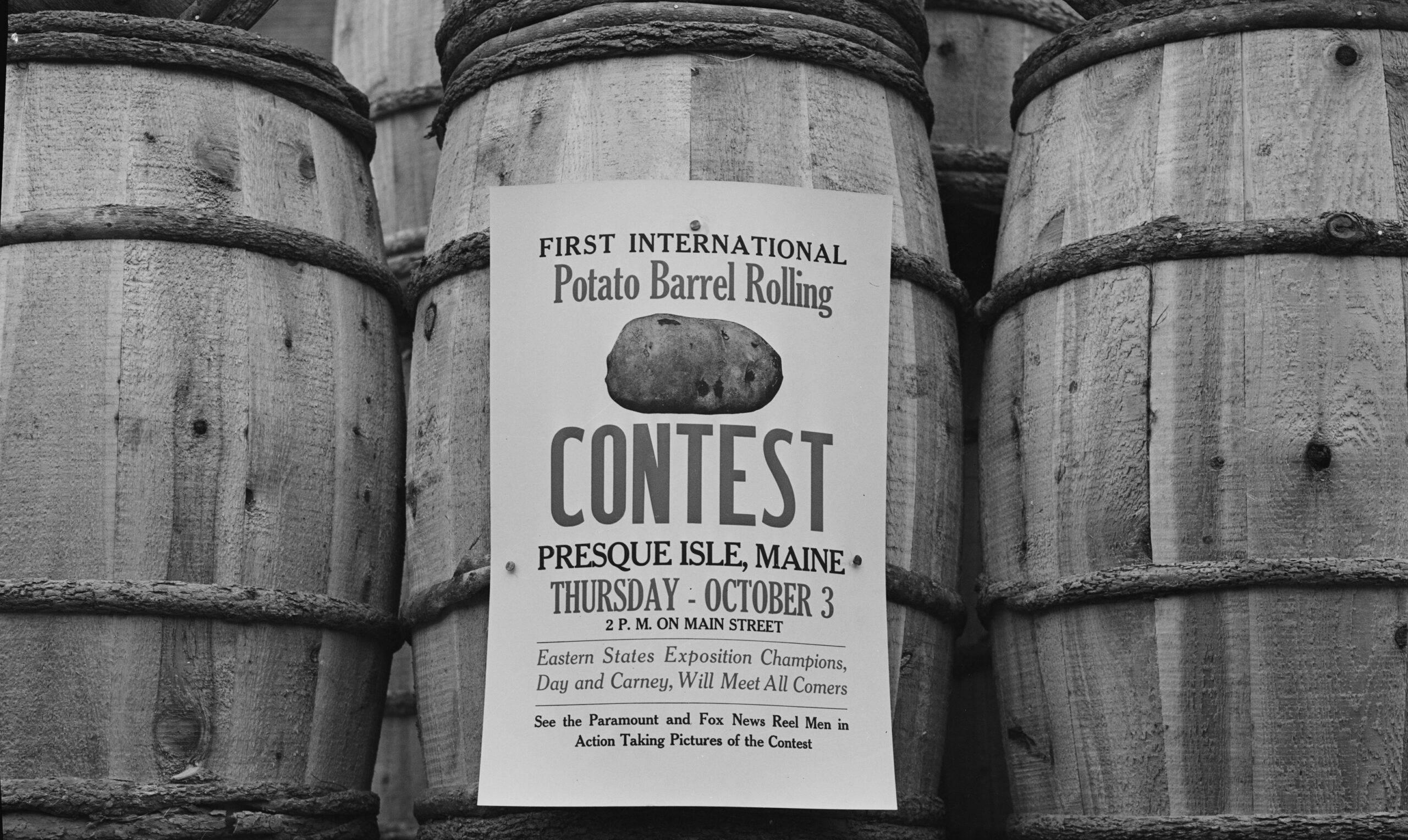
“Poster distributed throughout Aroostook County, Maine by the potato growers association advertising the barrel rolling contest in Presque Isle.” Photo by Jack Delano, October 1940. Library of Congress, FSA/OWI Collection. No known restrictions. Click the picture to see it full size.
Under that, in slanted letters: “Eastern States Exposition Champions, Day and Carney, Will Meet All Comers.” The Eastern States Exposition was the big farm fair for all of New England. So two men had already won there, and now anyone brave enough could try to beat them. The bottom line promised one more thrill: “See the Paramount and Fox News Reel Men in Action Taking Pictures of the Contest.” Newsreels were the short news films shown in movie theaters before the main picture. People all over the country might see Presque Isle on the big screen.
The Champion’s Jacket in Presque Isle, Maine
One of those champions was James Day. On race day he showed up in a jacket with big stitched letters across the back: his name in fancy script, then “CHAMPION,” then “Barrel Roller” and “1940.” Delano stood right behind him and took his picture.
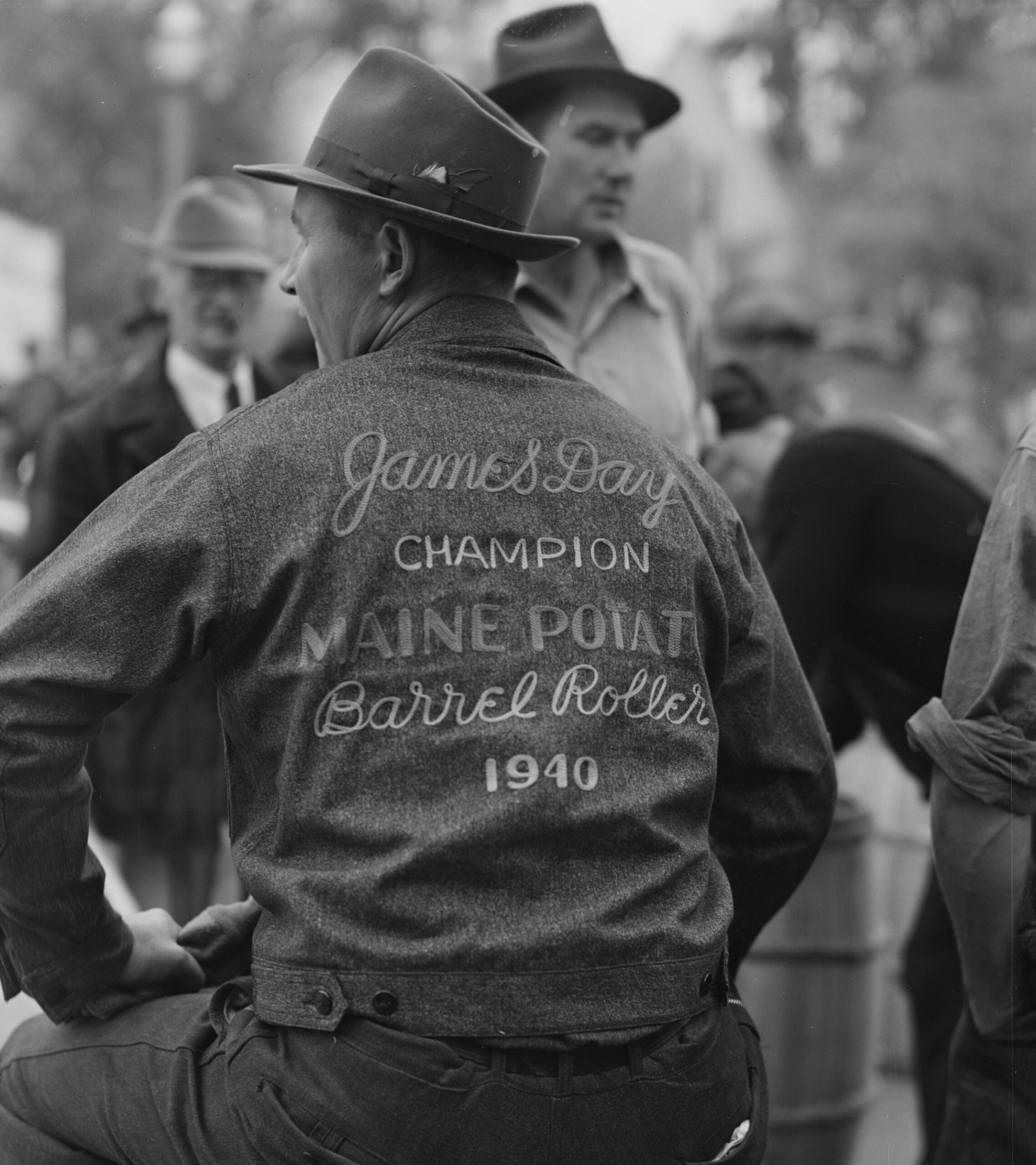
“James Day, ace barrel roller and idol of Aroostook boys. He lost in the contest. Presque Isle, Maine.” Photo by Jack Delano, October 1940. Library of Congress, FSA/OWI Collection. No known restrictions. Click the picture to see it full size.
Then Delano wrote a caption card that is the best line of the whole day: “James Day, ace barrel roller and idol of Aroostook boys. He lost in the contest.”
That’s it. Two short sentences. The kids of The County looked up to James Day. He wore his title on his back. And on the big day, in front of the newsreel cameras, somebody beat him. Delano’s cards don’t say who won, and Down East magazine, looking back at these photos in 2016, couldn’t find a record of the winner either.
Race Day on Main Street in Presque Isle, Maine
The rest of Delano’s cards from Presque Isle read like a schoolkid’s report of the best day of the year. There was a parade, with “the school band parading on the main street.” There were “schoolgirls carrying Aroostook potatoes on sticks.” A Boy Scout held the string at the finish line. Before the men raced, the boys had their own race: “the boys’ barrel rolling contest which preceded the men’s competition.”
A tractor pulled a float shaped like a giant potato, with a banner on the side bragging that Aroostook County grew the best potatoes in the world. The big potato had a surprise inside. Here is Delano’s card: “This giant “potato” was supposed to open and reveal an elaborate girls band. The mechanism kept getting stuck.” It did open in the end. Another card shows “drum majorettes” who “were revealed when the giant wood and paper potato was open.”
The newsreel men got special treatment, too. One card reads: “Weighing barrels of potatoes for the benefit of newsreel cameramen.” In Delano’s pictures of the race, the men tip each barrel up onto its bottom rim and spin it along like a heavy wheel, bent low beside it. Then, when the sun went down, the town kept going. “The evening program after the barrel rolling contest consisted of dancing in the street (plenty of jitterbugging),” Delano wrote. The jitterbug was the fast, swinging dance kids loved in 1940.
Earlier That Summer: Herbert Drost of Washburn, Maine
The October race was a second helping. Earlier in 1940, Presque Isle had held a potato barrel race at its summer potato festival, and newspapers far away noticed one racer. In August a photo ran in papers as far off as McAllen, Texas. Its caption said Herbert Drost of Washburn, Maine, a farm town nearby, had only one leg and entered the contest anyway.
Drost rolled his barrel of potatoes 120 feet in 21 and 3/5 seconds. That’s about the length of three school buses, in about 22 seconds, pushing a barrel as heavy as a man. He came in fourth, and the caption said his rivals “were among the best in the world at this game.”
Who Took the Picture in Presque Isle, Maine
Jack Delano was 26 years old that October. He was born in 1914 in a village in what is now Ukraine and came to America with his family in 1923, when he was eight. He studied art and music in Philadelphia, and in 1940 he was working as a photographer for the Farm Security Administration, or FSA.
The FSA was a government office from the Great Depression. It helped struggling farm families, and it sent photographers all over the country to show how Americans lived and worked. Most of the hundreds of pictures he made in Aroostook County that October show the potato harvest: pickers in the fields, potatoes being graded in Caribou, farm families at their back doors. On this one day he also got the fun.
Most of his cards are plain and careful. A few, like the one about James Day, have a wink in them. You can tell Delano liked these people. He found a spot up high to show the pole and the crowd together, and he got close enough to read a champion’s jacket.
Delano later moved to Puerto Rico, where he made films and wrote music. He died there in 1997. The Office of War Information handed his FSA negatives to the Library of Congress in 1944. They’re still there, free for anyone to see: the pole of barrels, the stuck potato, the dancing in the street, and James Day with “CHAMPION” on his back, on the day he lost.
Sources
- Jack Delano, “The “Pototem” pole standing in the main street of Presque Isle, Maine, as an advertisement for the barrel rolling contest,” October 1940. Caption card title, record and scan: Library of Congress, item 2017792064 (LC-USF347-041766-D). The scan on file is reversed (the store signs read backward), so we show it flipped left to right. FSA/OWI photographs: no known restrictions.
- More Jack Delano photos from Presque Isle, October 1940, all FSA/OWI, Library of Congress: the poster, item 2017792013 (words read off the full-size scan); James Day, item 2017792017; the giant potato, item 2017792023; the drum majorettes, item 2017792053; schoolgirls with potatoes, item 2017792033; the school band, item 2017792011; the boys’ race, item 2017792035; the Boy Scout at the finish line, item 2017748322; 200 pounds of potatoes, item 2017748325; weighing for the newsreels, item 2017792063; the start of the final heat, item 2017792078; the street dance, item 2017792021; “advertising stunt,” item 2017792016.
- “One Leg as Good as Two,” photo caption, McAllen Daily Press, McAllen, Texas, August 18, 1940, page 12: Library of Congress, Chronicling America (Herbert Drost of Washburn; 120 feet in 21 and 3/5 seconds; fourth place). Read off the page scan.
- Kristi Finefield, “You Say Potato, I Say Pototem,” Picture This, Library of Congress blog, February 2023: blogs.loc.gov.
- Will Grunewald, “Barrels of Fun,” Down East magazine, October 2016: downeast.com (the July 1940 festival race; no record of the October winner).
- Jack Delano’s life: Wikipedia. About the FSA/OWI photographs and their rights: Library of Congress, FSA/OWI Black-and-White Negatives and rights and restrictions.