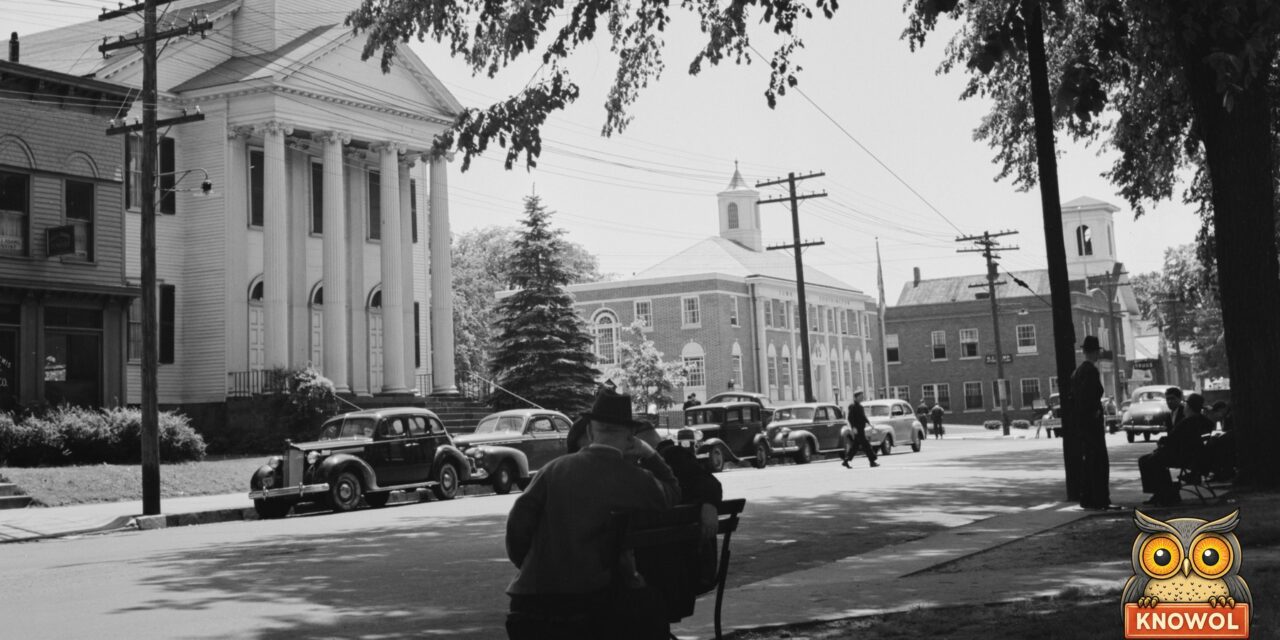
A man in a hat sits on a park bench under a big shade tree, with someone else tucked in beside him. Across the street stands a tall white church with big columns, a clock and a steeple. Long black cars are parked at the curb, and a man in a dark suit is crossing the street. It’s late May 1942, on the town green of Southington, Connecticut, and nothing much is happening. That was the point. The government had sent a photographer to spend a week showing what an ordinary American town looked like, and this quiet corner was part of it.
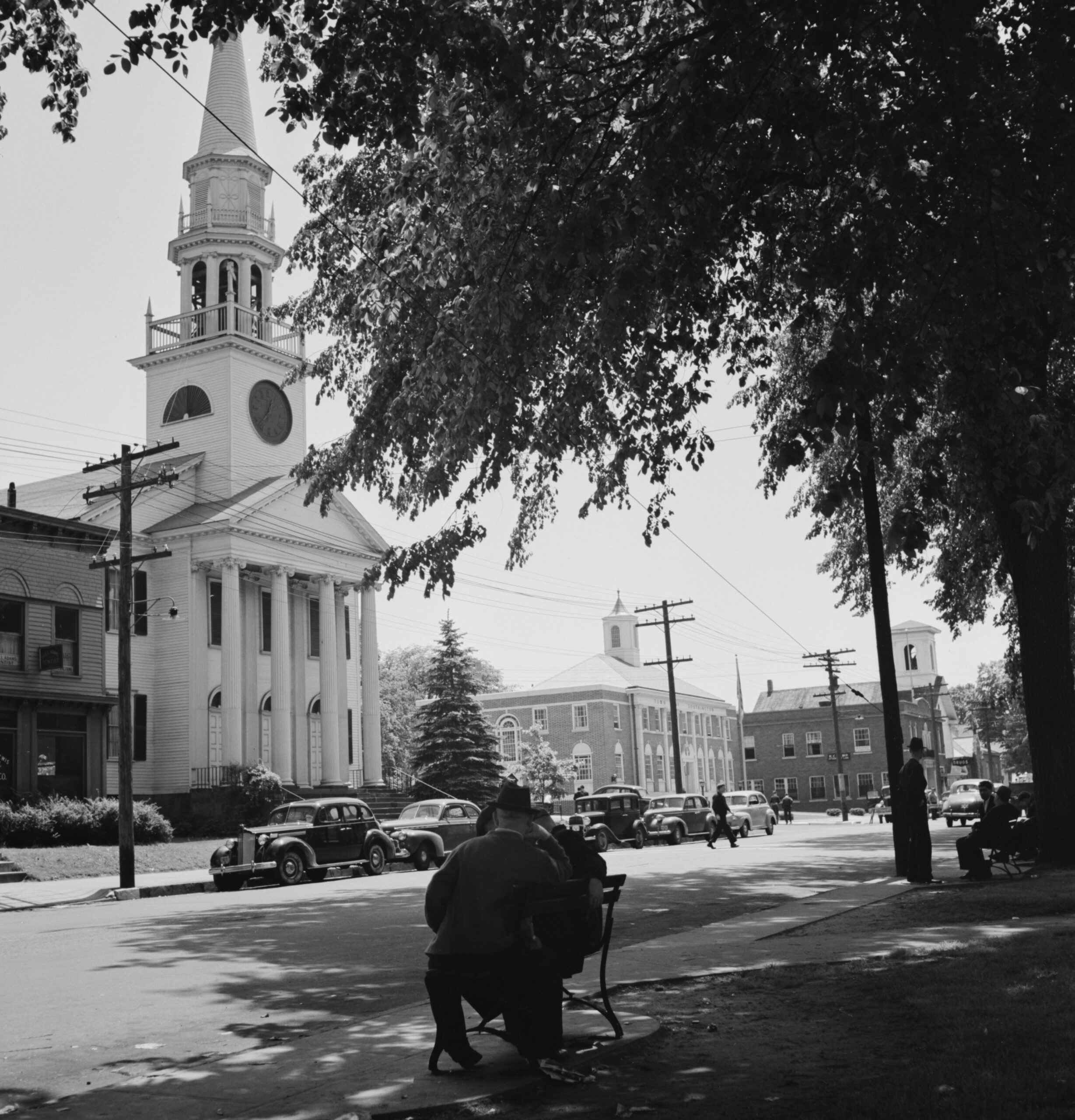
“Southington, Connecticut. The First Congregational Church, oldest of the town’s eleven churches, looks substantially the same as when it was erected in 1830.” Photo by Fenno Jacobs, May 23-30, 1942. Library of Congress, Prints and Photographs Division, FSA/OWI Collection. No known restrictions. Click the picture to see it full size.
The Week a Photographer Came to Southington, Connecticut
The photographer in Southington was Fenno Jacobs, a magazine photographer born in 1904 who had worked for Life and Fortune. The Library of Congress dates his Southington pictures to one week, May 23 to May 30, 1942. That was less than six months after the attack on Pearl Harbor pulled the United States into World War II.
Jacobs was working for the government’s wartime information office. In June 1942 it became the Office of War Information, or OWI. Its job was to tell the war’s story, at home and around the world. Many of the Southington caption cards carry the same words, the name of the whole series: “An American town and its way of life.”
Southington was a good pick for that. It sits in the middle of Connecticut, between Hartford and Waterbury. The 1940 census counted 9,649 people there. It had farms and orchards around it, factories in it, and a town green in the middle. In other words, it looked a lot like thousands of other towns.
The Church on the Green in Southington, Connecticut
The white church in the photo is the First Congregational Church of Southington. Jacobs’s card says it is the “oldest of the town’s eleven churches” and “looks substantially the same as when it was erected in 1830.” Substantially the same means it had hardly changed. An 1859 book about the church’s longtime pastor, the Reverend William Robinson, agrees that the building went up in 1830.
So in 1942, the church was 112 years old. That’s older than the cars in front of it, older than the telephone poles, and older than the electric wires strung across the picture. People’s great-great-grandparents could have sat on that same green and looked at the same church.
Look past the church and you can see a brick building with a white tower on top. Zoom in on the big scan and the words over its doorway read TOWN OF SOUTHINGTON. That’s the town hall, and Jacobs took a picture of it up close that same week.
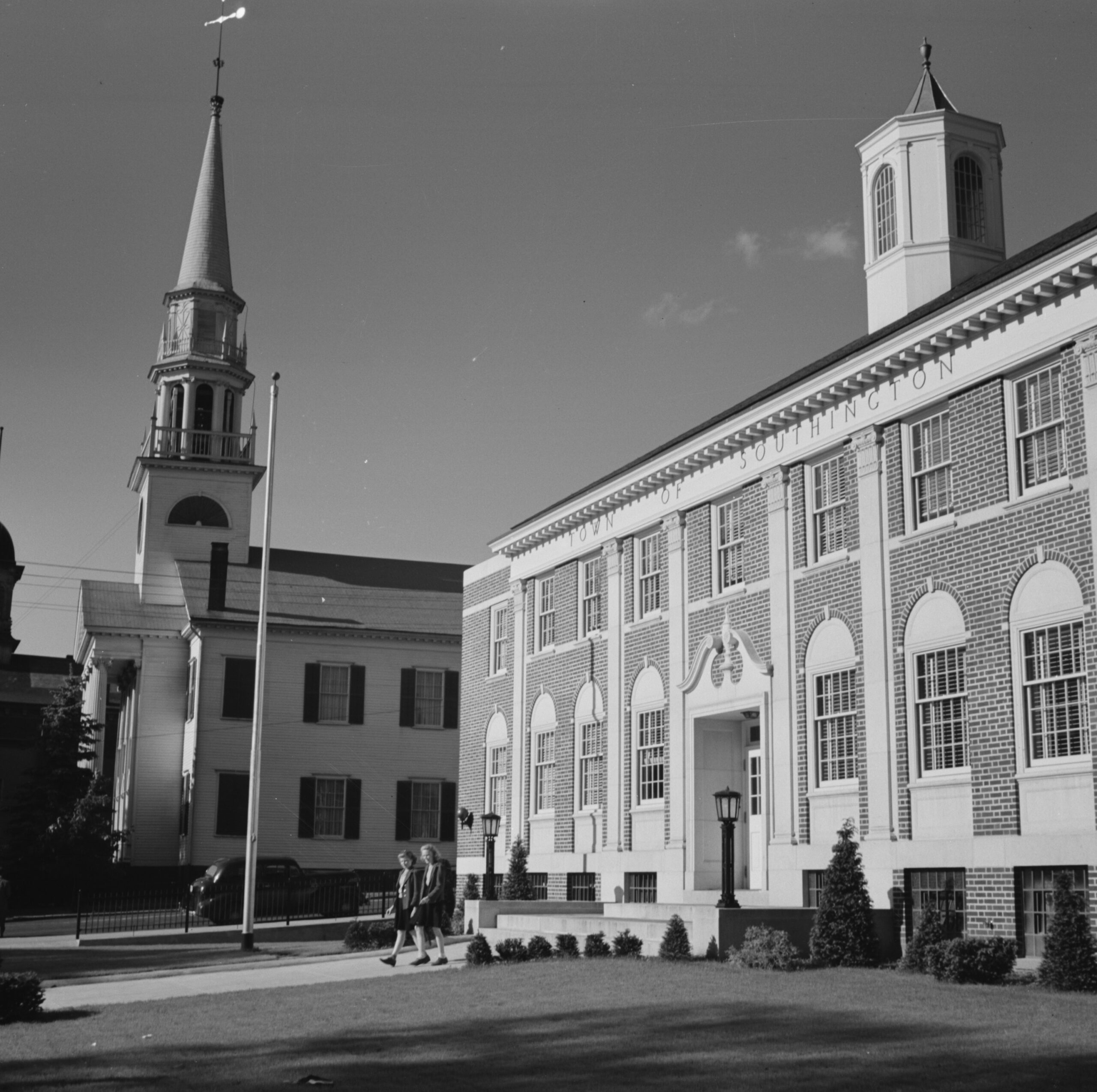
“Southington, Connecticut. Town hall, in which all of the people meet to make their own laws.” Photo by Fenno Jacobs, May 23-30, 1942. Library of Congress, Prints and Photographs Division, FSA/OWI Collection. No known restrictions. Click the picture to see it full size.
Captions Written for Strangers
Here’s the fun part of the Southington pictures. Read the caption cards and you can tell they weren’t written for people in Connecticut. They explain things anybody in Southington already knew.
The town hall card says it is the place “in which all of the people meet to make their own laws.” That’s how a New England town meeting works. Instead of a city council, the voters themselves come to the meeting and vote on the town’s business. Another card shows the town’s leader, First Selectman James Simone, sitting in the crowd at a town meeting. It says, “Like other citizens he has one vote on each measure.” Then it explains the job: “The office of the First Selectman corresponds to that of mayor.”
One card even explains a backyard game. “Bocci, an Italian game somewhat like bowling,” it begins. Today we usually spell it bocce. Players roll heavy balls down a dirt court and try to stop them closest to a small ball.
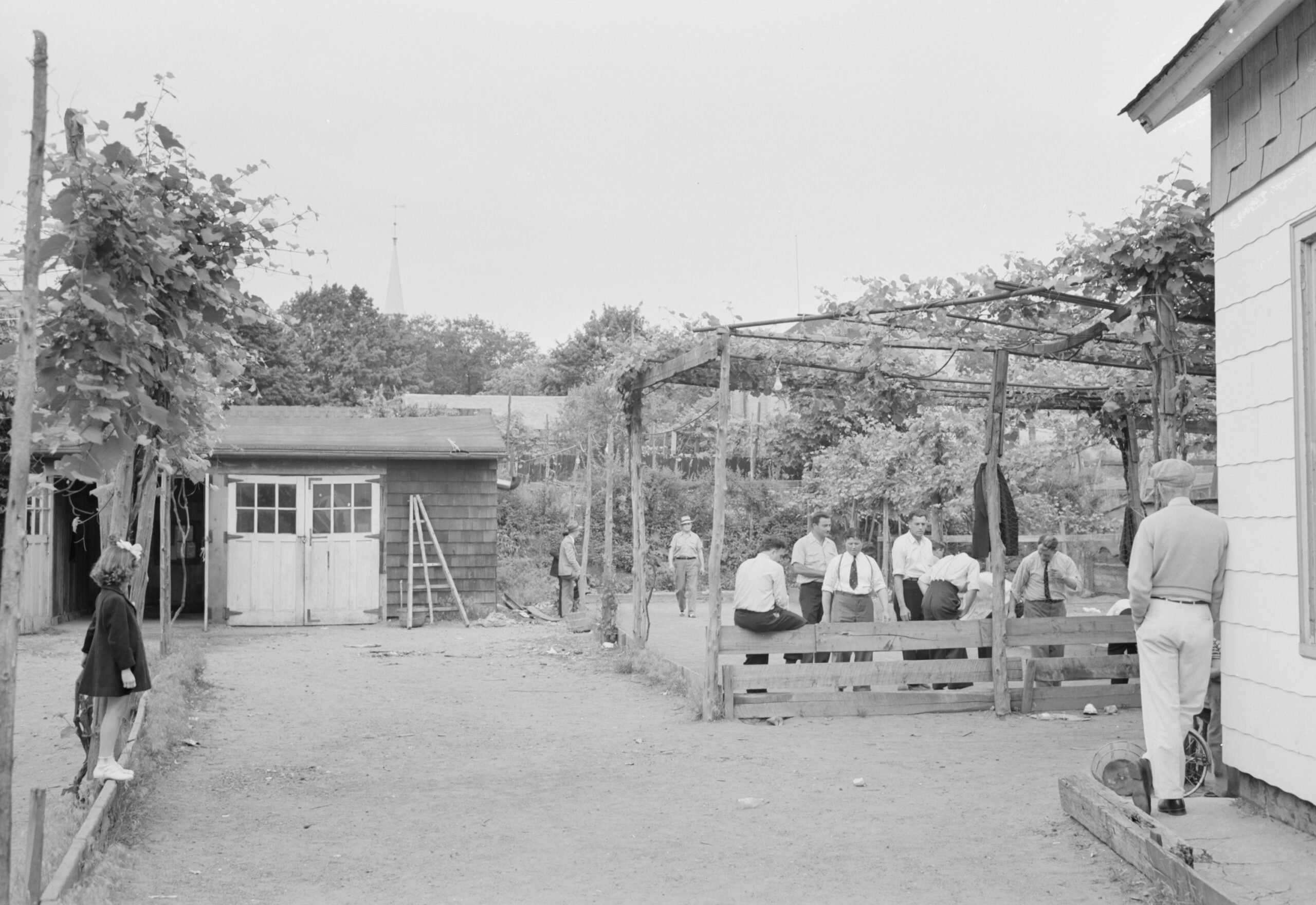
“Bocci, an Italian game somewhat like bowling…” (from the caption card). Southington, Connecticut. Photo by Fenno Jacobs, May 23-30, 1942. Library of Congress, Prints and Photographs Division, FSA/OWI Collection. No known restrictions. Click the picture to see it full size.
Nobody in Connecticut needed a town hall explained to them. But somebody far away might. The negatives came to the Library of Congress in 1944 from the OWI’s Overseas Picture Division, the part of the office that made pictures for people in other countries. Southington’s Wikipedia page says the pictures went into a booklet that was dropped from airplanes over Europe. We could not find a copy of that booklet to check, so for now that part stays a good story the town tells.
Who Jacobs Met in Southington, Connecticut
Jacobs didn’t only photograph buildings in Southington. His cards name real neighbors and tell a little about each one.
Mrs. Ethel Oxley ran a drugstore on the main street. Her card says, “Her family has had a business on this same corner for more than 200 years.” Nick Grillo came from Italy as a boy, saved for his boat ticket, and grew roses. His card calls him the developer of “the famous ‘thornless rose.'” Andrew Smedberg came from Sweden broke, the card says, and built a dairy farm that earned “a ‘good living’ for his family of seven.”
Jacobs also sat in on a Sunday dinner at Ralph Hurlbut’s house. It honored Corporal Robert Hurlbut, 21, “home on his first furlough from the army.” A furlough is a soldier’s leave, a short trip home. The card adds that Mr. Hurlbut “works in a defense plant.”
At a school on Beecher Street, the card says, half the students came from Italian American families and half from Polish American families. They held a May Day party and crowned a king and a queen, one from each group.
A Town at Work During the War
The war was in a lot of Jacobs’s Southington pictures, even the quiet ones. One card says the Atwater Manufacturing Company had made drop forgings (metal parts pounded into shape while red hot) since 1869, “first for use in the manufacture of wagons and carriages, later for automobiles, and today for the war.”
That week was also Memorial Day. Jacobs photographed the parade going down the main street, and his card has an honest line about the crowd: “The small number of spectators is accounted for by the fact that the town’s war factories did not close.” Spectators means people watching. Lots of Southington was at work.
That makes the two people on the bench in the first picture a little more interesting. On a week when the factories never stopped, somebody still found time to sit in the shade on the green. It’s a small, plain thing. But it fit the series title on the cards: an American town and its way of life, with an old church, a green, and a neighbor taking a rest.
Southington, Connecticut, Today
Southington is much bigger now, with more than 43,000 people in the 2020 census. The First Congregational Church still stands on the green.
Fenno Jacobs’s week of pictures is still at the Library of Congress. Because they were made for the government, they belong to everyone, free to see and share. Each one is a little window into one week in May 1942, when one Connecticut town stood in for all of America.
Sources
- Fenno Jacobs, “Southington, Connecticut. The First Congregational Church, oldest of the town’s eleven churches, looks substantially the same as when it was erected in 1830,” May 23-30, 1942. Caption card title, record and full-size scan: Library of Congress, item 2017865150 (LC-USW3-041969-E). The record notes the negatives’ transfer from the Office of War Information, Overseas Picture Division, in 1944. FSA/OWI photographs: no known restrictions.
- Other Fenno Jacobs caption cards from the same week, quoted word for word from the Library of Congress records: town hall, item 2017865104; First Selectman James Simone at the town meeting, item 2017865304; bocce, item 2017864931; Mrs. Ethel Oxley, item 2017865307; Nick Grillo, item 2017865255; Andrew Smedberg, item 2017864934; the Hurlbut family, item 2017865172; Beecher Street School, item 2017864944; Atwater Manufacturing Company, item 2017865013; the Memorial Day parade, item 2017864991.
- Memoir of the Rev. William Robinson, Formerly Pastor of the Congregational Church in Southington, Conn. (1859): Internet Archive (the church building of 1830).
- Southington, Connecticut, population 1940 and 2020, and the booklet story: Wikipedia. Fenno Jacobs: Wikipedia. The Office of War Information: Wikipedia.
- About the FSA/OWI photographs and their rights: Library of Congress, FSA/OWI Black-and-White Negatives and rights and restrictions.