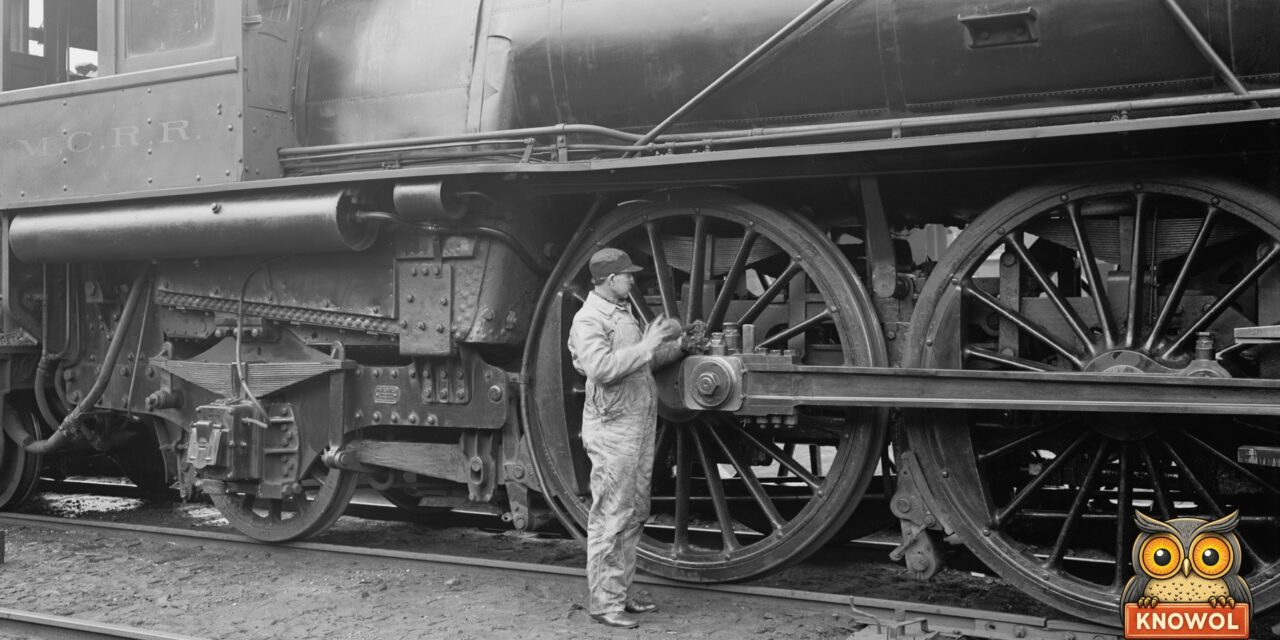
At four o’clock on a spring afternoon in 1899, a huge new engine rolled out of Boston, Massachusetts, pulling an express train west toward Springfield. Its number was 221. The man at the throttle wore overalls and a jumper, but earlier that day he had been visiting sick people in a frock coat and a tall hat. He was Dr. Humphrey F. Brackett, a railroad engineer and a doctor at the same time.
Newspapers loved him. The Springfield Republican passed along a Boston Globe story about him, and on April 11, 1899, the Portland Daily Press in Maine printed it under a big headline: “FASTEST THING ON EARTH.” A smaller line under it said it all: “A Physician Runs the Big Machine Out of Office Hours.”
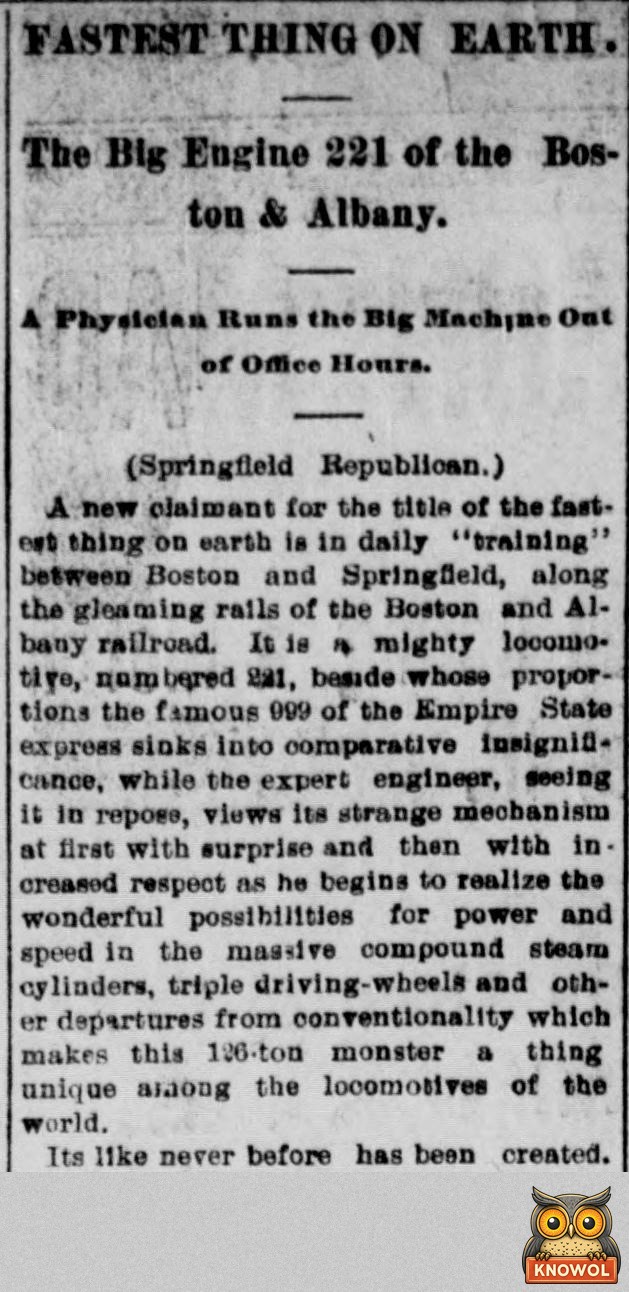
“Fastest Thing on Earth. The Big Engine 221 of the Boston & Albany. A Physician Runs the Big Machine Out of Office Hours.” The Portland Daily Press, Portland, Maine, April 11, 1899, page 2, reprinted from the Springfield Republican. Library of Congress, Chronicling America. Click the clipping to read it full size.
Engine No. 221 Out of Boston
Engine No. 221 belonged to the Boston and Albany Railroad, which ran from Boston across Massachusetts. “A new claimant for the title of the fastest thing on earth is in daily “training” between Boston and Springfield,” the story began.
The paper measured No. 221 against the most famous engine in America, the 999, which pulled New York’s record-setting Empire State Express. Next to No. 221, the paper said, “the famous 999 of the Empire State express sinks into comparative insignificance,” which was a fancy way of saying the 999 looked small.
The numbers were big. The 999 weighed 62 tons, while No. 221 weighed 85 tons by itself and 126 tons with its tender, the car behind the engine that held 4,500 gallons of water and eight tons of coal. No. 221 had six big driving wheels, three on each side, and each one stood 6 feet 2 inches tall, taller than most grown men.
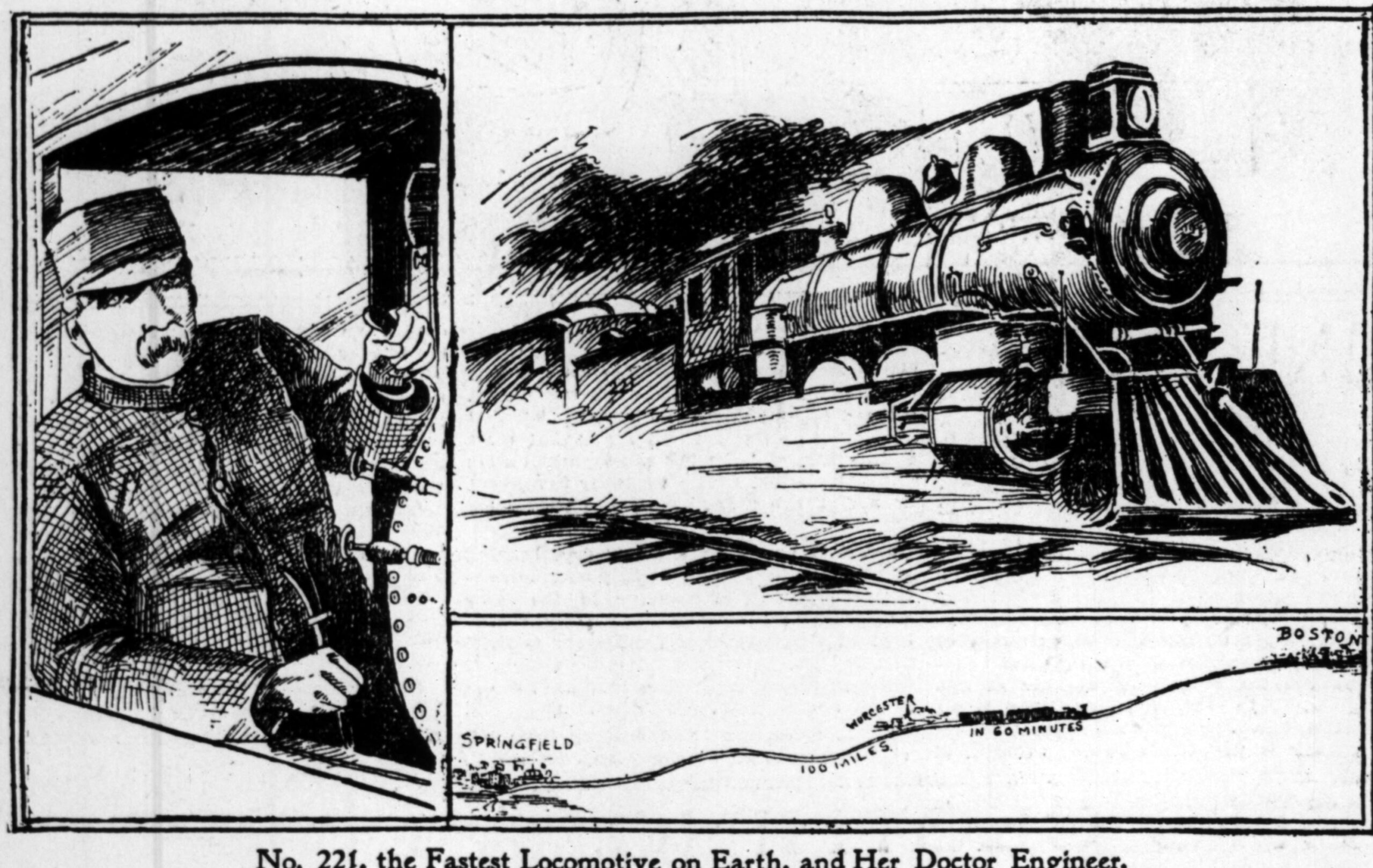
“No. 221, the Fastest Locomotive on Earth, and Her Doctor Engineer.” A newspaper artist drew Dr. Brackett in his cab, the engine, and a map of the run from Boston past Worcester to Springfield. St. Louis Post-Dispatch, April 30, 1899. Internet Archive, public domain. Click the picture to see it full size.
A Mile Every 40 Seconds Out of Boston
The builders of Boston’s engine No. 221 hoped it could keep up 90 miles an hour with a heavy train. The paper put it another way: “a mile every 40 seconds.” So far it had “done” 70 miles an hour “with such ridiculous ease” that everyone expected more.
Dr. Brackett was careful, though. The paper said “the driver of the young but vigorous steed has had to “feel” his way from day to day.” He let it run a little faster on the long, straight stretches, and he kept “repressing the natural yearning to “let her go” just once against the record.” He wanted to see how fast it could go, but he held back.
One day that spring, the New York train left Worcester for Boston 10 minutes late. With No. 221 pulling, it made up all 10 minutes in 24 miles, and then the engineer had to slow down so he would not get ahead of the schedule.
The Engine With One Giant Cylinder
Boston’s engine No. 221 had a strange look. Most engines had two cylinders of the same size, one on each side, and in each big metal tube the steam pushed a piston back and forth to turn the wheels.
No. 221 was a “compound.” Its steam pushed a piston in a small cylinder first, then flowed over into a much bigger cylinder on the other side and pushed again. Getting two pushes out of the same steam saved water, the paper said.
The big cylinder was so big, the paper joked, that it could give “sleeping accommodations for a good sized man who was willing to “cuddle up” a bit.”
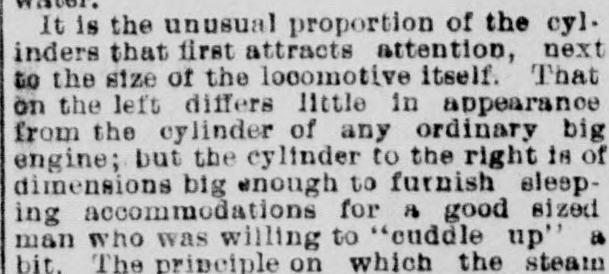
The cylinder big enough to sleep in. The Portland Daily Press, Portland, Maine, April 11, 1899, page 2. Library of Congress, Chronicling America. Click the clipping to read it full size.
No. 221 also fooled people’s ears. The St. Louis Post-Dispatch explained that most people guessed a train’s speed by its puffs. An ordinary engine puffed four times for each turn of its driving wheels, but No. 221 puffed only twice, so it sounded slow and it “really rushes past much more rapidly than the spectator imagines.”
The Doctor’s Door in Brighton
At home in Brighton, a neighborhood of Boston, his name was painted in gold on the front door. “The door of his residence on a pretty hillside in Brighton bears the name in gilt letters of “Dr. H. F. Brackett,”” the paper said.
Then came the best line of the story. “When the “driver” has washed away the grime accumulated in his mile-a-minute run with the New York “special,” he becomes at once the physician, and goes forth among his patients.”
The St. Louis paper added that his house was at 230 Washington Street, with “fast horses in his stable, a piano in his parlor.” The Portland paper said he “lives for three things”: “his wife, his engine and his patients.” He loved to talk about his engine, but about himself he was “mum” as the traditional oyster, which keeps its shell shut tight.
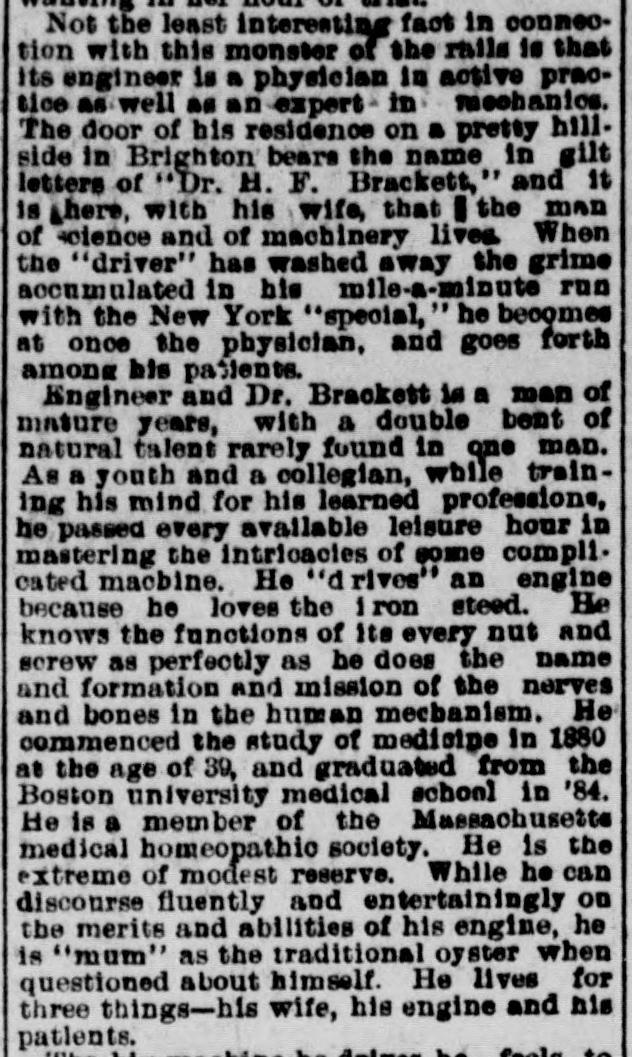
“Engineer and Dr. Brackett is a man of mature years, with a double bent of natural talent rarely found in one man.” The Portland Daily Press, Portland, Maine, April 11, 1899, page 2. Library of Congress, Chronicling America. Click the clipping to read it full size.
From Coal Shovel to Medical School
Humphrey Brackett was born in Maine in 1840, and he told the St. Louis paper how it all started. “Ever since I was a boy in Maine I like things that go, and I liked to help things to go that couldn’t go,” he said. “A puppy with a broken leg or a doll with the sawdust leaking out of her were my especial concern.”
He began on the railroad as a freight brakeman, then spent four years as a fireman, the worker who shovels coal into the engine’s fire. Next he ran a “sand engine” that hauled dirt to fill in Boston’s Back Bay, a muddy flat beside the city. A Minnesota paper said he hauled “much of the dirt on which the fine residences of Boston’s Back Bay district are built.” About 1881, he became an engineer on passenger trains.
He never stopped studying. “After I became a fireman I read the medical journals,” he said. Fast passenger runs meant he worked only three or four days a week, so on his days off he went to medical lectures in Boston. He began studying medicine in 1880, and Boston University’s medical school gave him his degree in 1884, when he was 44 years old. “I got my diploma in 1884. Yes, I wasn’t a very young sawbones then,” he joked, using old slang for a doctor.
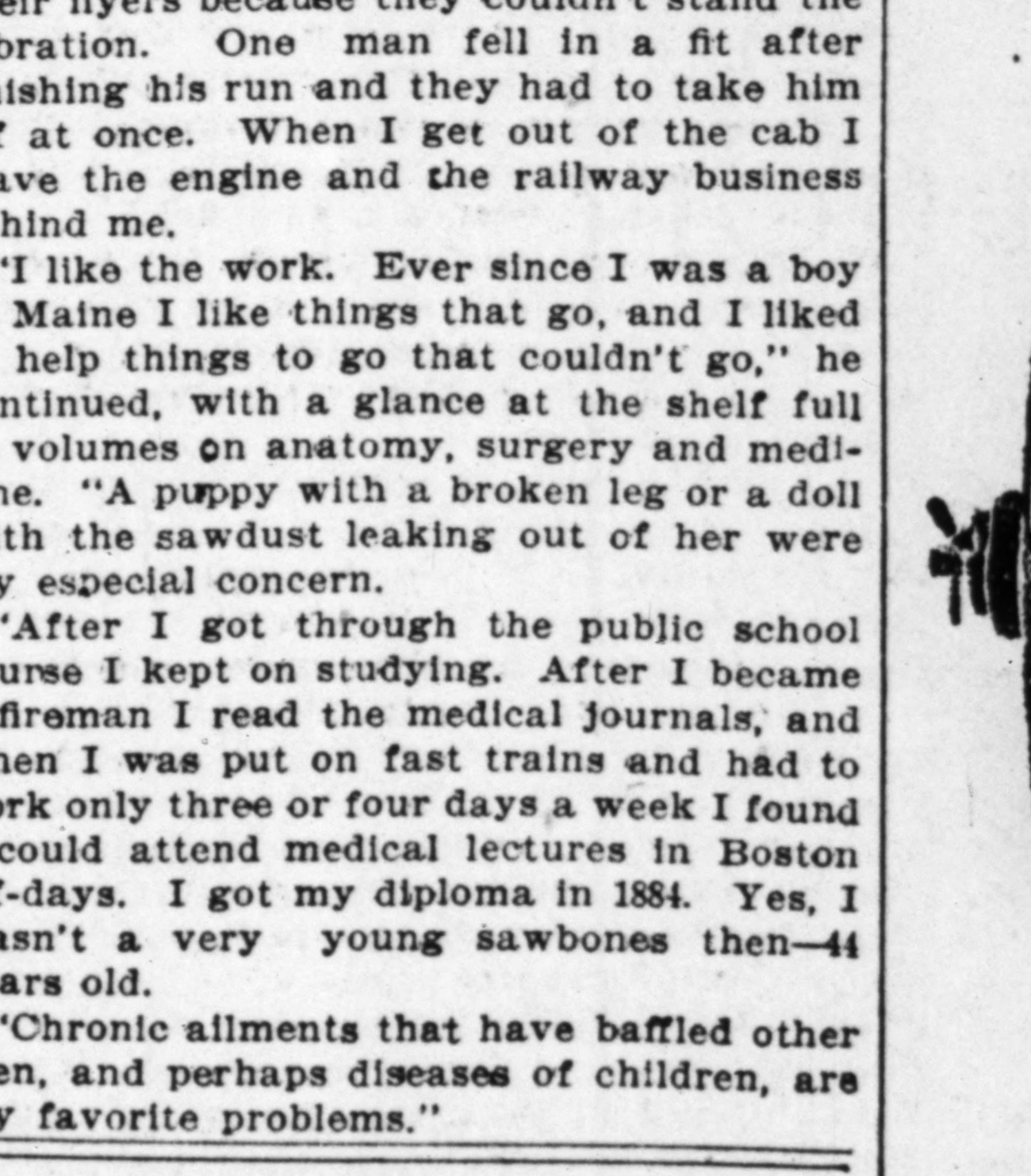
“A puppy with a broken leg or a doll with the sawdust leaking out of her were my especial concern.” St. Louis Post-Dispatch, St. Louis, Missouri, April 30, 1899. Internet Archive, public domain. Click the clipping to read it full size.
Three Nights a Week on the Boston Express
Dr. Brackett split his week between Boston’s sick people and the Springfield run. A Minnesota paper, the Little Falls Weekly Transcript, said that three nights a week “he drives a monster locomotive at the rate of 70 miles an hour,” and on the other days he was a doctor. A railroad magazine said his train left Boston at 4 P.M. and got back at 10 P.M., so he had plenty of time for his patients.
He kept the two jobs apart. “When I get out of the cab I leave the engine and the railway business behind me,” he said. His favorite cases were the hard ones: “Chronic ailments that have baffled other men, and perhaps diseases of children, are my favorite problems.”
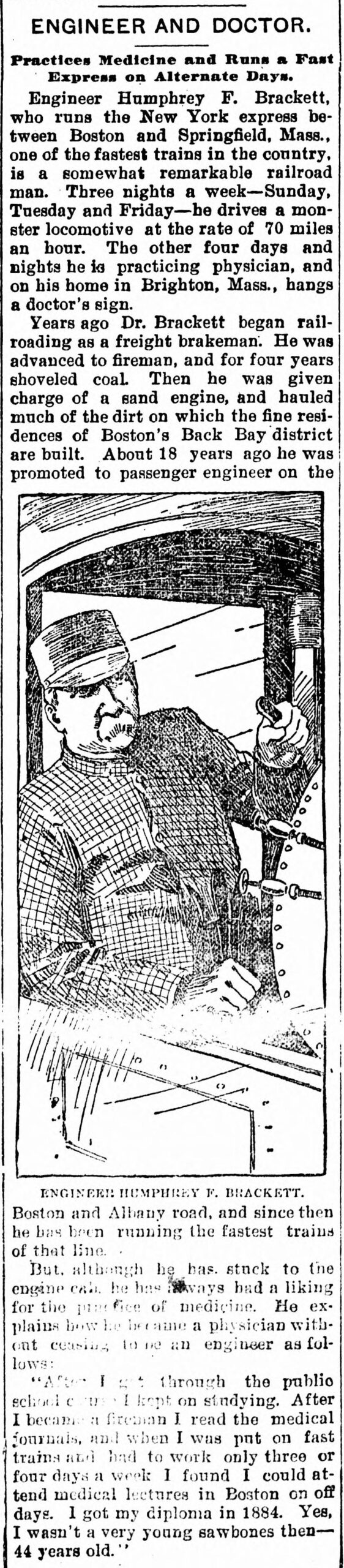
“Engineer and Doctor. Practices Medicine and Runs a Fast Express on Alternate Days.” The newspaper’s drawing is labeled “Engineer Humphrey F. Brackett.” Little Falls Weekly Transcript, Little Falls, Minnesota, July 4, 1899, page 3. Library of Congress, Chronicling America. Click the clipping to read it full size.
A Railroad Magazine Teases the Boston Papers
Not everyone believed the Boston papers’ “fastest thing on earth” talk. In June 1899, Locomotive Engineering, a magazine for railroad men, poked fun at the daily papers. It pointed out that the “126-tonner” figure counted the tender too, “but as they want to use as big figures as possible they lump it all together.”
The magazine liked the engine. It called No. 221 “a Schenectady compound,” built in Schenectady, New York, and said it was “doing remarkably good work.” But the engine, it said, “would blush with becoming modesty and immediately pop both safety valves to drown the flattery.” A safety valve lets out extra steam with a loud roar, so the joke was that the engine itself would be embarrassed by all that praise.
The magazine had no jokes about the doctor, though. “The engineer of the “221” has the distinction of being both an engineer and a physician,” it said.
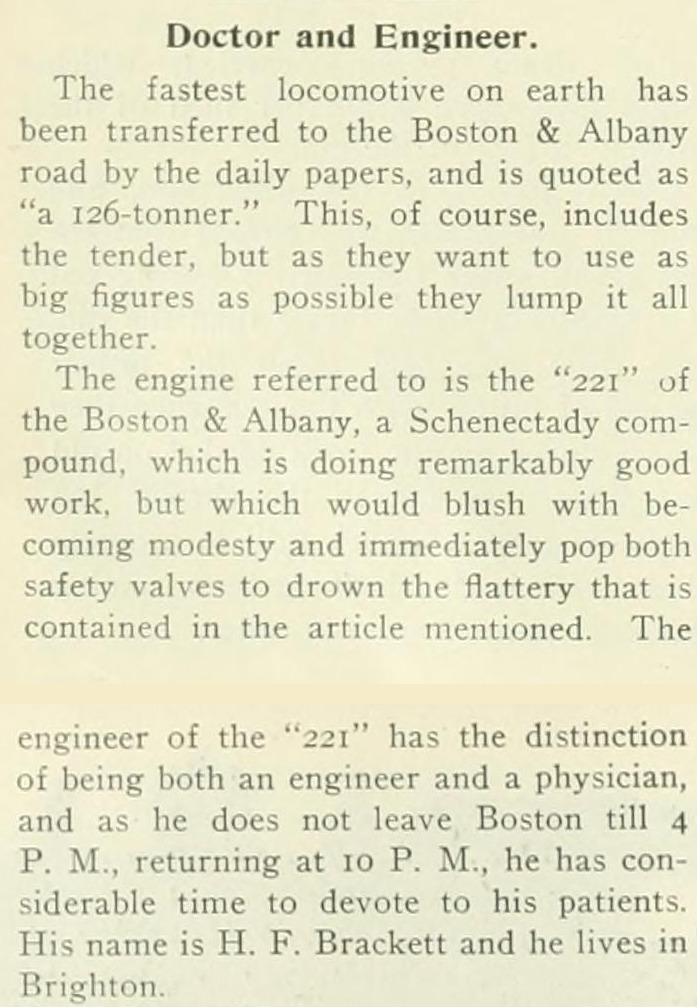
“Doctor and Engineer.” Locomotive Engineering, New York, June 1899, page 276. Internet Archive, public domain. Click the clipping to read it full size.
The St. Louis paper had promised a big test: “Next June 221 will have a semi-official trial and the world will know what Yankees can do in engine building.” We could not find a report of that trial in the papers we searched. Stories about No. 221 and its doctor did travel far, though, running that spring and summer in papers from Dover, New Hampshire, to Topeka, Kansas, El Paso, Texas, and Little Falls, Minnesota.
Dr. Brackett’s Long Run in Boston
Dr. Brackett of Boston kept both jobs for years. He died in Brighton on January 31, 1916, at the age of 75. A doctors’ journal noted that for many years he had been the “examining physician for the Brotherhood of Locomotive Engineers,” so the engineers’ own union trusted him to check the health of its members.
A magazine for engine men, Power, said goodbye in March 1916. It said he had kept his engineer’s rating on the Boston and Albany for thirty-eight years while he ran his medical practice. Then it painted the picture that sums him up: “During the day, while performing his duties as a medical man, he made his rounds in the conventional frock coat and tall hat. Four o’clock in the afternoon found him in the cab of “No. 221,” clad in overalls and jumper, hand on the throttle and eyes on the signal bridge.” A signal bridge is a frame over the tracks that holds the signal lights.
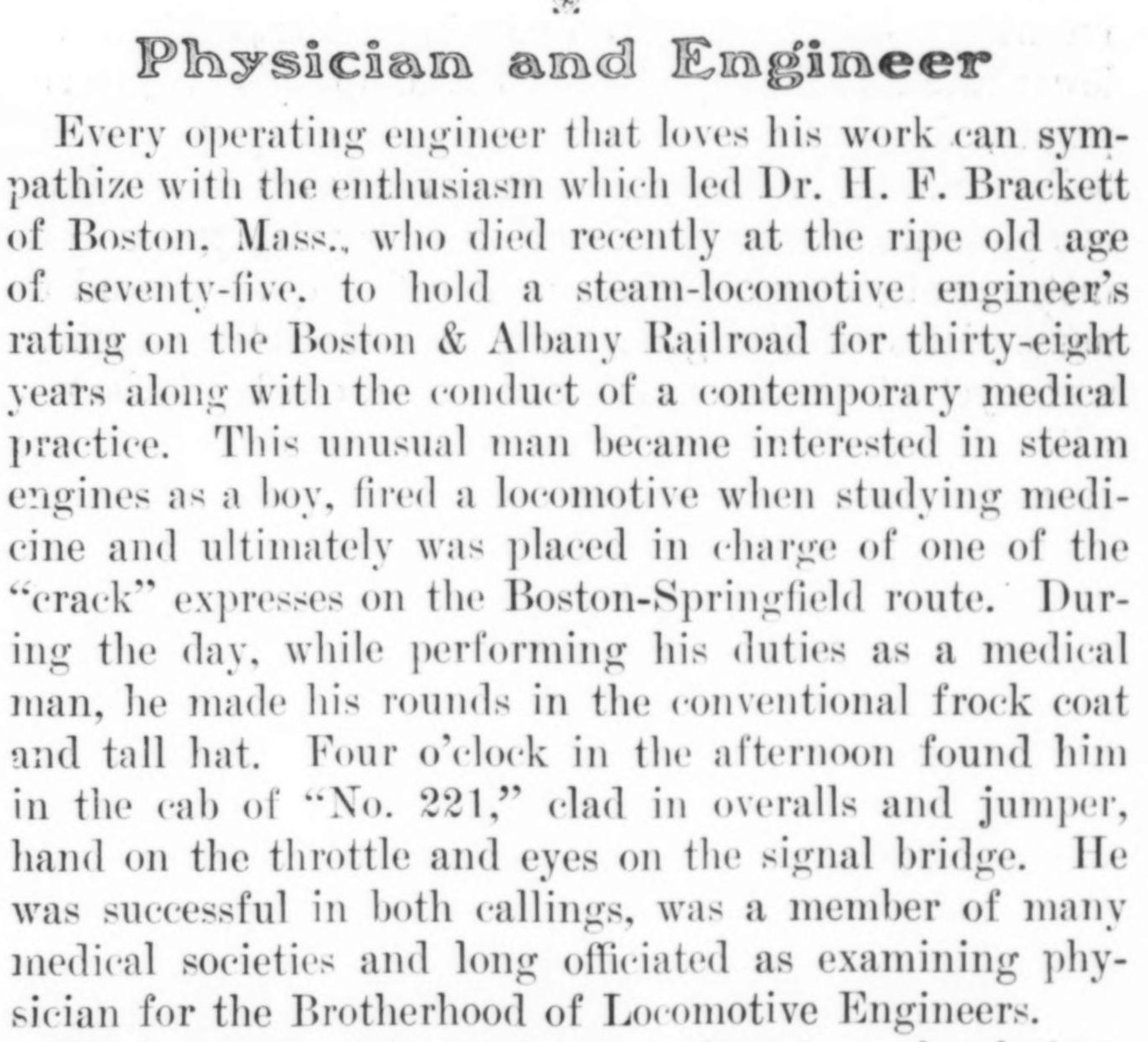
“Physician and Engineer.” Power, New York, March 14, 1916. Internet Archive, public domain. Click the clipping to read it full size.
The Pictures From Boston, Springfield and Beyond
The photograph at the top of this page is not Boston’s Dr. Brackett, and the engine is not No. 221. It shows another railroad engineer in overalls oiling the big driving wheels of a Michigan Central engine, taken by the Detroit Publishing Company sometime between 1900 and 1910. No photo of No. 221 or of Dr. Brackett turned up, so the newspaper drawings above are the closest look we have.
Dr. Brackett’s run ended at Union Station in Springfield, Massachusetts, and then he turned around for Boston.
IMAGE: photos/union-station-springfield-1900s.jpg | Union Station in [Springfield, Massachusetts, the western end of Dr. Brackett’s run, between 1900 and 1910. Detroit Publishing Co., Library of Congress.]
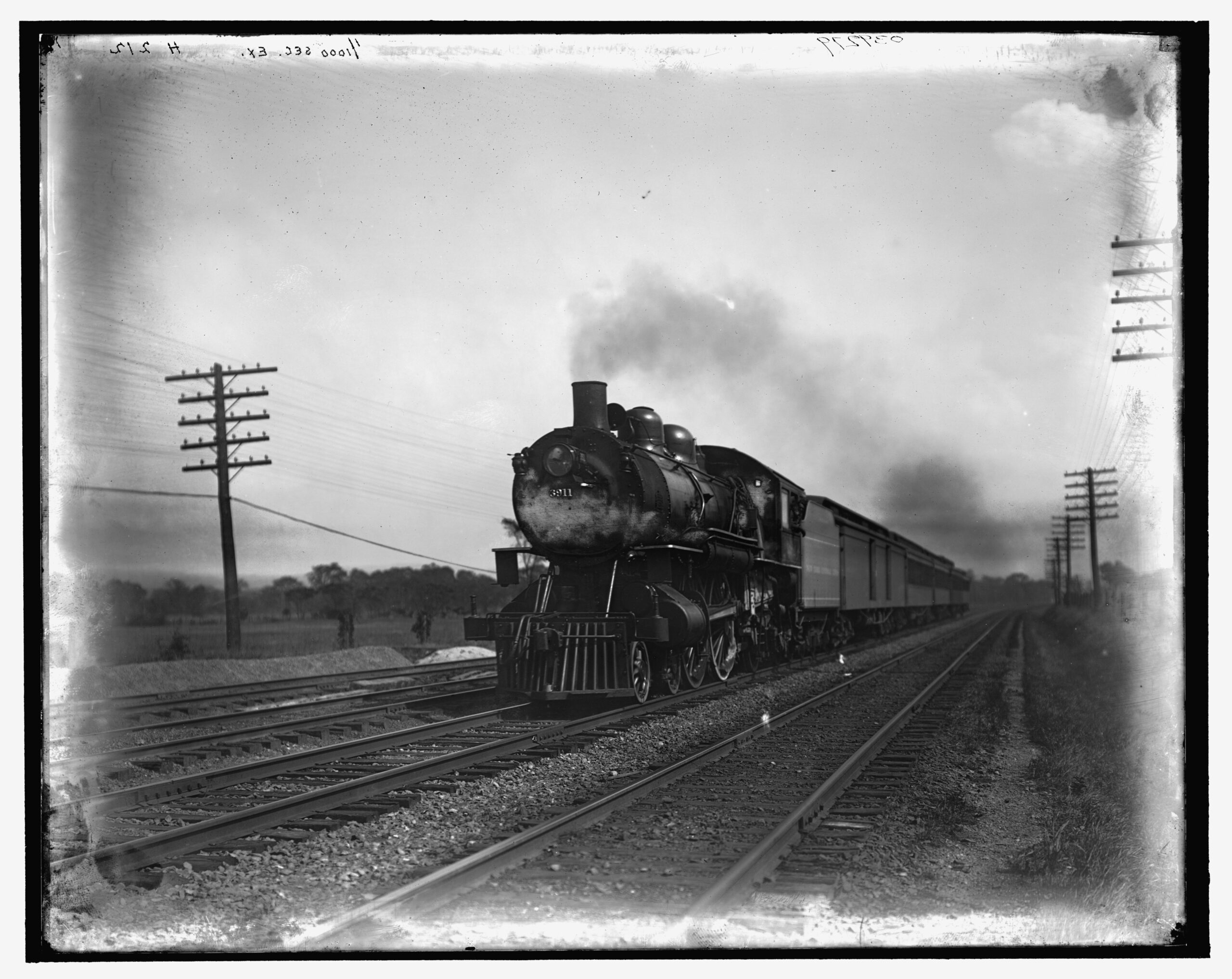
The Empire State Express near Utica, New York, between 1900 and 1915. In 1899, papers said Boston’s No. 221 made the train’s famous engine 999 look small. Detroit Publishing Co., Library of Congress. Click the picture to see it full size.
A boy from Maine liked “things that go,” and he liked to help things go that couldn’t. He did both for the rest of his life: one day with a doctor’s bag, the next with his hand on the throttle of the “fastest thing on earth.”
Sources
- “Fastest Thing on Earth,” The Portland Daily Press (Portland, Maine), April 11, 1899, page 2, reprinted from the Springfield Republican. Library of Congress, Chronicling America.
- “Big Boston and Albany Engine and Her Possibilities of Speed,” Springfield Weekly Republican (Springfield, Massachusetts), April 14, 1899, page 11. Library of Congress, Chronicling America.
- “Fastest Locomotive,” Foster’s Daily Democrat (Dover, New Hampshire), April 19, 1899, page 4. Library of Congress, Chronicling America.
- “The Fastest Locomotive,” The Topeka State Journal (Topeka, Kansas), April 21, 1899, page 3. Library of Congress, Chronicling America.
- “The Fastest Locomotive on Earth Is Run by Dr. Humphrey F. Brackett of Massachusetts,” St. Louis Post-Dispatch, April 30, 1899. Internet Archive.
- “Fastest Locomotive,” El Paso Daily Herald (El Paso, Texas), May 6, 1899, page 4. Library of Congress, Chronicling America.
- “Doctor and Engineer,” Locomotive Engineering, June 1899, page 276. Internet Archive.
- “Engineer and Doctor,” Little Falls Weekly Transcript (Little Falls, Minnesota), July 4, 1899, page 3. Library of Congress, Chronicling America.
- Obituary note for Dr. Humphrey F. Brackett, The Boston Medical and Surgical Journal, February 17, 1916. Internet Archive.
- “Physician and Engineer,” Power, March 14, 1916. Internet Archive.
- General Alumni Catalogue of Boston University, 1918, page 244 (Humphrey F. Brackett, M.D. 1884). Internet Archive.
- Detroit Publishing Co., “Railroad engineer oiling up before the start,” between 1900 and 1910. Library of Congress Prints and Photographs Division. No known restrictions on publication.
- Detroit Publishing Co., “Union Station, Springfield, Mass.,” between 1900 and 1910. Library of Congress Prints and Photographs Division. No known restrictions on publication.
- Detroit Publishing Co., “Empire State Express, Utica, N.Y.,” between 1900 and 1915. Library of Congress Prints and Photographs Division. No known restrictions on publication.
- The newspapers, magazines, book and photographs were all published or made before 1931 and are in the public domain.