Two giant wheels float over the rooftops of a town. Each one is ringed with round holes, like a row of eyes. A little cabin hangs between them. Newspapers printed that drawing all over the country in the summer of 1909, and under it they printed the name of the man who dreamed it up: D. C. Clark of Muskegon, Michigan. He called his flying machine “The Cherubim.” He had found the plan for it in the Bible.
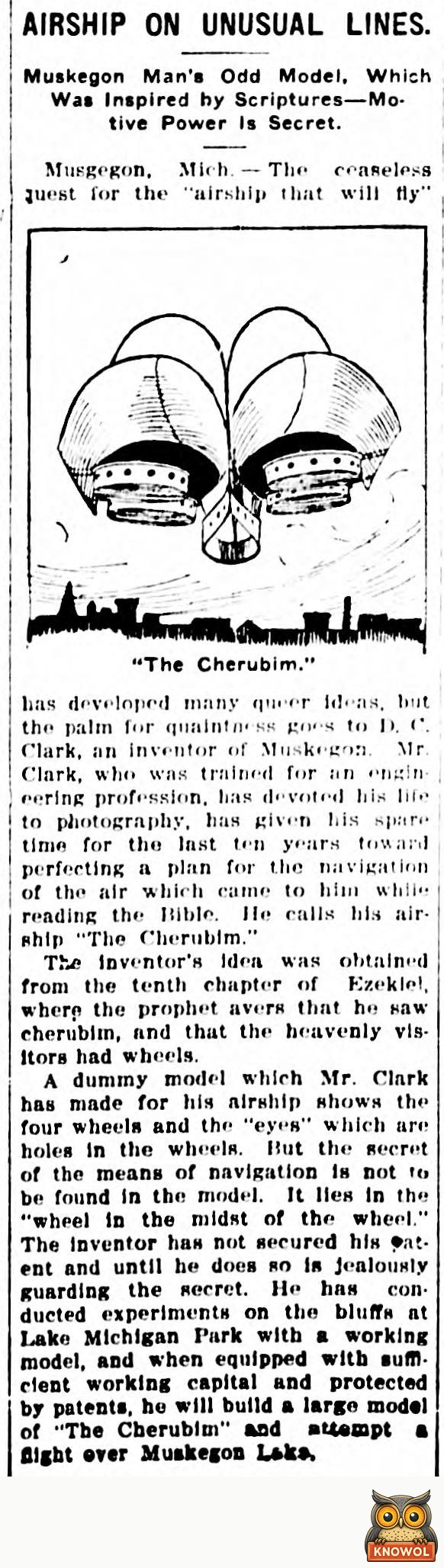
“Airship on Unusual Lines.” The Wheatland World, Wheatland, Wyoming, August 6, 1909, page 5. Library of Congress, Chronicling America. Click the clipping to read it full size.
Everybody wanted to fly
In 1909, flying was brand new. The paper started the story by talking about “the ceaseless quest for the ‘airship that will fly.'” Ceaseless means it never stopped. That quest, the paper said, had turned up “many queer ideas, but the palm for quaintness goes to D. C. Clark.” In plain words, of all the odd ideas out there, his was the most unusual one of all. Yet Clark was no stranger to machines. He “was trained for an engineering profession,” the paper said, but he “has devoted his life to photography.” He made pictures for a living, and he worked on his airship in his spare time.
He had been at it a long while. Clark “has given his spare time for the last ten years” to a plan for flying, the story said, and the plan “came to him while reading the Bible.”
The wheels with eyes
The idea came from the Book of Ezekiel, chapter 10. In it, the prophet Ezekiel tells of a vision. He saw cherubim, heavenly beings, and beside them were wheels. The wheels were covered with eyes, and each one looked like a wheel inside a wheel.
Clark took that picture and turned it into a machine. He built what the paper called “a dummy model,” a model just for show. It “shows the four wheels and the ‘eyes’ which are holes in the wheels.”
The model didn’t show how the thing would actually fly, though. That part was hidden on purpose. The headline put it simply: “Motive Power Is Secret.” Motive power is whatever makes a machine go, like the engine in a car. Clark said his secret lay in the “wheel in the midst of the wheel.”
A secret on the bluffs
Why the secret? Clark didn’t have a patent yet. A patent is a paper from the government that says an idea belongs to you, so nobody else can copy it and sell it. Until he got one, the paper said, he was “jealously guarding the secret.”
He had already tested a real working model, not just the dummy. He “conducted experiments on the bluffs at Lake Michigan Park with a working model.” The bluffs were high sandy hills above the shore of Lake Michigan.
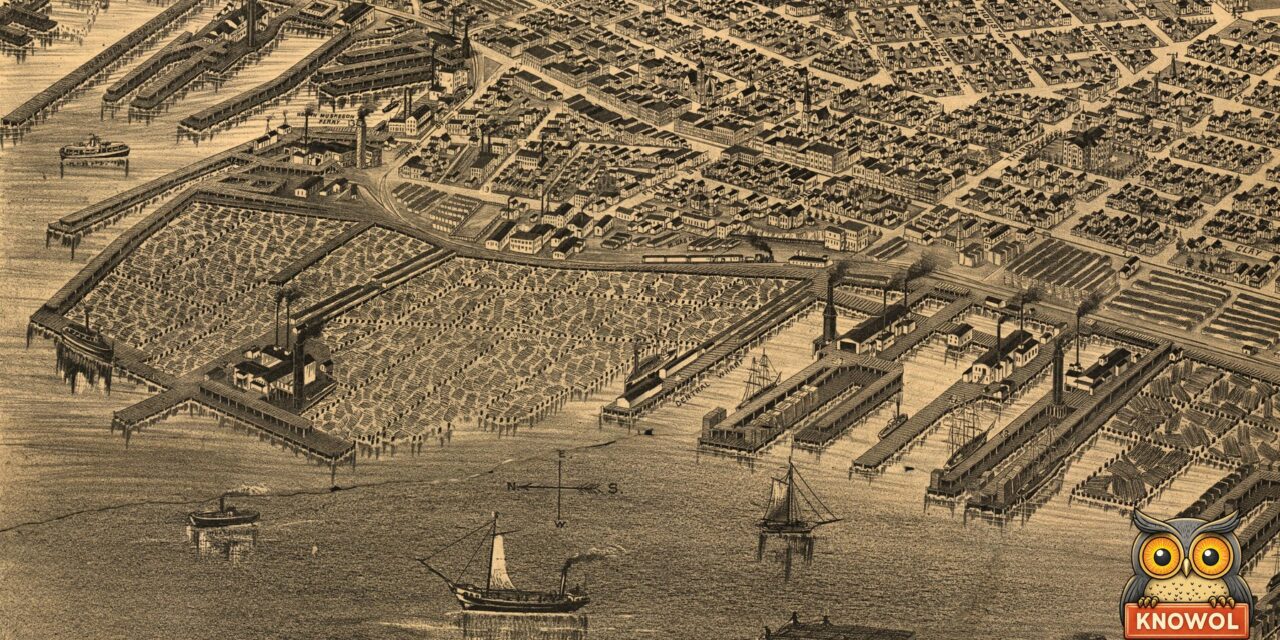
And he had a big plan. Once he had enough money and his patents, Clark would “build a large model of ‘The Cherubim’ and attempt a flight over Muskegon Lake.” Muskegon Lake is the harbor that sits right beside the city and opens out into Lake Michigan. The picture at the top of this page is a bird’s-eye map of Muskegon drawn in 1889, twenty years before Clark’s story, looking across Muskegon Lake at the town. The lake is busy with docks, lumber piles, sailboats and steamboats.
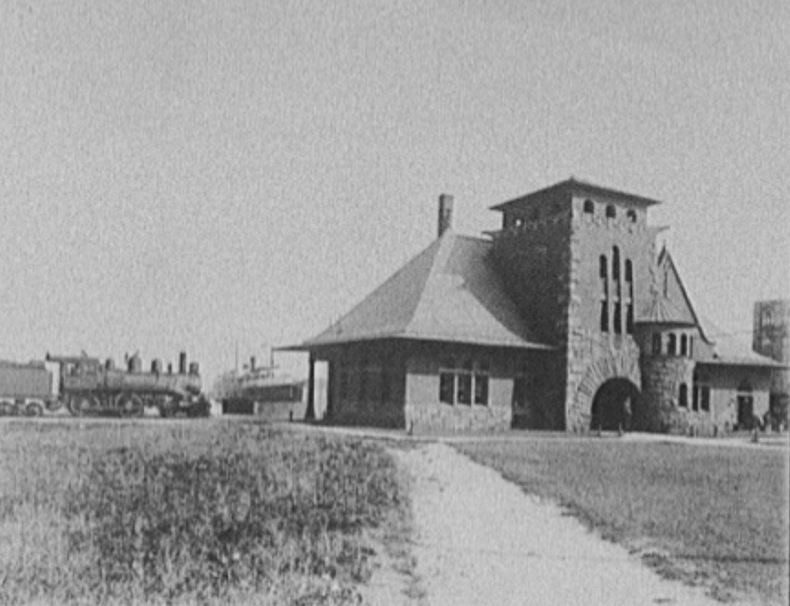
The railroad station and steamer dock at Muskegon, Michigan, about 1900, with a locomotive and a lake steamer at the left. Detroit Publishing Co., Library of Congress. Click the picture to see it full size.
The same summer, at Fort Myer
Clark’s story hit the papers at just the right moment. A few days before, the Wright brothers had shown the world what a flying machine could do.
On July 27, 1909, Orville Wright flew his airplane at Fort Myer, near Washington, D.C., with a passenger on board. A North Carolina paper put it in big letters: “WRIGHT FLIES OVER AN HOUR.” He stayed up “one hour, twelve minutes and forty seconds,” a new world’s record for a flight with a passenger. President William Howard Taft came out to watch.
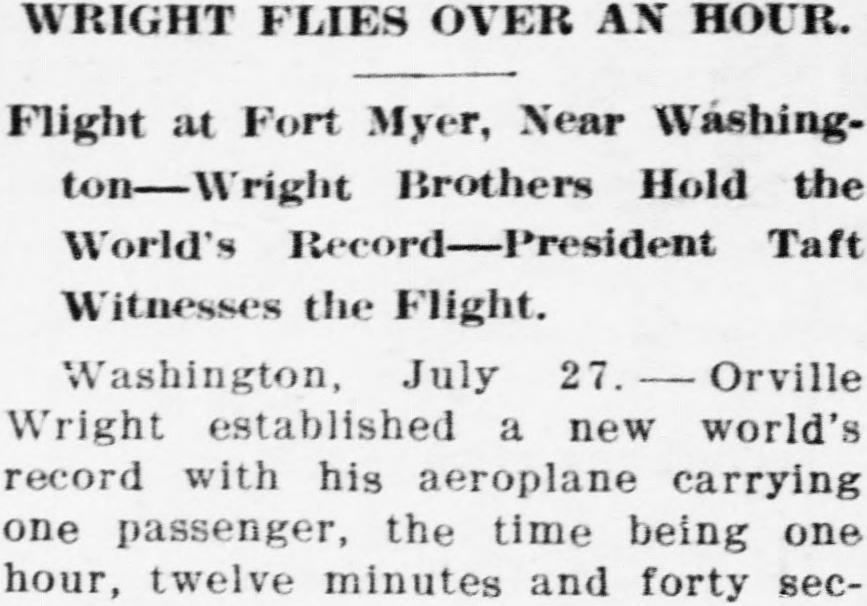
“Wright Flies Over an Hour.” The Caucasian, Clinton, North Carolina, July 29, 1909, page 1. Library of Congress, Chronicling America. Click the clipping to read it full size.
Clark’s Cherubim looked nothing like the Wrights’ airplane. Still, they were all chasing the same dream that summer: to lift off the ground and stay up.
What happened to The Cherubim?
The story about Clark ran in papers from Wyoming and Colorado to Kansas and Wisconsin. Then the trail goes quiet. We could not find a patent for The Cherubim, or any report of the big flight over Muskegon Lake, in the papers we searched.
That doesn’t make Clark’s story a sad one. For ten years a photographer in Muskegon spent his spare hours on one big idea he found in the pages of the Bible. He built a model and tested it on the sand bluffs over Lake Michigan. And for a few weeks in 1909, people from Wyoming to Wisconsin opened their papers and saw his dream the way the artist drew it: two great wheels with eyes, already high above the rooftops.
Sources
- The Wheatland World (Wheatland, Wyoming): August 6, 1909, page 5 (“Airship on Unusual Lines,” with the drawing “The Cherubim”).
- The same story also ran in papers in Lamar, Colorado (August 4, 1909, page 7), Ladysmith, Wisconsin (August 5, 1909, page 3) and WaKeeney, Kansas (August 14, 1909, page 3).
- The Caucasian (Clinton, North Carolina): July 29, 1909, page 1 (“Wright Flies Over an Hour”).
- The Bible, Book of Ezekiel, chapter 10 (King James Version).
- Detroit Publishing Co., “R.R. Station & steamer dock, Muskegon,” about 1900, Library of Congress, no known restrictions on publication.
- All newspaper images: Library of Congress, Chronicling America. Published 1909.
- Cover: “Birds-eye view of Muskegon, Michigan 1889, from Muskegon Lake looking east,” Library of Congress, Geography and Map Division. It shows Muskegon twenty years before Clark’s story.