In April 1904, workmen in Wading River, New York, pried up a big flat stone in front of an old fireplace. Underneath it lay an old wallet, said to hold money, deeds and bonds. Right away, grown men were arguing over it. Before anyone took a good look inside, it was wrapped up, sealed with wax and handed to the notary, and the whole village was left wondering what it was worth.
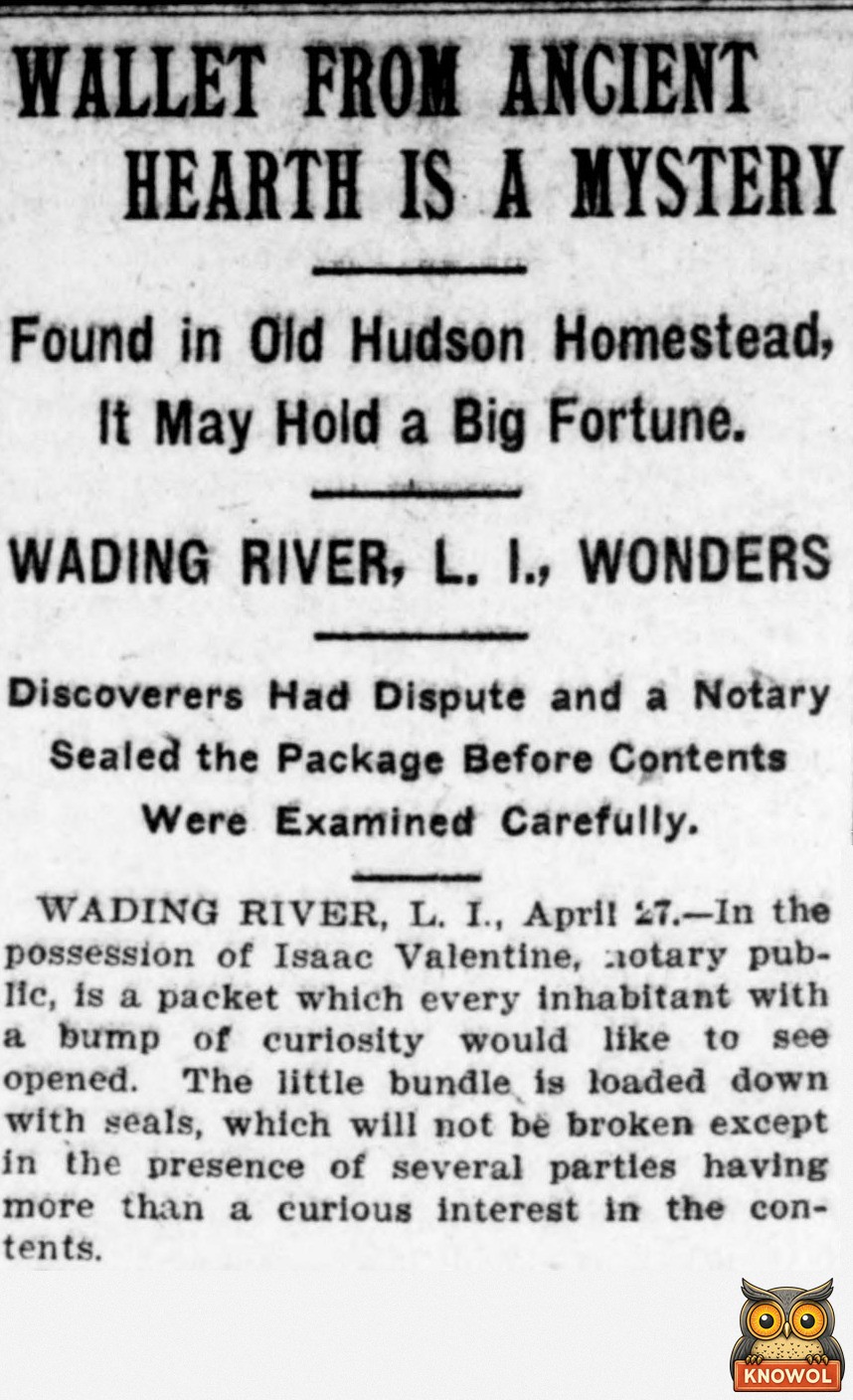
“Wallet From Ancient Hearth Is a Mystery.” The New York Times, New York, April 28, 1904, page 9. Internet Archive. Published 1904, public domain. Click the clipping to read it full size.
The New York Times told the story on April 28 under a headline that sounds like a storybook: “Wallet From Ancient Hearth Is a Mystery.” A smaller line under it gave away the funny part: “Discoverers Had Dispute and a Notary Sealed the Package Before Contents Were Examined Carefully.”
An Old House by Long Pond in Wading River
Wading River is a small village on the north shore of Long Island, in Suffolk County, New York. The house in this story stood near the north end of Long Pond, looking out over the water, not far from the road down to Manor. It had been built in the 1820s or so. The Washington Times said “about seventy-five years ago.”
For most of its life, the place belonged to the Hudson family. Henry Hudson owned it first. The Times said he was “somewhat eccentric,” which meant a little odd in his ways. In his day, hunters and fishermen used the house as a place to stay, back before the land around it “was all posted with ‘keep off’ signs.”
When Henry died, the house went to his son Charles. When Charles died, it went to his brothers, Franklin and Ellsworth Hudson. Some gifts were set aside for Mrs. Pauline Wall, who had been Charles’s housekeeper, and her daughter, Hannah.
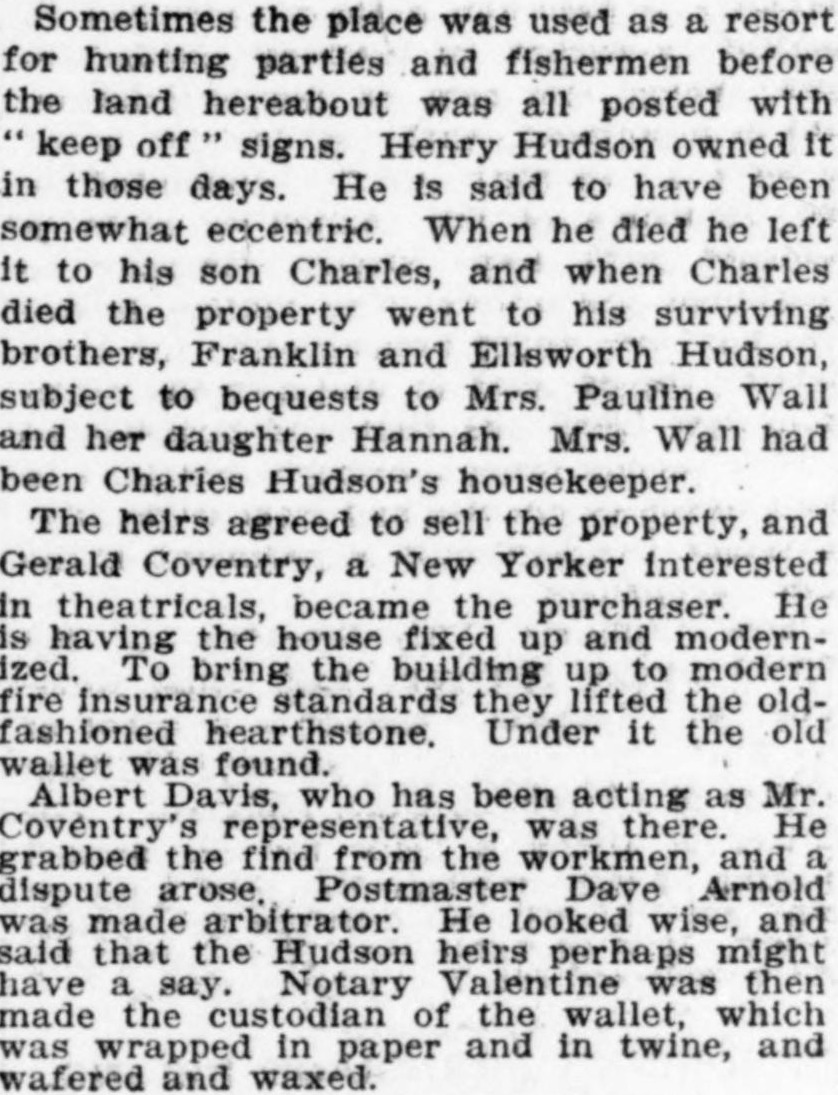
The Hudson house, the hearthstone and the argument. The New York Times, April 28, 1904, page 9. Internet Archive. Published 1904, public domain. Click the clipping to read it full size.
A Broadway Man Buys the Wading River House
The Hudson brothers agreed to sell. The buyer was Gerald Coventry, who the Times called “a New Yorker interested in theatricals.” That was putting it mildly. Coventry was the stage manager of the Casino, a big theater in New York City. A stage manager runs the show behind the curtain: the actors’ entrances, the scenery, the lights, the timing.
Coventry already knew Wading River well. Two summers before, in July 1902, the theater paper the New York Clipper reported that the cast of the musical “A Chinese Honeymoon” took a Sunday trip out to his country home there.
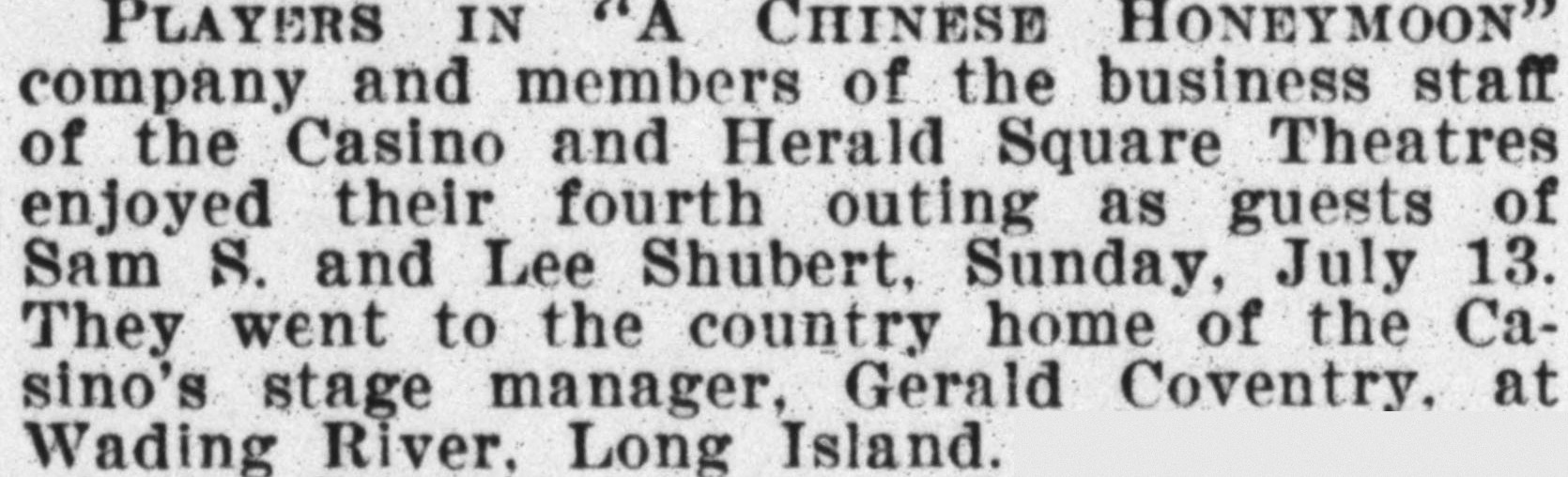
The cast of a Broadway show visits Gerald Coventry’s country home. New York Clipper, July 19, 1902. Internet Archive. Published 1902, public domain. Click the clipping to read it full size.
In the spring of 1904, Coventry was having the old Hudson house “fixed up and modernized.” To meet the fire insurance rules of the day, the workmen had to lift the “old-fashioned hearthstone.” A hearthstone is the wide stone slab on the floor in front of a fireplace. It keeps sparks and hot coals from setting the wooden floor on fire. Under that slab, the workmen found the wallet.
Grab It First, Look Later
Albert Davis was at the house that day, looking after things for Coventry. The Times said “He grabbed the find from the workmen, and a dispute arose.” The wallet might belong to the new owner, to the workmen who found it, or to the Hudson family who had owned the house for all those years. Nobody could agree.
So they called in the postmaster, Dave Arnold, to settle it. He was made the arbitrator, which means the neutral person both sides agree to listen to. Here is the paper’s best line: “He looked wise, and said that the Hudson heirs perhaps might have a say.”
That was the end of the argument, for the moment. The wallet went to Isaac Valentine, the village notary public. A notary is an official who witnesses signatures and important papers, so he was a trusted person to hold it. It “was wrapped in paper and in twine, and wafered and waxed.” Wafers were small sticky disks used to seal letters, and hot sealing wax went over the knots. If anyone opened the bundle, the broken seals would show it.
The Washington Times said the notary “sealed it up awaiting the arrival of the Hudson heirs.” The bundle would be opened only with them in the room.
What Was Inside the Wallet From Wading River
Here is the funny part. The Times said “those who found the package forgot to examine its contents before it was sealed.” So the village had to guess.
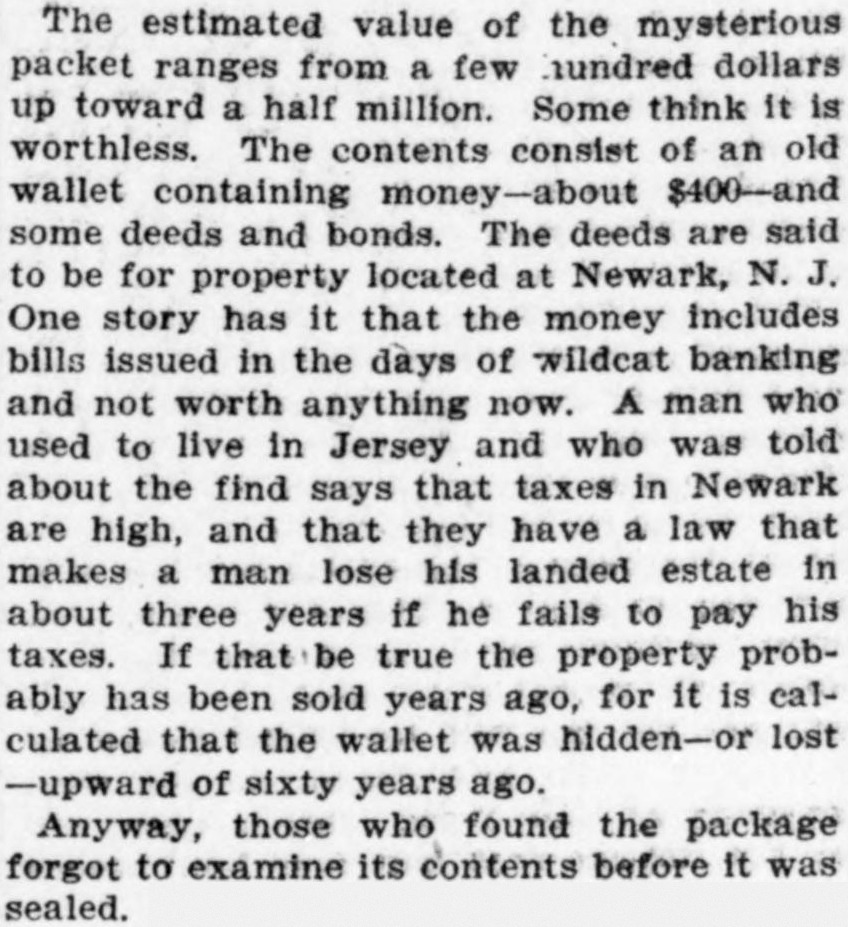
The guessing begins. The New York Times, April 28, 1904, page 9. Internet Archive. Published 1904, public domain. Click the clipping to read it full size.
The story going around Wading River was that the wallet held “about $400” in money, plus some deeds and bonds. A deed is the paper that proves who owns a piece of land. A bond is a paper promise to pay back a loan, with interest. The deeds were said to be for land in Newark, New Jersey, a big and growing city by 1904.
The guesses ran wild. The Times said the value “ranges from a few hundred dollars up toward a half million.” That was a huge sum in 1904. Then again, “Some think it is worthless.”
Why the Money in the Wading River Wallet Might Be Worthless
There were two good reasons to doubt the treasure. The first was the money itself. One story said some of the bills came from “the days of wildcat banking.” Back before the Civil War, many small banks printed their own paper money. Some of those banks failed or vanished, and their bills became just paper. People called them wildcat banks.
The second reason was the land. A man who used to live in New Jersey said Newark had high taxes, and a law that could make an owner lose his land in about three years if he didn’t pay them. Nobody had paid taxes on that land from under a hearthstone for a long, long time. The Times said the wallet was hidden, or lost, “upward of sixty years ago.” That would be the early 1840s, when the house was still fairly new.
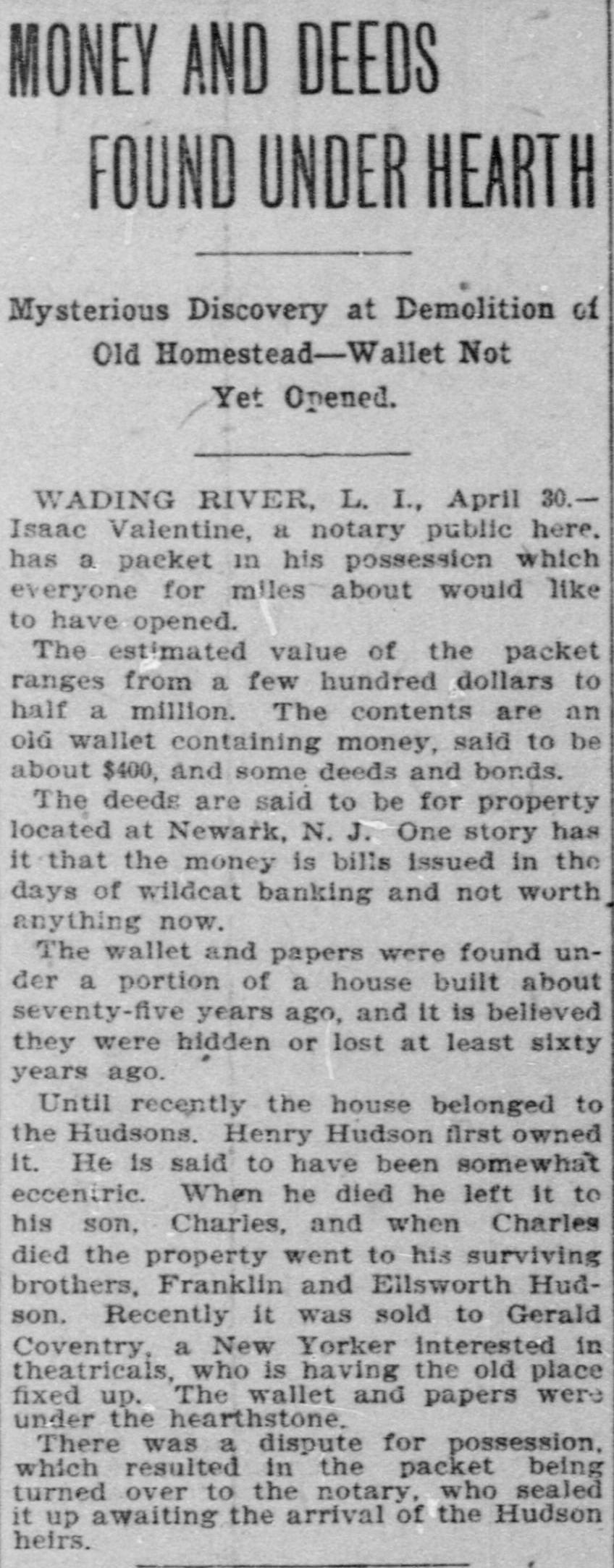
“Money and Deeds Found Under Hearth.” The Washington Times, Washington, D.C., May 1, 1904. Library of Congress, Chronicling America. Published 1904, public domain. Click the clipping to read it full size.
A Second Paper Tells the Wading River Story
The story traveled. On May 1, The Washington Times ran it under the headline “Money and Deeds Found Under Hearth,” with the line “Wallet Not Yet Opened.” It said Isaac Valentine had a packet “which everyone for miles about would like to have opened.” The two papers agree on the names, the $400, the Newark deeds and the sealed bundle.
The Ending Nobody Printed
We searched the New York papers and many others for the rest of 1904 and the years after. We found no report of the day the seals were broken in Wading River. Maybe the Hudson heirs came, the notary cut the twine, and everyone saw a few old bills and some papers for land long since sold. Maybe it was something more. The papers never said.
So the best part of the story is the one the Times caught that week in April 1904. Picture a little village by a pond on Long Island, a new owner from Broadway, a crew of workmen, a postmaster trying to look wise, and a small bundle of paper and twine with wax on every knot. Nobody knew what was inside, and for a while, everybody in Wading River wanted to.
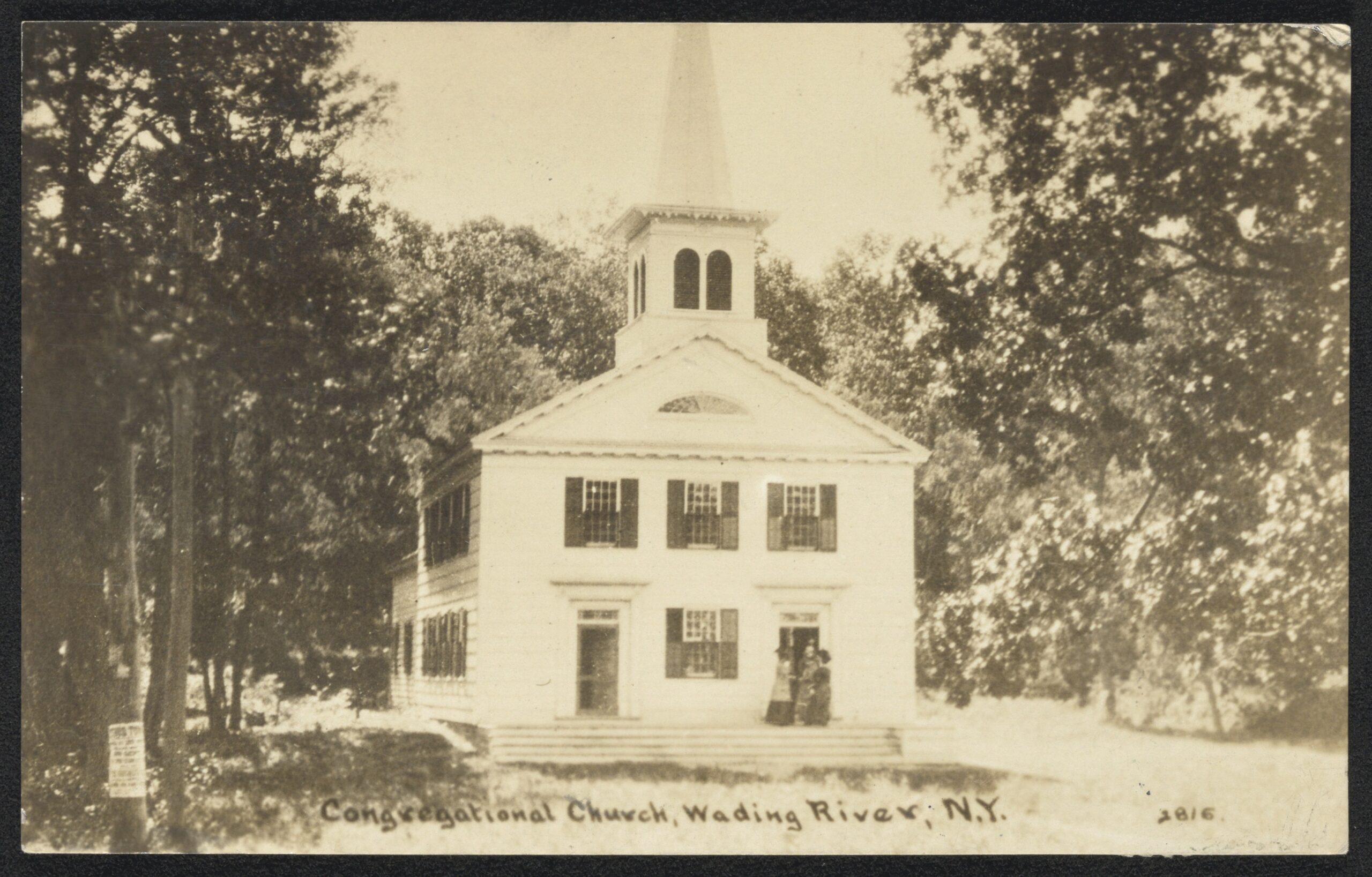
Congregational Church, Wading River, N.Y., a real photo postcard from about 1917. Library of Congress, Prints and Photographs. Click the picture to see it full size.
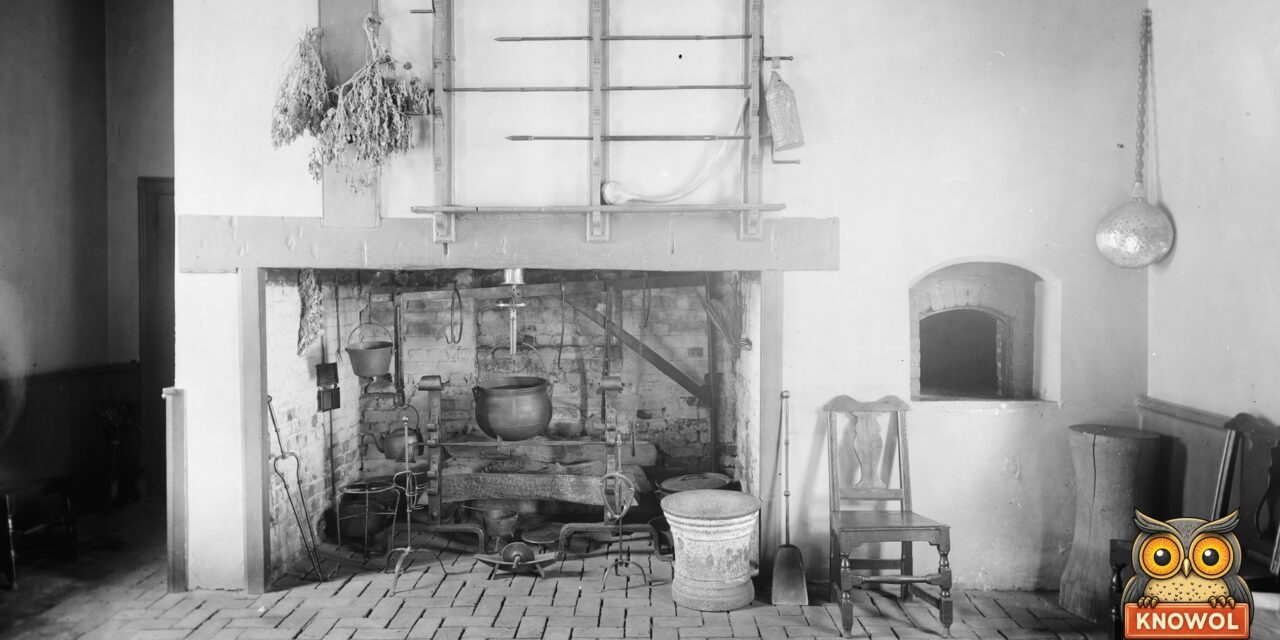
No photo of the Hudson house or its hearth is known. The fireplace on the cover is the old kitchen fireplace at Mount Vernon, George Washington’s home in Virginia, photographed by the Detroit Publishing Company in the early 1900s. It shows the kind of big brick fireplace and hearth that old houses of that time had, with iron pots hanging inside.
Sources
- “Wallet From Ancient Hearth Is a Mystery.” The New York Times, New York, April 28, 1904, page 9. Internet Archive
- “Money and Deeds Found Under Hearth.” The Washington Times, Washington, D.C., May 1, 1904. Library of Congress, Chronicling America
- Gerald Coventry’s country home at Wading River. New York Clipper, July 19, 1902. Internet Archive
- “Congregational Church, Wading River, N.Y.,” real photo postcard, about 1917. Library of Congress, Prints and Photographs. Published before 1931, public domain.
- Cover: “The Old kitchen fireplace, Mt. Vernon, Va.,” Detroit Publishing Co., between 1900 and 1915. Library of Congress, Prints and Photographs. No known restrictions on publication.
- Newspaper pages printed in 1902 and 1904 are in the public domain.