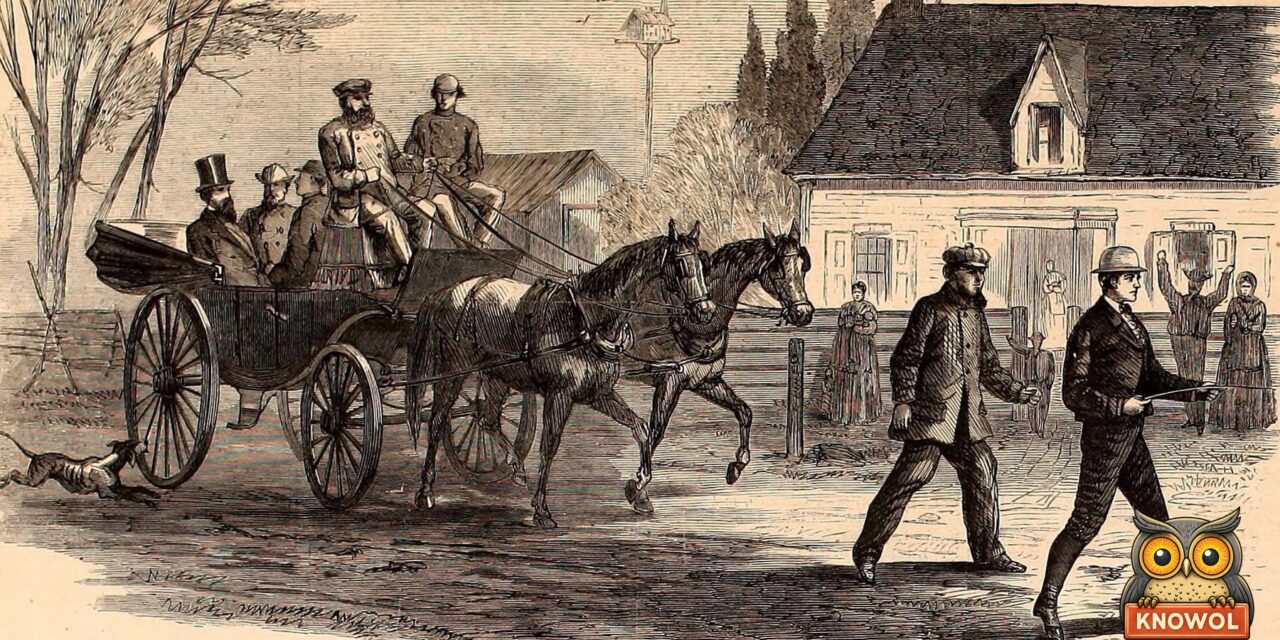
Just before 1 o’clock on Thursday afternoon, November 14, 1867, a slim young man in walking clothes reached the Mansion House hotel in Buffalo, New York. His name was Edward Payson Weston. He had walked there all the way from Portland, Maine, and he wasn’t done. He was walking to Chicago, Illinois to win a bet.
The bet was big. Harper’s Weekly, a magazine in New York, said it was “a wager of $10,000.” Weston had to cover more than 1,200 miles in 30 days. Only 26 of those days were for walking, because Weston never walked on a Sunday. He had left Portland at noon on October 29. He was due in Chicago at noon on Thursday, November 28.
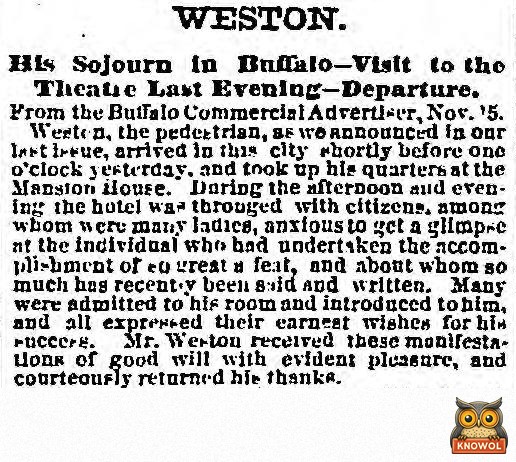
“Weston. His Sojourn in Buffalo, Visit to the Theatre Last Evening, Departure.” A report from the Buffalo Commercial Advertiser of November 15, 1867, reprinted in the Chicago Tribune, Chicago, Illinois, November 19, 1867, page 1. Library of Congress, Chronicling America. Click the clipping to read it full size.
Why Edward Payson Weston Was Walking
Weston wasn’t walking from Maine to Chicago for fun. He explained why in a letter the papers printed that fall. In the winter of 1866, he wrote, he trusted his money to the wrong people. “I lost all I had and some thousands of dollars which kind friends had loaned me,” he said. For months after that he “could barely gain a living for my family.”
Then Mr. Goodwin, the man who put up the money for the bet, “asked me if I could walk yet?” Weston had made one long walk before, to Washington in 1861. If he won this time, he wrote, he could pay back everything he owed.
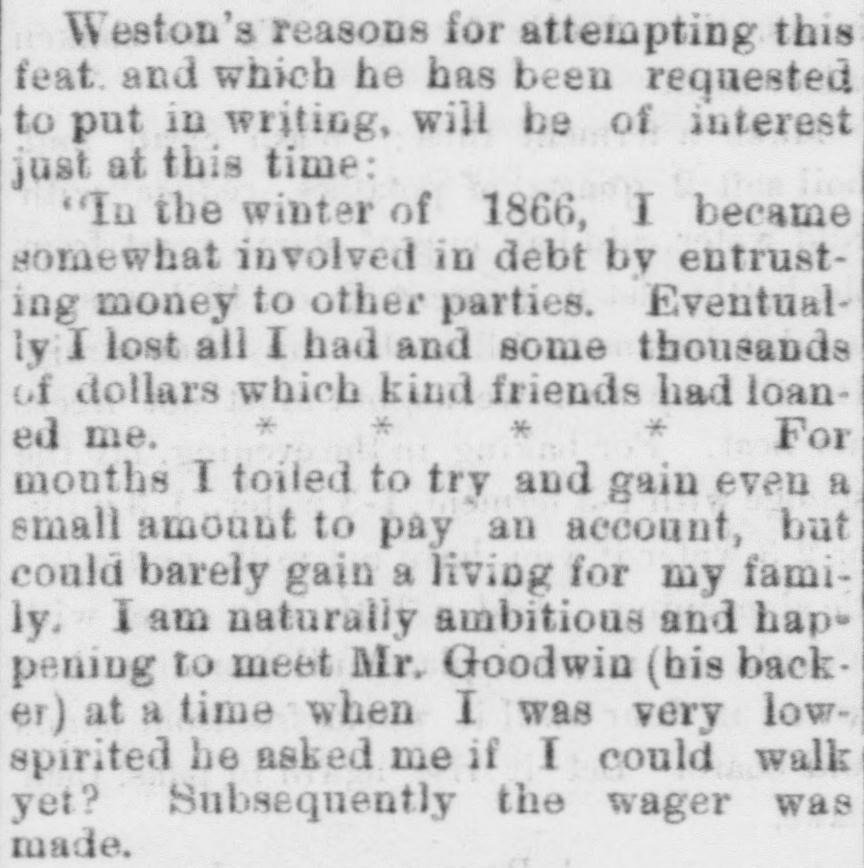
Weston’s own reasons for the walk, in his words. Prescott Journal, Prescott, Wisconsin, November 30, 1867, page 2. Library of Congress, Chronicling America. Click the clipping to read it full size.
Buffalo, New York, Turns Out to See Him
In Buffalo, Weston’s hotel filled up fast. The Buffalo Commercial Advertiser said the Mansion House was “thronged with citizens, among whom were many ladies.” That evening he went to the theatre, where a private box had been saved for him. When the audience spotted him, they broke into “vociferous cheering and applause,” which means loud, shouting cheers. Two actors, Mrs. Meek and Mr. Chanfrau, even worked a line about him into the show.
The next morning, Friday, November 15, people were waiting outside the hotel by half past five. Weston set off at 6:35, with Buffalo policemen marching in front of him, behind him and on both sides. He went down Main Street and over the swing bridge across the creek. People crowded the doors and windows to watch, and many looked like they had “recently and hastily arisen from bed.” They had rolled out of bed just to see him go by.
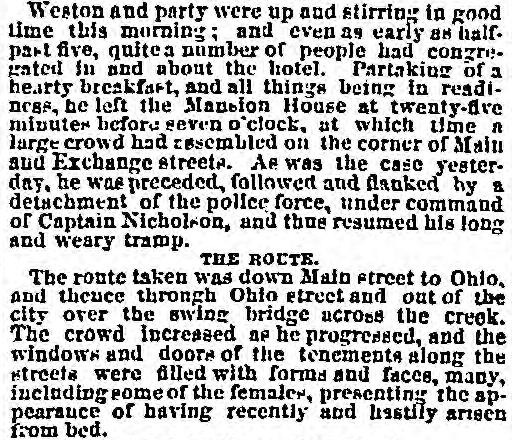
Weston leaves the Mansion House on the morning of November 15, 1867, with Buffalo’s police all around him. Buffalo Commercial Advertiser report, reprinted in the Chicago Tribune, Chicago, Illinois, November 19, 1867, page 1. Library of Congress, Chronicling America. Click the clipping to read it full size.
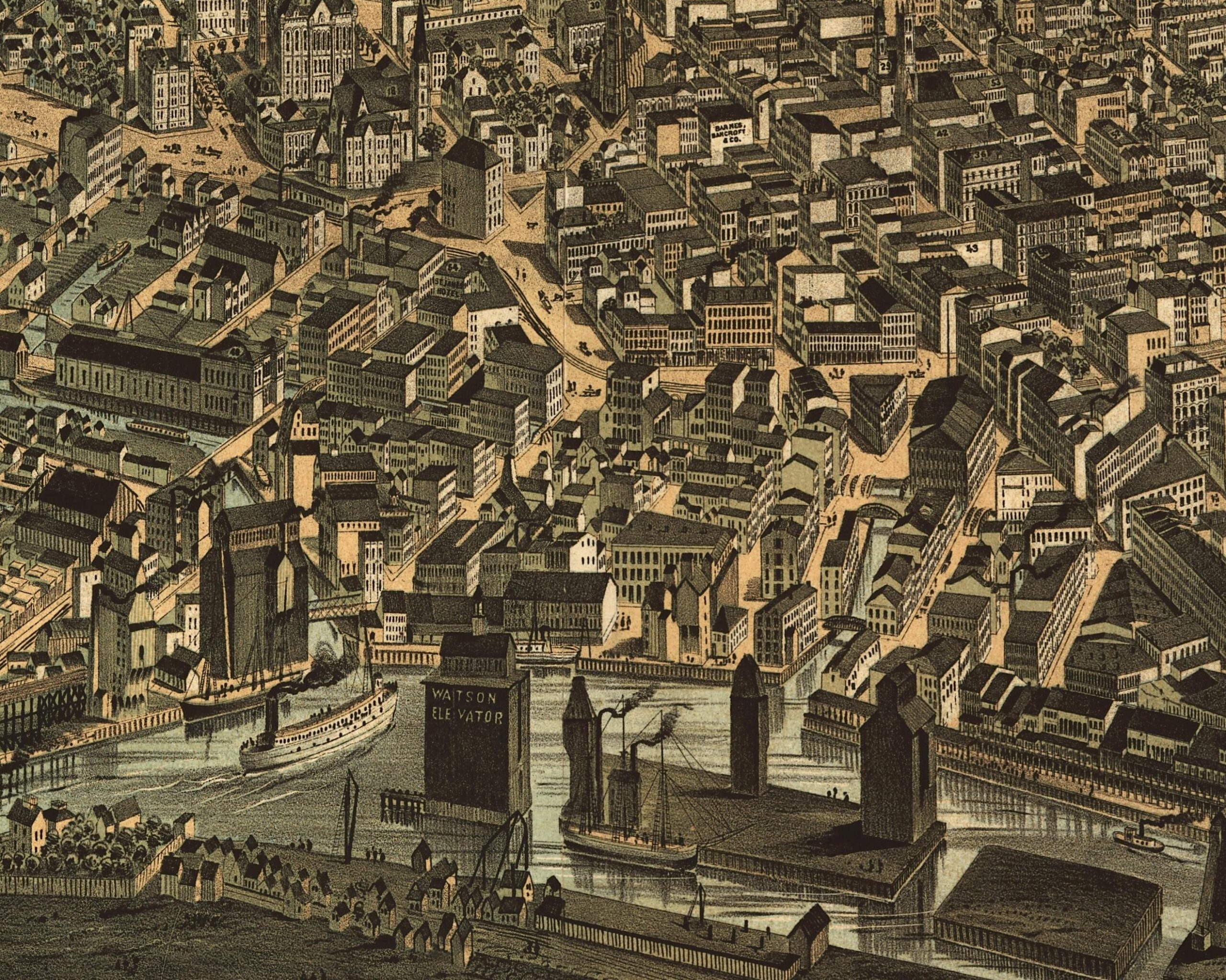
Downtown Buffalo, New York, and its harbor on a bird’s-eye map drawn in 1880, thirteen years after Weston’s visit. The building marked 42 was the office of the Commercial Advertiser, the paper that wrote about his stay, in 1880. “The city of Buffalo, N.Y. 1880,” E. H. Hutchinson, publisher. Library of Congress Geography and Map Division. Click the picture to see it full size.
Whiskey for Weston’s Shoes
The Buffalo reporter also got a look at Weston’s shoes, and they surprised him. Weston’s walking boots were three sizes bigger than the shoes he wore every day. They had low heels and broad soles, and they were “quite heavy.”
Then came the oddest part. Weston didn’t drink. His shoes did. “Although Weston is of strictly temperate habits, the same cannot be said of his walking-shoes,” the paper said, “as a dram of whiskey is frequently given them, being poured into them by means of a small funnel inserted at the side.”
Strictly temperate means he never drank alcohol. A dram is a small drink. His helpers poked a little funnel into the side of his boot and poured the whiskey right in. It was meant “to keep his feet from chafing or swelling.” Chafing is when skin gets rubbed raw.
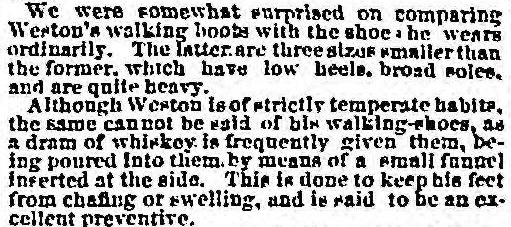
Weston’s big walking boots, and the whiskey that went into them. Buffalo Commercial Advertiser report, reprinted in the Chicago Tribune, Chicago, Illinois, November 19, 1867, page 1. Library of Congress, Chronicling America. Click the clipping to read it full size.
That line was too good to stay in Buffalo. The Chicago Tribune printed it, and so did the Prescott Journal, far away in Wisconsin.
Sand, a Tavern and a Little Whip South of Buffalo
South of Buffalo, the road by the lake was covered with sand blown off the beach, in places “twelve inches or more” deep. Weston strode right through it without slowing down. Past the toll gate the police turned back, and he told them he “should not forget them.” Eight miles out, at Crandall’s tavern, a roadside inn, the last of his Buffalo friends said goodbye. He had covered those eight miles in one hour and fifty minutes.
The reporter’s last look at Weston was a happy one. He was “striding over the ground at a rapid rate, switching himself with his little riding whip, and smilingly looking over his shoulder behind.” Before he left, Weston asked for one more thing. He wanted enough of his photographs sent back by express to give “each member of the police force who had escorted him in and out of the city” a copy.
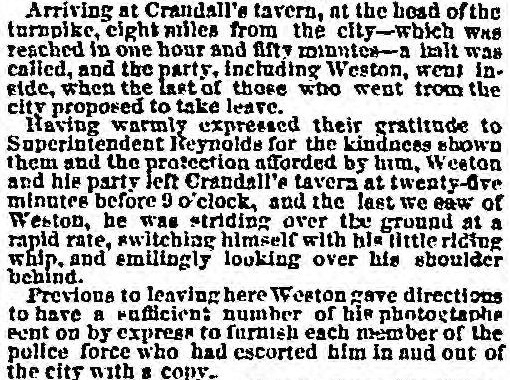
At Crandall’s tavern, eight miles from Buffalo: the little riding whip, and a photograph for every policeman. Buffalo Commercial Advertiser report, reprinted in the Chicago Tribune, Chicago, Illinois, November 19, 1867, page 1. Library of Congress, Chronicling America. Click the clipping to read it full size.
Never on a Sunday, and the 100-Mile Day
Weston had one rule he wouldn’t bend, even with a deadline. Since leaving Portland, the Buffalo paper said, he “has not travelled a single rod on Sunday.” A rod is 16 and a half feet. The bet also had a second part. Somewhere along the way, Weston had to walk 100 miles inside 24 hours. Harper’s Weekly said he got five chances. He had missed twice before Buffalo, and he never did make it on this trip.
Thanksgiving Day in Chicago, Illinois
On Thursday, November 28, 1867, Weston walked into Chicago. It was Thanksgiving Day, people had the day off, and crowds turned out to see him. He crossed the city limits at “precisely seven and a half minutes past nine o’clock, by Chicago time.” His deadline was noon. He had almost three hours to spare.
The Chicago Tribune skipped Friday’s paper because of “the little event of Thanksgiving.” On Saturday it said the hero of the day was “simply a little wiry pedestrian who had walked all the way from Portland in twenty-six days. He said he would do it, and he did it.”
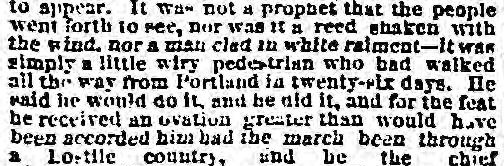
“He said he would do it, and he did it.” Chicago Tribune, Chicago, Illinois, November 30, 1867, page 3. Library of Congress, Chronicling America. Click the clipping to read it full size.
Weston had a joke for his Chicago crowd about Indiana. He’d been told it was 57 miles from Laporte, Indiana, to the Hyde Park House, a hotel just outside Chicago. But “the Hyde Park House kept moving off, and I walked seventy-three miles before I reached it,” he said. With miles that long, he said, he would buy land in Indiana by the mile, “for if I buy five miles I have got the whole State.”
What the Walk Paid Weston
In Chicago, the bet itself didn’t pay off for Weston. He had missed the 100-mile day, and the Tribune said he figured his costs at “about $1,300 more than he will receive as his share of the wager.”
But remember those photographs. The Tribune guessed Weston had sold “twelve thousand of his photographs,” and it thought they had probably paid for the whole trip. He also had talks lined up in towns all the way back to Portland. The paper decided he would end up with “a nice little nest egg,” which means money saved for later.
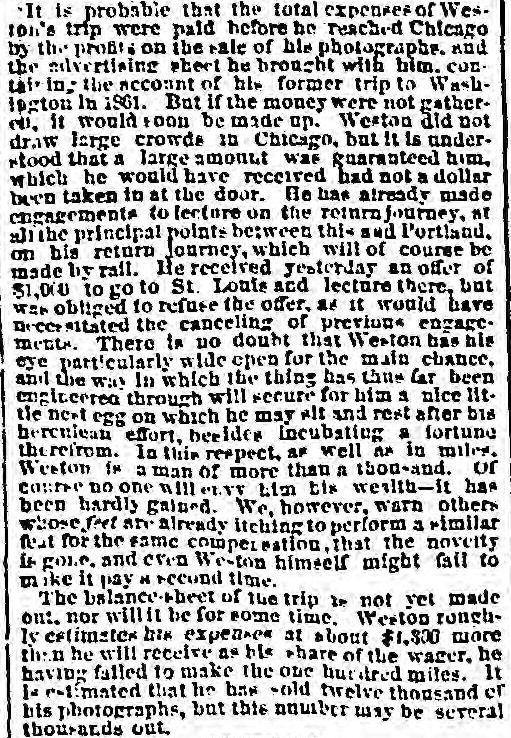
“How It Pays”: photographs, talks and the bet. Chicago Tribune, Chicago, Illinois, November 30, 1867, page 3. Library of Congress, Chronicling America. Click the clipping to read it full size.
What a Photograph Cost in Chicago in 1867
On the same Chicago Tribune page that told about Weston in Buffalo, the Hesler Gallery at 113 Lake Street advertised “Cartes de Visite $1.50 per dozen.” A carte de visite was a small photograph mounted on a stiff card. The ad had a tip for parents, too: “the little folks should be brought in as early in the day as possible.”
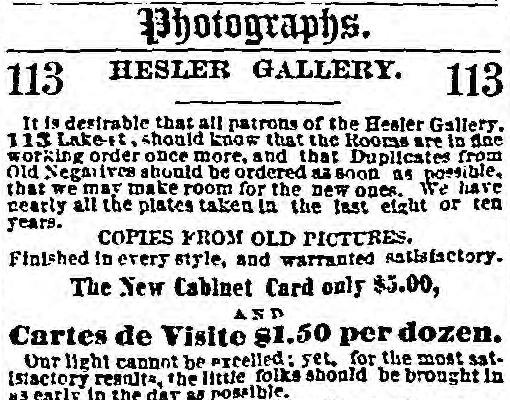
A photographer’s ad on the same page as the Buffalo report. Chicago Tribune, Chicago, Illinois, November 19, 1867, page 1. Library of Congress, Chronicling America. Click the clipping to read it full size.
Edward Payson Weston Kept Walking
Weston kept walking for the rest of his long life. In 1910, at the age of 70, he set out to walk from Los Angeles to New York, and La Junta, Colorado, tried to keep up.
The picture at the top of this page comes from Harper’s Weekly of November 23, 1867. Its artist, Stanley Fox, sketched Weston’s walk “at the time Weston was passing,” with the judges riding behind in a coach. One of the two walkers is Weston, and the other is a judge who walked near him. The man out in front carries a little whip, just like the one the Buffalo paper saw.
Back in Buffalo, a reporter had watched him go, whip in hand, smiling over his shoulder. Weston never drank the whiskey. His shoes did, and they carried him all the way to Chicago.
Sources
- “Weston. His Sojourn in Buffalo, Visit to the Theatre Last Evening, Departure,” from the Buffalo Commercial Advertiser, Nov. 15, reprinted in the Chicago Tribune (Chicago, Illinois), November 19, 1867, page 1. Also on this page: the Hesler Gallery ad. Library of Congress, Chronicling America.
- Prescott Journal (Prescott, Wisconsin), November 30, 1867, page 2: the whiskey-in-the-shoes paragraph again, and Weston’s letter about his debts. Library of Congress, Chronicling America.
- “Weston. The Great Pedestrian Feat Achieved,” Chicago Tribune (Chicago, Illinois), November 30, 1867, page 3: the Thanksgiving arrival, Weston’s talk, and “How It Pays.” Library of Congress, Chronicling America.
- “Weston the Pedestrian,” Harper’s Weekly, November 23, 1867, page 739, and the engraving “Weston, the Pedestrian, on the Road, the Manner in Which the Walk Is Conducted,” sketched by Stanley Fox, page 740 (the cover). Internet Archive.
- “The city of Buffalo, N.Y. 1880,” bird’s-eye map, E. H. Hutchinson, publisher. Library of Congress Geography and Map Division.
- Edward Payson Weston, 1839-1929, photograph record, for his birth year. Library of Congress Prints and Photographs Division.
- The newspapers, magazine and map above were published before 1931 and are in the public domain.