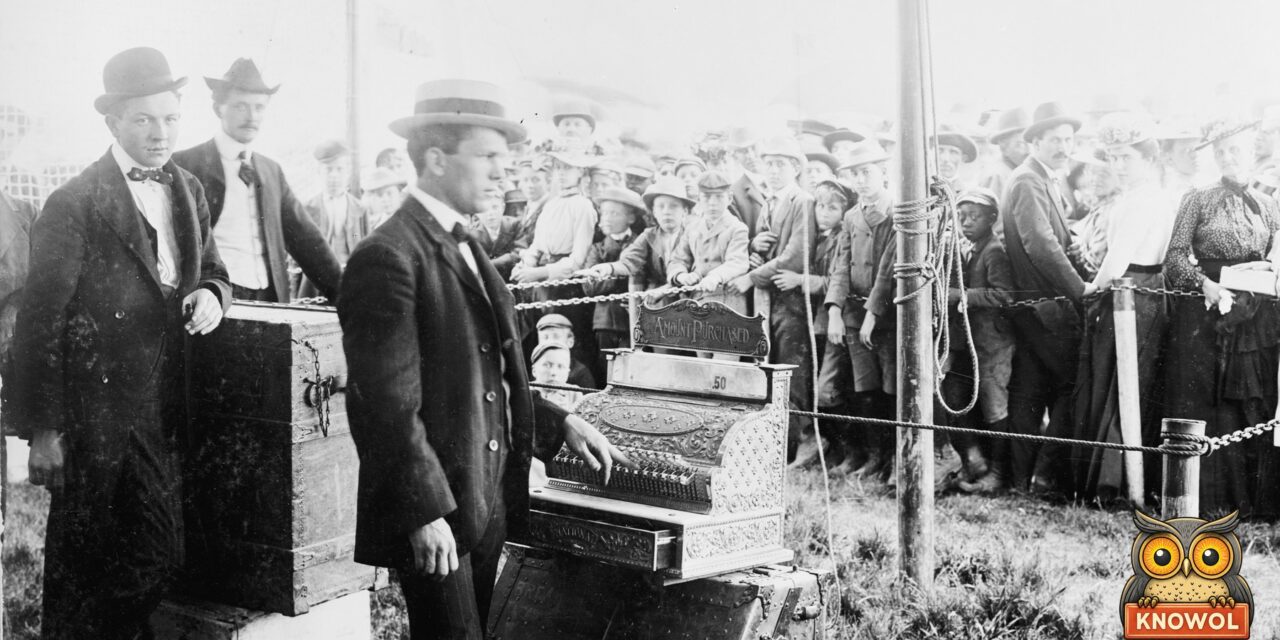
On the morning of Thursday, June 4, 1896, four boys walked into the office of the Chronicle, the daily paper in The Dalles, Oregon. Their names were George FitzGerald, Glenn Patterson, John FitzGerald and Clint Bradshaw. They had a pocketbook with them, a small purse for coins. Somebody had lost it, and the boys had found it. Inside was “over a dollar in small change.”
It was a hard morning to find a dollar, because the circus had come to town that same day. The paper did the arithmetic. “There was enough money to buy them all a ticket to the circus,” it said, “and enough left to buy peanuts for the elephant.” The boys handed the pocketbook over anyway.
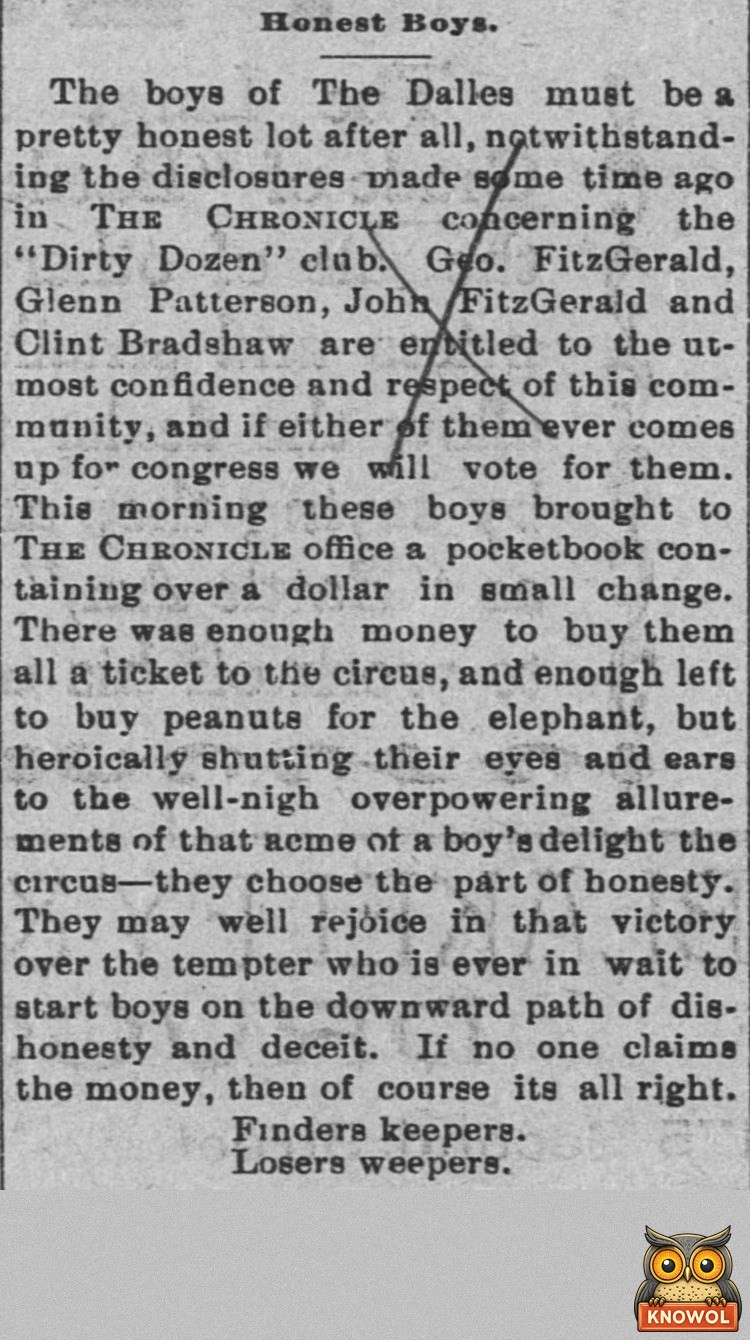
“Honest Boys.” Somebody marked an X on this copy of the paper before it was filmed. The Dalles Daily Chronicle, The Dalles, Oregon, June 4, 1896, page 3. Library of Congress, Chronicling America. Click the clipping to read it full size.
The top of a boy’s world
The Chronicle called the circus “that acme of a boy’s delight.” Acme means the very top. The town had been waiting since May 23, when the show’s advertising car came through to stir up a crowd.
The ad was not shy. Bond Bros. called their circus the “World’s Best Shows.” The ad promised “3 BIG CIRCUSES IN 3 BIG RINGS” and a “MONSTER MENAGERIE OF RARE WILD BEASTS!” A menagerie was a circus’s traveling zoo. A drawing showed a trainer inside a cage wagon full of big cats.
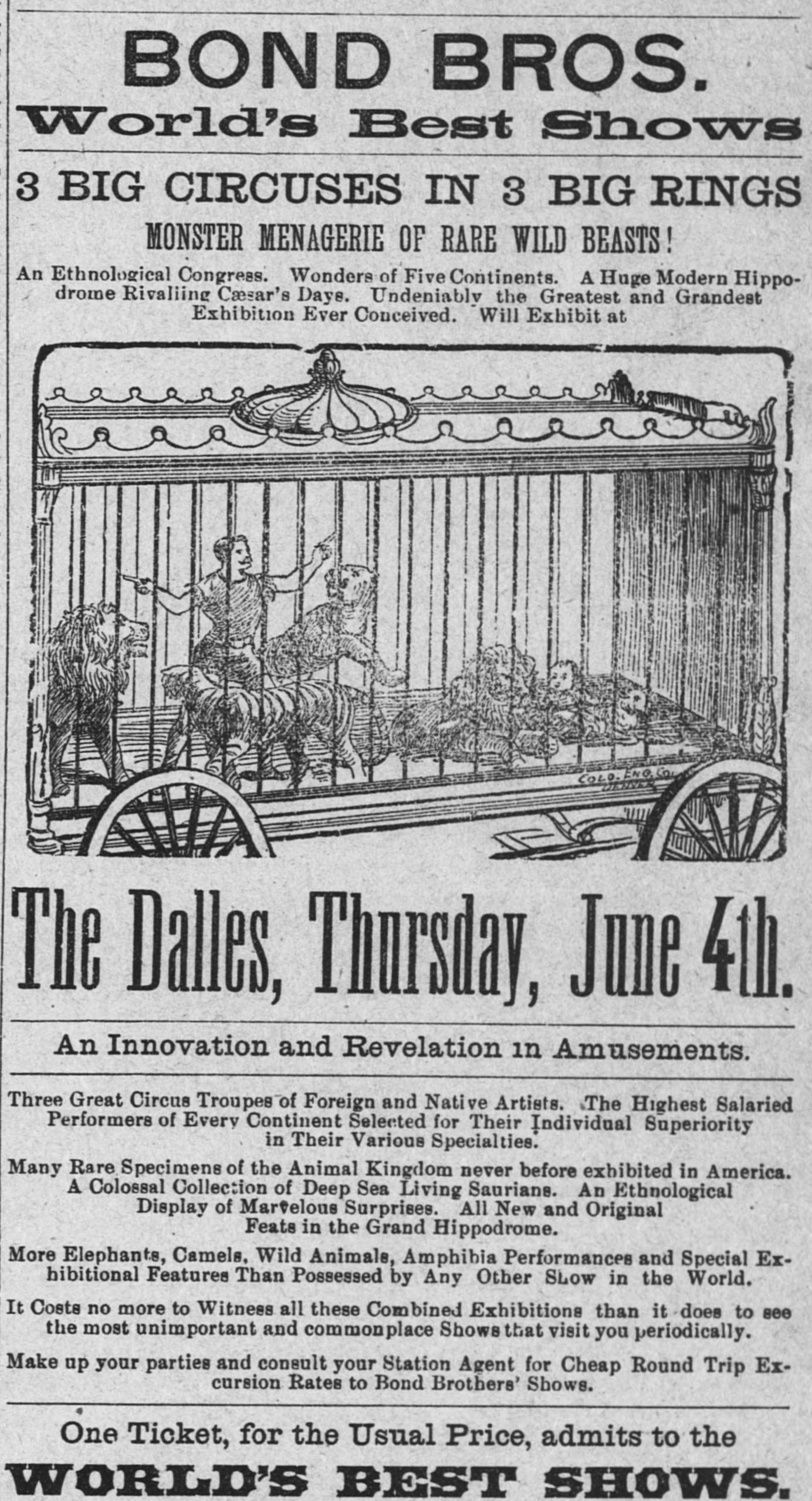
The Bond Bros. ad for circus day in The Dalles. The Dalles Weekly Chronicle, The Dalles, Oregon, June 3, 1896, page 2. Library of Congress, Chronicling America. Click the clipping to read it full size.
On circus morning the Chronicle went and looked. It counted four elephants, three camels, a one-humped camel called a dromedary, and a zebra, “which is a very rare acquisition.” It also counted “four funny clowns.” The morning parade was “very creditable,” which means pretty good. The men raised the tents on the river beach below the Wasco warehouse.
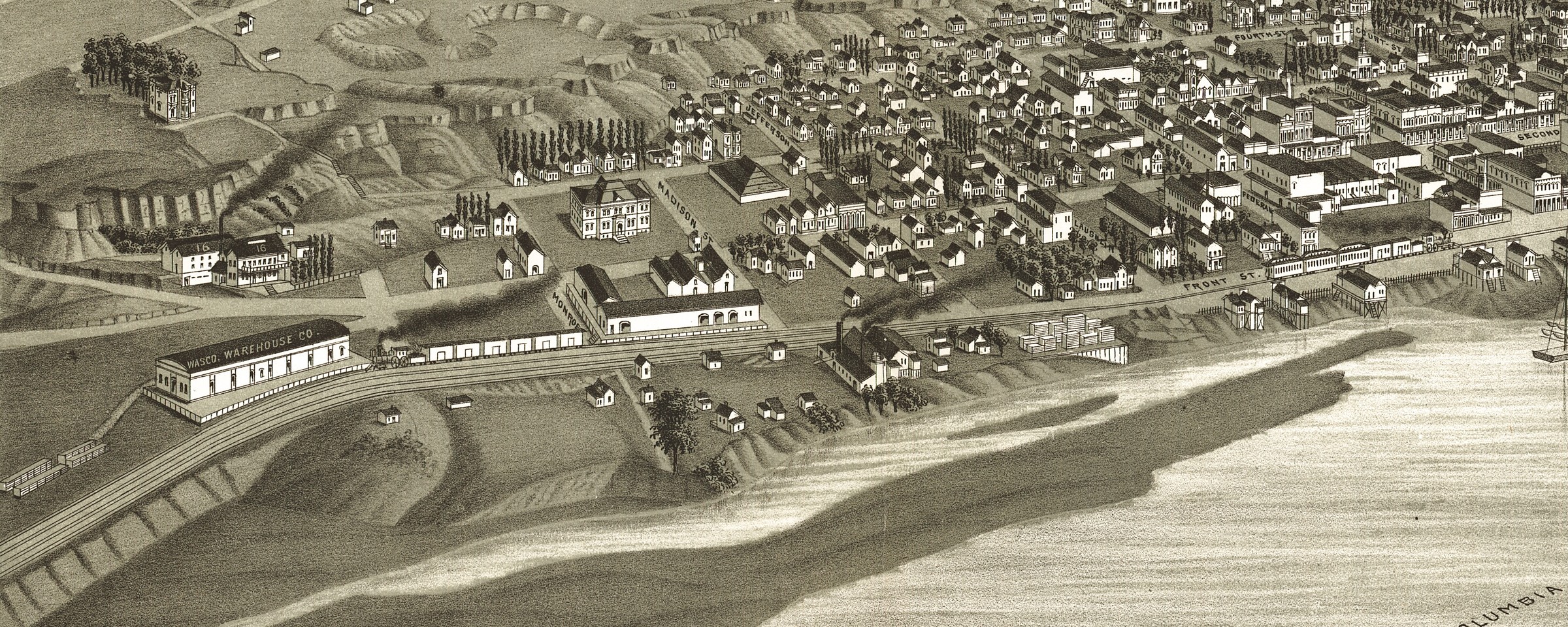
The Dalles in a bird’s-eye view drawn in 1884, twelve years before the circus. The long building by the railroad tracks at the left is lettered Wasco Warehouse Co., with river beach below it. H. Wellge, published by J. J. Stoner. Library of Congress, Geography and Map Division. Click the picture to see it full size.
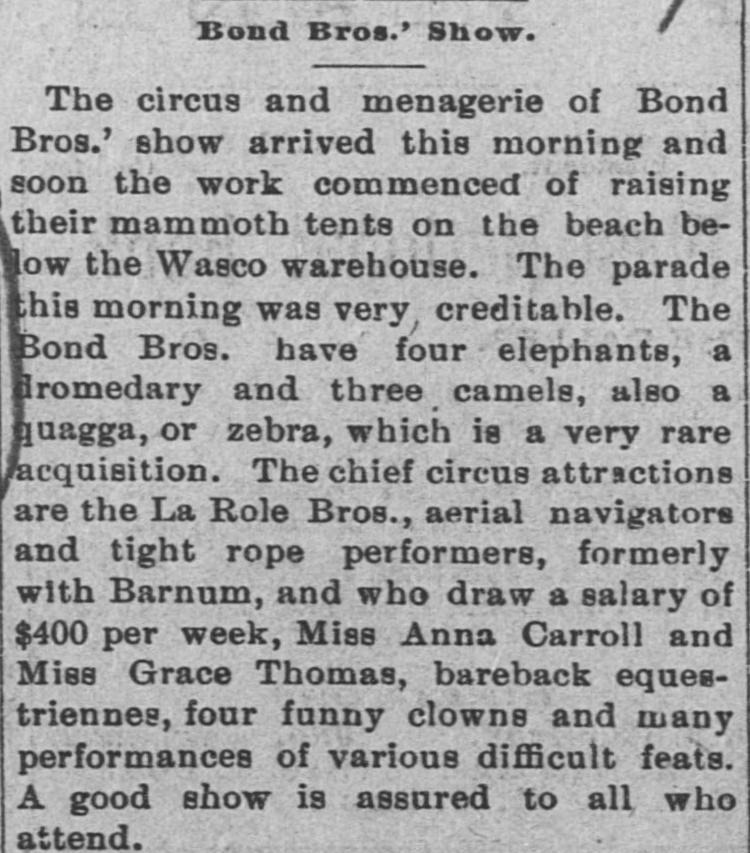
“Bond Bros.’ Show.” A fold in the paper hides the first letters of a few lines. The Dalles Daily Chronicle, The Dalles, Oregon, June 4, 1896, page 3. Library of Congress, Chronicling America. Click the clipping to read it full size.
Even the big tent had seen better days. It had “suffered severely from snow and wind at Idaho Falls,” the paper said, and a new one would replace it the next day in Portland. A Walla Walla, Washington, paper could not say the circus “was the best that ever showed in this city.” Still, it was “clean and creditable,” and it cost less than most.
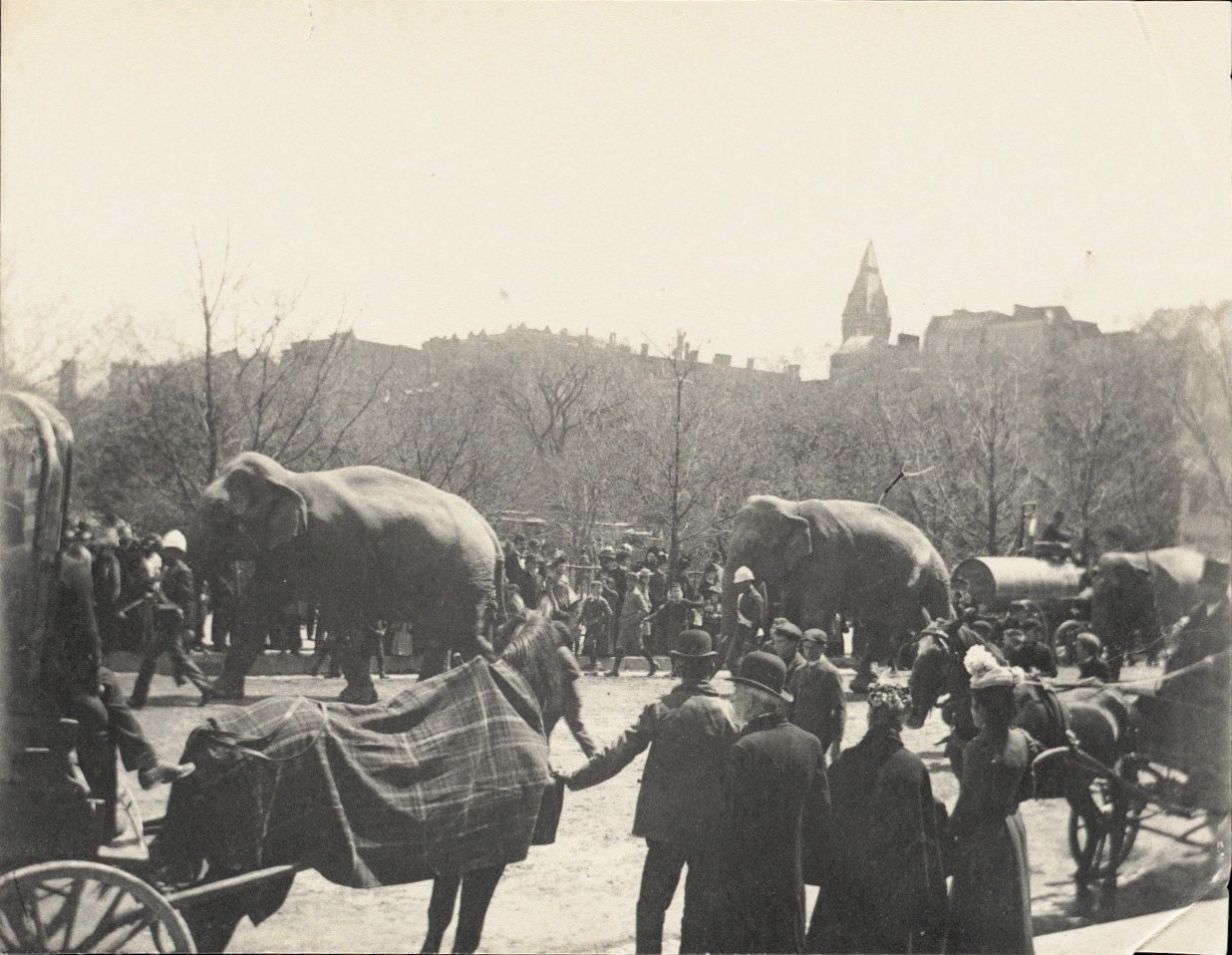
Circus elephants in a street parade, in a snapshot from about 1900. The library’s title is “Parade. Ringling Brothers, Tremont St.” It was taken in Boston, and it is not the Bond Bros. show. In front, a man holds a horse that wears a plaid blanket. Boston Public Library, Boston Pictorial Archive, via Digital Commonwealth. No known copyright restrictions. Click the picture to see it full size.
A town on its guard
Circus day had a bad name in 1896. In Olympia, Washington, where the same show was headed, the Washington Standard warned its readers. It said “bunco sharps and confidence men” were traveling along with Bond Bros. Those were swindlers who ran betting games nobody could win. “Risk your money on no game connected with a circus side-tent,” the paper said. “They are all delusions and snares.”
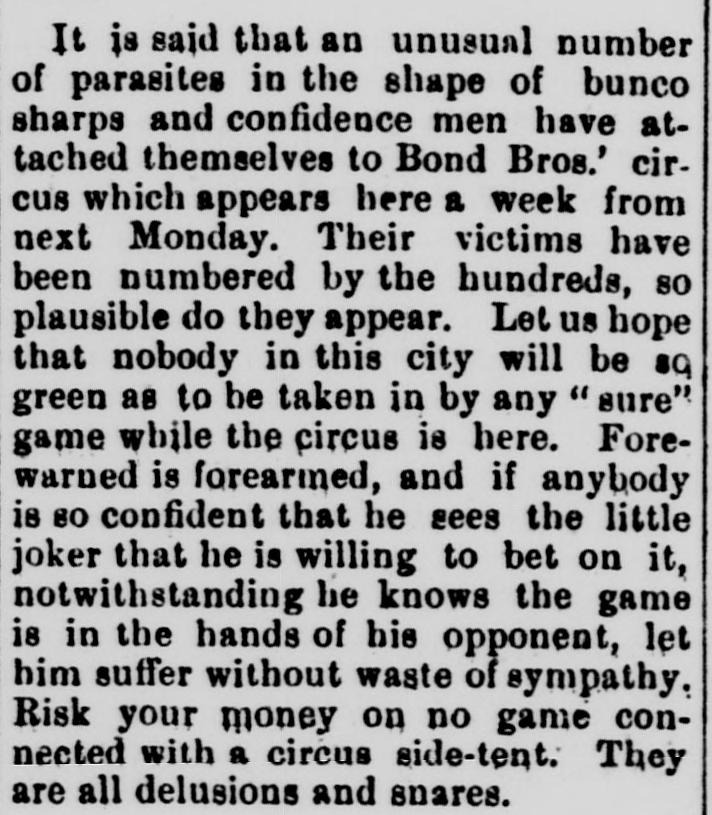
The warning printed in Olympia ten days before the circus got there. Washington Standard, Olympia, Washington, June 5, 1896, page 3. Library of Congress, Chronicling America. Click the clipping to read it full size.
The Dalles got ready as well. Marshal Blakeney appointed three special police officers for the day. The city recorder, a town official, gave notice that any “crooked work” at the circus grounds would be punished “to the full extent of the law.” So that was the mood on June 4. A whole town was watching for somebody to take what wasn’t theirs. Then four boys came through the newspaper’s door to give money back.
“We will vote for them”
The Chronicle was delighted, and a little surprised. Three weeks earlier it had told on a secret boys’ club called the “Dirty Dozen.” An officer hunting for a missing roll of blankets had found the clubhouse, a shack on the bank of a slough. Boys were lying on the blankets, smoking and reading. The paper even listed the club’s “library” of cheap adventure books. The titles included “Ten Buckets of Blood, or a Boy’s Revenge,” and “Nosebag Gallagher, the Terror of the Black Hills.”
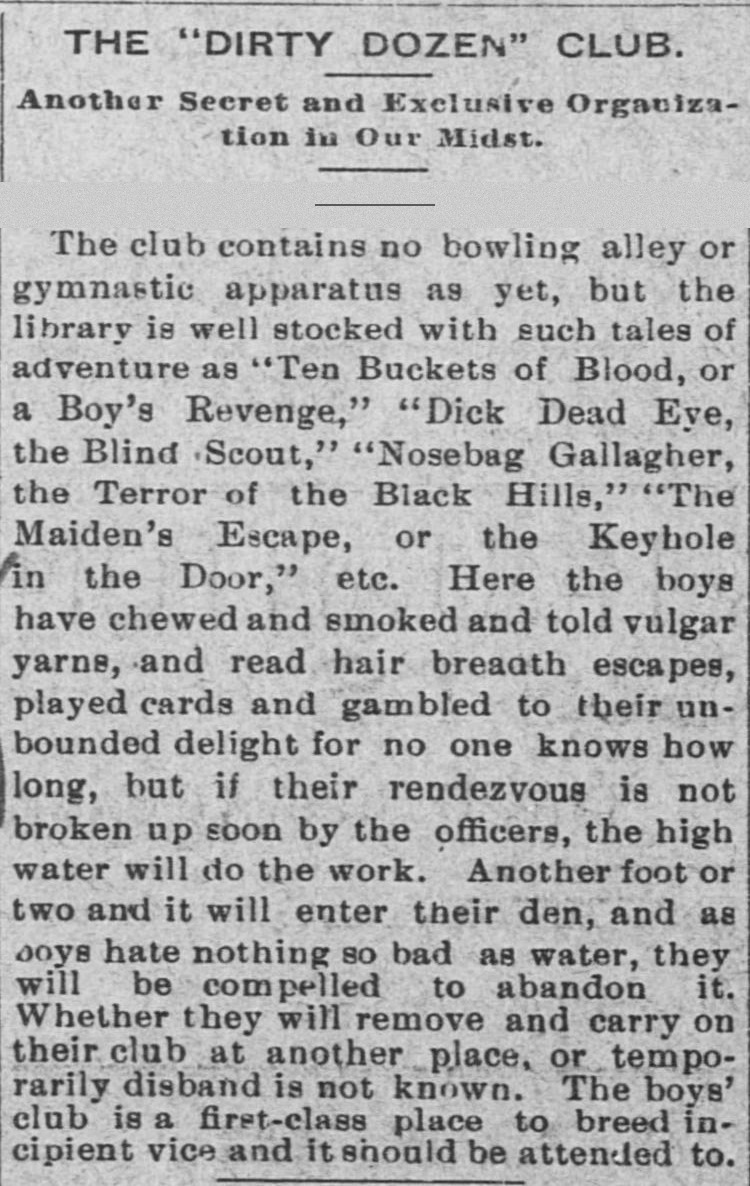
The headline and the last part of the Chronicle’s story about the boys’ secret club. Two parts of the story, joined. The Dalles Daily Chronicle, The Dalles, Oregon, May 12, 1896, page 3. Library of Congress, Chronicling America. Click the clipping to read it full size.
Now the same paper took it back. “The boys of The Dalles must be a pretty honest lot after all,” it began. The four finders were “entitled to the utmost confidence and respect of this community, and if either of them ever comes up for congress we will vote for them.” They had shut “their eyes and ears” to the circus, the paper said. In its own words, “they choose the part of honesty.”
Grown men wanted to go, too
The pull of a circus did not wear off with age. The night before, the city council of Astoria, Oregon, took up a request from Bond Bros. The show wanted a break on its license, the fee a circus paid a town to perform. In Astoria it was $75 a show.
The Daily Morning Astorian had fun with it. Its headline was “THEY WANT TO SEE THE CIRCUS.” Aldermen are city council members, and Alderman Parker “evidently wanted to see the show.” Alderman Bergman “told of the amusement the circus would be for children and servant girls, and begged the council to be easy on the poor circus man.” The paper joked that “the other councilmen were in tears.” The council said no anyway.
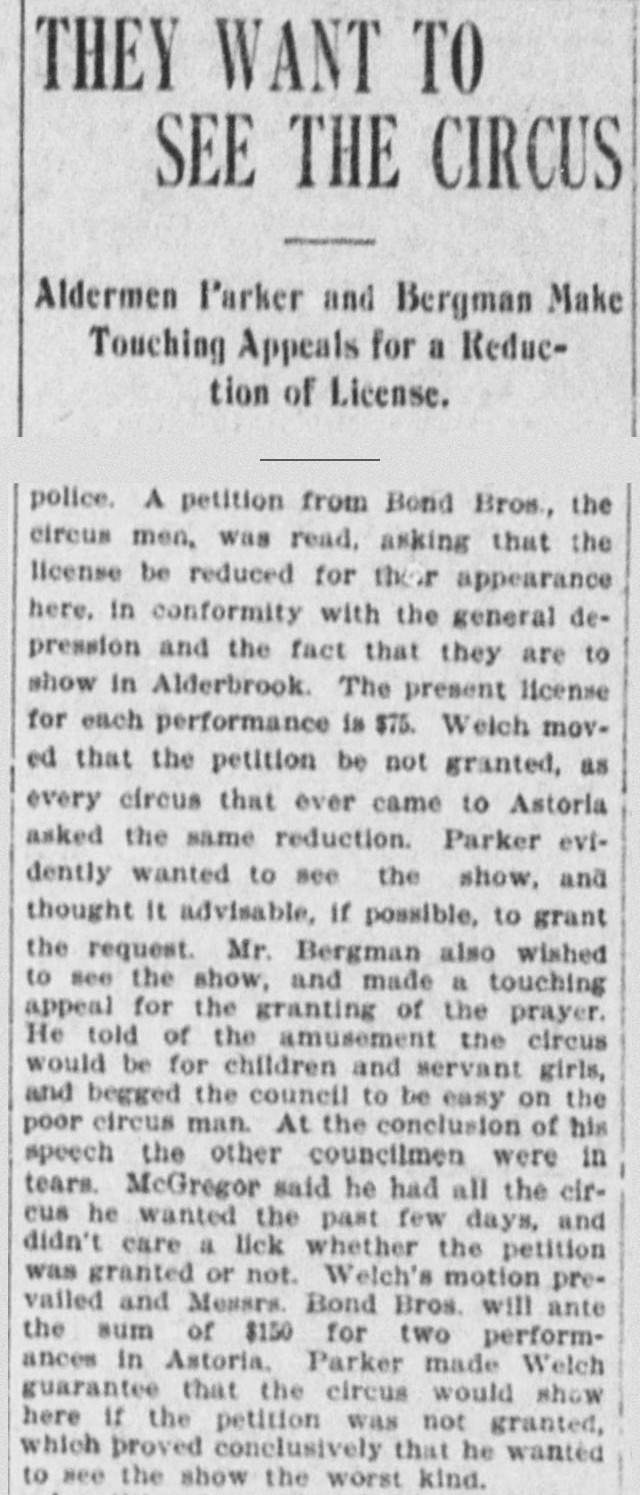
The headline and the circus part of the council report. Two parts of the story, joined. The Daily Morning Astorian, Astoria, Oregon, June 4, 1896, page 1. Library of Congress, Chronicling America. Click the clipping to read it full size.
What a ticket bought
We found no review of the show in the Chronicle. But the circus kept moving, and on June 17 it reached Seattle, Washington. Two days before, the Seattle Post-Intelligencer printed a paragraph of praise headed “The Titan of Shows.” The Olympia paper had printed it ten days earlier, almost word for word, with a different town and date. Praise like that came ready to print, with a blank for the town’s name.
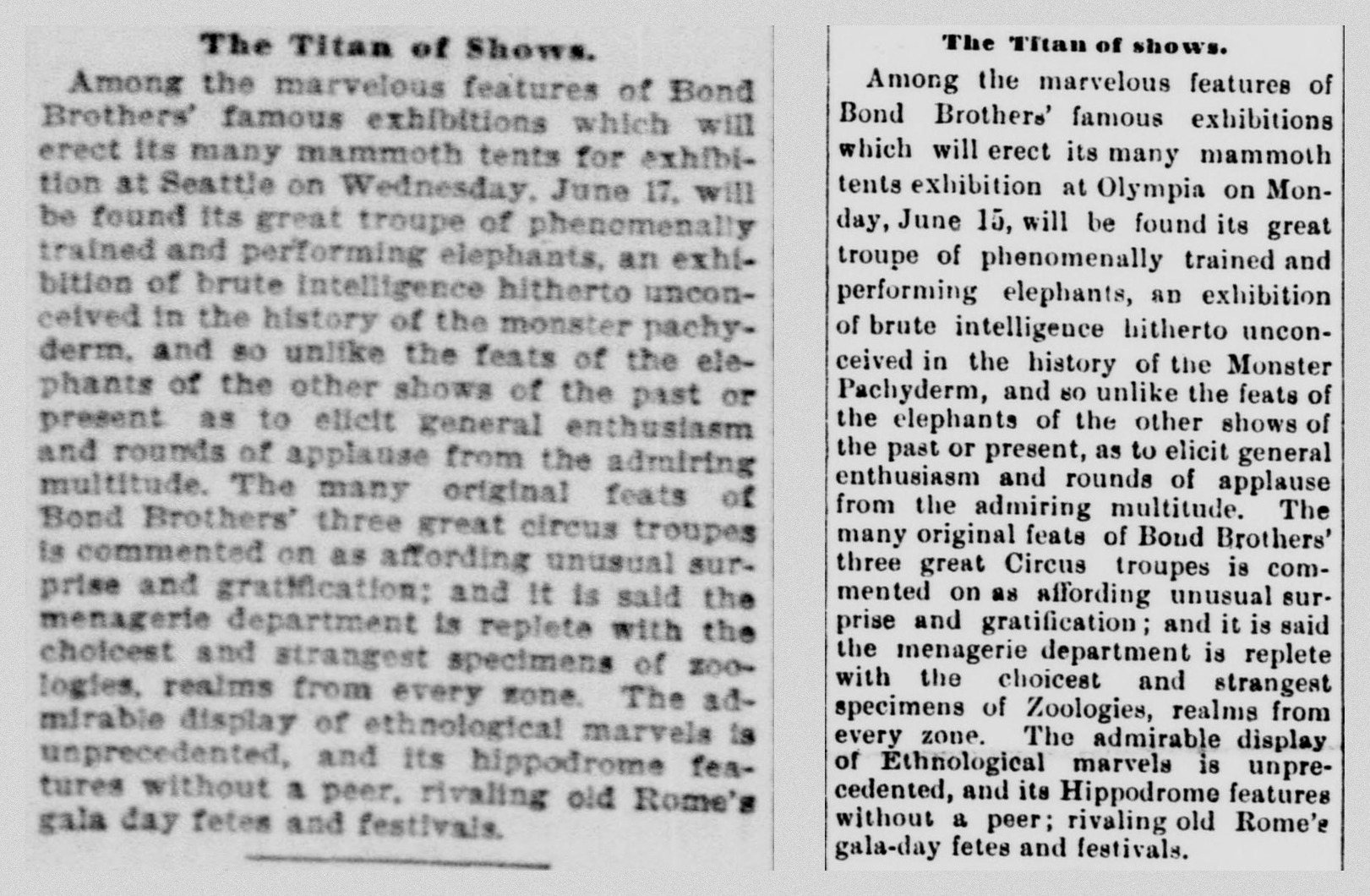
One paragraph, two towns. Left: Seattle Post-Intelligencer, Seattle, Washington, June 15, 1896, page 5. Right: Washington Standard, Olympia, Washington, June 5, 1896, page 3. Library of Congress, Chronicling America. Click the picture to see it full size.
The morning after the show, a Post-Intelligencer reporter told what really went on under the tent. The three rings turned out to be two, with most of the acts “taking place in but one.” The reporter also wrote, “The menagerie contained but few animals.” The star act was a team of brothers on the flying trapeze, and their work “was excellent.”
Nobody seemed to mind. The tents were crowded “with fully 2,000 people.” Boys kept creeping up to the rings. “The clowns got rid of some very ancient jokes, but everything went and the crowd seemed satisfied.” Then came the best line of all. “They were not all small boys at Bond Brothers’ circus last night, but many seemed to think they were.”
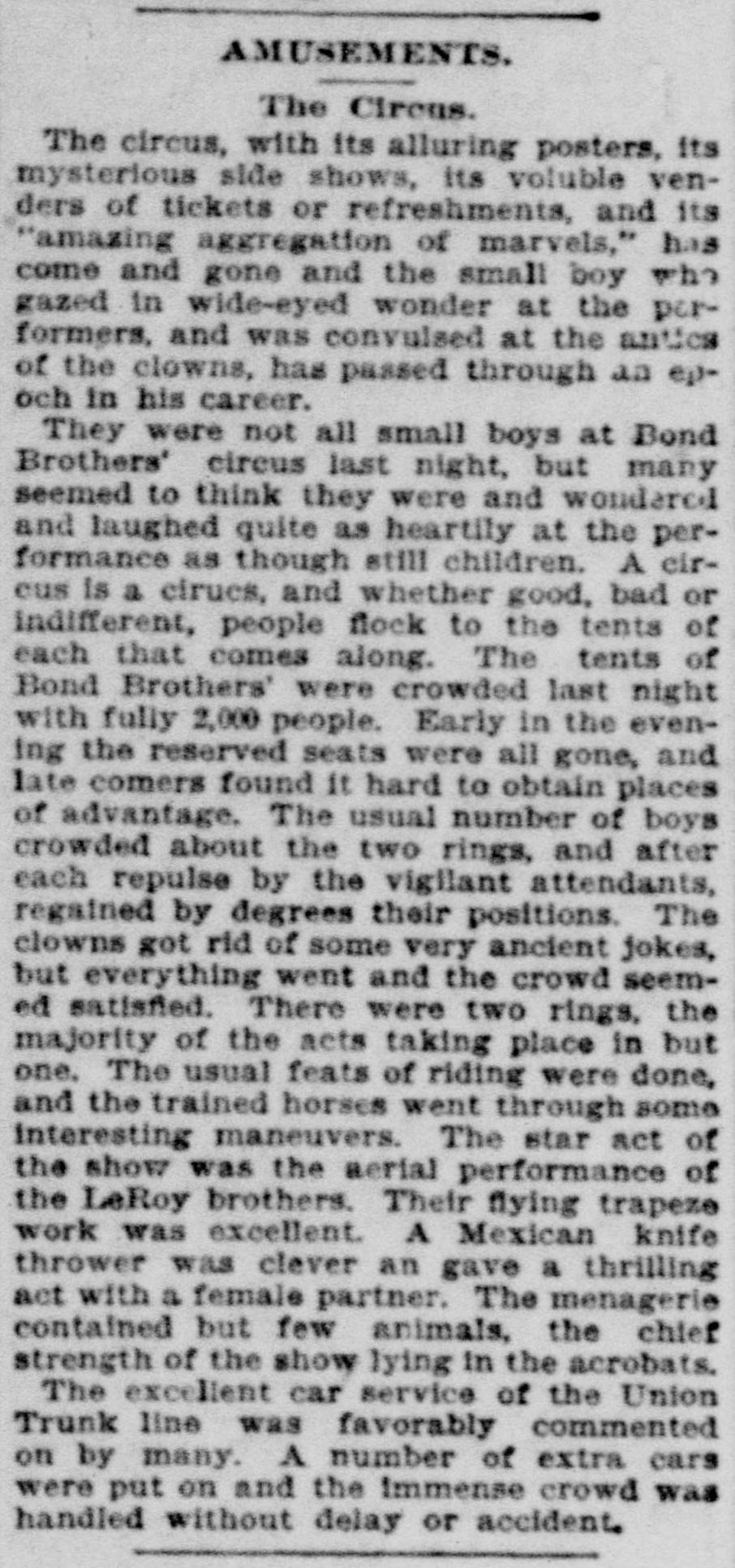
“The Circus.” Seattle Post-Intelligencer, Seattle, Washington, June 18, 1896, page 5. Library of Congress, Chronicling America. Click the clipping to read it full size.
By the numbers
- Over $1: the small change in the lost pocketbook
- 4: the boys who turned it in
- 3: the rings in the ad
- 2: the rings the Seattle reporter counted
- 4: the elephants the Chronicle counted in The Dalles
- $75: the license The Dalles charged the circus
- 2,000: the crowd in Seattle
Finders keepers
The Chronicle never said who lost the pocketbook, or whether the four boys got inside the tent that day. It did say what should happen next. “If no one claims the money, then of course its all right.” Under that it printed two short lines: “Finders keepers. Losers weepers.”
The photo at the top of this story is not from The Dalles. It shows the main entrance of the Ringling Bros. circus, some time between 1895 and 1910. A ticket man works a fancy cash register. Behind the chain, a crowd of boys looks on. George, Glenn, John and Clint stood that close to a circus once, with a dollar that wasn’t theirs, and they turned it in.
Sources
- The Dalles Daily Chronicle (The Dalles, Oregon): June 4, 1896, page 3 (“Honest Boys,” “Bond Bros.’ Show,” the special police, the circus license and the tent); June 3, 1896, page 4 (the Walla Walla review, reprinted); May 23, 1896, page 3 (the advertising car); May 12, 1896, page 3 (the “Dirty Dozen” club).
- The Dalles Weekly Chronicle, June 3, 1896, page 2 (the Bond Bros. ad).
- The Daily Morning Astorian (Astoria, Oregon), June 4, 1896, page 1 (“They Want to See the Circus”).
- Washington Standard (Olympia, Washington), June 5, 1896, page 3 (the warning and “The Titan of Shows”).
- The Seattle Post-Intelligencer (Seattle, Washington): June 15, 1896, page 5 (“The Titan of Shows”); June 18, 1896, page 5 (“The Circus”).
- Cover: Detroit Publishing Co., “[Main entrance, Ringling Bros. circus],” glass negative, between 1895 and 1910, Library of Congress, no known restrictions on publication. It shows another circus in another place.
- H. Wellge, “Panoramic view of the city of The Dalles, Or. county seat of Wasco County 1884,” published by J. J. Stoner, Library of Congress, Geography and Map Division.
- “Parade. Ringling Brothers, Tremont St.,” photographic print, about 1900, Boston Public Library, Boston Pictorial Archive, Digital Commonwealth, no known copyright restrictions.
- All newspaper images: Library of Congress, Chronicling America. Published 1896.