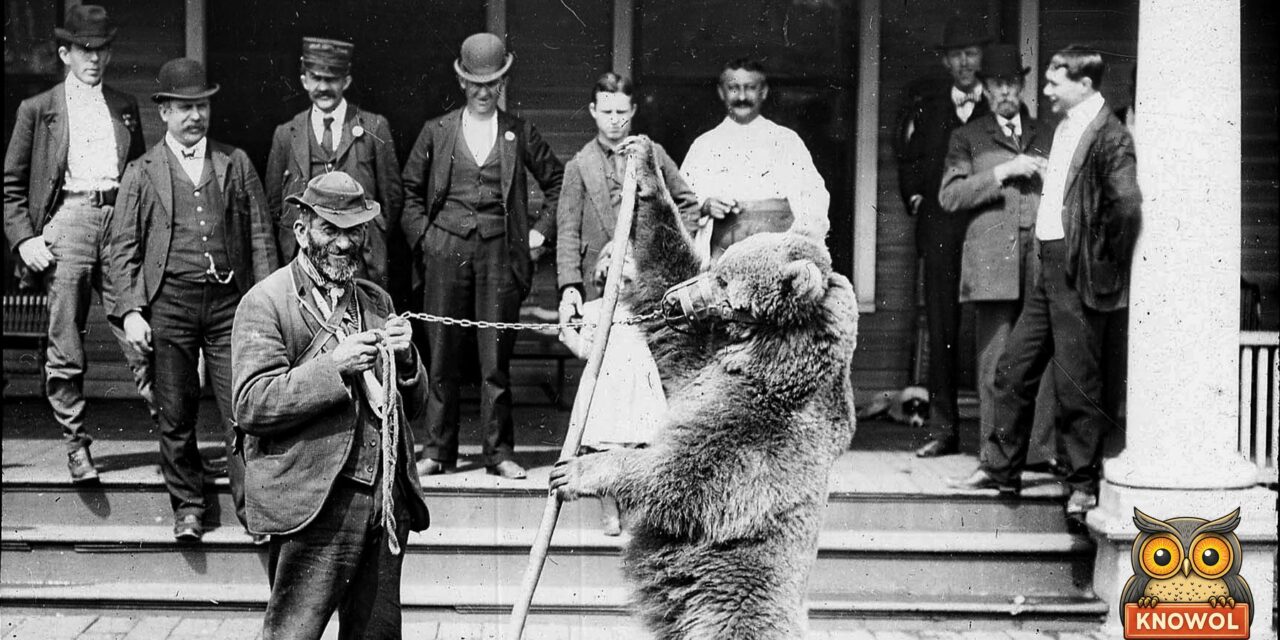
About nine o’clock on Friday morning, November 12, 1897, a strange parade stopped in front of a butcher shop on Eynon Street in West Scranton, Pennsylvania. There were four men, six women and nine children. There were four horses, three bears and, as the newspaper put it, “a number of monkeys.” One of the bears was big, shaggy and very hungry.
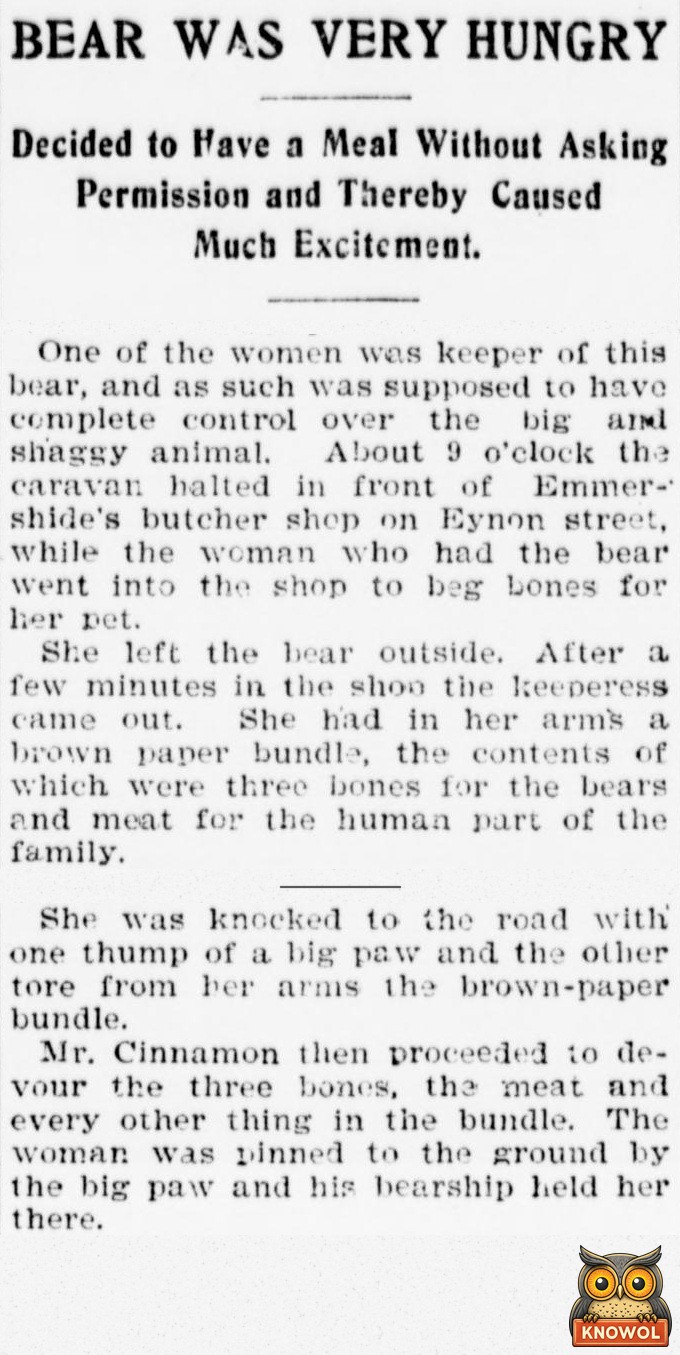
“Bear Was Very Hungry.” The headline and four paragraphs of the story, joined. The Scranton Tribune, Scranton, Pennsylvania, November 13, 1897, page 7. Library of Congress, Chronicling America. Click the clipping to read it full size.
The band with three bears
They were a band of travelers who lived in tents and moved from town to town with their animals. The Scranton Tribune told their story the next morning, and it did not print one of their names. But the reporter gave the biggest bear a name of his own: “Mr. Cinnamon.” A cinnamon bear is a bear with reddish-brown fur, the color of the spice.
One of the women was the big bear’s keeper. The paper said she “was supposed to have complete control over the big and shaggy animal.” That morning she left him outside, with one of the men holding him. Then she went into Emmershide’s butcher shop to ask for bones.
Three bones and some meat
A few minutes later she came back out with a bundle wrapped in brown paper. The paper told what was in it: “three bones for the bears and meat for the human part of the family.” Three bones, three bears. It should have worked out fine.
Mr. Cinnamon saw the bundle. “He was hungry and desperate,” the Tribune said. He broke away from the man who held him and jumped at his keeper. “She was knocked to the road with one thump of a big paw and the other tore from her arms the brown-paper bundle.”
Then he ate. He ate “the three bones, the meat and every other thing in the bundle.” That was his own bone, the other bears’ bones and the people’s meat too. The whole time, he kept one big paw on the woman so she could not get up. The reporter called him “his bearship,” a joke on “his lordship.”
Nobody wanted to argue
Nobody could help her. The men “had their hands full with the frightened horses and the two smaller bears.” When anyone came close, Mr. Cinnamon “turned his head and with a sinister growl kept them all at a respectful distance.” Sinister means mean and scary. A respectful distance is far enough back to be safe.
The two smaller bears were hungry too, and those were their bones. They stayed out of it. “Hungry as they were,” the paper said, “the smaller bears didn’t care to eat just then.”
At last the food ran out. “Finally when only the brown paper was left of the bundle the big tyrant released his foot from the woman and condescended to be lead peaceably away.” A tyrant is a bossy ruler. “Condescended” means he agreed, as if he were doing everybody a favor. (“Lead” is the paper’s spelling of led.) The Tribune does not say the woman was hurt. It does not say what the family ate that day, either.
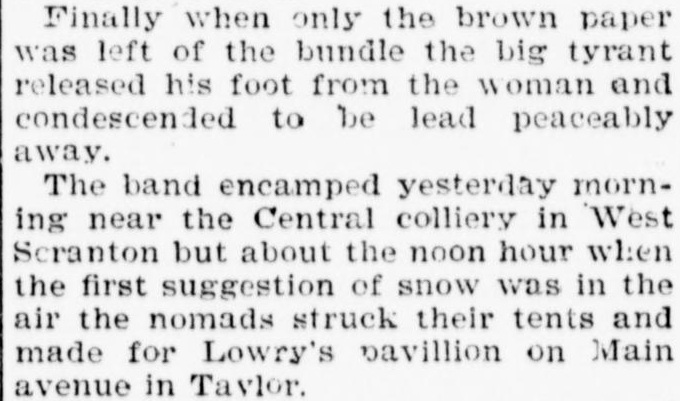
The end of the meal, and the band’s move to Taylor. The Scranton Tribune, Scranton, Pennsylvania, November 13, 1897, page 7. Library of Congress, Chronicling America. Click the clipping to read it full size.
Snow in the air
The band had been coming down the valley all week. On Monday, the Tribune’s news from Priceburg, a mining town up the valley, told of a camp of tents on the Boulevard road. “They have monkeys and bears,” it said. By Friday’s paper, the Priceburg writer reported that the campers “have departed.” It was very likely the same band.
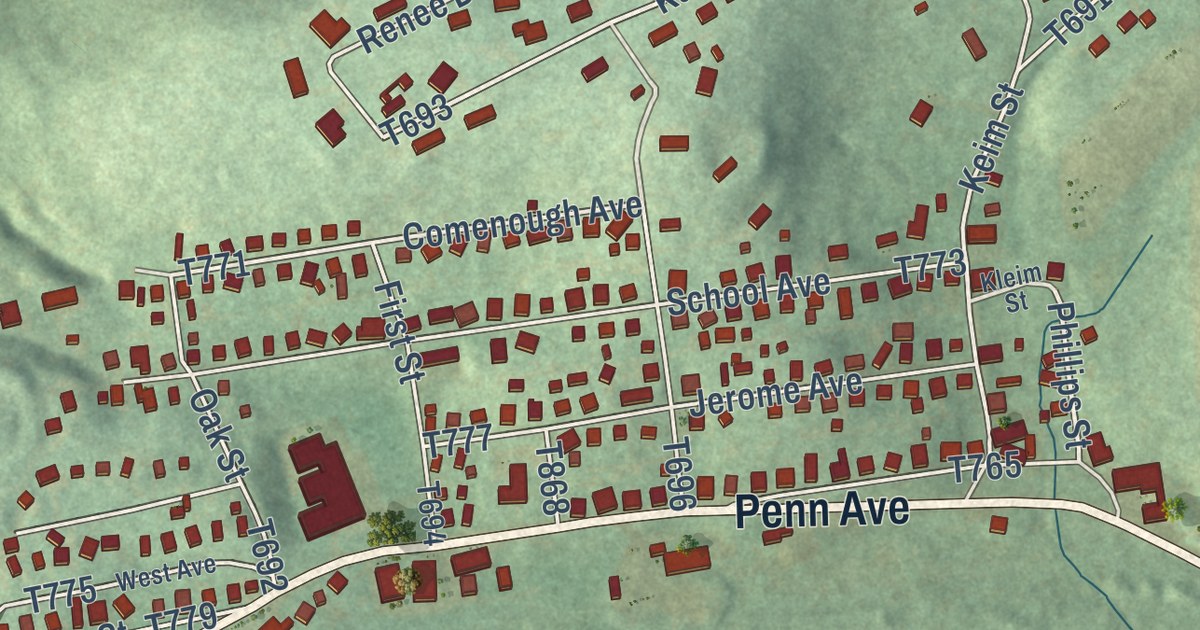
The bear story fills in the rest. About a week earlier, police in Carbondale had ordered the band out of that city. On Wednesday they were camped in North Scranton. On Thursday morning they passed through the middle of the city. On Friday morning they set up near the Central colliery in West Scranton. A colliery is a coal mine and its buildings.
Their fires burned wood, and coal from the culm dump nearby. Culm is what a coal mine throws away: slate, dust and bits of coal too small to sell. Scranton was a hard-coal city, and hills of culm stood beside its mines.
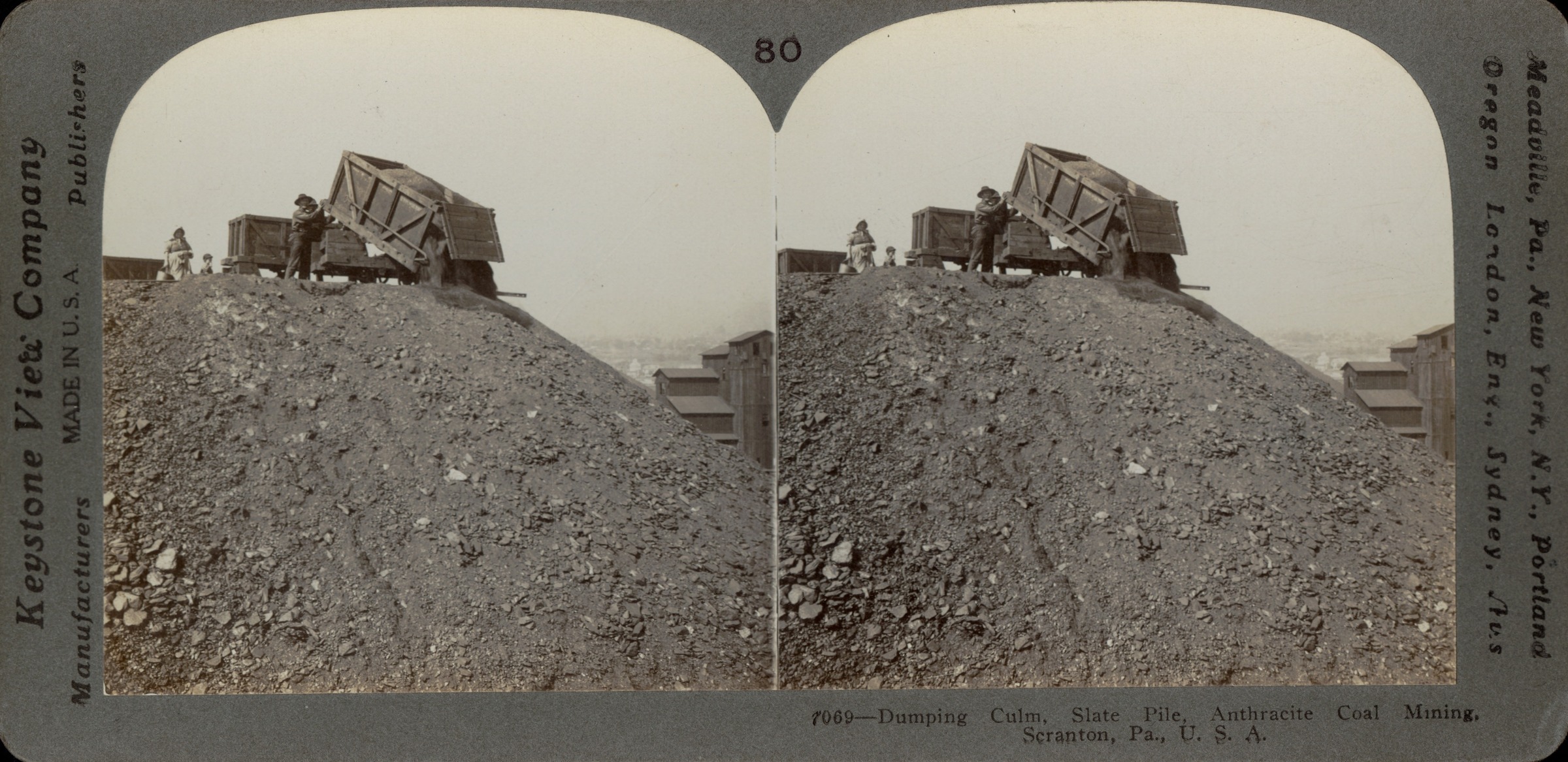
“Dumping Culm, Slate Pile, Anthracite Coal Mining, Scranton, Pa.” A mine car tips its load onto a culm dump in Scranton. Anthracite is hard coal. Keystone View Company stereograph card, copyright 1905. Boston Public Library, by way of Digital Commonwealth, no known copyright restrictions, public domain. Click the picture to see it full size.
They did not stay long. The paper said that “about the noon hour when the first suggestion of snow was in the air” the band “struck their tents.” To strike a tent is to take it down. They headed for Lowry’s pavilion on Main Avenue in Taylor, the next town down the valley. The paper called it a regular camping ground for bands passing through.
By the count
The reporter counted everybody. Here is the Tribune’s list:
- 4 men and 6 women
- 9 children
- 4 horses
- 3 bears, one big and two smaller
- “a number of monkeys”
- one of the women was “ninety-five years of age”
What the photos show
We found no photo of the Scranton band. The picture at the top of this story was taken three years later, in 1900, in Lewiston, New York. A Dutch doctor named Lambert van Kleef was traveling in America with his camera. He caught the same kind of sight: a bear standing up with a pole, its keeper holding the chain, and the men of the town looking on from a porch.
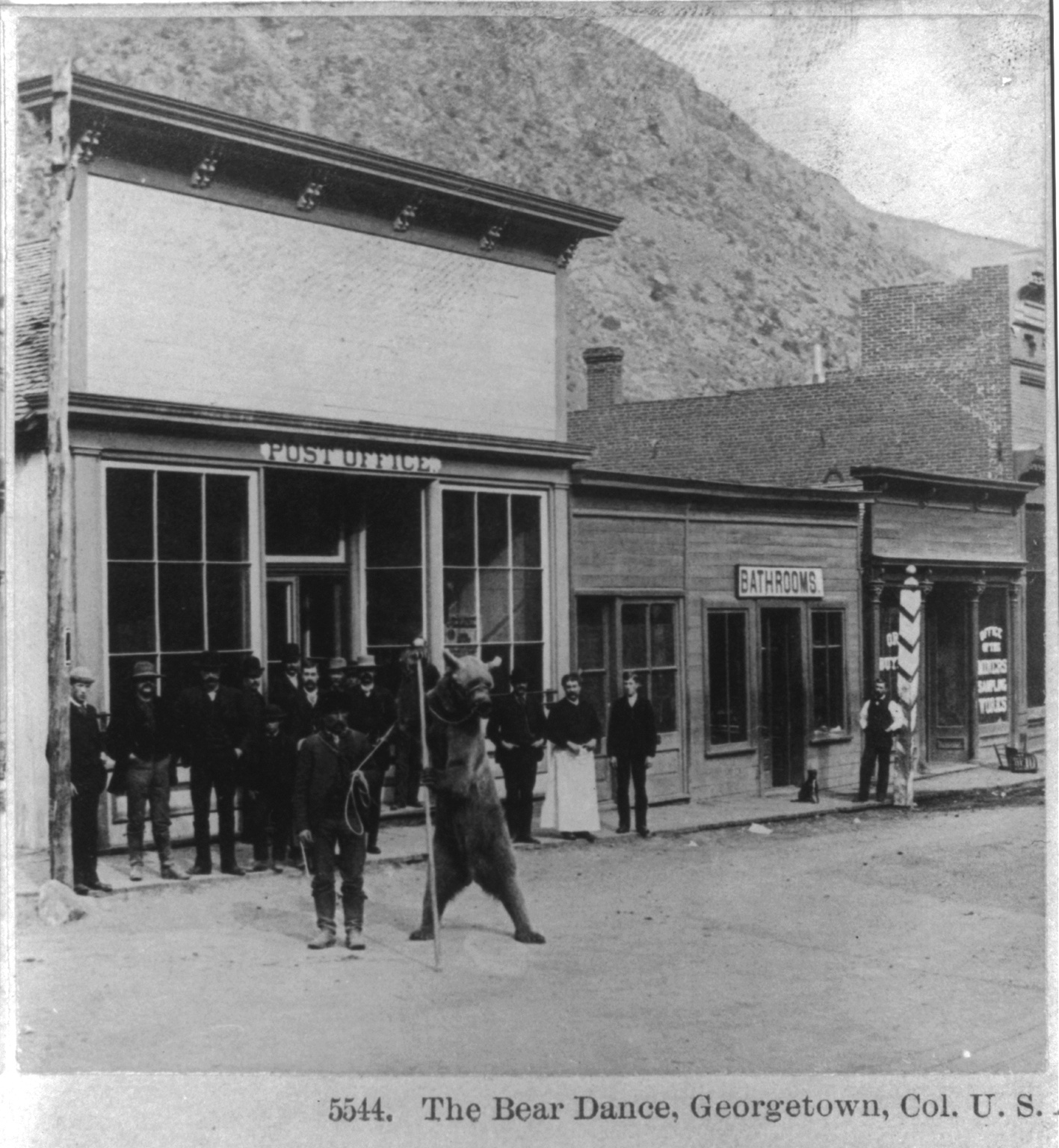
“The Bear Dance, Georgetown, Col.” A bear and its keeper draw a crowd in front of the post office in Georgetown, Colorado. This is not the Scranton bear. Kilburn Brothers, 1890. Library of Congress. Click the picture to see it full size.
Bears like these were led from town to town and made to stand up and “dance” for a crowd. Look closely and you can see the muzzle and the chain. It was not much of a life for a bear.
We searched the Tribune’s next four issues and found nothing more about the band. So the last we see of them, they are heading for Taylor with snow coming: nineteen people, four horses, some monkeys and three bears. Two of the bears had missed their bones. The third, the big one, had been led peaceably away with everybody’s dinner inside him.
Sources
- “Bear Was Very Hungry,” The Scranton Tribune (Scranton, Pennsylvania), November 13, 1897, page 7. Library of Congress, Chronicling America.
- The Scranton Tribune’s Priceburg column: November 8, 1897, page 7 (the camp on the Boulevard road, with monkeys and bears) and November 12, 1897, page 7 (the campers have departed). Library of Congress, Chronicling America.
- Cover photo: a traveling bear and its keeper in Lewiston, New York, 1900, by Lambert van Kleef (1846-1928). Regionaal Historisch Centrum Limburg, Maastricht, by way of Wikimedia Commons, public domain.
- Photos in the story: “Georgetown, Colorado. The bear dance”, Kilburn Brothers, 1890, Library of Congress Prints and Photographs Division, no known restrictions on publication. “Dumping culm, slate pile, anthracite coal mining, Scranton, Pa.”, Keystone View Company, copyright 1905, Boston Public Library, by way of Digital Commonwealth, no known copyright restrictions.