On a Friday in June 1910, John Wallig opened a letter from Madrid, Spain. Wallig was “the well known market street hardware man” in Kenosha, Wisconsin, a factory town on Lake Michigan between Chicago and Milwaukee. He had never met the man who wrote it. But the stranger said he trusted him. He said he knew Wallig “only from good references of your honesty.”
The writer said he was a rich Russian banker, locked up in a Spanish prison. He had a fortune hidden away and a “darling daughter” who needed help. If Wallig would help him, the banker would hand over a reward of $160,000. There was just one small thing. Wallig had to send some money first.
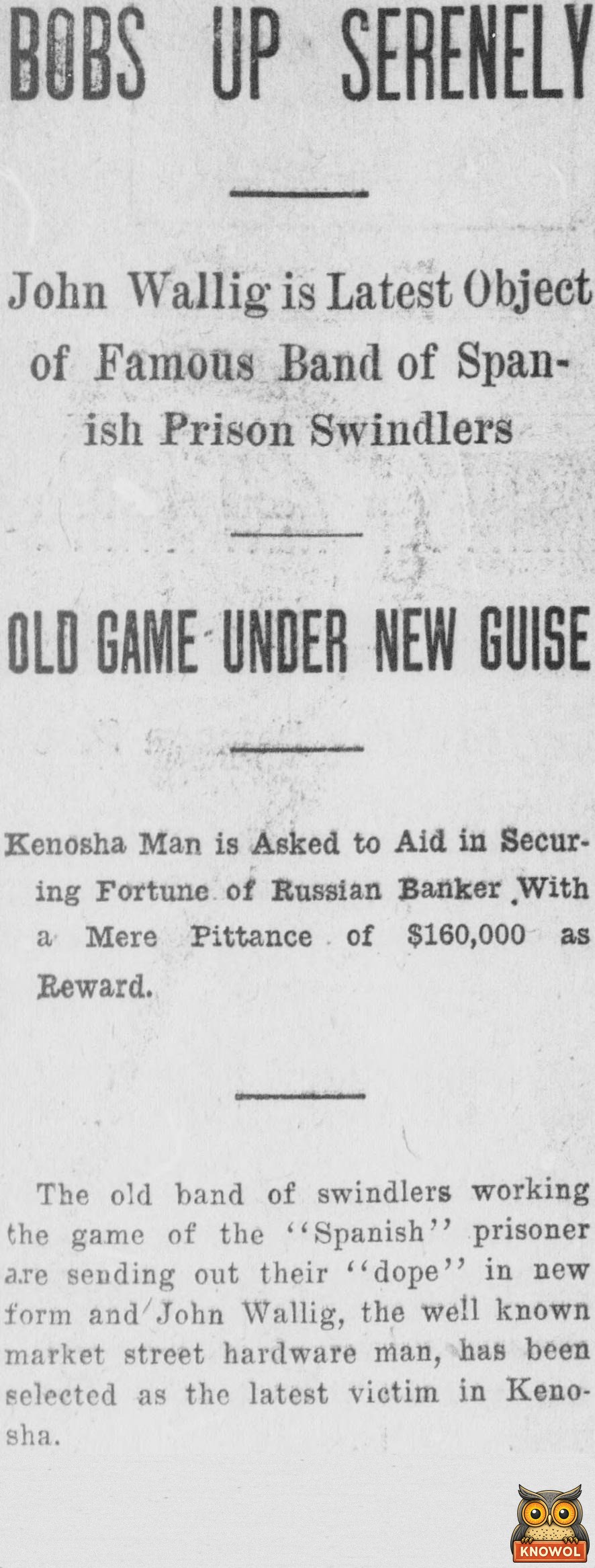
“Bobs Up Serenely … Old Game Under New Guise,” The Telegraph-Courier, Kenosha, Wisconsin, June 16, 1910, page 2. Library of Congress, Chronicling America. Click the clipping to read it full size.
Here is the twist. There was no banker, no daughter and no fortune. Kenosha’s paper, the Telegraph-Courier, told the whole town that “all of these letters are fakes.” It was the work of “the old band of swindlers working the game of the ‘Spanish’ prisoner,” one of the most famous tricks in the world. And Kenosha had been getting it for years.
Kenosha, Wisconsin, Had Seen the Spanish Prisoner Before
In September 1905, C. H. Hurd, “the well known Main street druggist” in Kenosha, Wisconsin, got a letter mailed from Valencia, Spain. The writer called himself “Manual Garcia,” a Cuban locked up “in the castle at Valencia.” He said he had “married one Mary Hurd while in Cuba,” so he was family, sort of.
He asked Hurd to look after his daughter, “a girl fifteen years of age,” and offered 39,000 pounds in British money to pay for her care. The paper that proved his fortune was hidden in “a special portmanteau made with a secret compartment.” A portmanteau is a big leather suitcase.
Hurd didn’t bite. “Mr. Hurd has turned the matter over to the officials,” the paper said. It also remembered Frank H. Lyman, “the well known shoe dealer,” who had gotten a letter like it “nearly ten years ago.”
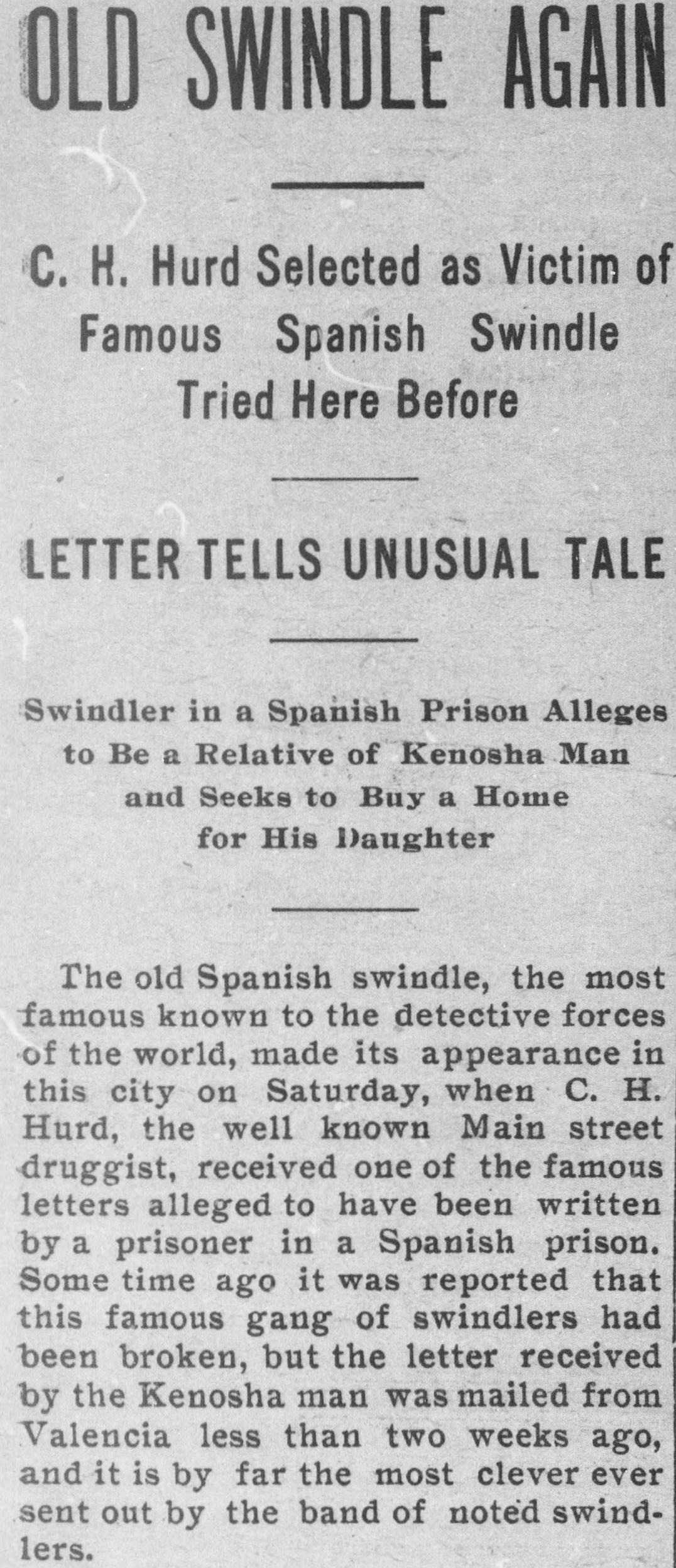
“Old Swindle Again,” The Telegraph-Courier, Kenosha, Wisconsin, September 28, 1905, page 1. Library of Congress, Chronicling America. Click the clipping to read it full size.
In August 1908, John Mindermann of Kenosha got one signed “Angel Ruiz.” This writer said his own mother had been an “Anna Mindermann.” The daughter, the paper said, was “now at Gibralter waiting to welcome any sucker from America.” The paper poked fun at him, too: “The man is modest as he asserts that the fortune which he has hidden amounts to only $480,000.” By then, “More than a dozen of these letters have been received in Kenosha but as yet not a single Kenosha man has been caught by the bait.”
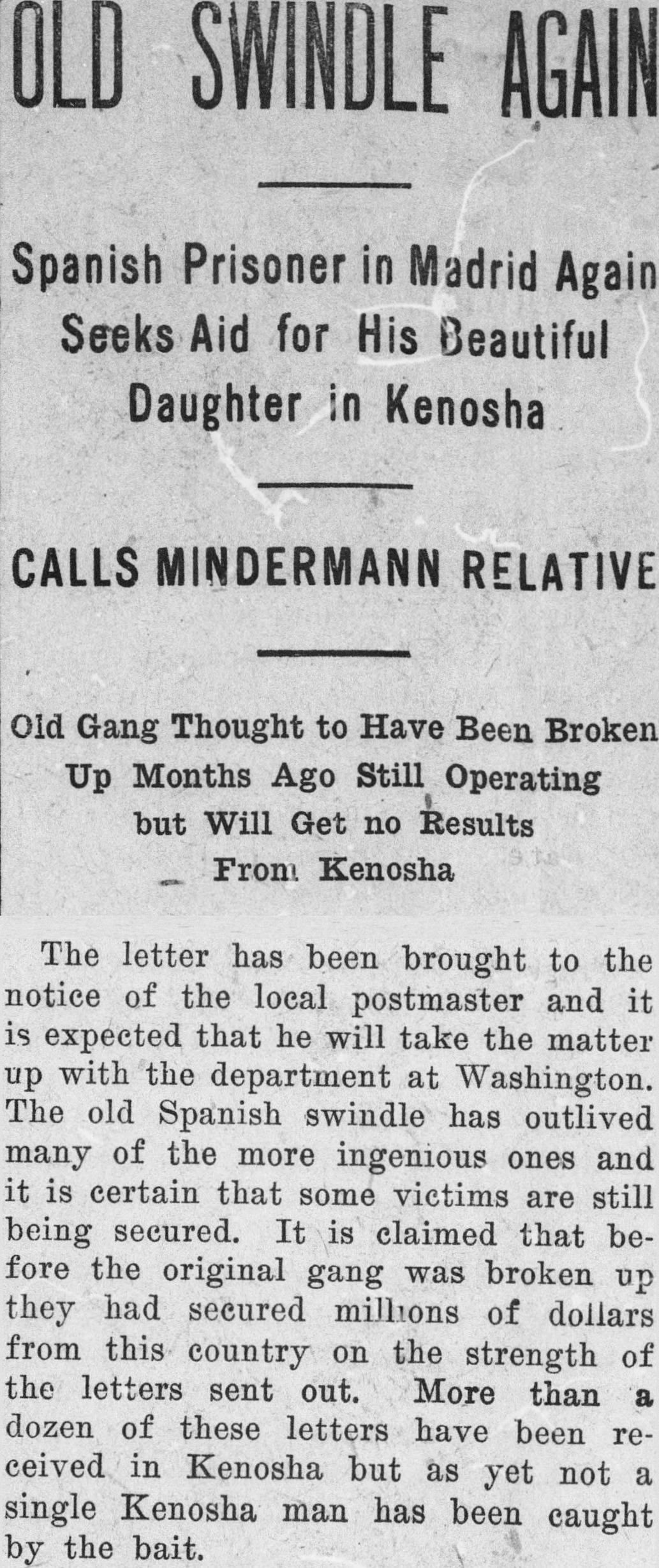
“Old Swindle Again,” The Telegraph-Courier, Kenosha, Wisconsin, August 13, 1908, page 6: the headlines and the last paragraph. Library of Congress, Chronicling America. Click the clipping to read it full size.
How the Spanish Prisoner Trick Worked
In February 1910, a warning about the letters came to Kenosha, Wisconsin, from the United States State Department, the part of the government that deals with other countries. It came “under the seal of the state department,” and it asked to “be given the widest possible publicity.” The warning laid out the trick like a recipe:
- A prisoner in Spain is “at the point of death.” He “has but one friend,” a prison priest who sneaks his letters out of “the prison fort.”
- The prisoner is rich. But the paper that proves it is hidden in “a secret receptacle of his valise,” and a Spanish court is holding the valise, which is a suitcase.
- He has a “darling daughter.” The stranger who looks after her gets “one-fourth of the prisoner’s entire fortune.”
- “There is but one condition.” The stranger must first send money to set the suitcase free.
“It is a simple scheme,” the statement said, “but presented in such a plausible way” that people believed it. Plausible means it sounds like it could be true. Plenty of Americans had “bitten,” and done it “promptly and cheerfully.”
The gang had helpers in America, too. They would “select a man and find out all they can about him; they get hold of family names.” That helps explain how a letter could show up in Kenosha talking about a Mary Hurd or an Anna Mindermann.
The police in Spain could not stop it, the warning said. “Under the Spanish laws a felony must be consummated before the police may act.” In plain words, the trick had to work first. “The money must be actually paid over,” and the person who lost it had to go to Spain and speak in court.
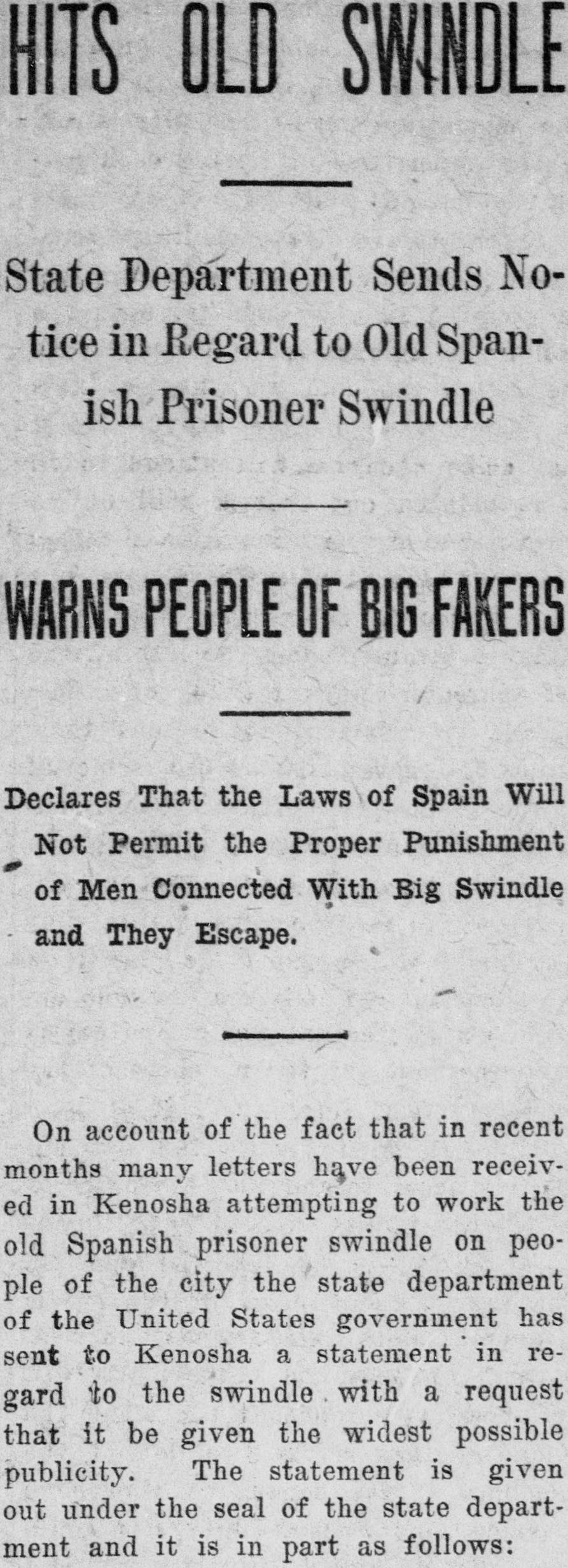
“Hits Old Swindle,” The Telegraph-Courier, Kenosha, Wisconsin, February 10, 1910, page 3. Library of Congress, Chronicling America. Click the clipping to read it full size.
John Wallig’s Letter Came With a Clipping
Four months later, the letter reached John Wallig, the hardware man on Market Street in Kenosha, Wisconsin. This one had a new trick. Tucked inside was “a portion of a newspaper which appears to have been clipped from some English paper.” It told “the full story of the arrest of Alexander Demidofft at London.” The clipping was there to make the sad story look real.
“The letter is the most carefully prepared ever sent out by the band of Spanish swindlers,” the paper said. It printed the whole thing, word for word:
Dear Sir.
Although I know you only from good references of your honesty my sad situation compels me to reveal to you an important affair in which you can procure a modest fortune saving at the same time that of my darling daughter.
Before being imprisoned here I was established as a banker in Russia, as you will see by the enclosed article about me. Many English newspapers have published an account of my arrest in London.
I beseech you to help me to obtain a sum of $480 I have in America, and to come here to raise the seizure of my baggage by paying to the registrar of the court the expenses of my trial and recover my portmanteau, containing a secret pocket where I have hidden the document indespensable to recovering the said sum.
As a reward I will give up to you third part viz $160,000.
I can not receive your answer in person, but you must send a cablegram to a person in my confidence who will deliver it to me.
Awaiting your cable to instruct you in my behalf, I am sir,
Your truly
Demidofft.
First of all answer by cable, not by letter as follows:
M. Ramos, Silva 33 Cuarto, Madrid.
“Awaiting Wallig.”
A few of those old words need help. “Viz” means “namely.” A cablegram was a telegram sent along a wire under the ocean. And the “$480” is a slip in the printing. A third part of the fortune was $160,000, so the banker meant $480,000.
All Wallig had to do was cable two words to Madrid: “Awaiting Wallig.” Instead, the letter went to Kenosha’s postmaster, a man named Maloney, who passed it along to “the postoffice officials at Washington.”
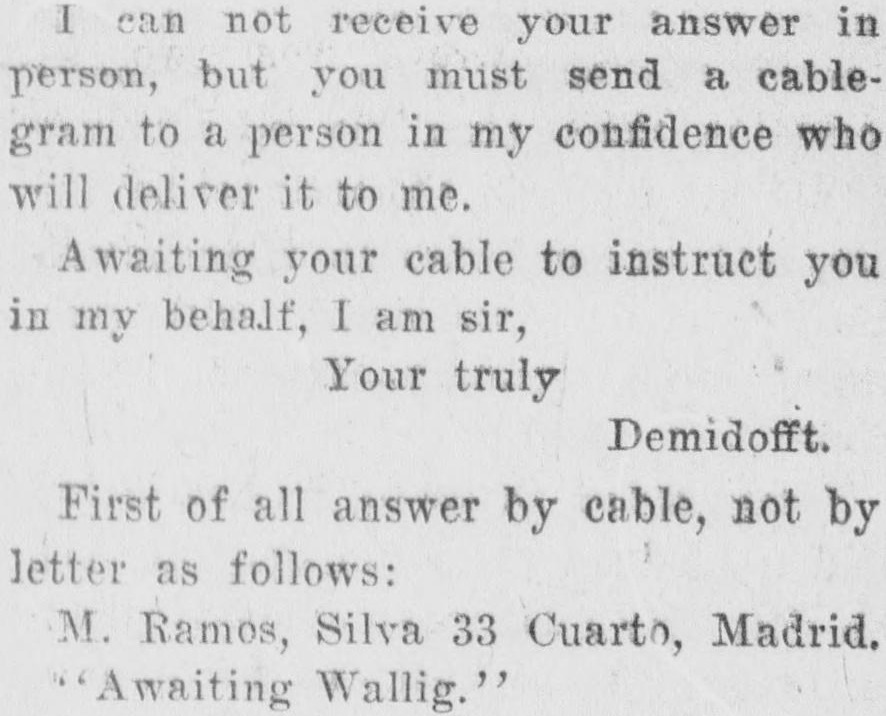
The end of John Wallig’s letter, with the cable address in Madrid. The Telegraph-Courier, Kenosha, Wisconsin, June 16, 1910, page 2. Library of Congress, Chronicling America. Click the clipping to read it full size.
That same month, two men in Oakland, California, got letters that were “practically identical.” Their prisoner offered the same “$160,000 reward,” the San Francisco Call reported on June 23, 1910.
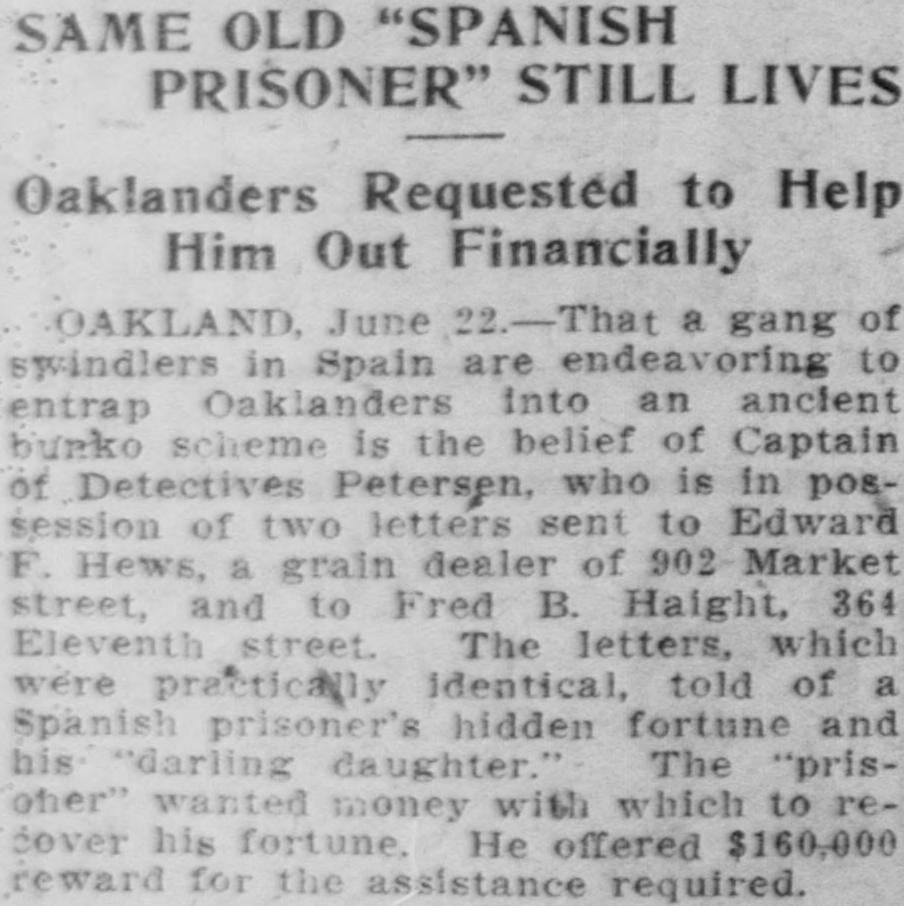
“Same Old ‘Spanish Prisoner’ Still Lives,” The San Francisco Call, San Francisco, California, June 23, 1910, page 7. Library of Congress, Chronicling America. Click the clipping to read it full size.
The Kenosha letters the paper described from 1908 to 1911 came from Madrid, the capital of Spain. The city was real, with grand squares and clock towers. The prisoner, the priest, the fortune and the darling daughter were not.
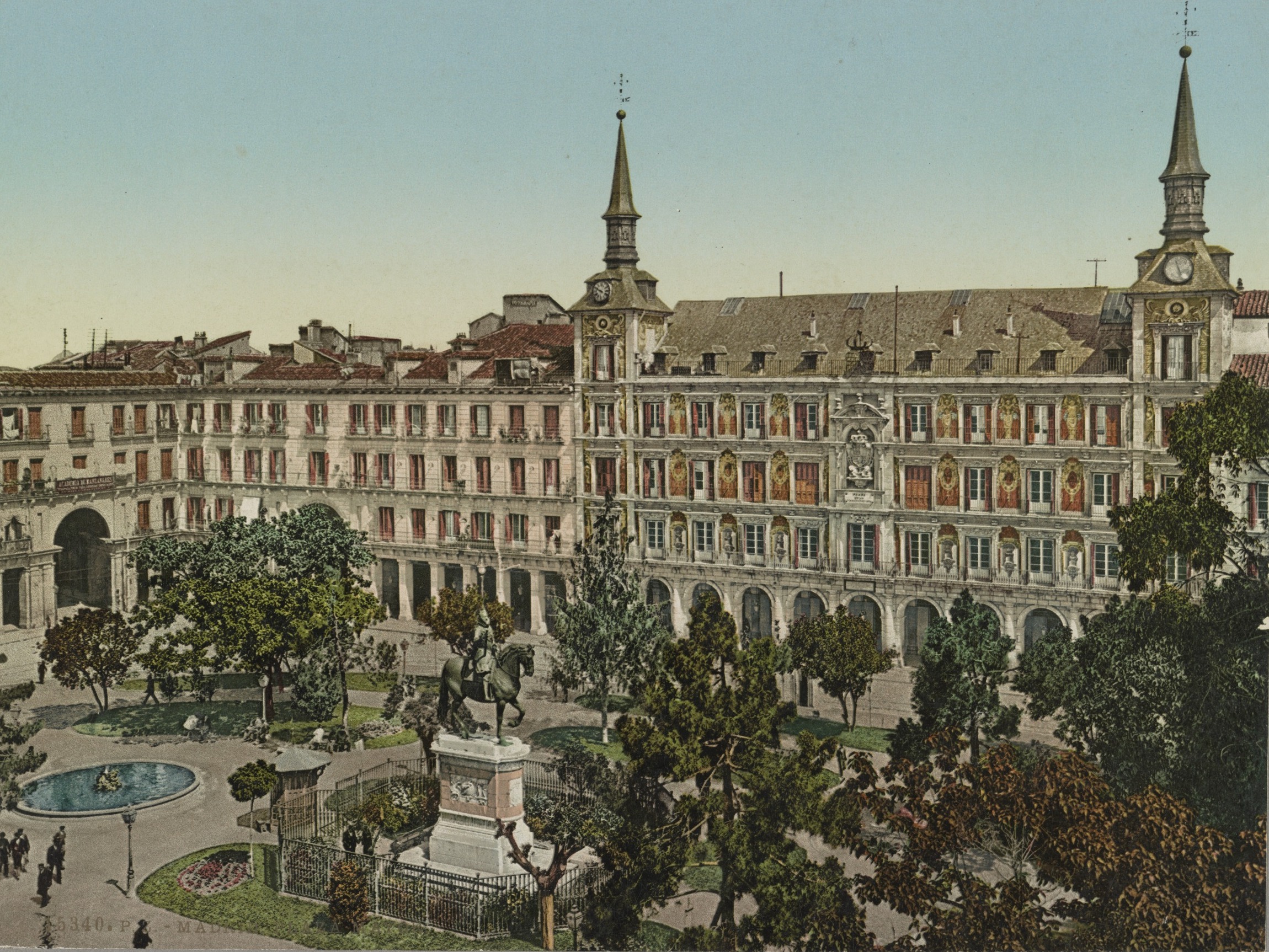
The Plaza Mayor, the big main square of Madrid, Spain, on a color Photochrom print made between about 1890 and 1906. It shows the city many of the Kenosha letters were mailed from, not the swindlers. Photoglob Co., Photochrom Print Collection, Library of Congress. Click the picture to see it full size.
By the Numbers
- 1890s: Frank H. Lyman, a Kenosha shoe dealer, got the first letter the paper knew about.
- $480,000: the hidden fortune in John Mindermann’s 1908 letter.
- $160,000: the reward promised to John Wallig in 1910, and to two men in Oakland.
- About 20: the letters that reached Kenosha in “three or four days” in June 1911.
- $500 or $5,000: what the letters usually asked for, an amount that “curiously fitted in with the known circumstances” of the person, a 1912 report said.
- 0: Kenosha men “caught by the bait” as of 1908.
“Like the Ghost of Banquo” in Kenosha, Wisconsin
In June 1911, the letters poured into Kenosha, Wisconsin. About 20 came in “three or four days.” All were “post marked from Madrid, Spain, and the hand writing on all of them is the same.” Each one was signed “Alexander Sadrowsky,” another banker pining away in a Spanish prison.
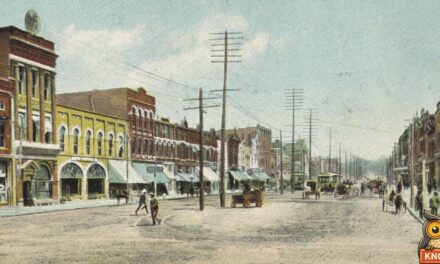
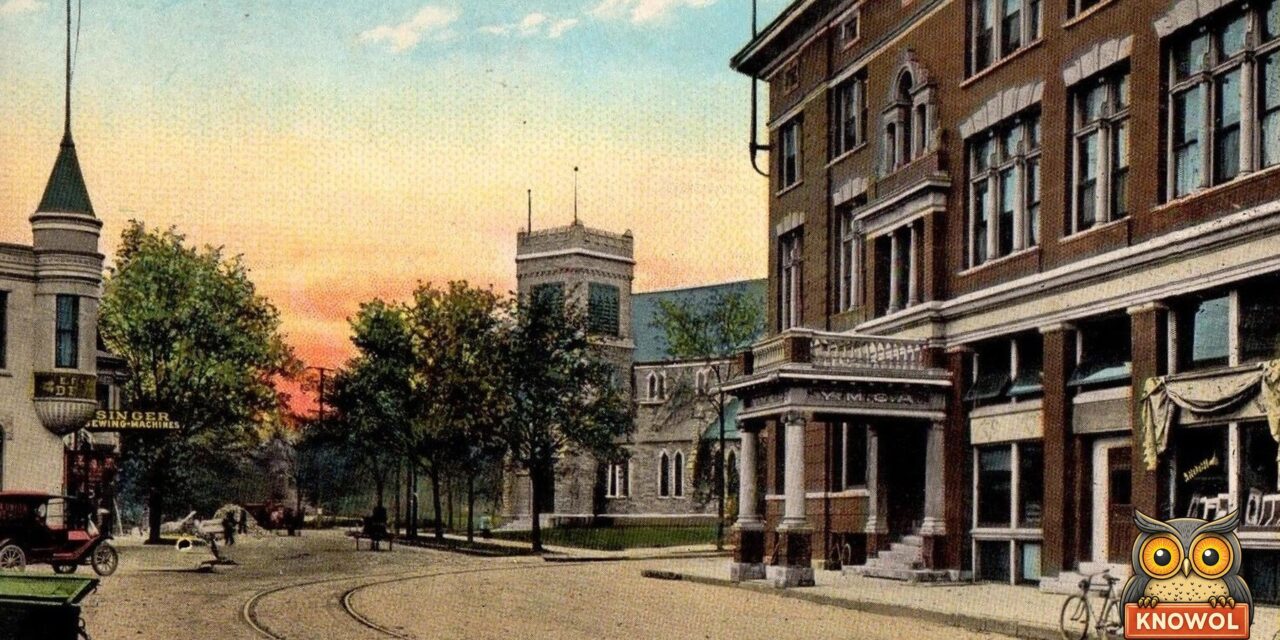
“A half a dozen are scattered about among the business men on Main street,” the paper said, “while some of them have been sent to working men in the factories.” The postcard at the top of this story shows Kenosha’s Main Street at Park Avenue around those years.
The Telegraph-Courier said the old swindle was “Like the ghost of Banquo that would not down.” Banquo is a ghost in William Shakespeare’s play Macbeth who keeps showing up where nobody wants him. The paper’s advice was short: “don’t answer the letter or pay any attention to it,” and “under any circumstances don’t send any money to help the imprisoned banker and his fair daughter.”
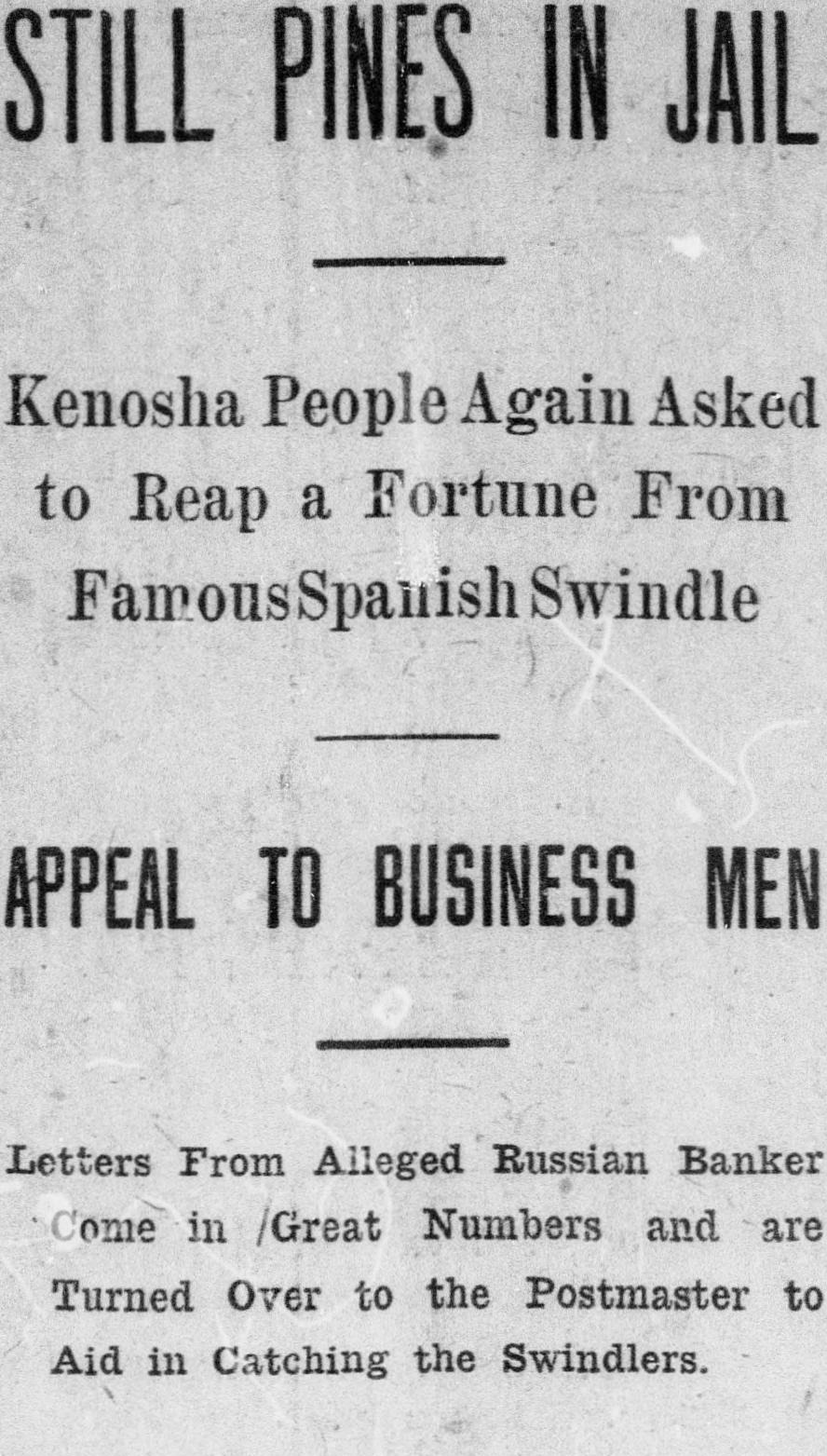
“Still Pines in Jail,” The Telegraph-Courier, Kenosha, Wisconsin, June 8, 1911, page 3. Library of Congress, Chronicling America. Click the clipping to read it full size.
Police Raided a House in Bilbao, Spain
In March 1912, the Telegraph-Courier in Kenosha, Wisconsin, had big news from Spain. Police in the city of Bilbao had arrested a gang of swindlers and taken “their complete paraphernalia.” The Spanish police believed they had “at last succeeded in putting an end to” the Spanish prisoner. The Albuquerque Evening Herald in New Mexico ran the same news.
Inside the house, police found “long lists of Spanish, American and English names, with biographical notes attached.” Those were notes about each person’s life and family. By then, the paper said, “Scores of the letters” had come to Kenosha, “the last batch of them arriving only a few days ago.”
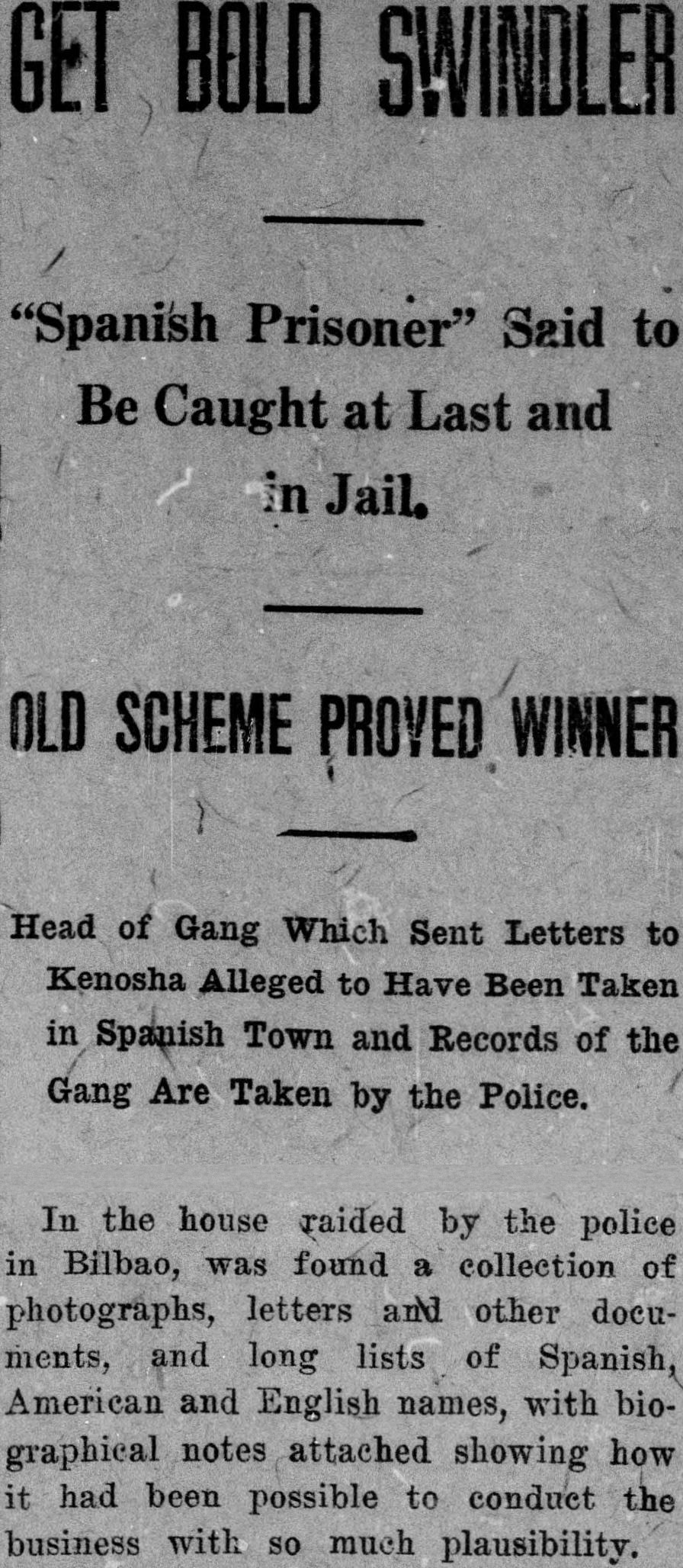
“Get Bold Swindler,” The Telegraph-Courier, Kenosha, Wisconsin, March 7, 1912, page 8: the headlines and the paragraph about the raid. Library of Congress, Chronicling America. Click the clipping to read it full size.
The Letters Kept Coming to Kenosha, Wisconsin
The raid didn’t stop the letters to Kenosha, Wisconsin. In May 1913, “a new letter” arrived. It went to John Comes, “a well known grocer,” and to W. S. Lamb, “the well known Milwaukee avenue druggist.” The paper joked, “The beauty of the new letter is that it is brief and it can be read in about one-third the time of the letters which were formerly sent to Kenosha.” It still began with the same words John Wallig had read three years before: “Although I know you only from good references of your honesty.”
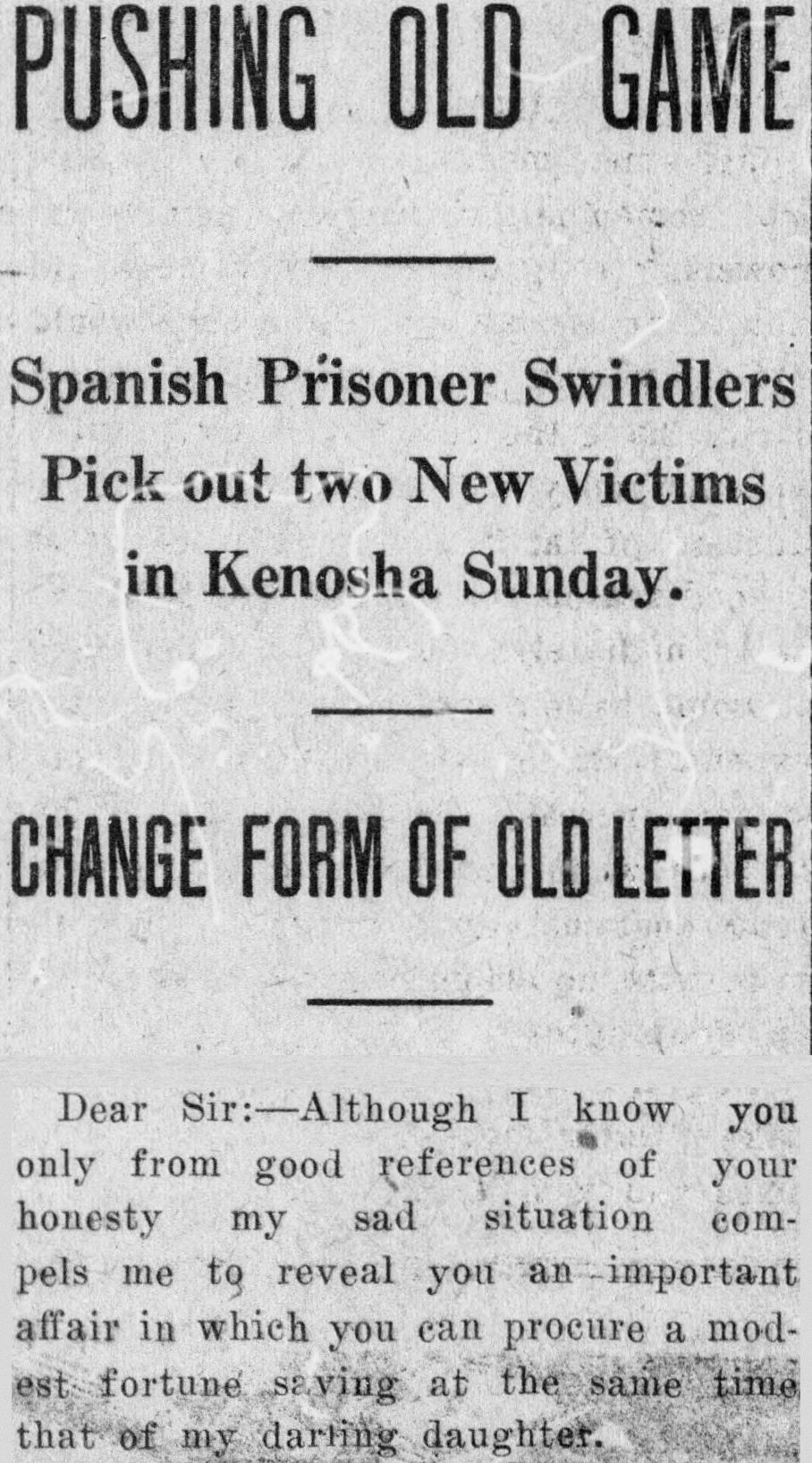
“Pushing Old Game,” The Telegraph-Courier, Kenosha, Wisconsin, May 15, 1913, page 7, with the opening of the “new” letter. Library of Congress, Chronicling America. Click the clipping to read it full size.
That fall, one more Kenosha man got the letter. On October 30, 1913, the paper reported that “William H. Dailey of Ridge street, was the latest victim selected by the gang. He failed to fall for the letter filled with tears and promises and turned it over to the postoffice department.”
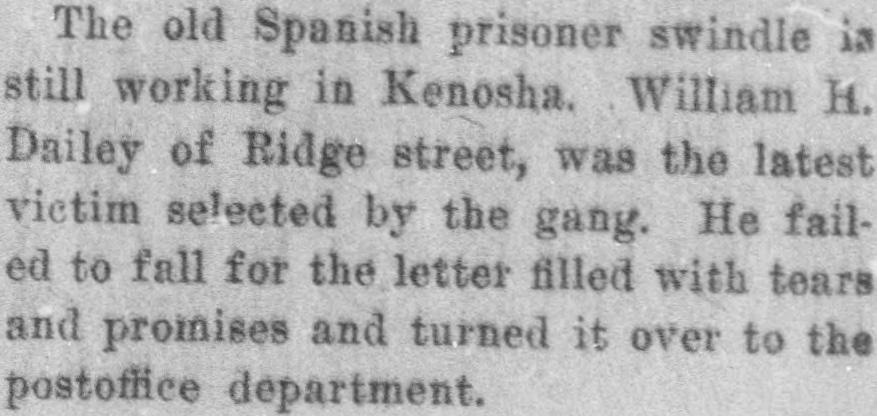
A short item in the “Local Items” column, The Telegraph-Courier, Kenosha, Wisconsin, October 30, 1913, page 5. Library of Congress, Chronicling America. Click the clipping to read it full size.
From C. H. Hurd the druggist in 1905 to William Dailey in 1913, the Kenosha letters in this story all ended up in the same place: with the postmaster or the officials. The trick is still around today. It comes by email now instead of by mail, with a stranger in trouble, a hidden fortune and a little money to send first. The Telegraph-Courier’s advice from 1911 still works. Don’t answer it, and don’t send any money.
Sources
- “Bobs Up Serenely,” The Telegraph-Courier (Kenosha, Wisconsin), June 16, 1910, page 2. Library of Congress, Chronicling America.
- “Old Swindle Again,” The Telegraph-Courier, September 28, 1905, page 1. Library of Congress, Chronicling America.
- “Old Swindle Again,” The Telegraph-Courier, August 13, 1908, page 6. Library of Congress, Chronicling America.
- “Hits Old Swindle,” The Telegraph-Courier, February 10, 1910, page 3. Library of Congress, Chronicling America.
- “Same Old ‘Spanish Prisoner’ Still Lives,” The San Francisco Call (San Francisco, California), June 23, 1910, page 7. Library of Congress, Chronicling America.
- “Still Pines in Jail,” The Telegraph-Courier, June 8, 1911, page 3. Library of Congress, Chronicling America.
- “Get Bold Swindler,” The Telegraph-Courier, March 7, 1912, page 8. Library of Congress, Chronicling America.
- “Spanish Prisoner Now Believed Captured,” Albuquerque Evening Herald (Albuquerque, New Mexico), March 6, 1912, page 8. Library of Congress, Chronicling America.
- “Pushing Old Game,” The Telegraph-Courier, May 15, 1913, page 7. Library of Congress, Chronicling America.
- “Local Items,” The Telegraph-Courier, October 30, 1913, page 5. Library of Congress, Chronicling America.
- Photo: “Madrid. Plaza Mayor,” Photochrom print, Photoglob Co., about 1890 to 1906. Library of Congress Prints and Photographs Division, Photochrom Print Collection. No known restrictions on publication.
- Cover: “Corner Main and Park Avenue, Kenosha, Wis.,” postcard no. 368, E. A. Bishop, about 1907 to 1915. Wikimedia Commons, public domain.
- The newspapers, print and postcard above were all published before 1931 and are in the public domain.