
The old north end of Groton on the east bank of the Thames, a town of stone-walled farms, the Gales Ferry landing where Yale's crew trains, a Quakertown meetinghouse that hid freedom seekers, and the Pequot land at Mashantucket.
Ledyard on the map
Click the map to look closer.
Ledyard today
By KNOWOL
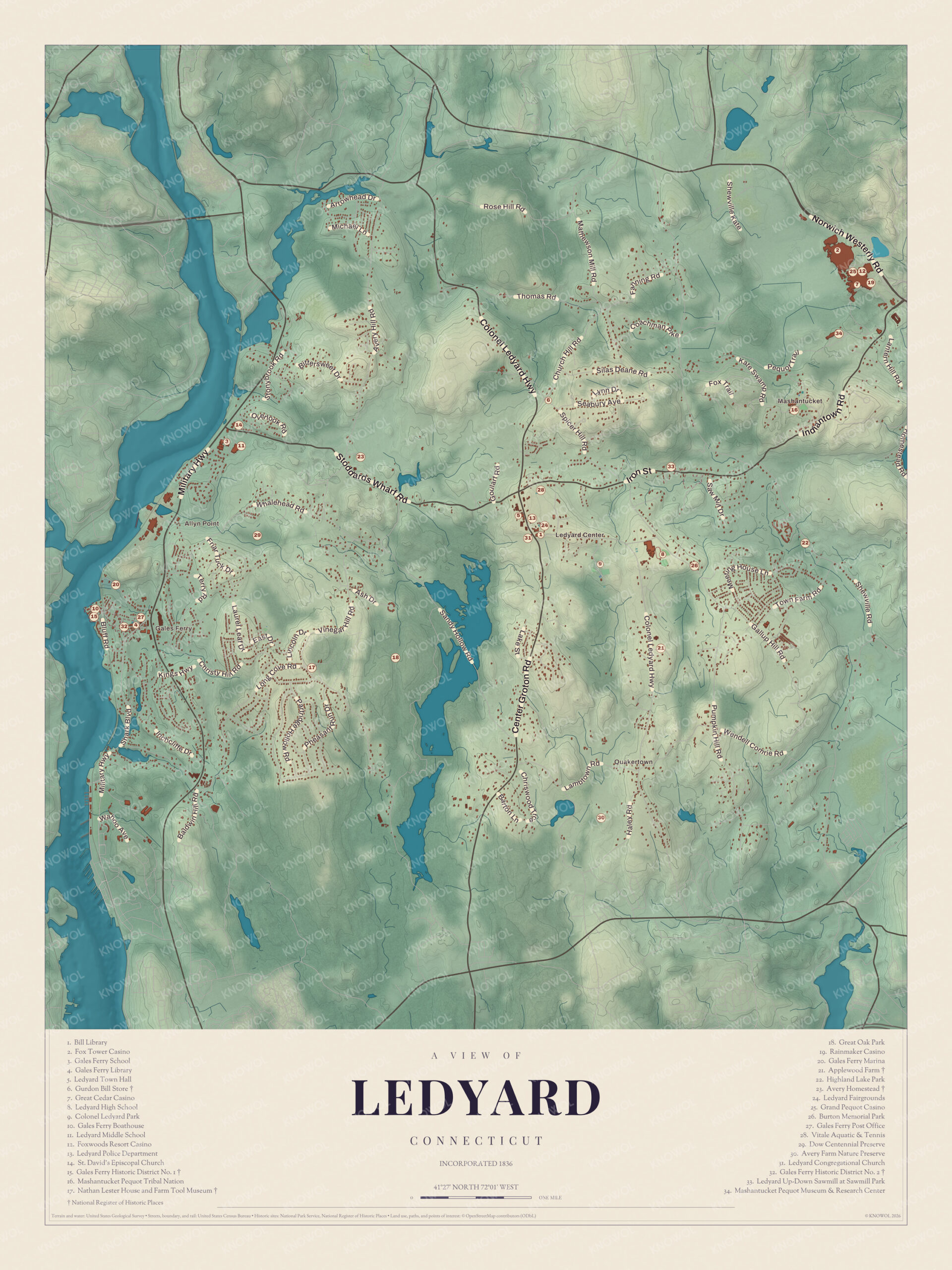
Shaded hills from Gales Ferry on the Thames across Ledyard Center to Quakertown and Mashantucket, every street down to Long Cove Road, and a guide of 34 numbered landmarks with the National Register sites marked.5
The story of Ledyard
The meetinghouse at Quakertown
In 1815 the Rogerenes of Quakertown built a meetinghouse of many gables. The elder's family lived on the first floor and the whole society met in the open room upstairs. The timber is said to have come from trees blown down in that September's gale, sawn at the Rogerenes' own mill. Between 1830 and 1850 Quakertown was a station on the Underground Railroad. Freedom seekers were hidden in the meetinghouse and sent on by night, and its people were mobbed more than once for it. They stood for peace, too. Jonathan Whipple of Quakertown became president of the Connecticut Peace Society in 1869, and in 1871 young James E. Whipple spent weeks in the Norwich jail for refusing the military tax. In 1869 Zerah Whipple opened a school here that taught deaf pupils to speak.6789
From North Groton to Ledyard
Before 1836 Ledyard was the north end of Groton. The legislature made it a parish, North Groton, in 1724, and in November 1726 the people surveyed the parish to find its exact center for their meetinghouse. It came out forty or fifty rods from the corner of Capt. John Morgan's goat pasture. Notices went up on warning posts at Capt. Morgan's, at Ralph Stoddard's and at Sergeant Robert Geer's mill. A small Separate church gathered here in the 1740s, and in 1803 its old meetinghouse was moved to Gales Ferry, where Methodists worshiped in it for more than fifty years. The town was incorporated June 1, 1836, with about two thousand people, and named for Col. William Ledyard. Ten days later it chose three selectmen: Capt. Anson Avery, Capt. Henry Hallett and Noah Davis.1011121
The land at Mashantucket
Mashantucket, in the northeast corner of Ledyard, is Pequot land. In 1665 lands were laid out there for Cassasinamon and his community, and in 1666 the colony confirmed about 3,000 acres. Cassasinamon had asked for land at the head of the Mystic River, nearer the fishing places, and he kept his home at Noank until he died in 1692. Some families planted at Mashantucket right away, and the rest moved inland after Groton claimed the Noank land in 1712. Pequot men enlisted with Connecticut soldiers in the French and Indian War and the Revolution. In 1856 the state cut the reservation to 216 acres. The Mashantucket Pequot Tribal Nation won federal recognition in 1983, recovered more than 2,000 acres, and opened its museum in 1998.1314155
Through the years
25 moments from 1665 to today.
- 1665Lands at Mashantucket are laid out for Cassasinamon and his Pequot community; the colony confirms the grant in 1666.13
- 1683Robert Allyn dies at Allyn's Point, on the large grant he received on the east bank of the Thames.16
- 1696About this year the Avery Homestead on Avery Hill Road is built.17
- 1712After Groton claims the Noank land, the rest of Cassasinamon's community moves inland to Mashantucket.13
- 1724The legislature makes the north part of Groton a parish, North Groton.10
- 1726North Groton surveys the parish to find its exact center for the meetinghouse.10
- 1729Samuel Seabury, later the second presiding bishop of the Episcopal Church, is born here.1
- 1740A ferry first crosses the Thames at what becomes Gales Ferry.2
- 1781Col. William Ledyard is killed commanding Fort Griswold at the Battle of Groton Heights; the town will carry his name.1
- 1793Nathan Lester builds his farmhouse on Vinegar Hill Road.18
- 1803The Separates' old meetinghouse is moved to Gales Ferry, where Methodists worship in it for more than fifty years.11
- 1815The Rogerenes build the Quakertown meetinghouse, said to be framed from trees felled by that September's gale.6
- 1818Gurdon Bill and Philip Gray buy the land for the Gurdon Bill Store.19
- 1826Russel Gallup builds the farmhouse at Applewood Farm.20
- 1830From about this year to 1850, Quakertown is a station on the Underground Railroad.7
- 1836Ledyard is incorporated on June 1 and chooses three selectmen ten days later.12
- 1843The Baptist church is formed, with Elder Stephen Peckham as its first pastor.12
- 1867The Bill Library opens, founded with Henry Bill's gift of $1,000.3
- 1869Israel Brown builds the up-and-down sawmill on Iron Street.21
- 1869Zerah C. Whipple opens a school at Quakertown that teaches deaf pupils to speak.9
- 1871James E. Whipple of Quakertown is jailed in Norwich for refusing to pay the military tax.8
- 1983The Mashantucket Pequot Tribal Nation wins federal recognition.5
- 1986Foxwoods begins as a bingo hall on the reservation.5
- 1993The Mashantucket Pequot Reservation Archeological District is named a National Historic Landmark.14
- 1998The Mashantucket Pequot Museum and Research Center opens.5
Places to see
The numbers match the landmark guide printed on the 2026 map.
- 1Bill LibraryLedyard Center. Henry Bill's free library of 1867.Visit their website
- 6Gurdon Bill StoreChurch Hill Road. A country store left almost untouched.
- 10Gales Ferry BoathouseThe old ferry landing. Yale's crew training camp.
- 15Gales Ferry Historic District No. 1Gales Ferry. The old village by the river.
- 16Mashantucket Pequot Tribal NationNortheast corner. The Mashantucket Pequot reservation.
- 17Nathan Lester House and Farm Tool MuseumVinegar Hill Road. A 1793 farmhouse with trails.
- 21Applewood FarmColonel Ledyard Highway. Russel Gallup's orchard farm of 1826.
- 23Avery HomesteadAvery Hill Road. Twelve generations of one family.
- 33Ledyard Up-Down SawmillSawmill Park, Iron Street. A working water-powered sawmill of 1869.Visit their website
- 34Mashantucket Pequot Museum & Research CenterMashantucket. Pequot history from the ice age on.Visit their website
On the National Register
All 15 places in Ledyard on the National Register of Historic Places that still stand today, oldest first, and why each one matters.4
-
Mashantucket Pequot Reservation Archeological District
National Historic Landmark
Nearly 1,638 acres of the uplands the Mashantucket Pequot Tribe calls Wawarramoreke, Pequot land on the earliest known map of the region. More than fifteen sites have turned up stone tools and colonial trade goods, and later village sites with farmsteads enclosed by stone walls. It was named a National Historic Landmark in 1993.14
-
Avery Homestead
By 1726 the house was big enough that its parlor held church services for the new parish of North Groton. More than twelve generations of the Avery family have lived here, and Amos Avery spent a decade in the 1950s and 1960s restoring it to its 18th-century look.17
-
Lamb Homestead
One of the town's oldest farms, settled by Isaac Lamb by family tradition about 1714, with a house documented here by 1731. The Lambs helped found the Baptist congregation of Groton, the first in the state, and the family still owned the farm when it was listed.22
-
William Noyes Farmstead
William Noyes built the oldest part about 1735, and James Woodbridge likely enlarged it after 1783. A full two-and-a-half-story farmhouse was unusual in Ledyard, where most farmhouses were Capes, and the place was farmed into the early 1940s.23
-
David Chapman Farmstead
David Chapman, grandson of an early proprietor, built a one-room house with a ladder to the loft about 1744 and doubled it in 1756, probably adding the gambrel roof. The barn behind it is thought to be 18th century too.24
-
Capt. Thomas Fanning Farmstead
One of the oldest surviving farms in town. Thomas Fanning bought 100 acres from Jonathan Brewster of Preston in 1746 and 1747 with a barn already standing, and an 18th-century barn, a corn crib and a blacksmith shop still circle the meadow.25
-
Capt. Mark Stoddard Farmstead
A Cape farmhouse at the end of a half-mile drive on 130 acres, with a barn that is a rare survivor of the 1700s. Mark Stoddard served in the Revolution, and one of his grandsons was master of the USS Kearsarge when it sank the CSS Alabama.26
-
Perkins-Bill House
A gambrel-roofed Cape built between 1773 and 1777. Solomon Perkins, his son Solomon Jr. and the next owner, Benjamin Bill, all defended Fort Griswold in the Battle of Groton Heights in 1781.27
-
Gales Ferry Historic District No. 1
Part of the old core of the village that grew up around the ferry to Uncasville, with farmstead buildings from the late 1700s and early 1800s.2
-
Gales Ferry Historic District No. 2
The rest of the old village core, separated from District No. 1 by a railroad cut, with more farmsteads from the late colonial and early national years.2
-
Nathan Lester House
Nathan Lester built this farmhouse on land his grandfather Peter had bought, and it's one of the few 18th-century houses left in town. The Lesters kept it until 1908, and it's now a town park with the Ledyard Historical Society's farm tools in the barns.18
-
Shubel Smith House
Sea captain Shubel Smith raised livestock for sale in the West Indies, and some of the many stone walls here may have penned his animals. Known as Stonecroft, it's one of Ledyard's finest surviving farmhouses of its time and still has an early loom upstairs.28
-
Gurdon Bill Store
Gurdon Bill ran this country store until shortly before his death in 1856, and it has hardly been used since 1875, so its L-shaped counter, pine shelving and drawers survive. The consultant who nominated it called it the best preserved early 19th-century store known in Connecticut.19
-
Applewood Farm
Russel Gallup, a War of 1812 militiaman and a deacon of the Ledyard Congregational Church for more than 50 years, built the farmhouse and planted the apple orchards it's named for. The farmhouse, corn crib, barn, silo and chicken coop were counted in the listing.20
-
Main Sawmill
Israel Brown built this up-and-down sawmill, the only known working mill of its type in the state, on a site with a sawmill since the 1790s. It ran until 1935, and volunteers spent nine years restoring it before Sawmill Park opened in 1975.21
In their words
“"My heart, doctor," promptly explained the gallant young officer with a significant twinkle in his eye, "I left at home in Ledyard."”
Capt. Adam Larrabee, shot through the lung in the War of 1812, in A memorial volume of the bi-centennial celebration of the town of Windham, 189329
“There are probably but few States in the Union that cannot reckon a native of Ledyard among their citizens.”
History of New London County, Connecticut, 188212
“And may they tell their children to tell their children's children from whom so great and so lasting a present was made.”
The trustees of the Bill Library, thanking Henry Bill, 186730
Nearby towns
Sources
- Ledyard, Connecticut, Wikipedia
- Gales Ferry, Connecticut, Wikipedia
- Catalogue of the Bill Library, Ledyard, Conn (1867), Internet Archive
- National Register of Historic Places listings in New London County, Connecticut, Wikipedia
- Map of Ledyard, Connecticut in 2026, KNOWOL (USGS elevation, Census Bureau roads)
- The Rogerenes; some hitherto unpublished annals belonging to the colonial history of Connecticut (1904), on the Quakertown meetinghouse, Internet Archive
- The Rogerenes; some hitherto unpublished annals belonging to the colonial history of Connecticut (1904), on the Underground Railroad at Quakertown, Internet Archive
- The Rogerenes; some hitherto unpublished annals belonging to the colonial history of Connecticut (1904), on the Quakertown peace meetings, Internet Archive
- History of New London County, Connecticut (1882), on Zerah C. Whipple, Internet Archive
- History of New London County, Connecticut (1882), on the parish of North Groton, Internet Archive
- The separates; or, Strict Congregationalists of New England (1902), Internet Archive
- History of New London County, Connecticut (1882), on the incorporation of Ledyard, Internet Archive
- History of New London County, Connecticut (1882), on the lands at Mashantucket, Internet Archive
- Mashantucket Pequot Reservation Archeological District, Wikipedia
- History of the town of Stonington, county of New London, Connecticut (1900), on the Pequot reservations, Internet Archive
- Genealogical and biographical record of New London County, Connecticut (1905), on Robert and John Allyn, Internet Archive
- Avery Homestead, Wikipedia
- Nathan Lester House, Wikipedia
- Gurdon Bill Store, Wikipedia
- Applewood Farm, Wikipedia
- Main Sawmill, Wikipedia
- Lamb Homestead, Wikipedia
- William Noyes Farmstead, Wikipedia
- David Chapman Farmstead, Wikipedia
- Capt. Thomas Fanning Farmstead, Wikipedia
- Capt. Mark Stoddard Farmstead, Wikipedia
- Perkins-Bill House, Wikipedia
- Shubel Smith House, Wikipedia
- A memorial volume of the Bi-Centennial Celebration of the Town of Windham, Connecticut (1893), on Capt. Adam Larrabee, Internet Archive
- Catalogue of the Bill Library, Ledyard, Conn (1867), the trustees' vote of thanks, Internet Archive