
A city on a plateau above the Nashua River that began as one family's farm on Lancaster's new grant, made horn combs by hand in a farmhouse kitchen, and grew into the Pioneer Plastics City and the birthplace of Johnny Appleseed.
Then and now
The same town 140 years apart. Click either map to look closer.
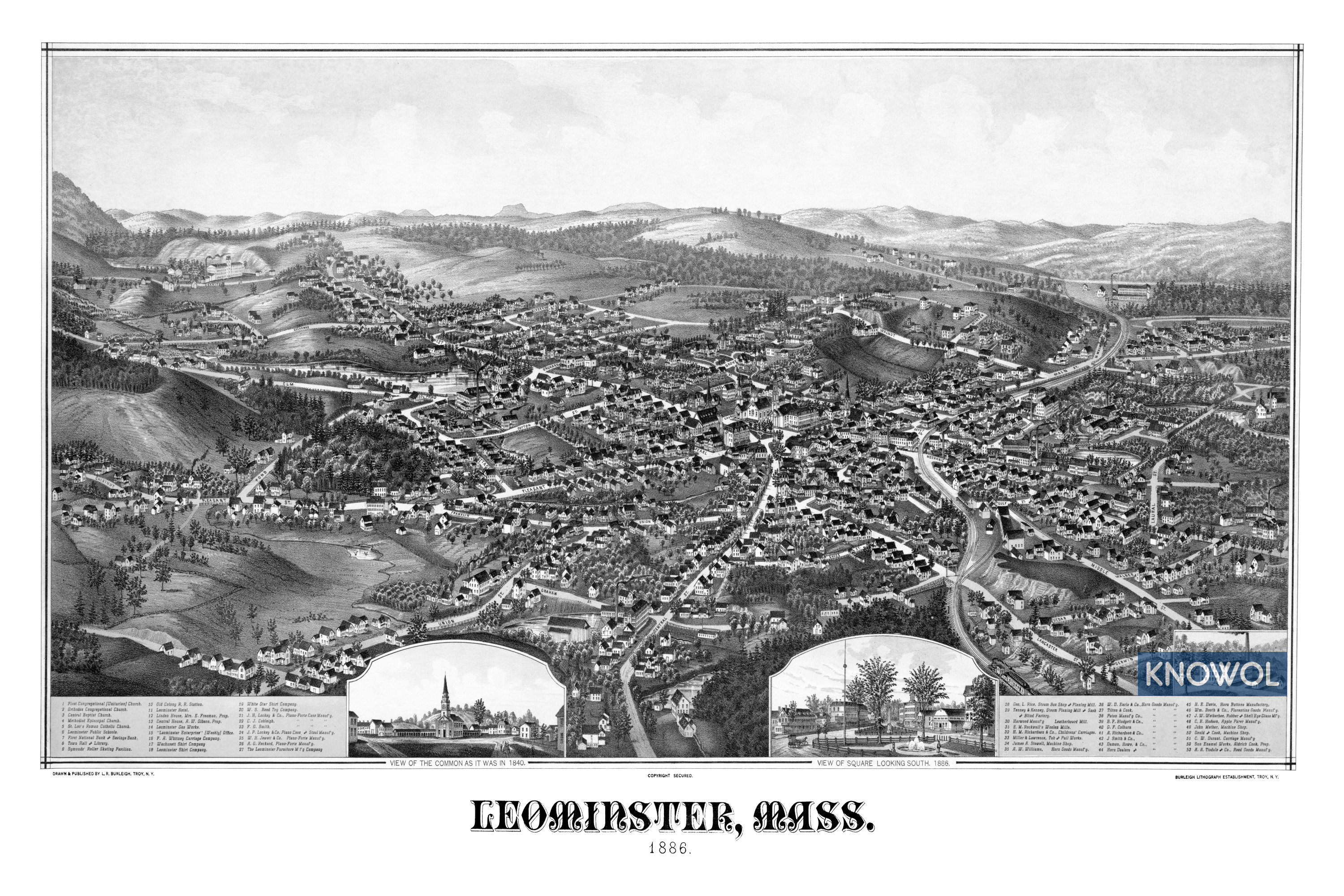
Leominster in 1886
By Lucien R. Burleigh
A hand-drawn bird's-eye view with the Town Hall, the public schools, the Old Colony Railroad station, the Leominster Hotel, the Wachusett and Leominster shirt companies, Richard's children's carriages, Mather's machine shop and Symonds' roller skating pavilion, plus an inset of the Common as it looked in 1840.6
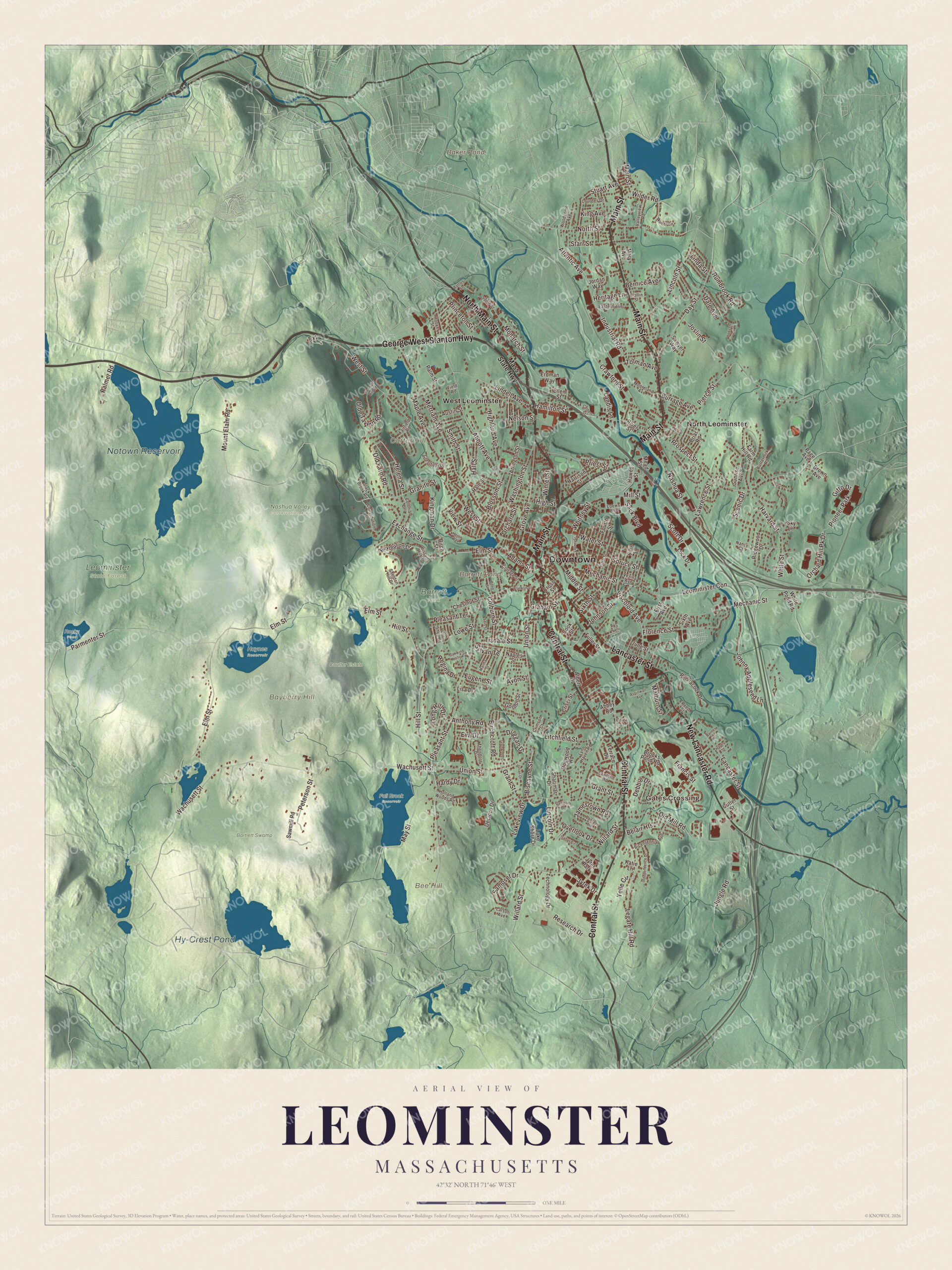
Leominster today
By KNOWOL
The whole city on its plateau above the Nashua River, shaded from USGS elevation data, with North Main, Main, Central and Lancaster streets, New Lancaster Road, the George West Stanton Highway, Notown Reservoir, Barrett Pond, Baker Pond and Bee Hill.3
The story of Leominster
Seven years alone on the new grant
In 1725 Gershom Houghton of Lancaster began a house on land his father had deeded him in the new grant, the tract that became Leominster. It wasn't a log cabin. The speaker at the site in 1910 said it was a framed house, well built, with hewn oak timbers. By tradition, his wife carried stones for the chimney in her homespun woolen apron. For seven years the Houghtons were the only family living on what is now Leominster ground. Gershom died in 1757, and his widow later set up one double stone for her two husbands. The name Houghton didn't fit, so a caret shows where the rest of it went. In 1910 the Historical Society set a boulder on the spot, and the only known piece of the house was a diamond-shaped pane of glass in the town museum.7
Combs from a farmhouse kitchen
Leominster's comb trade started small. About 1775 Obadiah Hills, whose family came from Newbury, began making combs of horn in the kitchen of the old Hills house on Pleasant Street. Every step was hand work. A comb maker might pack his stock in his saddlebags and ride to the nearest market, and a household could hold six to twelve young apprentices learning the trade. The first screw press was built in a hut in the Ashby woods, out of sight until the patent came through. Later, cow horns came in by the freight-car load. When horn grew scarce, celluloid took its place, and Viscoloid, Foster Grant and Tupperware followed. In the 1950s Don Featherstone designed the plastic pink flamingo for Union Products of Leominster.89103
We must, we can, and we will be free
On March 3, 1766, Leominster's town meeting sent the people of Boston a message of support that ended, "We must, we can, and we will be free." At the first alarm on April 19, 1775, fifteen men left home and marched for Lexington, and a full company enlisted that same day. The town's 1888 history says that in all 153 families, no one was accused or even suspected of being a Tory. That October, Ezekiel Price, long the chairman of Boston's selectmen, was in Leominster while he kept a diary of the siege. On Sunday, October 1, he went to the first service ever held in the Rev. Francis Gardner's new meetinghouse. The old 1741 meetinghouse was sold at auction to the Baptists of Harvard and carried off to Still River.11121314
Through the years
24 moments from 1653 to today.
- 1653Lancaster is founded, and the land that becomes Leominster is part of it.3
- 1701Settlers returning under a new grant bargain for the land with George Tahanto of the Nashaway.3
- 1725Gershom Houghton builds the first house, a framed house of hewn oak.7
- 1740Leominster is incorporated on June 23, which is July 4 by the new-style calendar.2
- 1741The frame of the first meetinghouse is raised.14
- 1757The Rev. John Rogers is dismissed over doctrine, and a fifth of his flock keeps him as their own minister.14
- 1766Town meeting tells the people of Boston, "We must, we can, and we will be free."11
- 1774John Chapman, later Johnny Appleseed, is born in Leominster on September 26.3
- 1775On April 19, fifteen men leave their homes and march for Lexington.12
- 1775About this year Obadiah Hills begins making horn combs in his kitchen.8
- 1775On October 1 the new meetinghouse holds its first service, with a Boston diarist in the pews.13
- 1796William Nichols and Jonas Kendall build the town's first paper mill.2
- 1800The Telescope, a weekly paper, starts on June 2. It lasts until October 1802.15
- 1838About 2,000 acres of No Town are added to Leominster.16
- 1838The Leominster Anti-Slavery Society is formed.17
- 1858Cousins F. W. and F. A. Whitney start making baby carriages.18
- 1873A fire on the night of July 10 hits the town hard.19
- 1886A business guide calls Leominster's toy factory the largest in the world.20
- 1901Bernard Wendell Doyle founds the Viscoloid Company.3
- 1910On June 23 the Historical Society unveils a boulder at the site of the first house.7
- 1915Leominster becomes a city on November 2.3
- 1937Foster Grant makes 20 million pairs of plastic sunglasses.3
- 1938Earl Tupper founds Tupperware in Leominster.3
- 1994The Johnny Appleseed Festival begins its run at Monument Square.3
Places to see
Places worth a visit in Leominster today.
- Monument SquareDowntown. The Common the city grew around.
- Johnny Appleseed LaneGranite birthplace marker. Where John Chapman was born, 1774.
- Leominster State ForestWest of the Monoosnoc hills. 4,246 acres with Notown cellar holes.Visit their website
- Notown ReservoirWest of the Monoosnoc hills. Water beside the state forest.
- South Monoosnoc HillWestern Leominster. Highest point, once quarried for granite.
- Monoosnoc BrookThrough downtown. The old factories lined its banks.
- French HillAbove downtown. Neighborhood of triple deckers.
- Nashua RiverEast and north ends. Below the plateau the city sits on.
- North LeominsterNorth end. Village on the old Fitchburg Railroad.
On the National Register
All 12 places in Leominster on the National Register of Historic Places that still stand today, oldest first, and why each one matters.5
-
Pine Grove Cemetery
Established in 1742, it is the city's oldest cemetery and the principal surviving piece of the town's early settlement. It began beside the first meetinghouse of 1741, and it was the town's only cemetery until 1840.21
-
Frances H. and Jonathan Drake House
Built in 1848, this typical Greek Revival worker's cottage is notable as a stop on the Underground Railroad during the pre-Civil War years. Frances and Jonathan Drake are documented as having hosted Shadrach Minkins after he was successfully extracted from custody at a Boston court hearing.22
-
F. A. Whitney Carriage Company Complex Historic District
One of the best-preserved factory complexes in the city, where the F. A. Whitney Company made baby carriages until 1952. At its height in the early 1920s it turned out 200,000 carriages a year with three to four hundred workers; the oldest building is the 1872 Second Empire office.4
-
W. S. Reed Toy Company-Wachusett Shirt Company Historic District
Two Summer Street properties tied to William S. Reed, who brought toy making to Leominster, starting with wooden blocks. His Second Empire brick factory of 1880 survives; after fires in 1892 and 1896 the plant later became the number 3 mill of the Wachusett Shirt Company.23
-
Wachusett Shirt Company
The five-building complex was developed between 1887 and 1910, and was home to one of the city's leading employers until the 1930s. Most of the complex converted into a residential complex known as Riverway Apartments in 1981.24
-
Jewett Piano Company Building
Built in 1892, it is a well-preserved example of late 19th-century wood-frame industrial construction. It is one of two surviving 19th-century piano case company plants in the city, which was known for this industry until World War I. The building was listed on the National Register of Historic Places in 2019.25
-
Whitney & Company
The utilitarian brick four-story building was built in 1893, and extended in 1923. It was built by Fred Abbot Whitney and Walther F. Whitney, whose business was the manufacture of boxes, notably paper boxes and satin-lined boxes, used for shipping other products to customers.26
-
Wellington Piano Case Company Building
The four-story brick building was built in 1895 by Frank E. Wellington, who manufactured piano cases for upright and grand pianos. The building was listed on the National Register of Historic Places in 1984.27
-
Cluett Peabody & Company
A 1902 factory building at 123 First Street where Cluett, Peabody & Company, the Troy, New York, firm best known for its Arrow collars and shirts and the Arrow Collar Man advertisements, made shirts and collars.28
-
Leominster High School
Built in 1904 and 1905, it is the city's most architecturally elaborate school building, and it served as Leominster's second high school until 1963, when the present high school was built. It later became Carter Junior High School.29
-
Monument Square Historic District
Leominster's traditional town common, known as the Common, with a monument marking the site of the town's second meetinghouse (1775 to 1824), a Native American mortar moved here in 1880, veterans' memorials and a firefighters' memorial. The Leominster Historical Society's headquarters is beside the square.30
-
Earl Company Factory
The Earl Company's factory building at 34 Tremaine Street, one of the city's newest National Register listings.5
In their words
“We must, we can, and we will be free. We cannot part with our creation right.”
Leominster town meeting, March 3, 1766, to the people of Boston, as printed in the History of Worcester County, 188911
“[Rome] was founded by one man and so was our town; in that distinction we are on an equality with the Eternal City.”
H. Wilson Gibbs, at the first-house boulder, Leominster Historical Society, 19107
“it would be impossible to find a community of 7,000 persons more really contented, prosperous and happy.”
Leominster, Historical and Picturesque, 188831
Nearby towns
Sources
- Leominster, Massachusetts, Wikipedia
- Leominster, Massachusetts, historical and picturesque (1888), on the settlement, incorporation and early trades, Internet Archive
- Map of Leominster, Massachusetts in 2026, KNOWOL (USGS elevation, Census Bureau roads)
- F. A. Whitney Carriage Company Complex Historic District, Wikipedia
- National Register of Historic Places listings in northern Worcester County, Massachusetts, Wikipedia
- Beautifully detailed map of Leominster, MA from 1886, restored by KNOWOL
- Exercises at the unveiling of the boulder marking the site of the first house erected in Leominster, 1725 (1910), Internet Archive
- Leominster, Massachusetts, historical and picturesque (1888), on the comb business, Internet Archive
- History of Worcester County, Massachusetts (1889), Leominster chapter, on the early comb makers, Internet Archive
- Commonwealth history of Massachusetts, volume 5 (1927), on Leominster's horn and celluloid trade, Internet Archive
- History of Worcester County, Massachusetts (1889), Leominster chapter, on the address of 1766, Internet Archive
- Leominster, Massachusetts, historical and picturesque (1888), on the Revolution, Internet Archive
- Diary of Ezekiel Price, 1775 to 1776, Proceedings of the Massachusetts Historical Society, vol. 7 (1863 to 1864), Internet Archive
- Leominster, Massachusetts, historical and picturesque (1888), on the first church and meetinghouse, Internet Archive
- History of Worcester County, Massachusetts (1889), Leominster chapter, on printing, Internet Archive
- History of Worcester County, Massachusetts (1889), Leominster chapter, on No Town, Internet Archive
- Leominster, Massachusetts, historical and picturesque (1888), sketch of Joel Smith, Internet Archive
- Leominster, Massachusetts, historical and picturesque (1888), on children's carriages, Internet Archive
- Gazetteer of the State of Massachusetts (1874), on Leominster, Internet Archive
- Leading manufacturers and merchants of central and western Massachusetts (1886), on Leominster, Internet Archive
- Pine Grove Cemetery, Wikipedia
- Frances H. and Jonathan Drake House, Wikipedia
- W. S. Reed Toy Company-Wachusett Shirt Company Historic District, Wikipedia
- Wachusett Shirt Company, Wikipedia
- Jewett Piano Company Building, Wikipedia
- Whitney & Company, Wikipedia
- Wellington Piano Case Company Building, Wikipedia
- Cluett Peabody & Company, Wikipedia
- Leominster High School, Wikipedia
- Monument Square Historic District, Wikipedia
- Leominster, Massachusetts, historical and picturesque (1888), on the town and its people, Internet Archive