
The planned mill city at Pawtucket Falls, once the farm village of East Chelmsford, where 5.6 miles of canals turned the Merrimack into power and the mill girls wrote a magazine of their own.
Then and now
The same town 150 years apart. Click either map to look closer.
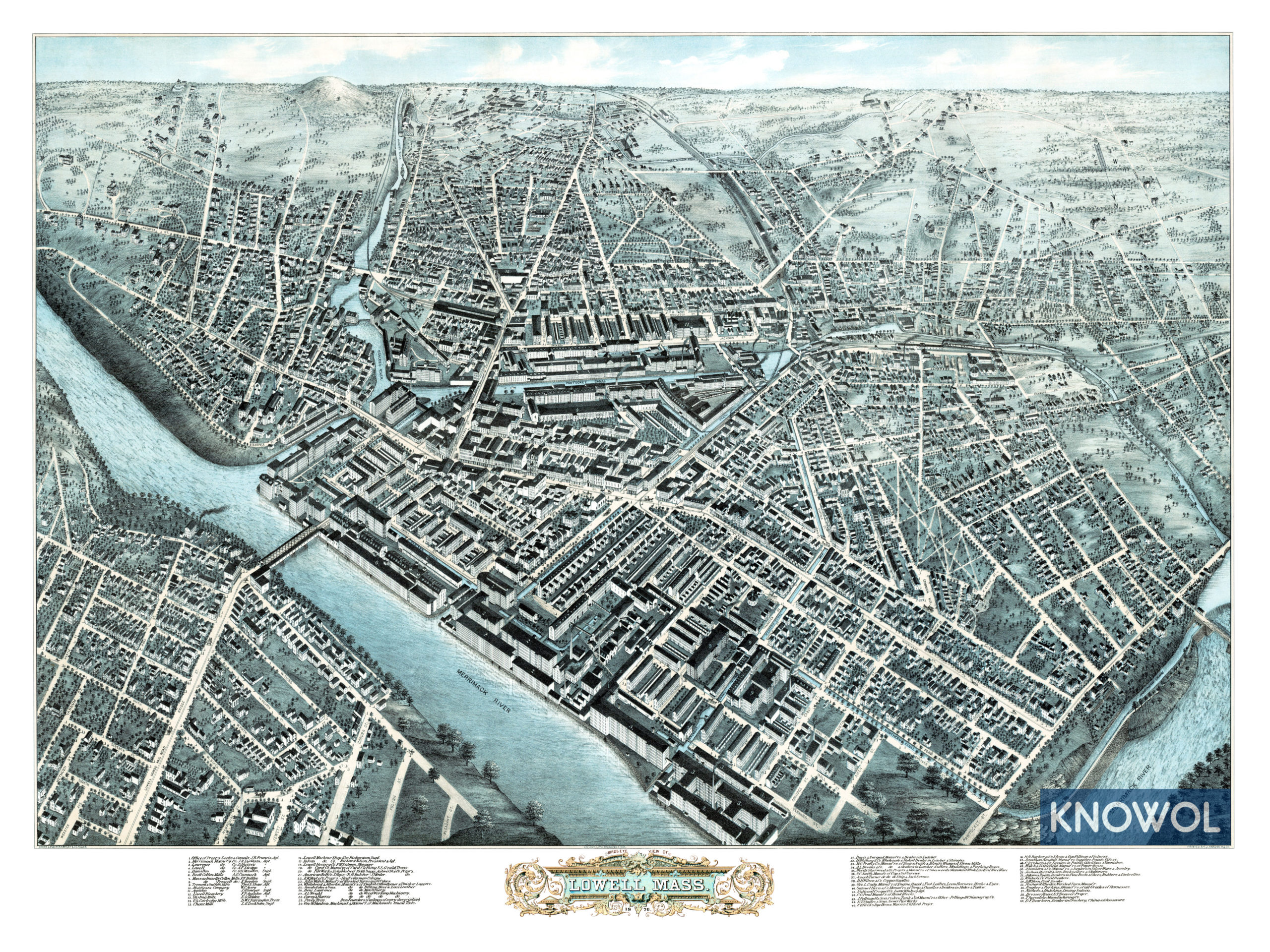
The bird's-eye view of 1876
By H.H. Bailey and J.C. Hazen
Lowell seen from the north, looking south across the city, with its street names and landmarks including the Merrimack Manufacturing Company, Lawrence Manufacturing, Massachusetts Cotton Mills, the Lowell Bleachery, the Lowell Machine Shop and Hoyt's German Cologne.4
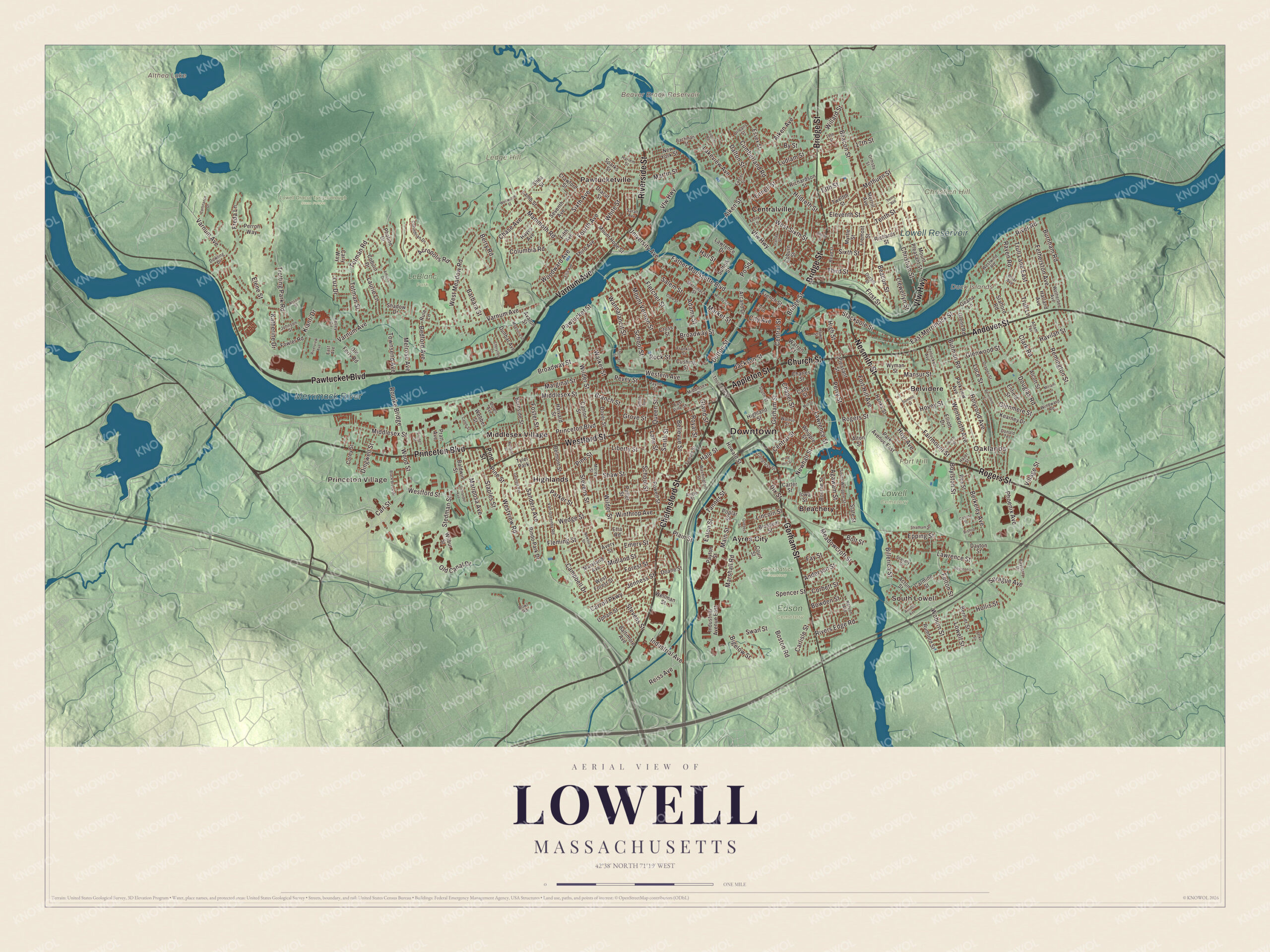
Lowell today
By KNOWOL
Shaded drumlins and river valleys where the Concord meets the Merrimack, with Chelmsford Street, Andover Street, the VFW Highway, Fort Hill, Christian Hill and the Lowell Reservoir.2
The story of Lowell
Lowell or Derby
When the Boston investors' new mill village was ready to become a town in 1826, the act of incorporation had one blank left: the name. Kirk Boott, the company agent, had been thinking of Derby, the English mill town. He'd also thought of Francis Cabot Lowell. When Nathan Appleton asked him about it, Boott said it came down to Lowell or Derby. Appleton answered, then Lowell by all means, and Lowell it was. The village it replaced, East Chelmsford, had three fire engines in 1825, filled by people passing buckets. In June 1826 Hurd's Mills burned, the worst fire of those days. The new town named fire wards who carried an official staff, and in 1829 town meeting voted $1,000 for a fire engine of its own.56
What the mill girls wrote
The young women who ran Lowell's looms started a magazine. The Lowell Offering came out from 1840 to 1845, written entirely by women working in the mills. Charles Dickens made a flying visit in January 1842 and took home four hundred pages of it. He told his readers that many boarding houses had a piano and nearly all the girls belonged to circulating libraries. In France, M. Thiers showed a bound copy to the Chamber of Commerce as proof of what working women could do in a republic. The women spoke for themselves in other ways too. About 1847 several of them went before a legislative committee at the State House on the hours of labor. One early agent, an old sea captain, admitted he'd have liked to rule his help like sailors, but didn't dare.278910
The first to fall
On April 19, 1861, four companies of the Sixth Massachusetts had to march across Baltimore through a mob of thousands. Four soldiers were killed, the first deaths of the Civil War. Addison O. Whitney and Luther C. Ladd were members of the Lowell Guards, and Charles A. Taylor was another member. Whitney was twenty-one and Ladd was only in his eighteenth year. They had been mill hands days earlier. Lowell turned into a soldiers' town that year, and in September Camp Chase opened here as a military rendezvous. On April 19, 1865, four years to the day, the Commonwealth and the city dedicated a monument to Ladd and Whitney, and the two lie buried in Monument Square beside it. Fifty-five years later the city directory still boasted that Lowell was the home of Ladd, Whitney and Taylor.1112131415
Through the years
25 moments from 1653 to today.
- 1653The state's list dates European settlement of the area to this year.2
- 1793Work begins on the Middlesex Canal, which will link the Merrimack with Boston by 1803.16
- 1802The Chelmsford Glass Works builds its Long House to lodge its workers.17
- 1822The Merrimack Manufacturing Company gets its charter, the first mill company in what becomes Lowell.18
- 1825East Chelmsford has three fire engines, filled by bucket brigades.6
- 1826The town is incorporated, and Kirk Boott's choice between Lowell and Derby goes to Lowell.5
- 1826Hurd's Mills burn in June, the worst fire of the early days.6
- 1829Town meeting votes $1,000 for the town's own first fire engine.6
- 1834A Varnum of Dracut builds his home across the river, in the section that comes to be called Centralville.19
- 1836Lowell becomes a city.2
- 1840The Lowell Offering, written by women in the mills, begins.2
- 1842Charles Dickens pays a flying visit and writes about it in American Notes.7
- 1847About this year, mill girls testify at the State House on the hours of labor.10
- 1850James B. Francis builds the Great Gate, nicknamed Francis' Folly.2
- 1851Centralville is annexed to the city.20
- 1856A floor settles under the crowd that came to hear Rufus Choate speak for the Union.21
- 1861Addison Whitney and Luther Ladd of the Lowell companies are killed at Baltimore on April 19.11
- 1861Camp Chase, a military rendezvous, opens at Lowell in September.13
- 1865The city and the state dedicate the Ladd and Whitney monument, four years to the day.14
- 1874Pawtucketville, until then part of Dracut, is annexed to Lowell.22
- 1876H.H. Bailey and J.C. Hazen publish their bird's-eye view of Lowell.4
- 1883Lucius A. Derby opens Lowell's first electrical business and puts up its first arc lights.23
- 1893City Hall goes up with its 180-foot clock tower.24
- 1906Work starts on Holy Trinity, the first church in America built for a Greek Orthodox congregation.25
- 1978Lowell National Historical Park is established.2
Places to see
Places worth a visit in Lowell today.
- Lowell National Historical ParkDowntown mill district. Mills, canals and the city's story.Visit their website
- Boott Cotton Mills MuseumDowntown mill district. A working weave room in a mill.Visit their website
- Pawtucket FallsMerrimack River. The rapids that powered the mills.
- Great GateThe canal system. Francis' Folly, which saved the city twice.
- Whistler House Museum of Art243 Worthen Street. Whistler's birthplace, now an art museum.Visit their website
- Kerouac ParkDowntown. Honors the city's native novelist.
- Jack Kerouac birthplace9 Lupine Road, Centralville. Where Kerouac was born in 1922.
- Fort Hill ParkBelvidere. Drumlin park on the old Rogers farm.
- Christian HillCentralville. Drumlin on the Dracut line.
On the National Register
20 of the 39 places in Lowell on the National Register of Historic Places that still stand today, oldest first, and why each one matters. See the full list of National Register places in Lowell.3
-
Jerathmell Bowers House
A Cape-style house with a central brick chimney, believed to date from about 1673. It is the oldest known home in Lowell.26
-
Chelmsford Glass Works' Long House
The building, built in 1802 by the Chelmsford Glass Works to house some of its workers, is a row of story-and-a-half Cape style wood-frame houses joined into a single structure. The building is one of the earliest industrial tenement structures built in the country.17
-
St. Patrick's Church
The parish was founded in 1831 for Irish workers who came to dig the Pawtucket and Merrimack canals. The stone Gothic Revival church of 1853 was designed by Patrick C. Keely and largely rebuilt after a fire in 1904.27
-
Allen House
Built about 1854, it is one of the city's finest early examples of Italianate architecture. In the early 20th century, it was the home of Charles Herbert Allen, a prominent local politician.28
-
Jonathan Bowers House
Built in 1872 for a local businessman, it is one of the most unusual houses in Massachusetts, being a circular masonry building with Second Empire styling. It was listed on the National Register of Historic Places in 1976.29
-
City Hall Historic District
Its centerpiece is the Richardsonian Romanesque City Hall of 1893 by Merrill and Cutler, with a 180-foot clock tower. Around it are Greek Revival and Romanesque Revival buildings, including work by Kirk Boott.24
-
Grace Universalist Church
Built in 1896 for a Universalist congregation, it has been St. George Greek Orthodox Church since 1973. Its 70-foot masonry dome is a very early tile vault by the immigrant architects Rafael Guastavino Sr. and Jr.30
-
Monarch Diner
A Worcester Lunch Car Company diner of 1940 that first ran in Waltham and was moved here in 1951. Now the Owl Diner, it is the last of sixteen diners that once operated in the city.31
-
Middlesex Canal
A 27-mile barge canal that linked the Merrimack River with the port of Boston, one of the first civil engineering works of its kind in the country. It ran until 1851, and remnants still survive.16
-
Lowell Locks and Canals Historic District
National Historic Landmark
The largest power canal system in the United States, 5.6 miles of canals on two levels with their gates and locks. It grew from the Pawtucket Canal of the 1790s, built to float logs around Pawtucket Falls, and drove every mill in the city.32
-
Holy Trinity Greek Orthodox Church
Built for Lowell's growing Greek community and opened in 1908, it was the first church in America built specifically for a Greek Orthodox congregation. It's known for its golden dome, mosaics and icons.25
-
Lowell National Historical Park
Established in 1978 and run by the National Park Service, it takes in sites across the city that tell the story of textile manufacturing in the Industrial Revolution.33
-
South Common Historic District
The South Common Historic District of Lowell, Massachusetts, encompasses the city's South Common and the various public, religious, and private residential buildings that flank its borders.34
-
Wamesit Canal-Whipple Mill Industrial Complex
Oliver Whipple built a canal along the Concord River to power the gunpowder mills he ran here until 1855, and the site grew into a larger mill complex in the mid-1800s.35
-
Tyler Park Historic District
The Tyler Park Historic District encompasses a planned residential development in western Lowell, Massachusetts. The development was designed by Olmsted, Olmsted and Eliot, and is centered on Tyler Park; this area is the only Olmsted design in the city.36
-
Belvidere Hill Historic District
The Belvidere Hill Historic District encompasses a residential area on the east side of Lowell, Massachusetts known for its fine 19th-century houses. The area, roughly bounded by Wyman, Belmont, Fairview, and Nesmith Streets, was developed beginning in the 1850s, and was one of the finest neighborhoods in the city, home to many of its business and civic leaders.37
-
Lowell Cemetery
Founded in 1841 on the banks of the Concord River and inspired by Mount Auburn Cemetery in Cambridge, it is one of the oldest garden cemeteries in the nation. Many of Lowell's wealthy industrialists are buried here under ornate Victorian stones.38
-
Rogers Fort Hill Park Historic District
The Rogers Fort Hill Park Historic District of Lowell, Massachusetts, encompasses the largest single residential development made in the city in the 19th century. The district includes the area historically associated with the Rogers Farm, purchased in 1805 by Zadock Rogers.39
-
Lowell Historic Preservation District
Created by the law that established the national park, it covers more than 500 acres: the mill complexes, worker housing, the business district, the civic heart of the city and the water power system that drove the mills.40
-
Pawtucket Congregational Church
The church was gathered in 1797, when Pawtucketville was still part of Dracut, on the site where the Pennacook sachem Passaconaway once lived. The present building dates from 1898, and its tower holds an 1822 bell from the Revere foundry.41
In their words
“People who visit Lowell casually are impressed with the surprising fact that a manufacturing city can be beautiful.”
Lowell city directory, 192642
“Lowell is wide open to the worker, but there is no room for the shirker.”
Lowell city directory, 192642
“I am now going to state three facts which will startle a large class of readers on this side of the Atlantic, very much.”
Charles Dickens on the Lowell mill girls, quoted in Massachusetts of today, 18928
Nearby towns
Sources
- Lowell, Massachusetts, Wikipedia
- Map of Lowell, Massachusetts in 2026, KNOWOL (USGS elevation, Census Bureau roads)
- National Register of Historic Places listings in Lowell, Massachusetts, Wikipedia
- Beautifully restored map of Lowell, Massachusetts from 1876, KNOWOL
- History of Middlesex County, Massachusetts (1890), on naming Lowell, Internet Archive
- History of Middlesex County, Massachusetts (1890), on Lowell's early fire service, Internet Archive
- The Bay State Monthly, March 1884, on Lowell in the 1840s, Internet Archive
- Massachusetts of today (1892), Internet Archive
- Middlesex County and its people (1927), on the Lowell Offering, Internet Archive
- Early factory labor in New England (1889), Internet Archive
- Middlesex County and its people (1927), on Baltimore, April 19, 1861, Internet Archive
- Massachusetts in the rebellion (1866), Internet Archive
- The Bay State Monthly, March 1884, on Lowell in the Civil War, Internet Archive
- Historical sketch of the old Sixth Regiment of Massachusetts Volunteers (1866), Internet Archive
- Lowell, MA City Directory 1916 (1916), Internet Archive
- Middlesex Canal, Wikipedia
- Chelmsford Glass Works' Long House, Wikipedia
- A memoir of Dr. James Jackson (1905), Internet Archive
- The Varnums of Dracutt (1907), on Centralville, Internet Archive
- Varnum School, Wikipedia
- Illustrated History of Lowell and Vicinity, Massachusetts (1897), Internet Archive
- History of Dracut, Massachusetts (1922), on Pawtucketville, Internet Archive
- Middlesex County and its people (1927), on Lucius A. Derby, Internet Archive
- City Hall Historic District, Wikipedia
- Holy Trinity Greek Orthodox Church, Wikipedia
- Jerathmell Bowers House, Wikipedia
- St. Patrick's Church, Wikipedia
- Allen House, Wikipedia
- Jonathan Bowers House, Wikipedia
- Grace Universalist Church, Wikipedia
- Monarch Diner, Wikipedia
- Lowell Locks and Canals Historic District, Wikipedia
- Lowell National Historical Park, Wikipedia
- South Common Historic District, Wikipedia
- Wamesit Canal-Whipple Mill Industrial Complex, Wikipedia
- Tyler Park Historic District, Wikipedia
- Belvidere Hill Historic District, Wikipedia
- Lowell Cemetery, Wikipedia
- Rogers Fort Hill Park Historic District, Wikipedia
- Lowell Historic Preservation District, Wikipedia
- Pawtucket Congregational Church, Wikipedia
- Lowell, MA City Directory 1926 (1926), on the city, Internet Archive