
Once Orford Parish of East Hartford, Manchester grew along the Hockanum and its brooks into a town of paper, cotton, glass and above all Cheney silk, the Silk City whose mills, mansions and workers' houses still stand together.
Then and now
The same town 146 years apart. Click either map to look closer.
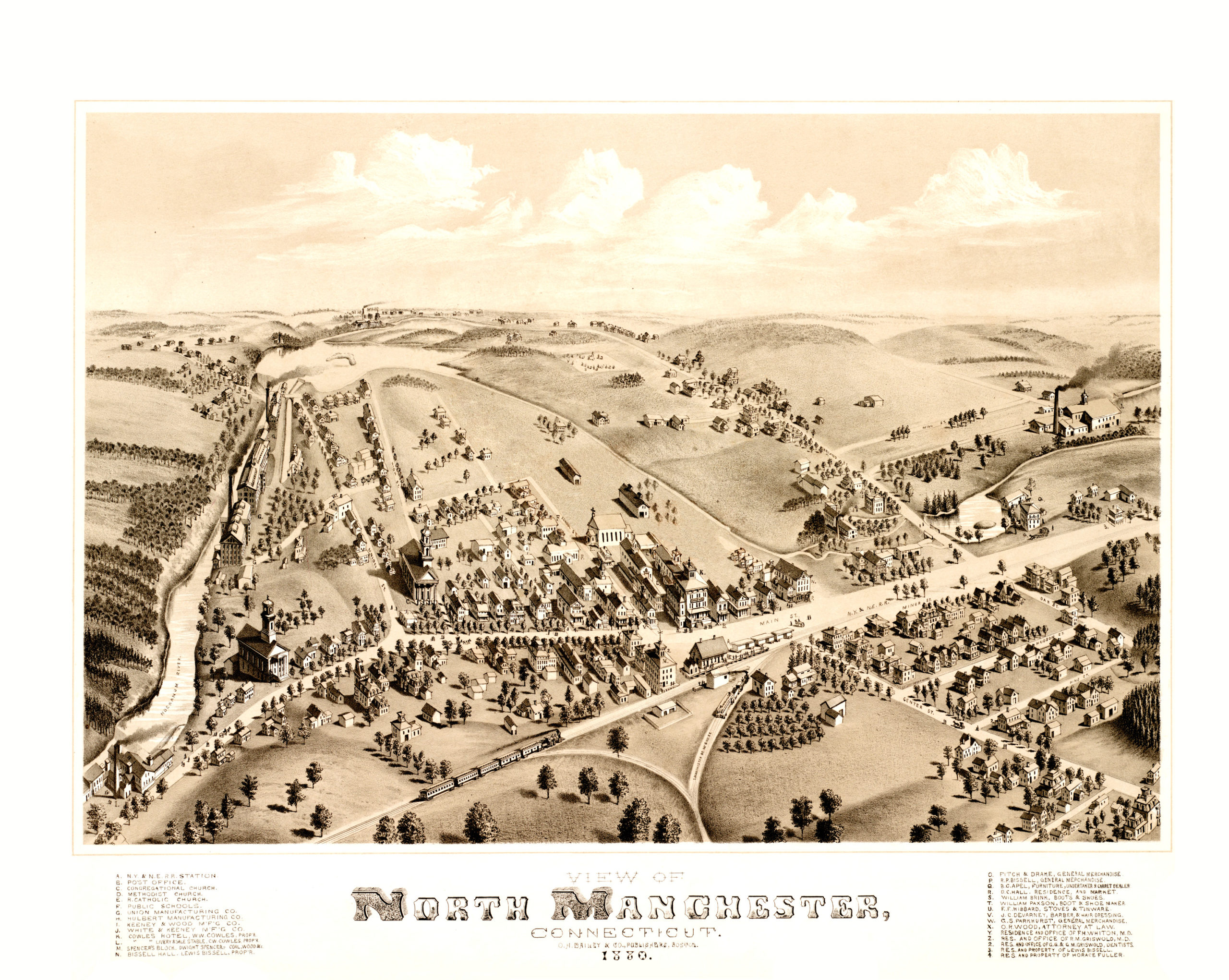
North Manchester in 1880
By O.H. Bailey & Co.
North Manchester as it looked in 1880, with the New York and New England Railroad station, the Cowles Hotel, the post office, Hulbert Manufacturing and Bissell Hall.5
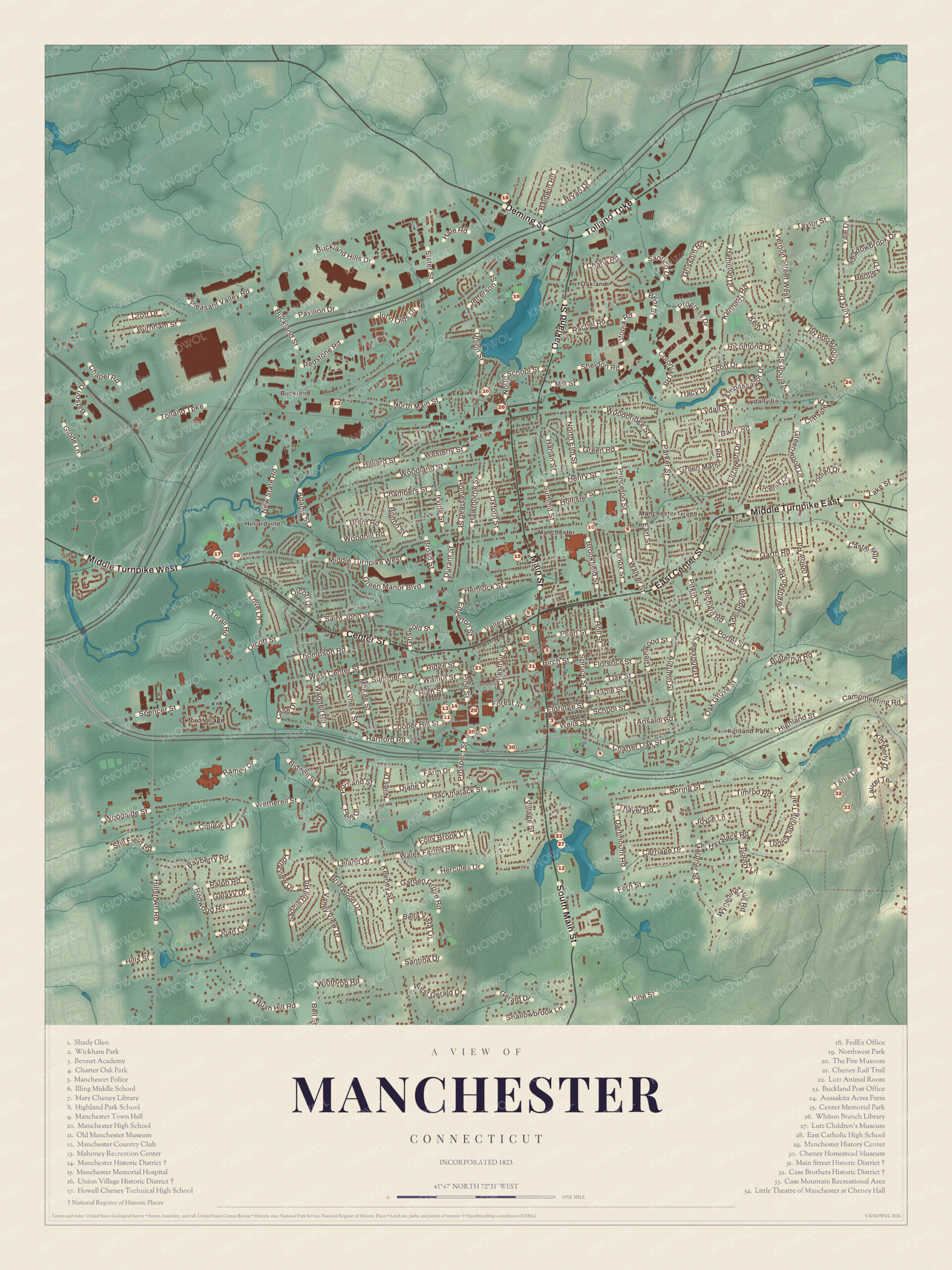
Manchester today
By KNOWOL
Shaded hills from Buckland and Lydallville down to Case Mountain, every street from Main Street to Tolland Turnpike, the Hockanum River, and a guide of 34 numbered landmarks with the National Register sites marked.6
The story of Manchester
Lexington on Manchester paper
Long before silk, Manchester's brooks made paper. When the battle of Lexington was fought in 1775, the Connecticut Courant printed the news on paper from the Watson and Ledyard mill on the Hockanum, a mill that sent Hartford's printers eight thousand sheets a week until someone burned it in 1778. The owners got a lottery from the state to recover. Others followed. One Manchester mill was said to be the first in the country to make white paper from old printed paper, lifting the ink out by a new process. In 1862 the Case twins started their Highland Park mill with $135. Fire stayed the enemy, though. By 1886 at least thirteen paper mills had burned here in forty years.789
A glass of water for Washington
Before the mills, the life of Orford Parish ran along its roads. Thomas Olcott kept a house of entertainment near Hop Brook as early as 1711, and great droves of cattle passed it on their way to market. Near Richard Pitkin's place stood a store, a tavern, a pottery and the glass factory, where people came just to watch the glass being made. At the Green, the Woodbridge tavern on the stage road between Hartford and Lebanon took in judges, statesmen and officers. The innkeeper's daughter liked to tell how she once handed General Washington a glass of water and got his thanks. In 1824 the whole region turned out at Buckland's Corners to cheer General Lafayette on his way to Hartford.101112
From Mount Nebo to the Silk City
The Cheneys came to silk the hard way. In 1836 the brothers built a small water-powered mill called Mount Nebo and started making sewing silk with half a dozen hands. They also went all in on mulberry trees for silkworms, and when that craze collapsed they came home and started over, working from imported raw silk. Years of trial followed, and in 1855 they began spinning silk from waste that couldn't be reeled. By 1886 more than fifteen hundred names were on the Cheney payroll, and in 1869 the company built its own branch railroad to the main line. Christopher Spencer, who invented the Spencer repeating rifle, was a Manchester native and a Cheney employee.3131
Through the years
23 moments from 1673 to today.
- 1673Colonists settle the land known as the Five Miles, east of Hartford.1
- 1711Thomas Olcott is appointed to keep a house of entertainment near Hop Brook.10
- 1772The parish is organized as the Ecclesiastical Society of Orford.14
- 1775The Connecticut Courant prints the news of Lexington on paper made at the mill on the Hockanum.7
- 1778That paper mill is set on fire and burns.7
- 1780Aaron Buckland starts the woolen mill at Buckland that the Hilliards later run.1
- 1783The Pitkins are granted the sole right to make glass in Connecticut for 25 years.15
- 1794Connecticut's first cotton mill starts spinning at what becomes Union Village.2
- 1808A post office opens at Manchester Green, then called Orford Parish.12
- 1823Manchester is incorporated as a town, set off from East Hartford.1
- 1824People gather at Buckland's Corners to honor General Lafayette on his way to Hartford.12
- 1836The Cheney brothers build the little Mount Nebo Silk Mill and begin making sewing silk.3
- 1838The Cheney silk business that will make Manchester the Silk City is under way.1
- 1847The Williams soap firm leaves Manchester, and James B. Williams moves to Glastonbury.16
- 1849The railroad reaches Union Village, which becomes the town's business center.17
- 1862The Case brothers start a paper mill at Highland Park with $135 between them.9
- 1869Cheney Brothers build a branch railroad from South Manchester to North Manchester.3
- 1880O.H. Bailey and Co. publish a bird's-eye view of North Manchester.5
- 1891Mineral Soap is renamed Bon Ami after its maker moves to Manchester.18
- 1923Manchester's centennial is the biggest celebration the town has ever held.19
- 1927The first Manchester Road Race is run.1
- 1931The five-sided Main Street post office is built.20
- 1978The Cheney Brothers Historic District is named a National Historic Landmark.21
Places to see
The numbers match the landmark guide printed on the 2026 map.
- 1Shady GlenNear the Bolton line. Ice cream and the winged cheeseburger.
- 11Old Manchester MuseumNear the Cheney mills. Cheney silk, Pitkin glass, Spencer rifles.Visit their website
- 14Manchester Historic DistrictWest of Main Street. The Cheney mill town and its neighborhoods.
- 16Union Village Historic DistrictUnion and North Main Streets. Mill village of the 1794 cotton mill.
- 20Fire MuseumNear the Cheney mills. In a restored 1901 firehouse.Visit their website
- 25Center Memorial ParkMain and Center Streets. Park on land the Cheneys gave.
- 30Cheney Homestead MuseumEast of the mills. The family house, with Keeney Schoolhouse.Visit their website
- 31Main Street Historic DistrictDowntown Main Street. Colonial Revival business blocks, 1890 to 1940.
- 32Case Brothers Historic DistrictSpring Street, Highland Park. The Case twins' paper mill and houses.
- 34Little Theatre of Manchester at Cheney HallHartford Road. The Cheneys' social hall, now a theater.Visit their website
On the National Register
All 9 places in Manchester on the National Register of Historic Places that still stand today, oldest first, and why each one matters.4
-
Pitkin Glassworks Ruin
The stone ruins of the glass factory the Pitkins opened after the state gave them a 25-year monopoly in return for gunpowder supplied to the Continental Army. It made mostly green glass, from demijohns to inkwells, until it closed in 1830.15
-
Union Village Historic District
The mill village that grew around one of Connecticut's first cotton mills. The Union Manufacturing Company built duplexes for its workers and Greek Revival houses for its managers, and more than 170 historic buildings remain.17
-
Woodbridge Farmstead
A well-kept Greek Revival farmhouse, the center of Meadow Brook Farm, held by the Woodbridge family for more than 150 years and farmed until about 1951.22
-
Cheney Brothers Historic District
National Historic Landmark
The company town of the Cheney silk mills: 175 acres with sixteen brick mills, workers' houses, churches, schools, Cheney Hall and the family mansions around the old Cheney Homestead. A National Historic Landmark.21
-
Manchester Historic District
Takes in most of the Cheney landmark district and the neighborhoods that grew up around it, reaching north to Center Springs Park, land given by the Cheneys and the Hilliards.23
-
Edward L. Burnham Farm
A Greek Revival farmhouse built for a family that grew broadleaf tobacco here, with rare 19th-century dairy and ice houses still on the grounds.24
-
Case Brothers Historic District
The paper mill the Case twins opened in 1862, the dams that made Upper and Lower Case Ponds, their two grand houses, and the rustic park they began on Case Mountain. The family made paper here until 1967.25
-
Main Street Historic District
Manchester's downtown, built up as its main business street with a remarkable run of Colonial Revival buildings, many of them built or helped along by the Cheneys.26
-
US Post Office, Manchester Main (Weiss Center)
A brick and limestone post office with a rare five-sided plan and a columned portico, set at an angle to the corner of Main and Center Streets. It served as the post office until 1991.20
In their words
“The romantic beauty of the Highlands is surpassed by that of few other localities in New England.”
The memorial history of Hartford County, 1886, on Highland Park27
“Fraternal co-operation, natural ingenuity, and untiring application were the factors which produced success.”
The memorial history of Hartford County, 1886, on the Cheney brothers3
“people came from afar to see the wonderful machine capable of making the fabulous amount of twelve pounds of good yarn in a single day.”
The memorial history of Hartford County, 1886, on the 1794 cotton mill28
Nearby towns
Sources
- Manchester, Connecticut, Wikipedia
- The history of Connecticut, from the first settlement to the present time (1840), on the first cotton mill, Internet Archive
- The memorial history of Hartford County, Connecticut, 1633-1884 (1886), on Cheney Brothers, Internet Archive
- National Register of Historic Places listings in Hartford County, Connecticut, Wikipedia
- Vintage map of Manchester, Connecticut in 1880, restored by KNOWOL
- Map of Manchester, Connecticut in 2026, KNOWOL (USGS elevation, Census Bureau roads)
- The memorial history of Hartford County, Connecticut, 1633-1884 (1886), on the Union Village paper mill, Internet Archive
- The memorial history of Hartford County, Connecticut, 1633-1884 (1886), on Peter Rogers' mills, Internet Archive
- History of Connecticut in monographic form (1925), on the Case brothers, Internet Archive
- The memorial history of Hartford County, Connecticut, 1633-1884 (1886), on the Five Miles and Hop Brook, Internet Archive
- The memorial history of Hartford County, Connecticut, 1633-1884 (1886), on the glass factory, Internet Archive
- The memorial history of Hartford County, Connecticut, 1633-1884 (1886), on the Green and the Woodbridge tavern, Internet Archive
- Genealogical and family history of the state of Connecticut (1911), on Frank Cheney and the Spencer rifle, Internet Archive
- The memorial history of Hartford County, Connecticut, 1633-1884 (1886), on the Society of Orford, Internet Archive
- Pitkin Glassworks Ruin, Wikipedia
- History of Connecticut in monographic form (1925), on the Williams soap firm, Internet Archive
- Union Village Historic District (Manchester, Connecticut), Wikipedia
- Encyclopedia of Connecticut biography (1917), on John T. Robertson and Bon Ami, Internet Archive
- History of Hartford County, Connecticut, 1633-1928 (1928), on the Manchester centennial, Internet Archive
- Weiss Center (US Post Office, Manchester Main), Wikipedia
- Cheney Brothers Historic District, Wikipedia
- Woodbridge Farmstead, Wikipedia
- Manchester Historic District (Manchester, Connecticut), Wikipedia
- Edward L. Burnham Farm, Wikipedia
- Case Brothers Historic District, Wikipedia
- Main Street Historic District (Manchester, Connecticut), Wikipedia
- The memorial history of Hartford County, Connecticut, 1633-1884 (1886), on the Highlands, Internet Archive
- The memorial history of Hartford County, Connecticut, 1633-1884 (1886), on the 1794 cotton mill, Internet Archive