
A hill town gathered from the corners of Glastonbury, Colchester and Hebron, where settlers spent fifty-four years finishing their meetinghouse, Colonel Buell kept a tavern on the Hartford to New London road, and two cotton mills once made a village of their own.
Then and now
The same town 157 years apart. Click either map to look closer.
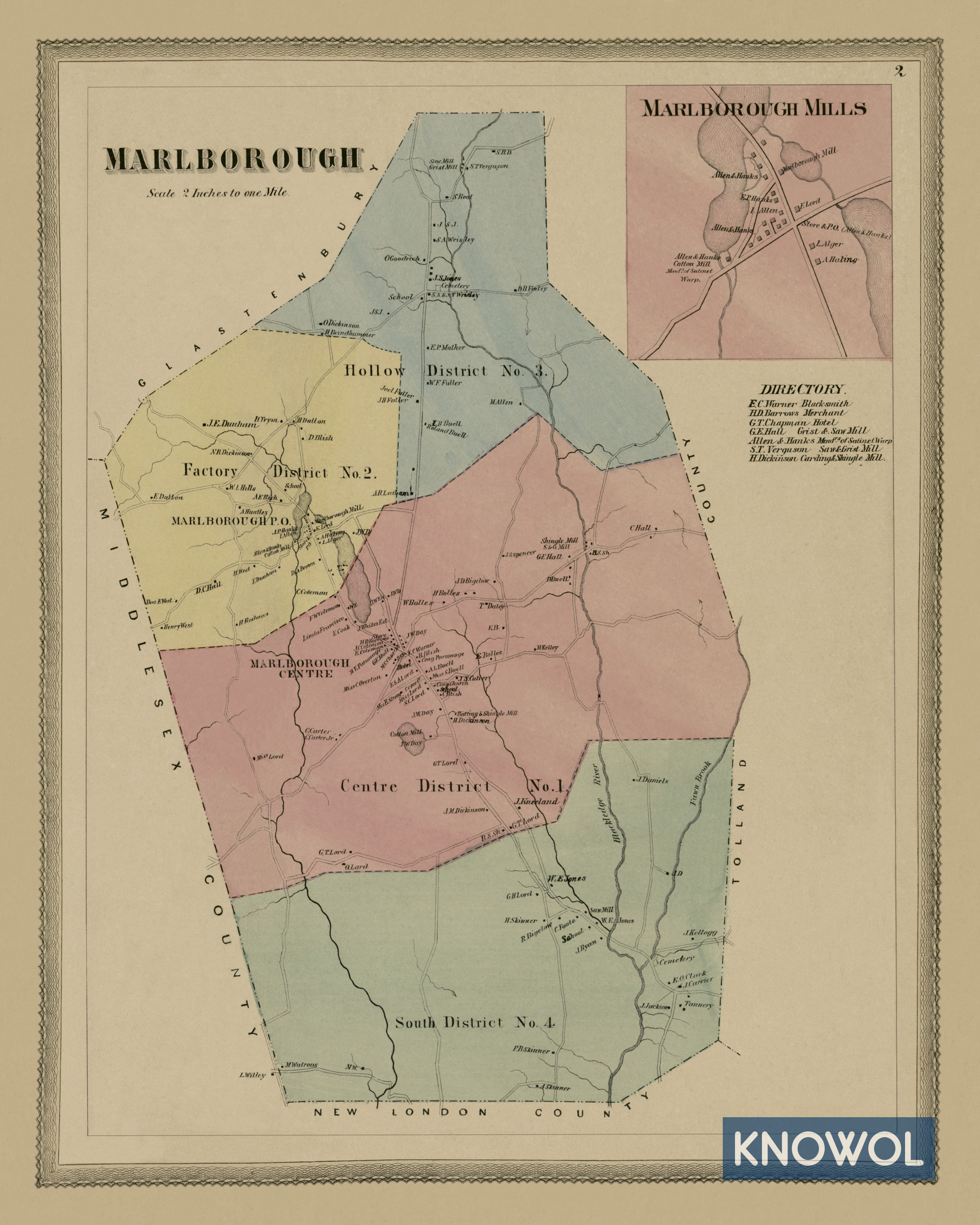
The landowners map
By Baker & Tilden
Marlborough divided into four districts with every landowner's name, an inset view of Marlborough Mills, and landmarks like the Allen & Hanks Cotton Mill, Warner Blacksmith Shop, Chapman Hotel, Marlborough Grist & Saw Mill, Dickinson Carding & Shingle Mill and Marlborough Centre.5
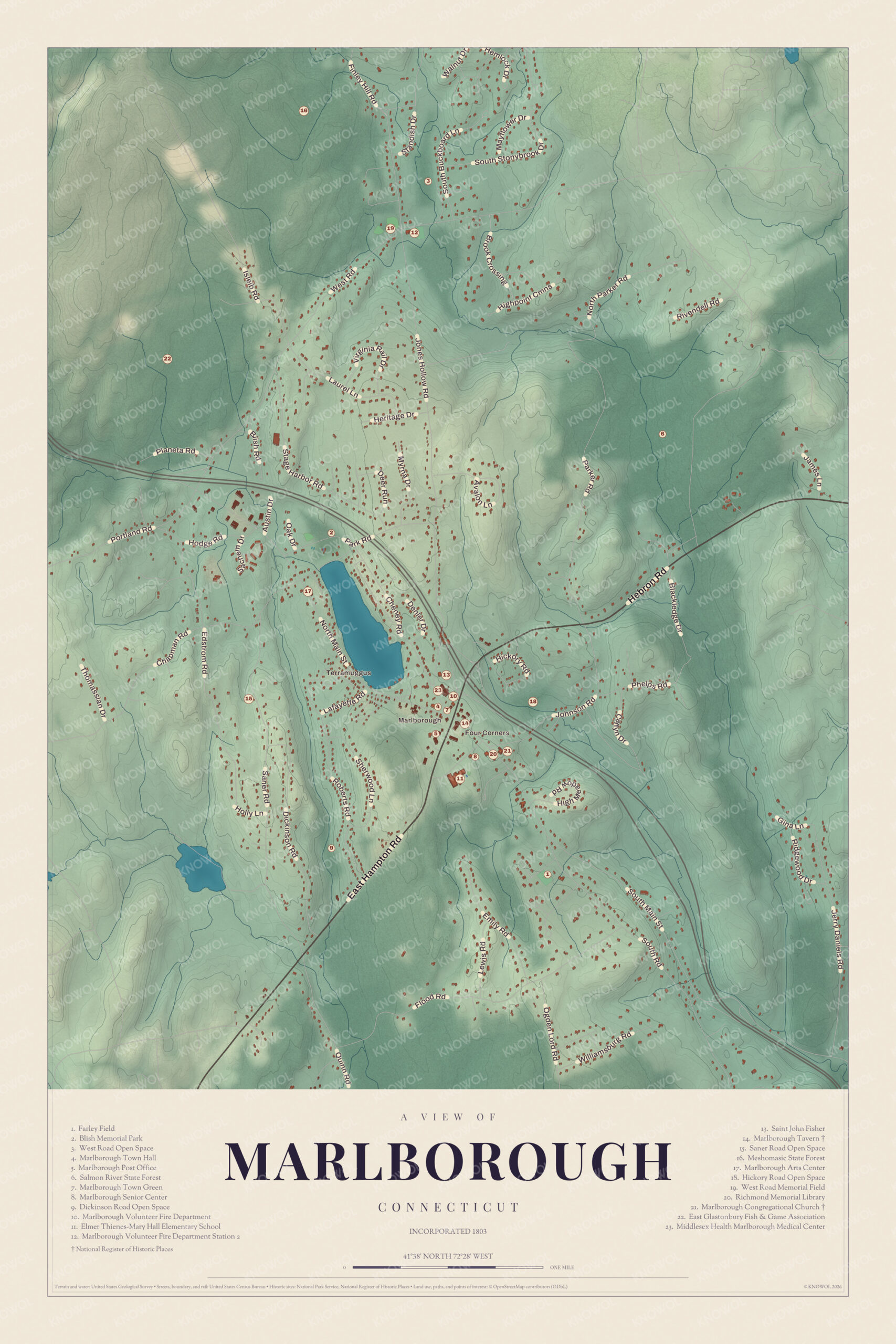
Marlborough today
By KNOWOL
Shaded hills from the Meshomasic woods down past Lake Terramuggus to the Salmon River country, every street, Marlborough Center, and a guide of 23 numbered landmarks with the National Register sites marked.6
The story of Marlborough
Fifty-four years to finish a meetinghouse
Marlborough began as the far corners of three towns. In 1736 the families there asked the General Assembly for a church of their own, saying they lived seven or eight miles from meeting and had more than sixty children too small to make the trip. They kept asking until 1747, when the parish was formed and named for Marlborough, Massachusetts, and for a while it was called New Marlborough. Tradition says the first minister was ordained standing on the meetinghouse timbers, and that before the walls went up, people met at the tavern with the minister at the bar. The meetinghouse took fifty-four years to finish. It was done in 1803 by laying the cornerstone last, and that same year Marlborough became a town.78921
The mill village
For much of the 1800s Marlborough had a second village a mile north of the church. The Marlborough Manufacturing Company, incorporated in 1815, built the north mill and houses for its workers, then sold out to the Union Manufacturing Company, which added the south mill and a store. By 1836 it was the most built-up spot in town, and in 1838 the company fitted up a chapel there. The mills made a blue cotton stripe sold to Southern merchants, and when the Civil War cut off that trade they stood idle. The north mill burned in 1862 and the south mill in 1864. Baker & Tilden's 1869 map still gave Marlborough Mills its own inset view, and the post office kept the name into the 1890s.310511
Colonel Buell's corner
At the corner of South Main Street and East Hampton Road stands the house Colonel Elisha Buell built about 1760. He kept it as an inn on the stage road between Hartford and New London and had a gunsmith shop nearby. During the Revolution his gunnery repaired and made muskets for soldiers from the towns around. One of his apprentices, Samuel Finley Jones, had lost both parents as a small boy. After learning the trade he bought a little farm and became the largest landowner in the northeast part of town. The Buell family kept the post office for more than fifty years and owned the house until 1898. The Society of Colonial Dames later restored it, and it opened again as a restaurant in 2018.1231314
Through the years
23 moments from 1648 to today.
- 1648Marlborough traces its beginnings to Sadler's Ordinary, a colonial rest stop said to have opened this year.1
- 1736Families in the far corners of three towns ask for their own church, citing more than sixty small children.7
- 1747The church society is formed and named Marlborough.1
- 1749Work begins on the first meetinghouse.1
- 1751Eleazer Kneeland builds the first sawmill, on Blackledge's River.15
- 1760The Centre schoolhouse is finished, the only school building in town for many years.16
- 1760About this year Colonel Elisha Buell builds the house that becomes the Marlborough Tavern.12
- 1775During the Revolution, Buell's gunnery repairs and makes muskets for soldiers from nearby towns.3
- 1803The meetinghouse is finished after fifty-four years, with the cornerstone laid last.2
- 1803On October 13, Marlborough is incorporated as a town.1
- 1815The Marlborough Manufacturing Company is incorporated and builds the north mill.3
- 1836The village around the Union Cotton Factory is the most built-up part of town.10
- 1838The Union Manufacturing Company fits up a chapel at the mill village.3
- 1842The present Congregational church is dedicated on March 16.17
- 1846Marlborough becomes its own probate district.18
- 1862The north mill burns. The south mill follows two years later.3
- 1863Ezra Hall of Marlborough is elected the youngest member of the state Senate.19
- 1869Baker & Tilden publish their landowners map of Marlborough.5
- 1890The town counts 582 people and lives by farming and silk making.11
- 1903Marlborough celebrates its centennial, with Mary Hall carrying most of the work.20
- 1960sMarlborough grows again as a home for people working in Hartford.1
- 1978The Marlborough Tavern is listed on the National Register.12
- 1993The Marlborough Congregational Church is listed on the National Register.21
Places to see
The numbers match the landmark guide printed on the 2026 map.
- 2Blish Memorial ParkToward Lake Terramuggus. Town park west of the center.
- 4Marlborough Town HallMarlborough Center. Beside the town green.
- 6Salmon River State ForestNortheast of town. State forest reaching into Marlborough.Visit their website
- 7Marlborough Town GreenMarlborough Center. The green at the heart of town.
- 14Marlborough TavernSouth Main Street and East Hampton Road. Colonel Buell's inn of about 1760.
- 16Meshomasic State ForestEdge of town. Connecticut's first state forest, begun 1903.
- 17Marlborough Arts CenterToward Lake Terramuggus. In the restored Charles W. Hall building.Visit their website
- 20Richmond Memorial LibraryNear the center. The town's public library.Visit their website
- 21Marlborough Congregational Church35 South Main Street. Greek Revival church built in 1842.
On the National Register
All 2 places in Marlborough on the National Register of Historic Places that still stand today, oldest first, and why each one matters.4
-
Marlborough Tavern
Also called the Col. Elisha Buell House, it was for many years a busy stagecoach stop on the road between Hartford and New London and a center of town life. Its parlor, taproom and second-floor ballroom keep their old paneling.12
-
Marlborough Congregational Church
A well-preserved Greek Revival church with Doric columns and a three-stage tower, built with money raised by subscription. As the only building in town big enough, it held town meetings into the 1900s.21
In their words
“When the working days are over I expect to see the sun go down behind the Marlborough hills, and await the resurrection morning from its sacred soil with my ancestors.”
Mary Hall at the Marlborough Centennial of 1903, as printed in Hebron, Connecticut, bicentennial, 191020
“It had been fifty-four years in building, and was finished by laying the corner-stone last.”
Mary Hall on the first meetinghouse, The Memorial History of Hartford County, 18862
“But the people who had had the persistence to keep at the work of building a meeting house for 54 years, having just finished it, and being about to settle a new minister, were not easily discouraged. They tried again and won.”
Mary Hall on Marlborough's fight to become a town, Hebron, Connecticut, bicentennial, 191020
Nearby towns
Sources
- Marlborough, Connecticut, Wikipedia
- The Memorial History of Hartford County, Connecticut (1886), on the first meetinghouse, Internet Archive
- The Memorial History of Hartford County, Connecticut (1886), on the gunnery and the cotton mills, Internet Archive
- National Register of Historic Places listings in Hartford County, Connecticut, Wikipedia
- Landowners map of Marlborough, Connecticut from 1869, restored by KNOWOL
- Map of Marlborough, Connecticut in 2026, KNOWOL (USGS elevation, Census Bureau roads)
- The Memorial History of Hartford County, Connecticut (1886), Mary Hall on the 1736 petition, Internet Archive
- The Memorial History of Hartford County, Connecticut (1886), on the name New Marlborough, Internet Archive
- Contributions to the ecclesiastical history of Connecticut (1861), on the church in Marlborough, Internet Archive
- Connecticut Historical Collections, by John Warner Barber (1836), on Marlborough, Internet Archive
- Register and manual of the state of Connecticut (1894), Internet Archive
- Marlborough Tavern, Wikipedia
- The Memorial History of Hartford County, Connecticut (1886), on Samuel Finley Jones, Internet Archive
- The Memorial History of Hartford County, Connecticut (1886), on the Buell postmasters, Internet Archive
- The Memorial History of Hartford County, Connecticut (1886), on the first mills, Internet Archive
- The Memorial History of Hartford County, Connecticut (1886), on the Centre schoolhouse, Internet Archive
- The Memorial History of Hartford County, Connecticut (1886), on the church of 1842, Internet Archive
- The Memorial History of Hartford County, Connecticut (1886), on the probate district, Internet Archive
- The Memorial History of Hartford County, Connecticut (1886), on Ezra Hall, Internet Archive
- Hebron, Connecticut, bicentennial, 1708-1908 (1910), Mary Hall's address, Internet Archive
- Marlborough Congregational Church, Wikipedia