
A river city on the west bank of the Connecticut that in 1816 owned more shipping than any town in the state, where Greek Revival mansions still line High Street above a Main Street that has been the center of town since 1650.
Then and now
The same town 149 years apart. Click either map to look closer.
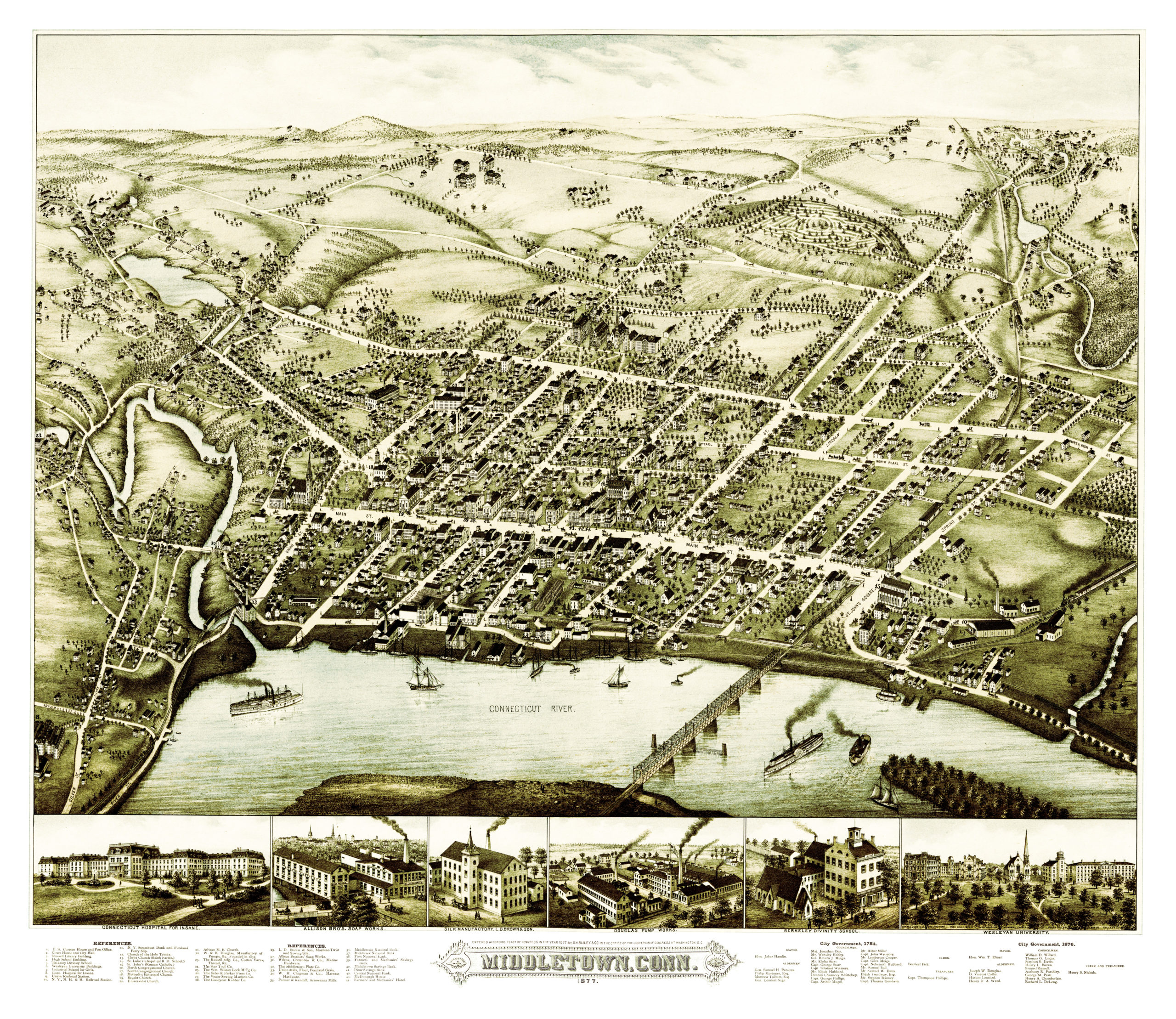
The 1877 bird's-eye view
By O.H. Bailey & Co.
Middletown drawn as if from the sky when about 7,000 people lived here and manufacturing was the mainstay of the city, with Wesleyan University, the Connecticut Hospital for the Insane, Berkeley Divinity School, Union Railroad Station and the Portland Ferry.5
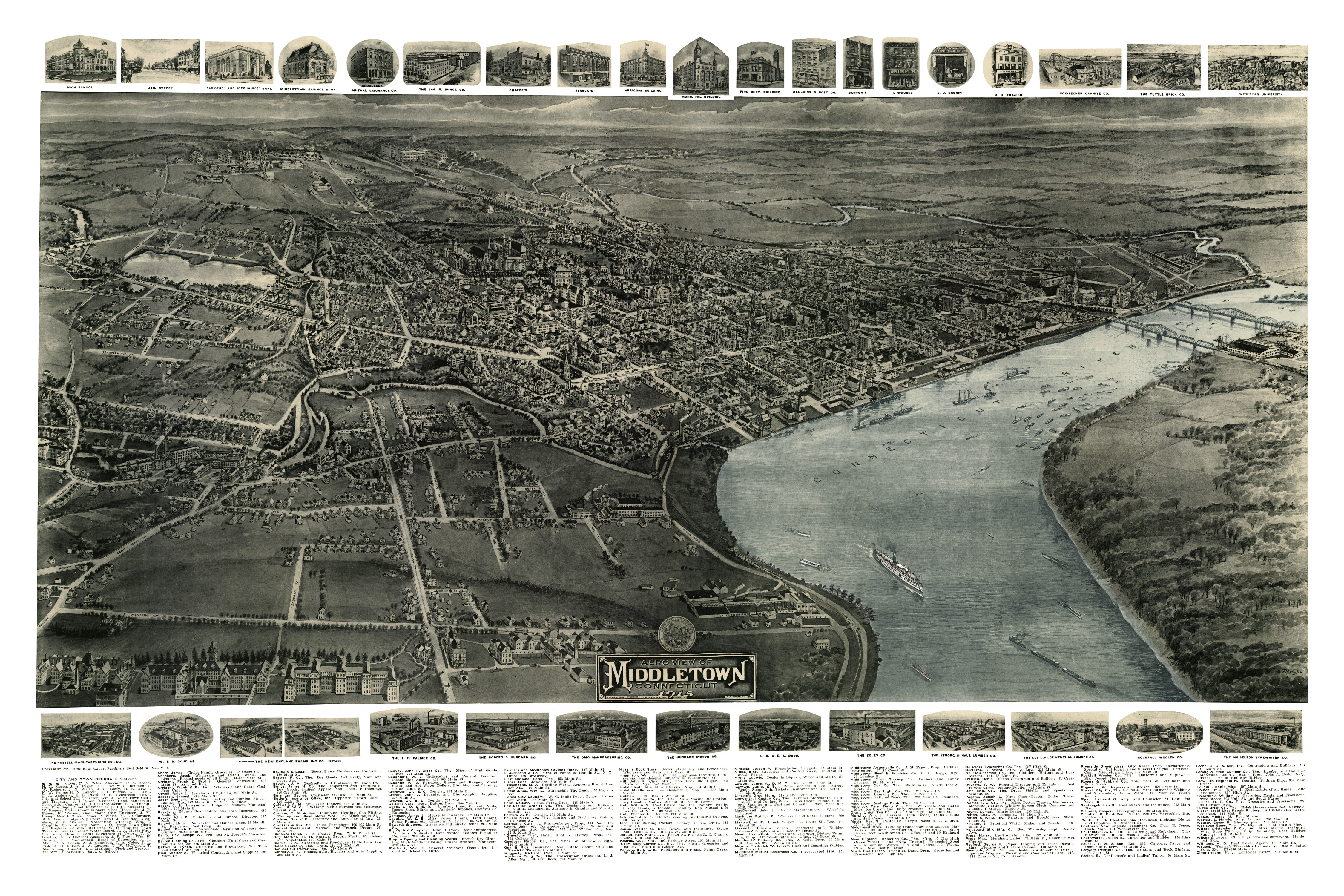
The 1915 bird's-eye view
By T.M. Fowler
Thaddeus Mortimer Fowler's hand-drawn view of the city at the beginning of the 20th century, with Wesleyan University, the Russell Manufacturing Company, the Hubbard Motor Company, the Goodyear Rubber Company, Dalton's Cafe, the Germania Cafe and Hazen's Book Store.6
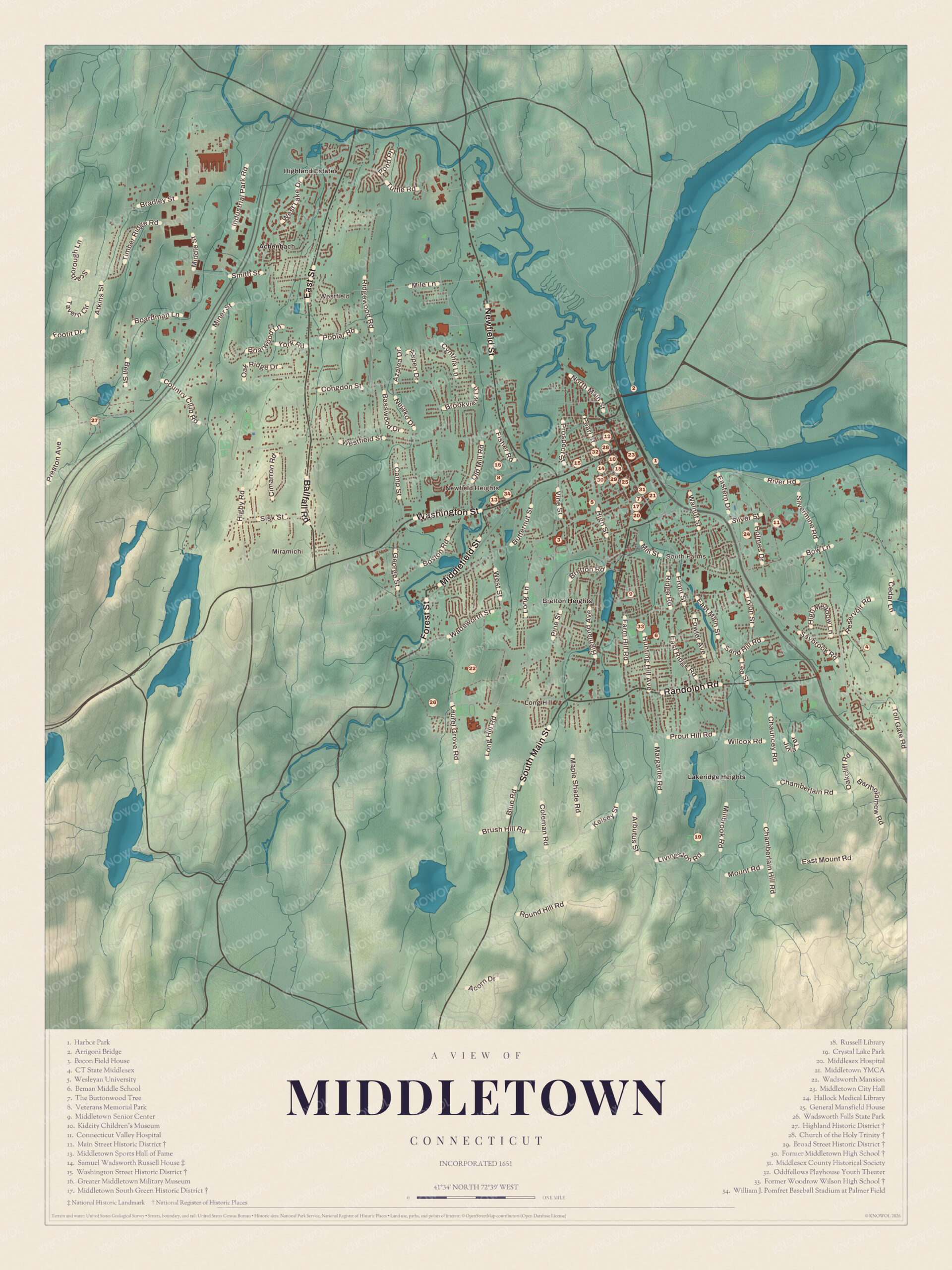
Middletown today
By KNOWOL
Shaded hills from Higby Mountain in the west to the Connecticut River, every street and the city line, with Westfield, South Farms, the Coginchaug River and Wadsworth Falls State Park, and a guide of 34 numbered landmarks with the National Register sites marked.7
The story of Middletown
The lead mine at the Strait Hills
On the north side of the Strait Hills, near where Butler's Creek runs into the Connecticut, there was a vein of lead ore that foreigners had already spent large sums on before the Revolution. In May 1775 the colony put Jabez Hamlin, Matthew Talcott and Titus Hosmer in charge of finding lead for the war. Hosmer wrote that seven tons of ore had been raised, and that if they could only refine it, the mine would supply all the colonies with lead. Smelting works were finished that September, and by November 1776 the committee held 5,140 pounds. But the vein was locked in granite and dove into the earth as it neared the river. In 1778 the Assembly called the work unprofitable and shut it down.3
Under the great elm
When the first settlers came in 1650, they held their Sunday services for about two years in the shade of a great elm near the river. In 1652 they built a rough little log church close beside it. The First Church was gathered in 1668 with Nathaniel Collins as pastor, and when he died in 1684, Cotton Mather called the Middletown church the golden candlestick from which Collins lit more than the whole colony. The old burying ground by the river was laid out in 1650, and in 1832 the elm was still standing in it, 26 feet around near the ground. For the town's 250th anniversary in 1900, a big granite boulder with bronze tablets naming the first settlers was placed on the site of the old stockaded meetinghouse.891011
Liberty, property and no stamps
Middletown lived by the river. Ships were built here as early as the winter of 1669 and 1670, and in 1726 Izrahiah Wetmore won the right to run a ferry across to the east side, at sixpence for a man, a horse and a load. By 1816 more shipping was owned here than in any other town in Connecticut. The port had spirit, too. On November 1, 1765, the day the Stamp Act took effect, the town bell tolled all day with its tongue muffled, and every vessel in the harbor flew its pennant at half mast. That night effigies were shown at every door in town and then burned, and a newspaper reported that small children who could hardly talk went singing through the streets: Liberty, Property and no Stamps.1213214
Through the years
25 moments from 1650 to today.
- 1650The first settlers arrive and hold their services in the shade of a great elm.8
- 1651On September 11 the General Court establishes the town of Mattabesett.1
- 1652The settlers build a rough log church close to the great elm.8
- 1653The town is renamed Middletown, about halfway between Windsor and Saybrook.1
- 1668The First Church is gathered, with Nathaniel Collins as its first pastor.9
- 1670In the winter of 1669 and 1670 a shipwright is allowed to build vessels here.12
- 1712Edward Higby settles Westfield at the foot of the bluff now called Higby Mountain.15
- 1726Izrahiah Wetmore is granted a ferry across the river, sixpence for a man, horse and load.13
- 1765On Stamp Act day the town bell tolls all day with its tongue muffled.14
- 1775The colony takes over the lead mine at the Strait Hills to make lead for the war.3
- 1784The center is incorporated as a city, with Jabez Hamlin as its first mayor.16
- 1789George Washington visits, and Boston Road is renamed Washington Street.17
- 1795The first Baptist church in Middletown is formed in the city with eleven members.18
- 1814Commodore Thomas Macdonough of Middletown wins the battle on Lake Champlain.1
- 1816More shipping is owned at Middletown than at any other town in Connecticut.2
- 1828Ithiel Town's temple-fronted Samuel Wadsworth Russell House is built on High Street.19
- 1831Wesleyan University is founded in the buildings of Partridge's military academy.1
- 1841Middletown opens the first public high school in Connecticut.1
- 1850The Russell Manufacturing Company's three mills employ about 200 people making suspenders and webbing.12
- 1868The Connecticut Hospital for the Insane opens, the state's first public mental hospital.1
- 1877O.H. Bailey & Co. publishes its bird's-eye view of the city.5
- 1884A state review says Middletown's maples and elms have earned it the name the Forest City of New England.20
- 1900For the 250th anniversary a granite boulder marks the site of the first meetinghouse.11
- 1923The city and the town are consolidated into one.1
- 1938The Arrigoni Bridge opens across the Connecticut River to Portland.1
Places to see
The numbers match the landmark guide printed on the 2026 map.
- 2Arrigoni BridgeNorth end, across the river. Twin steel arches to Portland, 1938.
- 5Wesleyan UniversityWest of Main Street. Founded by Methodists in 1831.Visit their website
- 11Connecticut Valley HospitalSouth Farms. The state's first public mental hospital.
- 12Main Street Historic DistrictDowntown. The center of town since settlement.
- 14Samuel Wadsworth Russell HouseHigh Street. Ithiel Town's Greek temple of 1828.
- 17Middletown South Green Historic DistrictUnion Park. Italianate and Second Empire houses.
- 18Russell LibraryBroad Street. Frances Russell's gift in an old church.Visit their website
- 22Wadsworth MansionWadsworth Street. Colonel Wadsworth's Long Hill estate.Visit their website
- 26Wadsworth Falls State ParkCoginchaug River. Big Falls over a basalt shelf.Visit their website
- 27Highland Historic DistrictAtkins Street and Country Club Road. Farmhouses of the early 1700s.
On the National Register
21 of the 36 places in Middletown on the National Register of Historic Places that still stand today, oldest first, and why each one matters. See the full list of National Register places in Middletown.4
-
Highland Historic District
Settled in the early 1700s by the Warner, Wilcox and Bacon families, it keeps the rural look of old Middletown, with four Georgian farmhouses from that century. The Wilcox family's tinware trade here later grew into Meriden's silver industry.21
-
Seth Wetmore House
Judge Seth Wetmore served 48 terms in the General Assembly. His house is Middletown's finest Georgian colonial, with a shell cupboard and overmantel painting in the northeast parlor, and it stayed in the Wetmore family for more than two hundred years.22
-
Washington Street Historic District
Merchants and ship captains built fine houses on what was then Boston Road, renamed for George Washington after his 1789 visit. It's centered on Washington Terrace Park and includes St. Sebastian Church, built by Italian masons to look like a church in Melilli, Sicily.17
-
Captain Benjamin Williams House
A fine late Georgian brick house with brownstone corners, built for a well-to-do sea captain when Middletown traded with the West Indies. Later the deKoven House, it's now a community center run by the Rockfall Foundation.23
-
Main Street Historic District
Main Street has been the center of community life since the earliest days of settlement. Its blocks hold banks, theaters and stores from the Old Banking House Block of 1796 to the 1930s.24
-
Starr Mill
Nathan Starr and his son made swords, pistols and rifles here on government contracts, some 70,000 arms in all, along with presentation swords for heroes like Andrew Jackson. The Russell Manufacturing Company added the second mill in 1865.25
-
Middletown Alms House
The town built it in 1813 and 1814 to house its poor, and it's the oldest surviving building in Connecticut built for that purpose. After 1853 it became a factory for tools, hardware and stoves.26
-
Wilcox, Crittenden Mill
John Watkinson's woolen mill of 1814 stands on Pameacha Creek, where a mill had stood since the 1650s. Wilcox, Crittenden made marine hardware here, and after a fire in 1907 rebuilt within two years without losing a customer or laying off a worker.27
-
Samuel Wadsworth Russell House
National Historic Landmark
Designed by Ithiel Town in the form of a Greek temple with six Corinthian columns, it's counted among the finest Greek Revival mansions in the Northeast. Samuel Russell founded Russell & Company, the leading American firm in the China trade. A National Historic Landmark since 2001.19
-
Broad Street Historic District
As the port declined, the gardens between Wesleyan and Main Street filled with houses, and the housing here tripled between 1830 and 1850. It holds the city's largest group of Greek Revival houses.28
-
Russell Company Upper Mill
The oldest textile mill building left in the city. In 1841 elastic webbing was first woven on power looms here, and by 1896 the Russell company was the nation's largest maker of suspenders.29
-
Alsop House
National Historic Landmark
Richard Alsop IV built it for his mother, and it's a National Historic Landmark for the paintings on its walls: figures in niches in the stair hall and scenes with local birds and insects in the morning room. Wesleyan has owned it since 1948.30
-
Metro South Historic District
The southern stretch of downtown, with colonial and Federal houses, the Greek Revival Baptist and Universalist churches, the 1892 Middlesex Opera House and the General Mansfield House of 1810.31
-
Beman Historic District
A 3.44-acre triangle that was a free, property-owning African American neighborhood in the 1800s, from George Jeffrey's land purchase in 1828 until 1937. Wesleyan owns nearly all of it today, and archaeologists have studied its house lots.32
-
Connecticut General Hospital for the Insane
Opened in 1868 on a hilltop in South Farms, with broad lawns and views over the city. By 1896 it was one of the largest institutions of its kind in the country. Shew Hall, the first building, is still its center.33
-
Church of the Holy Trinity and Rectory
Henry Dudley's brownstone Gothic church with a great rose window, built from 1870 to 1874 for a parish whose worship goes back to 1724. One rector, Edward Campion Acheson, was the father of Secretary of State Dean Acheson.34
-
Middletown South Green Historic District
Ninety acres around Union Park with Italianate and Second Empire houses from the city's growth in the 1860s to 1880s, Queen Anne houses on Crescent Street and two of the city's oldest homes.35
-
Xi Chapter, Psi Upsilon Fraternity
Built from 1891 to 1893 to a design by English architect Colin C. Wilson, it was the first purpose-built residential fraternity house in the United States and a model for those that followed.36
-
Old Middletown High School
The city's second high school, built from 1894 to 1896 in brick, brownstone and terra cotta with a corner turret. It's the city's only Romanesque Revival civic building, and it has been housing for older residents since 1978.37
-
Wadsworth Estate Historic District
Colonel Clarence S. Wadsworth's Long Hill estate, with Francis Hoppin's mansion of 1908 to about 1911 and grounds shaped with John Charles Olmsted. Its reinforced concrete saved the house from a fire in 1990, and the city bought it in 1994.38
-
U.S. Post Office
A Renaissance Revival post office of smooth limestone, a source of civic pride when it opened on a site the government had owned since 1841. Federal use of the corner ended in 1977.39
In their words
“The traveler can see but little of the city from any of its approaches by land or water, so completely is it embosomed in the foliage of the maple and the elm, which has given to it the well-merited name of "The Forest City" of New England.”
The historical, statistical and industrial review of the state of Connecticut, 188420
“The church of Middletown, upon the Connecticut River, was the golden candlestick from whence this excellent person illuminated more than the whole colony.”
Cotton Mather on Rev. Nathaniel Collins, quoted in the History of Middlesex County, 18849
“Our young children, that can hardly speak, have already learnt this lesson well, Liberty, Property and no Stamps, which they sing along the streets.”
A Middletown newspaper report of November 2, 1765, in Barber's Connecticut Historical Collections, 183614
Nearby towns
Sources
- Middletown, Connecticut, Wikipedia
- Connecticut historical collections, John Warner Barber (1836), on Middletown's shipping and manufactures, Internet Archive
- History of Middlesex County, Connecticut (1884), on the lead mine, Internet Archive
- National Register of Historic Places listings in Middletown, Connecticut, Wikipedia
- Bird's eye view of Middletown, Connecticut in 1877, restored by KNOWOL
- Vintage map shows Middletown, Connecticut in 1915, restored by KNOWOL
- Map of Middletown, Connecticut in 2026, KNOWOL (USGS elevation, Census Bureau roads)
- Historic towns of the Connecticut River valley (1906), on Middletown's churches, Internet Archive
- History of Middlesex County, Connecticut (1884), on the First Church and Nathaniel Collins, Internet Archive
- Connecticut historical collections, John Warner Barber (1836), on the ancient burying ground and its elm, Internet Archive
- Genealogical and family history of the state of Connecticut (1911), on the 250th anniversary memorial, Internet Archive
- History of Middlesex County, Connecticut (1884), on shipbuilding and the industries of 1850, Internet Archive
- History of Middlesex County, Connecticut (1884), on the Middletown ferry, Internet Archive
- Connecticut historical collections, John Warner Barber (1836), on the Stamp Act day of 1765, Internet Archive
- Connecticut historical collections, John Warner Barber (1836), on the settling of Westfield, Internet Archive
- The Connecticut quarterly (1895), on the Hamlin family and the first mayor, Internet Archive
- Washington Street Historic District (Middletown, Connecticut), Wikipedia
- A statistical account of the county of Middlesex, in Connecticut (1819), on the Baptist churches, Internet Archive
- Samuel Wadsworth Russell House, Wikipedia
- The historical, statistical and industrial review of the state of Connecticut (1884), on Middletown, the Forest City, Internet Archive
- Highland Historic District (Middletown, Connecticut), Wikipedia
- Seth Wetmore House, Wikipedia
- Captain Benjamin Williams House, Wikipedia
- Main Street Historic District (Middletown, Connecticut), Wikipedia
- Starr Mill, Wikipedia
- Middletown Alms House, Wikipedia
- Wilcox, Crittenden Mill, Wikipedia
- Broad Street Historic District (Middletown, Connecticut), Wikipedia
- Russell Company Upper Mill, Wikipedia
- Richard Alsop IV House, Wikipedia
- Metro South Historic District, Wikipedia
- Connecticut State Historic Preservation Review Board, minutes of September 12, 2025, on the Beman Historic District
- Connecticut Valley Hospital, Wikipedia
- Church of the Holy Trinity and Rectory (Middletown, Connecticut), Wikipedia
- Middletown South Green Historic District, Wikipedia
- Xi Chapter, Psi Upsilon Fraternity, Wikipedia
- Old Middletown High School, Wikipedia
- Wadsworth Mansion at Long Hill, Wikipedia
- Old Middletown Post Office, Wikipedia