
A town of hills and streams on the west bank of the Thames, home of the Mohegan people since before the colonists came, where Uncas kept his village at Shantok and the Oxoboxo once turned the wheels of woolen mills and quilt factories.
Montville on the map
Click the map to look closer.
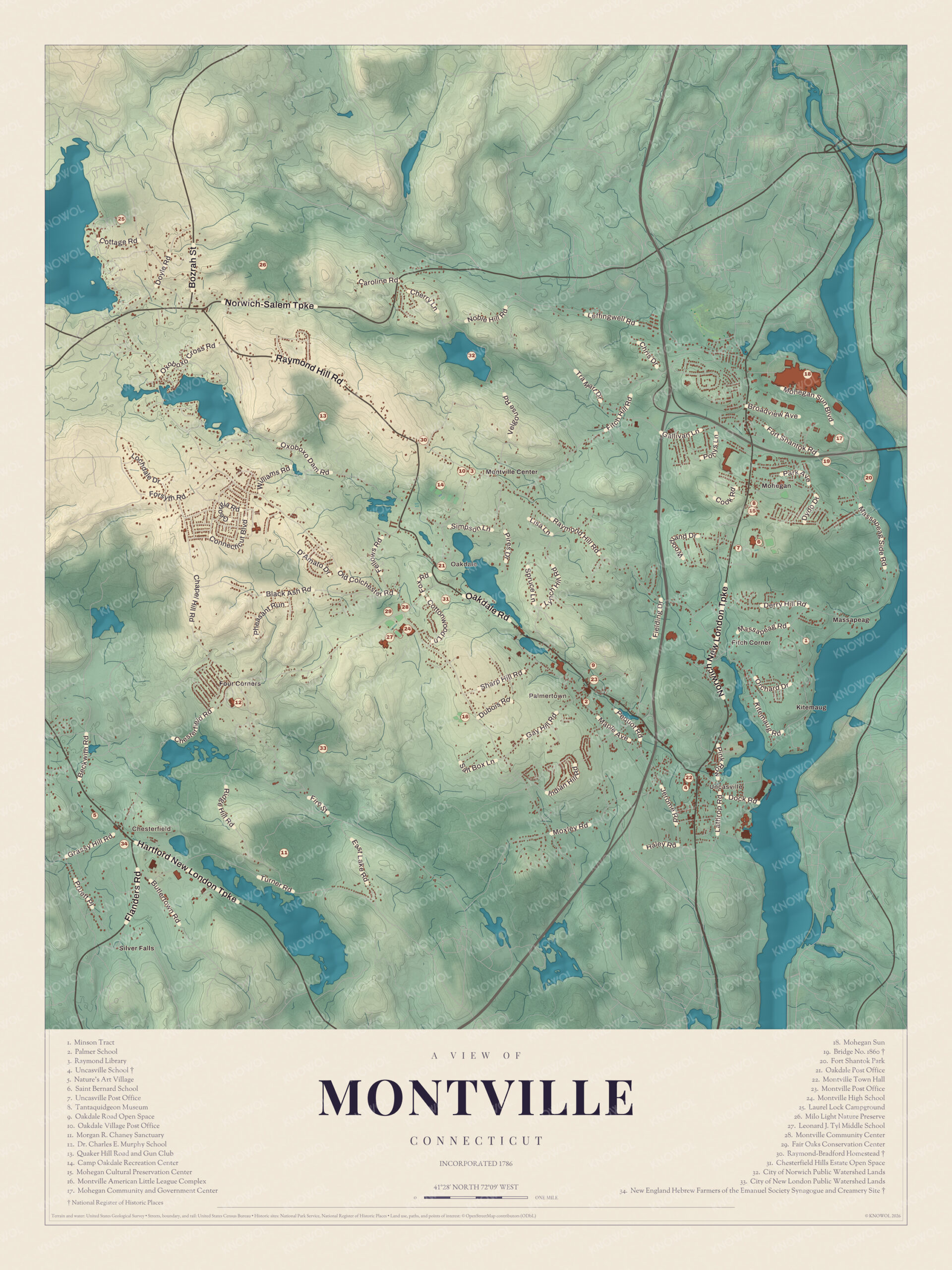
Montville today
By KNOWOL
Shaded hills from Chesterfield in the west down to the Thames, every street, Uncasville, Oakdale, Mohegan and the Oxoboxo River, and a guide of 34 numbered landmarks with the National Register sites marked.6
The story of Montville
Mills on the Oxoboxo
The Oxoboxo was once called Saw-Mill Brook, and for good reason. A saw-mill near its mouth was built by the direction of John Winthrop about 1653, and about a century later an iron-works called The Forge stood a few rods below it. In 1798 John and Arthur Scholfield, woolen makers who had first set up at Byfield, Massachusetts, leased the spot and started the first woolen machinery run by water power in Connecticut. About 1825 the preacher Lorenzo Dow gave the pond at the head of the stream the name Oxoboxo. When Montville became a town in 1786 it had just twelve small mills. By 1882 it had twenty, and Palmer Brothers in Palmertown were turning out 2,500 bed quilts a day.7894
Uncas, Occom and the Mohegan Church
Montville's story begins with the Mohegan people. From 1636 to 1682 their main village stood at Fort Shantok above the Thames, the first place they settled with the sachem Uncas. Samson Occom, a Mohegan, was born here in 1723 and became a minister. In 1766 and 1767 he preached nearly four hundred sermons in England and Scotland, raising money for the school that grew into Dartmouth College. In 1831 the Mohegan Church was built on a hill with a view of both Norwich and New London, on land given by two Mohegan women, Cynthia Hoscott and Lucy Teecomwas. A century later Gladys Tantaquidgeon and her family opened their museum nearby. The tribe was federally recognized in 1994, and Fort Shantok came back to Mohegan control in 1995.101112136
Halfway between New London and Norwich
For a long time Montville was simply the North Parish of New London, the country halfway up the river road to Norwich. Haughton's Tavern, thought to date from about 1746, was known as the halfway station, and people from both cities met in between, at Massapeag or elsewhere in Mohegan, to roast oysters, hunt squirrels, gather strawberries and wild plums, or sit down to a winter supper at Bradford's or Haughton's. On October 12, 1786, the General Assembly made the parish a town, and the first town meeting met in the North Parish meetinghouse that November. The selectmen were voted no pay for their time or expense. The first post office opened at Uncasville about 1822. Mohegan Sun opened on October 12, 1996, 210 years to the day after the town was born.141526
Through the years
25 moments from 1636 to today.
- 1636The main Mohegan village is set up at Fort Shantok above the Thames, where it stands until 1682.10
- 1646New London's first bounds make the Oxoboxo River its northern line, with Mohegan land to the north.1
- 1653About this year a saw-mill is built near the mouth of the Oxoboxo by the direction of John Winthrop.7
- 1658Uncas makes the first land grants here, to Richard Houghton and James Rogers.1
- 1703The land between the Oxoboxo and Norwich is added to New London.1
- 1710About this year the oldest part of the Raymond-Bradford Homestead is built.16
- 1723Samson Occom, Mohegan minister, is born in what is now Montville.11
- 1746About this year Haughton's Tavern goes up, later known as the halfway house between New London and Norwich.14
- 1758An iron-works called The Forge is probably started on the Oxoboxo by Jeremiah Vallet.7
- 1766Samson Occom sails for Britain, where he preaches nearly four hundred sermons by July 1767.11
- 1786The North Parish becomes the town of Montville on October 12, and holds its first town meeting on November 13.2
- 1787Elder Reuben Palmer's Baptist church begins with twelve people.17
- 1798John and Arthur Scholfield set up the first water-powered woolen machinery in Connecticut near the mouth of the Oxoboxo.7
- 1822About this year Montville's first post office opens at Uncasville.14
- 1825About this year the preacher Lorenzo Dow names the pond at the head of Saw-Mill Brook Oxoboxo.7
- 1831The Mohegan Church is built on land given by two Mohegan women.13
- 1840Gideon Palmer builds Palmer's Wharf on the Thames.18
- 1866James Bingham builds the stone Oakdale Mill to make manila paper.4
- 1882Palmer Brothers are turning out 2,500 bed quilts a day in Palmertown.4
- 1892Jewish farmers in Chesterfield build a synagogue and a cooperative creamery.19
- 1917Work begins on the Uncasville School, paid for by Grace Palmer Melcer.20
- 1931Gladys Tantaquidgeon and her family found the Tantaquidgeon Museum on Mohegan Hill.6
- 1936The fieldstone Bridge No. 1860 is built over Shantok Brook as a WPA project.21
- 1994The Mohegan Tribe is federally recognized.6
- 1996Mohegan Sun opens on October 12, 210 years to the day after Montville became a town.6
Places to see
The numbers match the landmark guide printed on the 2026 map.
- 3Raymond LibraryOakdale. The town's public library.
- 4Uncasville SchoolNorwich New London Turnpike. School of 1917, now Town Hall.
- 8Tantaquidgeon MuseumMohegan Hill. Native-founded museum of 1931.Visit their website
- 15Mohegan Cultural Preservation CenterMohegan. The tribe's cultural center.
- 17Mohegan Community and Government CenterMohegan. Seat of the Mohegan Tribe.
- 18Mohegan SunOn the Thames. Tribe's resort, opened in 1996.
- 19Bridge No. 1860Fort Shantok. Fieldstone arch over Shantok Brook, 1936.
- 20Fort Shantok ParkWest bank of the Thames. Main Mohegan village from 1636 to 1682.
- 30Raymond-Bradford HomesteadRaymond Hill Road. Farmhouse begun about 1710.
- 34Hebrew Farmers Synagogue and Creamery SiteChesterfield. Jewish farm settlement of the 1890s.
On the National Register
All 6 places in Montville on the National Register of Historic Places that still stand today, oldest first, and why each one matters.5
-
Fort Shantok Archaeological District
National Historic Landmark
The site of the main Mohegan village from 1636 to 1682 and the first place the Mohegan settled with the sachem Uncas. It holds more than a hundred known graves, was returned to Mohegan control in 1995, and was named a National Historic Landmark in 1993.10
-
Raymond-Bradford Homestead
Built on land bought by Mercy Sands Raymond, a widow from Block Island who ran a 1,500-acre farm with her son until her death in 1741. Reworked in the Federal style about 1820 and again in the 1870s, it was still owned by Raymond descendants when it was listed.16
-
Uncasville Mill Historic District
The old Uncasville Manufacturing Company mill on the Oxoboxo, ten connected brick buildings mostly from the 1880s to the 1920s, with mill houses on Crescent Street and Blumenthal Drive. Sidney Blumenthal and Company made plush and pile fabrics here from 1911 until the early 1960s.22
-
New England Hebrew Farmers of the Emanuel Society Synagogue and Creamery Site
Jewish families who had first settled in Brooklyn bought farms here in the 1890s with help from Baron de Hirsch, and in 1892 built a small synagogue and a cooperative creamery. It was one of the first rural Jewish settlements in the state; a stone plaque and the creamery's foundations mark the site today.19
-
Uncasville School
A Renaissance Revival school designed by Wilson Potter and paid for by Grace Palmer Melcer, whose family owned local mills. It was a center of village life, with evening classes for immigrants, and now holds the town offices.20
-
Bridge No. 1860
A fieldstone arch built as a Works Progress Administration project, a good example of the rustic park architecture of the 1930s. It's often called the Samson Occom Bridge.21
In their words
“It is beautifully situated on an eminence commanding a fair view of Norwich at the north, and New London at the south.”
Connecticut Historical Collections, 1836, on the Mohegan Church12
“A name descriptive of its elevated and retired situation.”
History of New London, Connecticut, 1895, on the name Montville23
“Meet half-way, at Massapeag, or Indian hill, or Cochegun rock, or some other part of Mohegan, to roast oysters, hunt squirrels”
History of Norwich, 1866, on how Norwich and New London people met in Montville15
Nearby towns
Sources
- Montville, Connecticut, Wikipedia
- History of New London County, Connecticut (1882), on the incorporation of Montville, Internet Archive
- History of New London County, Connecticut (1882), on the town of Montville, Internet Archive
- History of New London County, Connecticut (1882), on Palmer Brothers and the Oakdale Mill, Internet Archive
- National Register of Historic Places listings in New London County, Connecticut, Wikipedia
- Map of Montville, Connecticut in 2026, KNOWOL (USGS elevation, Census Bureau roads)
- History of New London County, Connecticut (1882), on the Oxoboxo and its first mills, Internet Archive
- History of Montville, Connecticut (1896), on the Scholfield brothers, Internet Archive
- History of New London County, Connecticut (1882), on the mills of 1786 and 1882, Internet Archive
- Fort Shantok, Wikipedia
- The historical, statistical and industrial review of the state of Connecticut (1884), on Samson Occom, Internet Archive
- Connecticut Historical Collections, John Warner Barber (1836), on the Mohegan Church, Internet Archive
- History of the Indians of Connecticut (1852), on the Mohegan chapel, Internet Archive
- History of Montville, Connecticut (1896), on the first post office and Haughton's Tavern, Internet Archive
- History of Norwich, Connecticut (1866), on meeting halfway at Mohegan, Internet Archive
- Raymond-Bradford Homestead, Wikipedia
- History of New London, Connecticut (1895), on Elder Reuben Palmer's church, Internet Archive
- History of New London County, Connecticut (1882), on Gideon Palmer, Internet Archive
- New England Hebrew Farmers of the Emanuel Society Synagogue and Creamery Site, Wikipedia
- Uncasville School, Wikipedia
- Samson Occom Bridge (Bridge No. 1860), Wikipedia
- Uncasville Mfg. Co., Historic Mills of Connecticut, Preservation Connecticut
- History of New London, Connecticut (1895), on the founding of Montville, Internet Archive