
A Litchfield County hill town on the Farmington River, where Pine Meadow's plane makers and the Greenwoods cotton duck mills ran on water power and the river runs through the gorge called Satan's Kingdom.
Then and now
The same town 148 years apart. Click either map to look closer.
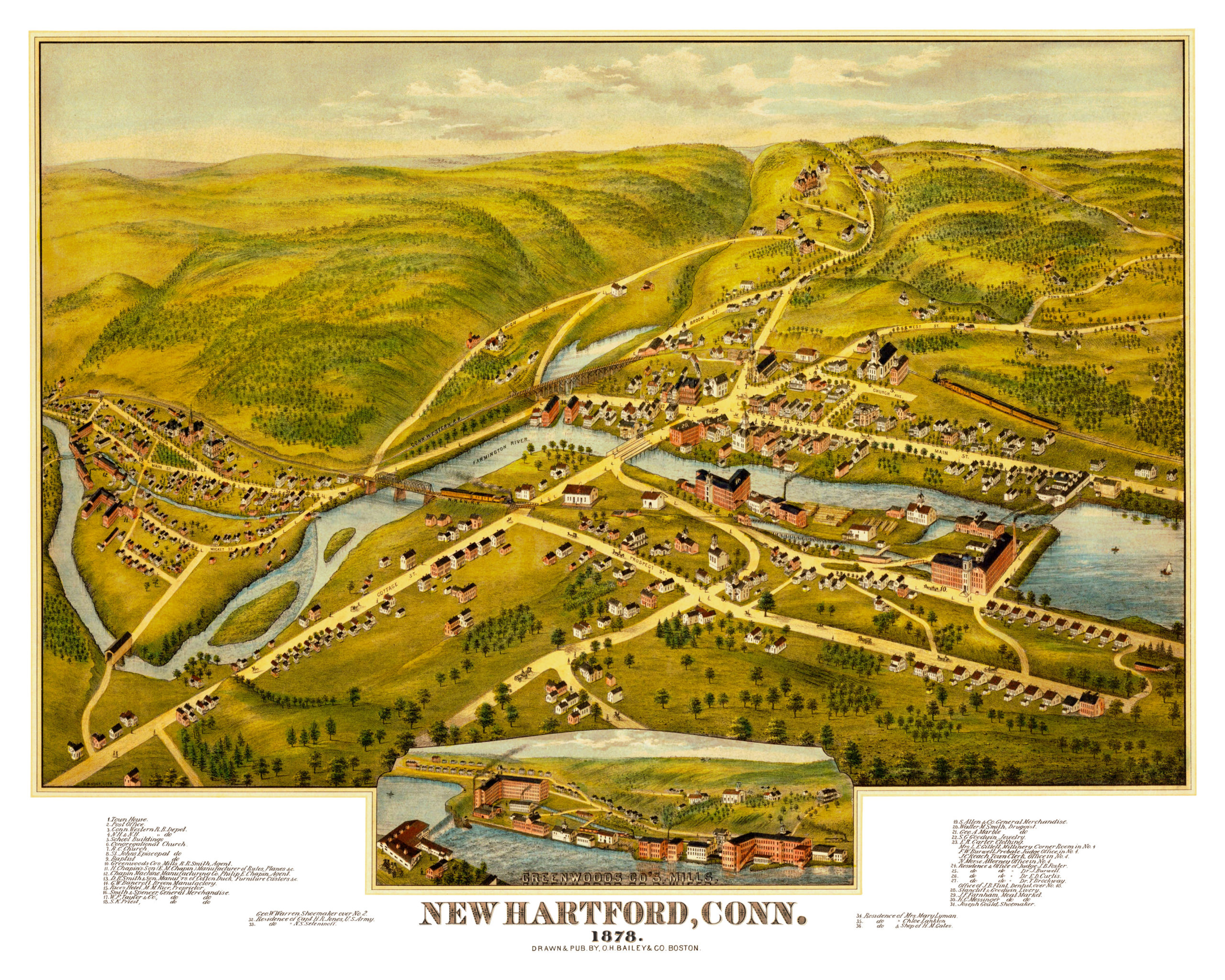
The bird's-eye view
By O.H. Bailey
New Hartford drawn as if from the sky toward the end of the 1800s, with Rice's Hotel, the Smith and Spencer General Store, J.F. Farnham's Meat Market, Gould's Shoe Store and the Chapin Machine Manufacturing Company.6
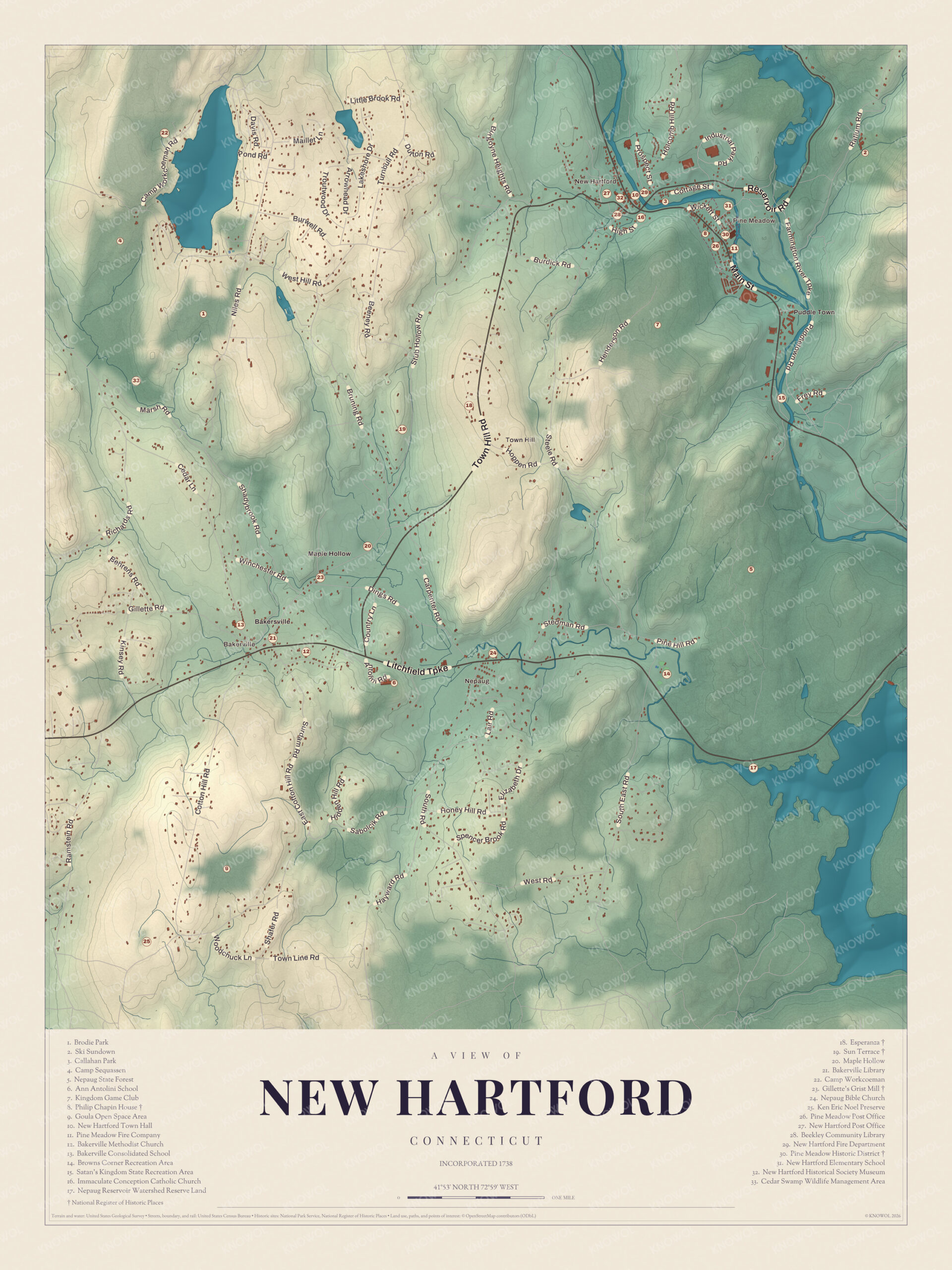
New Hartford today
By KNOWOL
Shaded hills from Cedar Swamp and West Hill Lake in the west to the Farmington River valley in the east, every street, the villages of Pine Meadow, Bakerville, Nepaug and Maple Hollow, and a guide of 33 numbered landmarks with the National Register sites marked.2
The story of New Hartford
Planes, cotton duck and yacht sails
New Hartford's rivers built its fortunes. Hermon Chapin, a plane maker, bought land in Hartford for a shop, but people there objected to more factories, so in 1826 he built at Pine Meadow instead. His family made planes, rules and levels there for generations, and he built the village's first Episcopal church. Up the river, the Greenwoods Company organized in 1845. By 1895 it was the biggest business in town, with 700 workers and 20,000 spindles making cotton duck and canvas up to 220 inches wide. During the Civil War a Smith family cotton works kept running constantly on tent cloth for the army, and one old book says the Greenwoods looms wove the sails for a famous American racing yacht.784910
From Town Hill down to the river
New Hartford's first church stood up on Town Hill, and about 1795 the celebrated preacher Dr. Griffin had just begun his ministry there. As the mills grew, the town's life moved down to the water. Capt. Michael Kellogg saw the value of the water power at the North End and built the first mill there, ignoring advice and criticism from men who were less far-sighted. Families in the south part of town found the trip to Town Hill too long, and in 1848 they formed their own South Church. By 1904 the old church on Town Hill stood abandoned, and summer homes of well-off families had risen around it, three miles from the tenements of the mill village.11121314
Bridges on the road to Albany
The Farmington gave New Hartford its mills, and it also gave the town a lot of bridges to pay for. In 1763 the town told the colony that the river on its northeast road was twelve rods wide, swift, with a very rocky bottom, and it won the right to tax its lands for a bridge. It built a large one in 1764 and said it had seven other costly bridges to keep up besides. When the big bridge wore out, and again after a sudden flood carried one away on the great road to Albany, the town asked the state for lotteries to rebuild. Turnpikes came in the 1790s, and the first toll gate on the Farmington River Turnpike stood east of Pine Meadow.1516171819
Through the years
23 moments from 1686 to today.
- 1686The land becomes part of the Western Grant to the proprietors of Hartford and Windsor.2
- 1733English settlement of New Hartford begins.2
- 1738New Hartford is incorporated as a town.2
- 1751The first dam on the river at New Hartford is built at the north end of the Satan's Kingdom gorge.3
- 1763The colony lets the town tax its lands to bridge a swift, rocky river twelve rods wide.15
- 1763Torringford parish is formed, taking in New Hartford's western tier of lots and half its name.20
- 1764The town builds a large bridge on the great road through its northeast corner.16
- 1775New Hartford sends fifty-five soldiers to the Revolution.21
- 1798The Greenwoods Turnpike Company is incorporated, starting its road at New Hartford.18
- 1795About this year the celebrated preacher Dr. Griffin begins his ministry in New Hartford.12
- 1806Roger Sheldon dams the river at Pine Meadow and digs a power canal across the bend.22
- 1814A moral society posts notices in the taverns warning Sunday travelers they can be prosecuted.23
- 1826Hermon Chapin builds his plane factory at Pine Meadow.7
- 1845The Greenwoods Company organizes to make cotton duck.4
- 1847Manchester's puddling works turn Salisbury iron ore into wrought iron just above the gorge.3
- 1848Families in the south part of town form the South Church, tired of the long trip to Town Hill.11
- 1865The Greenwoods Company takes down Barkhamsted's old meetinghouse and reuses part of it at its dam.24
- 1867The Philip Chapin House goes up facing the Pine Meadow green.25
- 1878O.H. Bailey publishes his bird's-eye view of New Hartford.6
- 1879The New Hartford Tribune is founded.26
- 1893Architect Melvin H. Hapgood gives Esperanza most of its Colonial Revival look.27
- 1932Sun Terrace, William Lescaze's International Style country house, is finished.28
- 1963Satan's Ridge Ski Area opens with a single T-bar. It's Ski Sundown today.29
Places to see
The numbers match the landmark guide printed on the 2026 map.
- 1Brodie ParkWest Hill Lake. Town beach and summer events.
- 2Ski SundownEast of the center. Opened in 1963 as Satan's Ridge.
- 8Philip Chapin HousePine Meadow. Italianate house of 1867 with belvedere.
- 10New Hartford Town HallNew Hartford Center. The seat of town government.
- 15Satan's Kingdom State Recreation AreaRoute 44 bridge. Put-in for tubing the Farmington.
- 18EsperanzaTown Hill Road. A novelist's Colonial Revival country estate.
- 19Sun TerraceStub Hollow Road. America's first International Style country house.
- 23Gillette's Grist MillMaple Hollow. Grist mill with its water wheel.
- 30Pine Meadow Historic DistrictPine Meadow. Mill village at the river bend.
- 32New Hartford Historical Society MuseumNew Hartford Center. The town's history collections.Visit their website
On the National Register
All 5 places in New Hartford on the National Register of Historic Places that still stand today, oldest first, and why each one matters.5
-
Pine Meadow Historic District
A well-preserved rural mill village that grew up after Roger Sheldon dammed the West Branch of the Farmington in 1806. A brass foundry, a textile mill and the Chapin woodworking factory ran on its canal, and the workers' houses and owners' homes still stand around a triangular green.22
-
Esperanza
A Greek Revival farmhouse that the novelist Julie Palmer Smith and her husband Morris enlarged with her book earnings, then remodeled in Colonial Revival style by Melvin H. Hapgood in 1893. The Smiths hosted Nathaniel Hawthorne, William Gillette and George Inness here.27
-
Gillette's Grist Mill
The only industrial building left in what was once a busier mill settlement on the Nepaug River. It's an extremely rare grist mill that still has its water wheel and iron gears from about 1870.30
-
Philip Chapin House
Built for Philip Chapin, owner of the tool factory his father Hermon started, it's one of New Hartford's finest Italianate houses, with a big belvedere and an elaborate porch facing Chapin Park.25
-
Sun Terrace
Frederick Vanderbilt Field commissioned it from the Swiss architect William Lescaze in 1929. It's the first documented International Style country house in the United States, with a flat roof, cantilevered decks and a rooftop terrace.28
In their words
“Realizing the value of the water power at the North End, he built the first mill there, disregarding both advice and criticism from less acute and far-sighted business men.”
Commemorative biographical record of Hartford County, 1901, on Capt. Michael Kellogg13
“The Grenadiers, of New Hartford, with white drooping plume, which waved in the breeze”
Barkhamsted, Conn., and its centennial, 1881, remembering the old militia companies31
“Under the shadow of the abandoned old church on Town Hill in the town of New Hartford have risen the tasty summer homes of wealth and culture”
The Connecticut magazine, 190414
Nearby towns
Sources
- New Hartford, Connecticut, Wikipedia
- Map of New Hartford, Connecticut in 2026, KNOWOL (USGS elevation, Census Bureau roads)
- The Connecticut quarterly (1895), on the Farmington River at New Hartford, Internet Archive
- The Connecticut quarterly (1895), on the mills of Pine Meadow and the Greenwoods Company, Internet Archive
- National Register of Historic Places listings in Litchfield County, Connecticut, Wikipedia
- Bird's-eye view of New Hartford, Connecticut from 1878, restored by KNOWOL
- Genealogical and family history of the state of Connecticut (1911), on Hermon Chapin, Internet Archive
- Genealogical and family history of the state of Connecticut (1911), on Edward Merrill Chapin, Internet Archive
- Evening post annual (1888), on a New Hartford cotton manufacturer, Internet Archive
- Encyclopedia of Connecticut biography (1917), on the Greenwoods sail cloth, Internet Archive
- Contributions to the ecclesiastical history of Connecticut (1861), on the South Church in New Hartford, Internet Archive
- History of ancient Woodbury, Connecticut (1854), on Dr. Griffin at New Hartford, Internet Archive
- Commemorative biographical record of Hartford County, Connecticut (1901), on Capt. Michael Kellogg, Internet Archive
- The Connecticut magazine (1904), on the old turnpike towns, Internet Archive
- The public records of the colony of Connecticut (1850), on the bridge tax of 1763, Internet Archive
- The public records of the state of Connecticut (1894), on the bridge of 1764, Internet Archive
- The public records of the state of Connecticut (1894), on the bridge carried away by a flood, Internet Archive
- The public records of the state of Connecticut (1894), on the Greenwoods Turnpike, Internet Archive
- Barkhamsted, Conn., and its centennial, 1879 (1881), on the turnpikes, Internet Archive
- History of Torrington, Connecticut (1878), on Torringford, Internet Archive
- History of Torrington, Connecticut (1878), on the soldiers of 1775, Internet Archive
- Pine Meadow Historic District, Wikipedia
- Connecticut Evangelical Magazine and Religious Intelligencer (1814), Internet Archive
- Barkhamsted, Conn., and its centennial, 1879 (1881), on the old meetinghouse, Internet Archive
- Philip Chapin House, Wikipedia
- Genealogical and family history of the state of Connecticut (1911), on Roger Jones and the New Hartford Tribune, Internet Archive
- Esperanza (New Hartford, Connecticut), Wikipedia
- Sun Terrace, Wikipedia
- Ski Sundown, Wikipedia
- Gillette's Grist Mill, Wikipedia
- Barkhamsted, Conn., and its centennial, 1879 (1881), on the militia companies, Internet Archive