
The harbor town the Puritans laid out in nine squares in 1638, where Yale grew up beside the Green, James Hillhouse's elms gave the Elm City its name, and oystermen, carriage makers and gunsmiths made a working port.
New Haven on the map
Click the map to look closer.
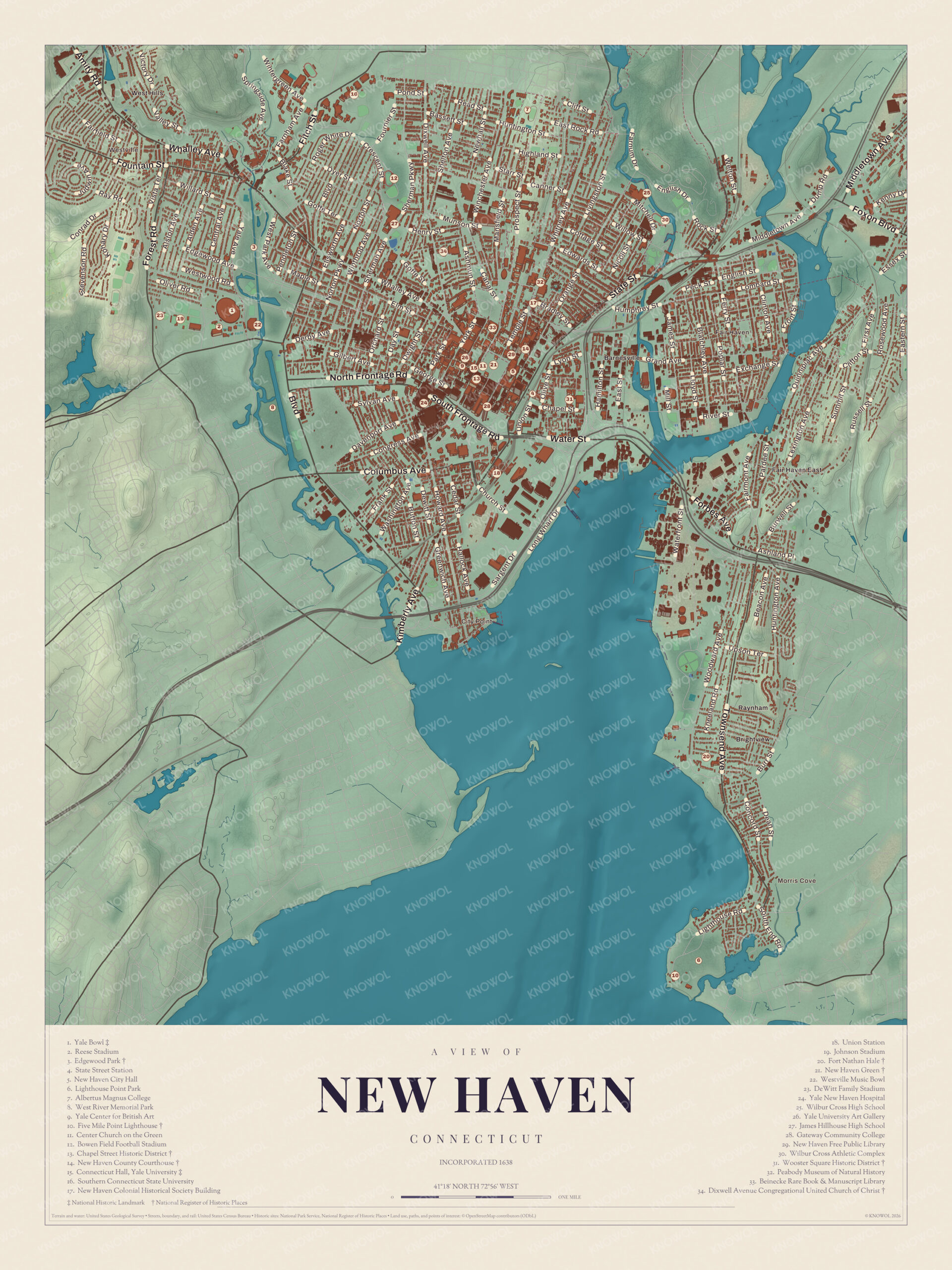
New Haven today
By KNOWOL
Shaded hills from West Hills and Westville down to the harbor and out to the East Shore, every street from Chapel to Whalley, Fair Haven, Morris Cove and City Point by name, and a guide of 34 numbered landmarks with the National Historic Landmarks and National Register sites marked.4
The story of New Haven
The man who planted the Elm City
New Haven got its nickname from one man's shovel. Between 1787 and 1796 James Hillhouse brought young elms from his farm out toward Meriden and planted them in rows along the town's streets and around the Green. A 1911 history says he set out many with his own hands, helped by a boy who held the trees or drove the stakes while Hillhouse shoveled in the dirt. That boy was Jeremiah Day, who grew up to be president of Yale. In 1792 Hillhouse also laid out Hillhouse Avenue, 105 feet wide, through the family farm, and its arching elms became famous. Most of those trees are long gone, but the name stuck.561
The judges on West Rock
In 1661 two of the judges who had signed King Charles I's death warrant, Edward Whalley and William Goffe, fled to New Haven. John Davenport helped hide them, and on May 15 they first lodged in a cluster of huge stone pillars near the top of West Rock, a spot where they could watch the harbor. Richard Sperry, who farmed on the far side of the ridge, sent food up with his boys, tied in a cloth and left on a certain stump. One night a panther put its head into the opening and glared at them, and one judge ran all the way down to Sperry's house. They left the cave soon after. Someone later carved on the rock: Opposition to Tyrants is Obedience to God.781
Oysters and the Long Wharf
New Haven has always lived off its harbor. In 1772 the Assembly let the owners of Long Wharf run a lottery to pay for it, and in 1779 British raiders burned the shipping tied up there. When the steamboat United States began regular runs to New York in 1824, the crew fired a cannon from the bow coming into port so the stagecoaches for Hartford and Boston would be ready, and the ticket system later used on steamboats everywhere was first tried on board. Out in Fair Haven, oystermen sailed as far as the Chesapeake by about 1823. In 1834 the schooner Mary and Martha laid down 1,600 bushels in Morris Cove, and Fair Haven became a great oyster shipping center.910111213
Through the years
23 moments from 1638 to today.
- 1638About five hundred Puritans led by John Davenport and Theophilus Eaton sail into the harbor and lay out a town of nine squares.4
- 1640The plantation of Quinnipiac is renamed New Haven, haven meaning harbor.1
- 1641New Haven sends families to start a colony on Delaware Bay. The Dutch and Swedes drive them out within months.14
- 1648The town sets aside land on what is now Elm Street for the college John Davenport hoped to found.15
- 1661Two of the judges who condemned Charles I first lodge in the rocks on West Rock now called the Judges' Cave.7
- 1664The New Haven Colony is merged into Connecticut.1
- 1716The Collegiate School moves here from Old Saybrook. Two years later it's renamed Yale College.1
- 1752Connecticut Hall is finished on the college yard. It still stands.4
- 1772The Assembly lets the owners of Long Wharf hold a lottery to pay for the wharf.9
- 1779General Tryon's raiders take the town and burn the shipping and buildings at Long Wharf.10
- 1784New Haven becomes a city, with Roger Sherman as its first mayor.1
- 1792James Hillhouse lays out Hillhouse Avenue, 105 feet wide, through his family farm.5
- 1796Grove Street Cemetery is organized to replace the crowded burying ground on the Green.4
- 1798Tomlinson's Bridge, a wooden toll bridge to East Haven, is finished.16
- 1824The steamboat United States begins regular trips between New Haven and New York.11
- 1827With a visiting priest in town over a Sunday, New Haven's Catholics gather for worship at No. 5 Long Wharf.17
- 1834The schooner Mary and Martha brings 1,600 bushels of oysters to plant in Morris Cove.13
- 1839The Africans of the Amistad are tried in New Haven's federal court.1
- 1845Carriage making is the city's leading industry, with 24 shops and 460 workers.2
- 1861Henry Austin's City Hall is finished on Church Street, facing the Green.18
- 1878New Haven opens the first commercial telephone exchange in the country, with six subscribers.19
- 1914The Yale Bowl opens, the first bowl-shaped stadium in the country.4
- 1973The city and its neighbors plant 72 cherry trees in Wooster Square.4
Places to see
The numbers match the landmark guide printed on the 2026 map.
- 1Yale BowlNear the West Haven line. The first bowl stadium, 1914.
- 5New Haven City HallChurch Street. Henry Austin's High Victorian Gothic, 1861.
- 10Five Mile Point LighthouseLighthouse Point Park. Brownstone tower of 1847.
- 11Center Church on the GreenThe Green. Ithiel Town's church of 1812.Visit their website
- 15Connecticut HallYale's Old Campus. Yale's oldest building, finished 1752.
- 20Fort Nathan HaleEast Shore. Forts from 1659 to the Civil War.
- 21New Haven GreenDowntown. Center square of the 1638 plan.
- 31Wooster Square Historic DistrictEast of downtown. Little Italy and the cherry trees.
- 32Peabody Museum of Natural HistoryWhitney Avenue. The Great Hall of Dinosaurs.Visit their website
- 34Dixwell Avenue Congregational United Church of ChristDixwell. Congregation founded in 1820.Visit their website
On the National Register
21 of the 71 places in New Haven on the National Register of Historic Places that still stand today, oldest first, and why each one matters. See the full list of National Register places in New Haven.3
-
New Haven Green Historic District
National Historic Landmark
The 16-acre center square of the colonists' nine-square plan, laid out by John Brockett and first called the marketplace. Its three early churches, Center, United and Trinity, made it a National Historic Landmark district.20
-
Fort Nathan Hale
A 20-acre park on the east shore holding the sites of a fort of about 1657, the Black Rock Fort taken by the British in 1779, the fort rebuilt for the War of 1812 and a Civil War fort with deep earthen bunkers.21
-
Morris House
The Pardee-Morris House, one of New Haven's oldest buildings, probably begun in the late 1600s by the family of Thomas Morris. The British partly burned it in 1779, and it's now a museum of the New Haven Museum.22
-
Connecticut Hall, Yale University
National Historic Landmark
Yale's oldest building and the only survivor of the Old Brick Row, a Georgian dormitory for two hundred years and now home to the philosophy department. A National Historic Landmark.23
-
Grove Street Cemetery
National Historic Landmark
Organized in 1796 to replace the crowded burying ground on the Green, and called the first private, nonprofit cemetery in the world, with family plots and paved, named lanes. Roger Sherman, Noah Webster and Eli Whitney are buried here.24
-
Wooster Square Historic District
Named for General David Wooster, a neighborhood of fine 1840s houses that became New Haven's Little Italy, home of Pepe's and Sally's. The 72 cherry trees planted in 1973 bring a festival every spring.25
-
Hillhouse Avenue Historic District
The avenue James Hillhouse laid out, lined with 19th-century mansions including the Yale president's house. Charles Dickens and Mark Twain both called it the most beautiful street in America.26
-
Five Mile Point Lighthouse
An 80-foot octagonal tower of East Haven brownstone built by Marcus Bassett to replace a wooden light of 1805 at the harbor entrance, about five miles from downtown. It was retired in 1877.27
-
James Dwight Dana House
National Historic Landmark
Henry Austin's Italianate house for the Yale geologist James Dwight Dana, who showed that geology was a far broader science than the study of single rocks. A National Historic Landmark.28
-
Quinnipiac River Historic District
Most of the old maritime village of Fair Haven on both banks of the Quinnipiac, grown up around a ferry and made busy by oysters. Fair Haven joined the city in 1871. The district holds 524 buildings and the Grand Avenue Swing Bridge.29
-
Lafayette B. Mendel House
National Historic Landmark
Home from 1900 to 1924 of the Yale biochemist Lafayette Mendel, who helped discover vitamins A and B and greatly widened what was known about nutrition. A National Historic Landmark.30
-
Winchester Repeating Arms Company Historic District
The surviving works of one of the nation's foremost arms makers and the worker neighborhoods around them, New Haven's most intact picture of a factory and the homes it filled.31
-
New Haven City Hall
Henry Austin's City Hall and the courthouse of 1871 to 1873 beside it, early High Victorian Gothic buildings on the east side of the Green. The front was saved when much of the rest came down in 1976, and the Amistad memorial stands before it.18
-
Othniel C. Marsh House
National Historic Landmark
Home of the paleontologist Othniel Charles Marsh until his death in 1899, with grounds that are now the Marsh Botanical Garden. A National Historic Landmark.32
-
Connecticut Agricultural Experiment Station
National Historic Landmark
The first state agricultural experiment station in the country, founded in 1875 and on Prospect Hill since 1882. A National Historic Landmark.33
-
Russell Henry Chittenden House
National Historic Landmark
Home from 1887 to 1943 of Russell Henry Chittenden, the Yale professor called the father of American biochemistry. A National Historic Landmark.34
-
East Rock Park
A 427-acre park around the red trap rock ridge of East Rock, with the Giant Steps trail, the Soldiers and Sailors Monument on top and views over the harbor to Long Island. It reaches into Hamden.35
-
Yale Bowl
National Historic Landmark
The first bowl-shaped stadium in the country, opened in 1914 with 70,896 seats, and the model for the Rose Bowl. A National Historic Landmark.36
-
New Haven County Courthouse
A white marble Beaux Arts courthouse on the Green with a grand central atrium, where Griswold v. Connecticut, the landmark birth control case, was tried.37
-
New Haven Railroad Station
Union Station, Cass Gilbert's Beaux Arts station of 1920, built after the earlier station burned. Nearly torn down in the 1970s, it was restored and reopened in 1985.38
-
Dixwell Avenue Congregational United Church of Christ
A congregation founded in 1820 as the African Ecclesiastical Society, central to Black New Haven ever since. Its church is John M. Johansen's Brutalist building of 1969.39
In their words
“The skilful precision with which New Haven was laid out around its central market-place elicited at that time universal admiration.”
The republic of New Haven, Charles H. Levermore, 188640
“The stranger within New Haven's gates is immediately impressed by the vista across the broad and beautiful Green”
Old paths and legends of the New England border, 19076
“lined on either side by the homes of wealth and learning of this collegiate city; and with its majestic elms forming a tree arched aisle of world-wide fame.”
Revolutionary characters of New Haven, 1911, on Hillhouse Avenue5
Nearby towns
Sources
- New Haven, Connecticut, Wikipedia
- An introduction to the history of Connecticut as a manufacturing state (1915), Internet Archive
- National Register of Historic Places listings in New Haven, Connecticut, Wikipedia
- Map of New Haven, Connecticut in 2026, KNOWOL (USGS elevation, Census Bureau roads)
- Revolutionary characters of New Haven (1911), on James Hillhouse and the elms, Internet Archive
- Old paths and legends of the New England border (1907), on the City of Elms, Internet Archive
- History and antiquities of New Haven, Conn., John Warner Barber (1870), on the Judges' Cave, Internet Archive
- History and antiquities of New Haven, Conn., John Warner Barber (1870), on Richard Sperry and the cave, Internet Archive
- The public records of the State of Connecticut (1894), on the Long Wharf lottery, Internet Archive
- The refugees of 1776 from Long Island to Connecticut (1913), on Tryon at New Haven, Internet Archive
- The Connecticut magazine (1899), on the steamboat United States, Internet Archive
- History of Connecticut in monographic form (1925), on the oyster trade, Internet Archive
- History of New Haven County, Connecticut (1892), on Fair Haven oysters, Internet Archive
- A historical account of Connecticut currency, continental money, and the finances of the revolution (1863), on the New Haven colony at Delaware Bay, Internet Archive
- The coming of Yale College to New Haven (1917), Internet Archive
- The public records of the State of Connecticut (1894), on Tomlinson's Bridge, Internet Archive
- History of Connecticut in monographic form (1925), on the first Catholic worship in New Haven, Internet Archive
- New Haven City Hall and County Courthouse, Wikipedia
- The trust company corner; a history from earliest times, 1638-1928 (1928), Internet Archive
- New Haven Green, Wikipedia
- Fort Nathan Hale, Wikipedia
- Morris House (New Haven, Connecticut), Wikipedia
- Connecticut Hall, Wikipedia
- Grove Street Cemetery, Wikipedia
- Wooster Square, Wikipedia
- Hillhouse Avenue, Wikipedia
- Five Mile Point Light, Wikipedia
- James Dwight Dana House, Wikipedia
- Quinnipiac River Historic District, Wikipedia
- Lafayette B. Mendel House, Wikipedia
- Winchester Repeating Arms Company Historic District, Wikipedia
- Marsh Hall, Wikipedia
- Connecticut Agricultural Experiment Station, Wikipedia
- Russell Henry Chittenden House, Wikipedia
- East Rock Park, Wikipedia
- Yale Bowl, Wikipedia
- New Haven County Courthouse, Wikipedia
- Union Station (New Haven), Wikipedia
- Dixwell Avenue Congregational United Church of Christ, Wikipedia
- The republic of New Haven: a history of municipal evolution (1886), Internet Archive