
The Leather City, once the Brooksby farms of Salem and the South Parish of Danvers, where minutemen ran sixteen miles to fight on April 19, 1775, thirty potteries fired bean pots, and George Peabody's free library still stands on Main Street.
Peabody on the map
Click the map to look closer.
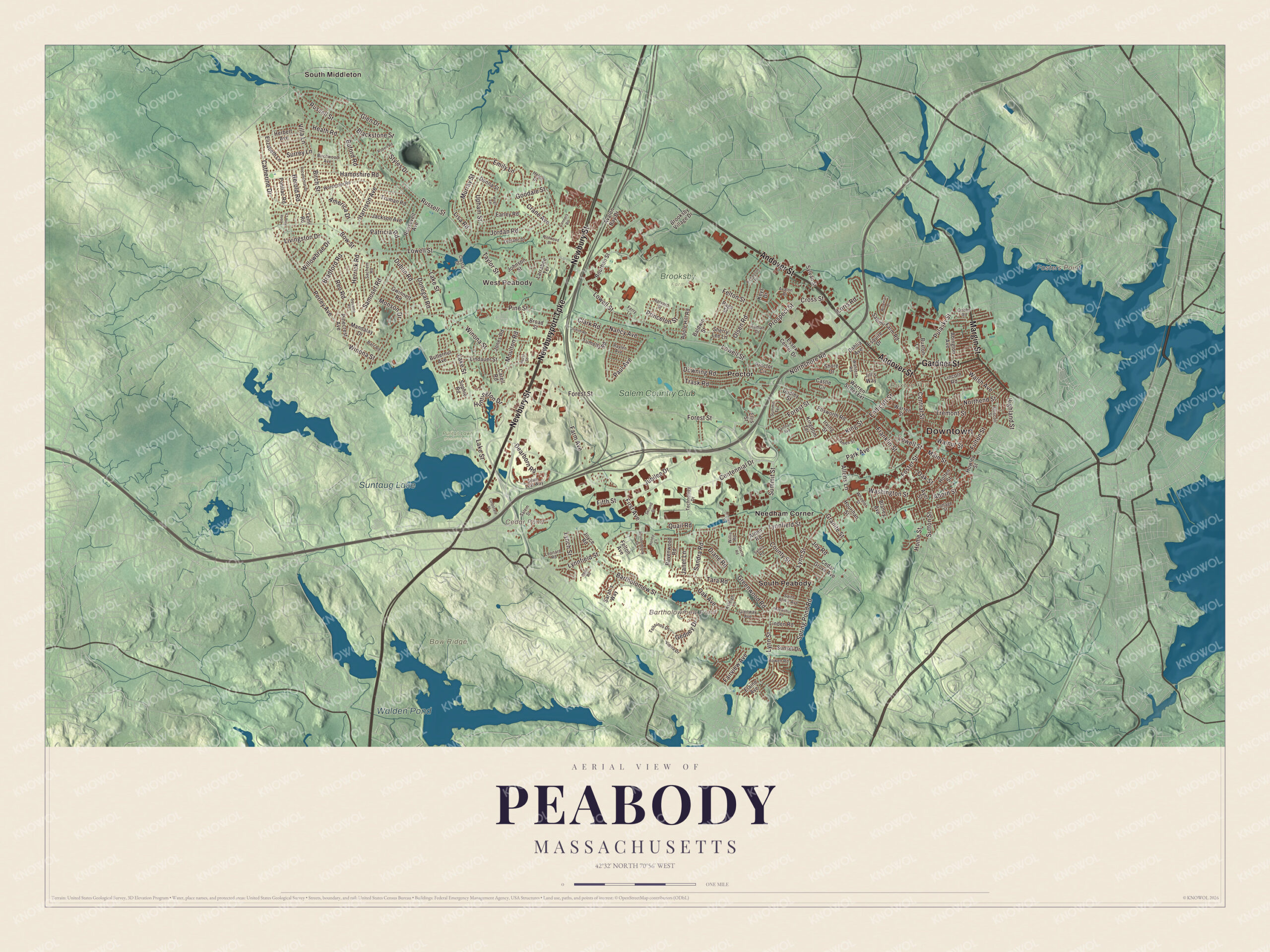
Peabody today
By KNOWOL
The city drawn from public survey data in the look of an old atlas, with Andover Street, Margin Street, Newbury Street, Gardner Street, Main Street and the Newburyport Turnpike, plus Cedar Pond, Suntaug Lake, Bow Ridge and Buxton Hill.2
The story of Peabody
The morning the minutemen ran
Word of the British march reached Danvers about nine in the morning on April 19, 1775. The minutemen of the South Parish gathered by the South Church, at the bend of the old Boston road near the Bell Tavern, under Gideon Foster, a 26-year-old captain chosen only ten days before. They went over fences and across fields and reached West Cambridge, sixteen miles away, in four hours. Five of Foster's men were killed there. Dennison Wallis was hit by thirteen bullets, left for dead, and lived for many years. In 1835 a granite monument designed by Asher Benjamin went up where they had gathered, and the old general helped lay its cornerstone. It has since been moved a short way, to Washington and Sewall Streets.4678
Bean pots, glue and hides
Long before anyone called it the Leather City, the South Parish made a little of everything. Joseph Southwick, a Quaker, started a tannery in 1739 that his family kept going for more than a century. More than thirty potteries once worked along the lane that's now Central Street and on what's now Lowell Street, turning out the brown ware of bean pots, flower pots and jugs, and during the War of 1812 it sold far and wide. Gideon Foster ground chocolate at his mill pond off Foster Street, and Elijah Upton made the town's first glue in 1817. By 1855 South Danvers had 27 tanneries working through 131,000 hides a year, and its most valuable farm crop was onions.9101112313
The grocer's boy who came home
George Peabody was born on Washington Street in 1795. At twelve he went to work in Captain Sylvester Proctor's grocery store and slept in its attic. He made his fortune as a banker in London but never forgot home. At the Danvers centennial dinner in 1852, a sealed envelope from him was opened. Inside was a toast, 'Education, a debt due from present to future generations,' and $20,000 for a free library and lyceum. The library opened in 1854 with 5,000 books, about half of them sent from London. When he visited in 1856, arches crossed the streets, and he told the crowd he was still the humble boy who had left. In February 1870 his coffin lay in state in the library's reading room.21415161718
Through the years
25 moments from 1626 to today.
- 1626English colonists from Cape Ann, led by Roger Conant, settle the area as part of Salem.2
- 1638Emanuel Downing buys a farm in Brooksby, where his son George, later the namesake of Downing Street in London, grows up.19
- 1692John Proctor, who farmed the old Downing land, is executed in the Salem witch trials.19
- 1739Joseph Southwick, a Quaker, starts a tannery that his family will run for more than a century.9
- 1750Washington Street is laid out as part of a new post road between Salem and Boston.20
- 1752The area is set off from Salem as part of the district of Danvers and becomes known as the South Parish.2
- 1771Ruth Proctor sees her late husband's job of widening the South meetinghouse through to the end and wins his pay at town meeting.21
- 1775On April 19 Gideon Foster's minutemen run sixteen miles to West Cambridge in four hours, and five of them are killed there.4
- 1795George Peabody is born in a house on Washington Street.2
- 1797The Salem and Danvers Aqueduct Company starts sending spring water toward Salem through wooden logs.22
- 1807Twelve-year-old George Peabody goes to work in Captain Sylvester Proctor's grocery store.14
- 1812During the War of 1812 brown ware from the parish's thirty-odd potteries sells far and wide.10
- 1817Elijah Upton makes the first glue in what will be South Danvers.12
- 1835The Lexington Monument, designed by Asher Benjamin, is dedicated on the spot where the minutemen gathered.7
- 1843A fire around the square burns the South Church, the Essex Coffee House and twelve other stores and houses.23
- 1852George Peabody's sealed letter gives $20,000 for a free library and lyceum, with the toast 'Education, a debt due from present to future generations.'15
- 1854The Peabody Institute Library opens on October 18 with 5,000 books.16
- 1855The South Parish breaks away from Danvers as the town of South Danvers.2
- 1855The new town has 27 tanneries working through 131,000 hides a year.3
- 1856George Peabody comes home to arches over the streets and tells the crowd he's still the humble boy who left.17
- 1868On April 30 South Danvers changes its name to Peabody.2
- 1870George Peabody's coffin lies in state in the library's reading room before his funeral in February.18
- 1883The Town House, now City Hall, is finished, with a great hall seating 1,500.24
- 1909A trade book calls the A. C. Lawrence Leather Company, with about 1,500 workers, the largest tannery in New England.25
- 1916Peabody becomes a city.2
Places to see
Places worth a visit in Peabody today.
- Peabody SquareDowntown. Center of the old South Parish.
- Peabody Institute LibraryMain Street. George Peabody's free library, dedicated 1854.Visit their website
- Washington Street Historic DistrictSouth of Main Street. Leaders' houses on the 1750 post road.
- Gen. Gideon Foster HouseWashington Street. The 1810 house, now a museum.Visit their website
- George Peabody House Museum205 Washington Street. Birthplace of George Peabody, with the Leather Museum.Visit their website
- Nathaniel Felton HousesFelton Street. Felton family houses from about 1700.Visit their website
- Brooksby FarmFelton Street. 275 acres owned by the city.Visit their website
- Tillie's FarmSouth Peabody. A city-owned farm.Visit their website
- West PeabodyWest of the highways. Farmland until the 1950s.
- Suntaug LakeCity line. Only partly inside the city.
On the National Register
All 17 places in Peabody on the National Register of Historic Places that still stand today, oldest first, and why each one matters.5
-
Nathaniel Felton Houses
The house of Nathaniel Felton Sr. was built about 1700; his son's house was built elsewhere and moved here by a grandson. The Peabody Historical Society runs both as house museums.26
-
John Proctor House
Local tradition tied this house to John Proctor, who was executed in the witch trials of 1692, but tree-ring dating shows it was built about 1727 by his son Thorndike. It stayed in the Proctor family into the mid-1800s and is not open to the public.27
-
Southwick House
Probably built about 1750, it's one of the city's oldest buildings. The land was first settled by John Southwick, a Quaker, and the Southwicks became one of the town's largest landowning families, later in pottery and tanning.28
-
Washington Street Historic District
Laid out in 1750 as part of a new post road between Salem and Boston, Washington Street became the street where Peabody's business and civic leaders built their houses. The 1810 Gen. Gideon Foster House is the oldest house on it.20
-
George Peabody House
George Peabody was born here in 1795, when this was part of Danvers. He bought the family homestead from his brother in 1816 so his mother could stay on, and the city made it a museum in 1989. It shares its site with the Peabody Leather Museum.29
-
Hickey-Osborne Block
Three Federal houses, the oldest built about 1797 for John Upton, were raised up and given brick storefronts underneath, the Upton house in 1897 and the other two in 1923, making one long block on Main Street.30
-
Gen. Gideon Foster House
A Federal house first built on Main Street and bought in 1815 by Gideon Foster, a veteran of the Revolution and the War of 1812. It was later moved to make way for a larger house, and the Peabody Historical Society has owned it since 1916.31
-
First Unitarian Church
A wood-frame church built in 1826, when the area was part of Danvers, with a rounded entrance hall framed by pilasters and a tower without a steeple. It has been converted to condominiums.32
-
Peabody Civic Center Historic District
The civic heart of Peabody, with City Hall, the Victorian Gothic St. John the Baptist Church of the 1870s, and Greek Revival and Italianate houses of the mid-1800s on Chestnut and Franklin Streets. A grist mill stood on Proctor Brook nearby as early as 1634.33
-
Peabody Institute Library
George Peabody gave the money for this free library and lecture hall in 1852, and the brick building was dedicated in 1854. It's claimed to be the oldest public library in the United States still working from the same place, and its Eben Dale Sutton Reference Room of 1869 was made to look like a reading room at Oxford.34
-
Sutton Block
Built in 1859, this three story brick building is the only Italianate commercial building in Peabody. It was built by Ebenezer Sutton, a local textile manufacturer.35
-
Peabody Central Fire Station
Built in 1873, the two story brick building is one of the oldest active fire stations in the state. The building has Victorian styling, with a mansard roof, and two truncated gables on its front facade.36
-
Moore-Hill House
An excellent example of a Gothic Victorian house, built in 1874 for W. H. Hill, with a cross-gabled roof.37
-
Peabody City Hall
Built in 1883 as the Town House to designs by Rufus Sargent of Newburyport, this Second Empire brick building held town meetings and later city council meetings in its big upstairs auditorium. It became City Hall when Peabody became a city.38
-
O'Shea Building
Built in 1904 by Thomas O'Shea, one of the city's leading businessmen at the time, it's a well-preserved Renaissance Revival block of brick, limestone and granite just east of Peabody Square, built with shops below and offices above.39
-
Second O'Shea Building
The second of two buildings put up in the 1900s by Thomas O'Shea, a local leather maker, this three-story brick and sandstone Colonial Revival block stands on Peabody Square, the city's central intersection.40
-
Samuel Brown School
The city's oldest existing school building, finished in 1911 for about one hundred pupils and named for Samuel Brown, who died at the Battle of Antietam. It became senior housing in 2008.41
In their words
“It was a pleasant place, then, this old town of ours, when there were green fields and shady walks where now are dusty streets and busy factories.”
George G. Smith remembering the South Parish at the Danvers centennial of 1852, in the History of Essex County, 188842
“I am still, in heart, the humble boy who left yonder unpretending dwelling.”
George Peabody, welcomed home by the old town of Danvers, 185617
“George Peabody, a Man who is a Man.”
Words on an arch over the street for his homecoming, 185643
Nearby towns
Sources
- Peabody, Massachusetts, Wikipedia
- Map of Peabody, Massachusetts in 2026, KNOWOL
- History of Essex County, Massachusetts (1888), Peabody chapter, on the industries of 1855, Internet Archive
- History of Essex County, Massachusetts (1888), Peabody chapter, on April 19, 1775, Internet Archive
- National Register of Historic Places listings in Essex County, Massachusetts, Wikipedia
- History of Essex County, Massachusetts (1888), Peabody chapter, on Dennison Wallis, Internet Archive
- History of Essex County, Massachusetts (1888), Peabody chapter, on the Lexington Monument, Internet Archive
- Peabody and the American Revolution, Peabody Historical Society
- History of Essex County, Massachusetts (1888), Peabody chapter, on Joseph Southwick's tannery, Internet Archive
- History of Essex County, Massachusetts (1888), Peabody chapter, on the potteries, Internet Archive
- History of Essex County, Massachusetts (1888), Peabody chapter, on General Foster's chocolate mill, Internet Archive
- History of Essex County, Massachusetts (1888), Peabody chapter, on Elijah Upton's glue, Internet Archive
- History of Essex County, Massachusetts (1888), Peabody chapter, on farming in 1855, Internet Archive
- History of Essex County, Massachusetts (1888), on George Peabody's boyhood, Internet Archive
- History of Essex County, Massachusetts (1888), Peabody chapter, on George Peabody's gift of 1852, Internet Archive
- Municipal history of Essex County in Massachusetts (1922), on the Peabody Institute Library, Internet Archive
- Proceedings at the reception and dinner in honor of George Peabody by the citizens of the old town of Danvers (1856), his address, Internet Archive
- Essex Institute Historical Collections, vol. 99 (1963), The Funeral of George Peabody, Internet Archive
- History of Essex County, Massachusetts (1888), Peabody chapter, on the Downing farm, Internet Archive
- Washington Street Historic District, Wikipedia
- Essex Institute Historical Collections, vol. 87 (1951), on Ruth Proctor, Internet Archive
- History of Essex County, Massachusetts (1888), Peabody chapter, on the aqueduct, Internet Archive
- History of Essex County, Massachusetts (1888), Peabody chapter, on the fire of 1843, Internet Archive
- History of Essex County, Massachusetts (1888), Peabody chapter, on the Town House, Internet Archive
- Industrial and Mercantile Peabody and Danvers Illustrated (1909), Internet Archive
- Nathaniel Felton Houses, Wikipedia
- John Proctor House, Wikipedia
- Southwick House, Wikipedia
- George Peabody House, Wikipedia
- Hickey-Osborne Block, Wikipedia
- Gen. Gideon Foster House, Wikipedia
- First Unitarian Church, Wikipedia
- Peabody Civic Center Historic District, Wikipedia
- Peabody Institute Library, Wikipedia
- Sutton Block, Wikipedia
- Peabody Central Fire Station, Wikipedia
- Moore-Hill House, Wikipedia
- Peabody City Hall, Wikipedia
- O'Shea Building, Wikipedia
- Second O'Shea Building, Wikipedia
- Samuel Brown School, Wikipedia
- History of Essex County, Massachusetts (1888), Peabody chapter, on the old South Parish, Internet Archive
- Proceedings at the reception and dinner in honor of George Peabody by the citizens of the old town of Danvers (1856), the decorations, Internet Archive