
A hill town in southeastern Litchfield County, once Waterbury's parish of Northbury, where Eli Terry made clocks for the whole country and his son's village of Terryville became the home of the Eagle Lock Company.
Then and now
The same town 132 years apart. Click either map to look closer.
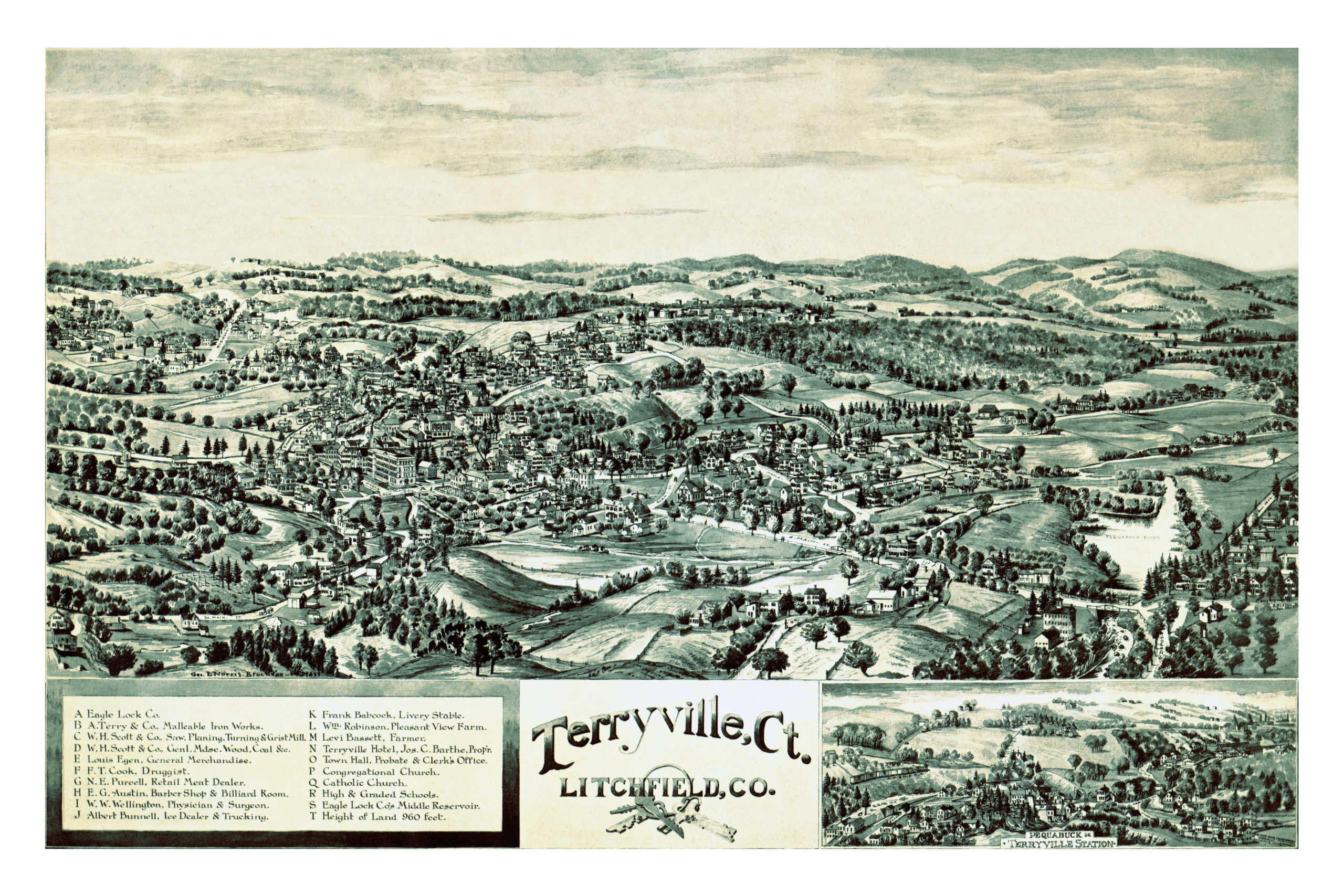
The bird's-eye view of Terryville
By George E. Norris
Terryville drawn as if from the sky at the end of the 1800s, with a set of keys beneath the village name, the Eagle Lock Company, the Terryville Hotel, E.G. Austin's Barber Shop and Billiard Room, Albert Bunnell's ice business, Purcell's Meat Shop and Pleasant View Farm.5
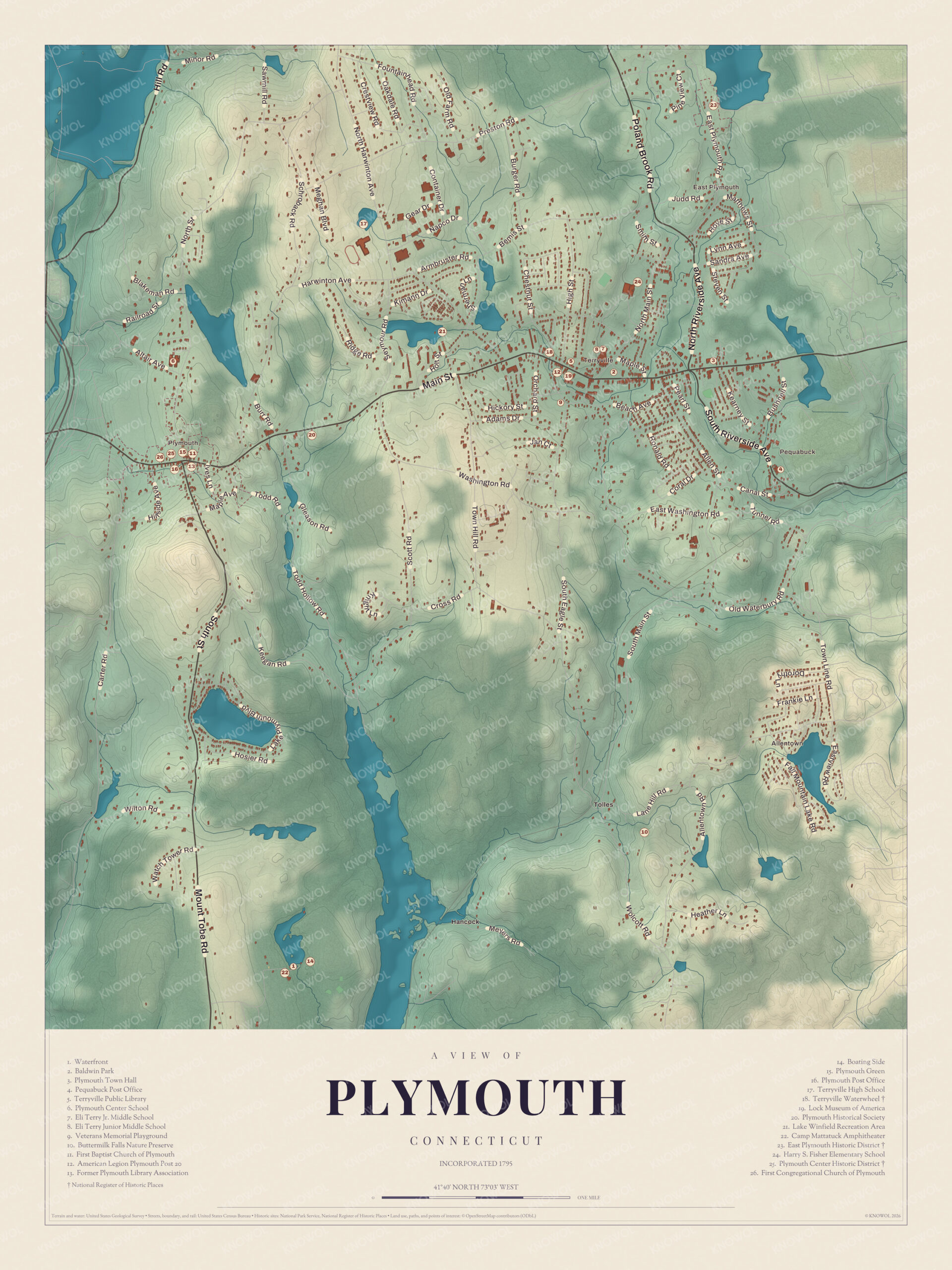
Plymouth today
By KNOWOL
Shaded hills from Greystone in the south to East Plymouth in the north, every street, the villages of Plymouth, Terryville, East Plymouth, Pequabuck and Hancock, and a guide of 26 numbered landmarks with the National Register sites marked.6
The story of Plymouth
The lead mine that never was
Plymouth's written story starts with a hope that didn't pan out. In 1657 a hunting party from Farmington thought it had found black lead in these hills, and got a deed from the Tunxis giving them the right to work it. It's believed to be the earliest English title to the region. No mine ever paid. Still, in 1895 the town historian could point to marks of rock blasting in the woods just north of the Harwinton line, near a spring that had always been called the Lead-Mine Spring. He wrote that the phantom of mineral wealth had haunted the region ever since. One landowner, the third John Sutliff, kept reserving "all mines contained therein" in every deed he gave, and even named one lot the Dimon mine.78
Clocks on horseback
Eli Terry came to Plymouth in 1793. At first he repaired clocks and watches, engraved metal and sold spectacles, the only goods he kept in stock. His first clocks were made a few at a time, mostly for buyers who had agreed to take them in advance, and they went out on horseback. In 1807 he took on four thousand clocks in a single contract, a job that ran four years. He worked with Seth Thomas and Silas Hoadley at a little settlement then called Ireland, later Hoadleyville and now Greystone. In 1814 came his short shelf clock, which the town's 1895 history calls the real foundation of the clock industry of this country. By 1845 Plymouth's five clock factories were turning out 95,500 clocks a year.9101112132
How Terryville became the lock town
Terryville was hardly a crossroads when Eli Terry Jr. built a clock shop on the Pequabuck. Jason Fenn remembered going with his father to the raising, in about 1827. The younger Terry sold his clocks as far away as Kentucky, and the village took his name. Locks came soon after. A new lock shop in 1834 wanted only men who would be good citizens to build up the community, and William E. McKee, who stuck with the trade through lean years, finally sold his stock at a dividend of 185 percent. The lock makers joined as the Eagle Lock Company in 1854. One of its machines drilled 12,000 keys a day, and in 1850 Andrew Terry began hiring immigrants for his iron foundry, bringing the village its first German family.1214151617181920
Through the years
25 moments from 1657 to today.
- 1657A Farmington hunting party thinks it has found black lead here and gets a deed to mine it, the earliest English title to the region.7
- 1739The Society of Northbury, the north parish of Waterbury, holds its first meeting.21
- 1740St. Peter's Episcopal parish is organized, its first church in what is now Thomaston.22
- 1777Moses Dunbar of Northbury is hanged at Hartford, the only Tory executed as such in Connecticut.23
- 1780Northbury and Westbury are set off from Waterbury together as the town of Watertown.24
- 1780In a hard winter with snow four feet deep, David Luddington shoots the last deer known to be killed in Plymouth.25
- 1792St. Matthew's Church is founded at the crossroads that becomes East Plymouth.26
- 1793Eli Terry moves to Northbury and goes into business repairing clocks and selling spectacles.9
- 1795Northbury becomes a town of its own, named Plymouth.1
- 1807Terry takes on a contract for four thousand clocks, a job that runs four years.12
- 1809Terry, Seth Thomas and Silas Hoadley make wooden clocks at a settlement called Ireland, later Hoadleyville and now Greystone.13
- 1814Terry devises the short shelf clock, the foundation of the American clock industry.12
- 1824Eli Terry Jr. builds a clock shop on the Pequabuck, where the Lewis Lock Company's shop later stood.12
- 1834A new lock shop in Terryville, run by John C. Lewis and William E. McKee, is hiring.16
- 1837Forty-nine members leave the old church to start one in Terryville, and fifty-one to start one in Plymouth Hollow.27
- 1845Five clock factories in town make 95,500 clocks, and two lock factories make 42,000 dozen locks.2
- 1850Andrew Terry starts hiring immigrants in New York for his iron foundry, and Terryville's first German family arrives.20
- 1854The Terryville lock makers unite as the Eagle Lock Company.18
- 1870With 4,149 people, Plymouth has the largest population of any town in Litchfield County.3
- 1875Plymouth Hollow is set off as the town of Thomaston, named for Seth Thomas.28
- 1894George E. Norris publishes his bird's-eye view of Terryville.5
- 1895Plymouth celebrates its centennial on May 14 and 15, finishing in a big tent on Baldwin Park.29
- 1972Thomas F. Hennessy's lock collection joins the Eagle Lock Company's to start the Lock Museum of America.6
- 1975The abandoned Eagle Lock Company site burns, leaving one building undamaged.1
- 2002The Terryville Waterwheel is listed on the National Register.30
Places to see
The numbers match the landmark guide printed on the 2026 map.
- 2Baldwin ParkTerryville. Terryville's village green.
- 3Plymouth Town HallTerryville. Town offices east of downtown.
- 5Terryville Public LibraryTerryville. Near the Lock Museum.Visit their website
- 15Plymouth GreenPlymouth Center. The old town common.
- 18Terryville WaterwheelMain Street, Terryville. A 22-foot wheel from about 1851.
- 19Lock Museum of AmericaMain Street, Terryville. Over 1,000 Eagle locks and keys.Visit their website
- 21Lake Winfield Recreation AreaNorth of Terryville. Town recreation area by the lake.
- 23East Plymouth Historic DistrictEast Plymouth. Crossroads village of St. Matthew's Church.
- 25Plymouth Center Historic DistrictPlymouth Center. The town's first village center.
- 26First Congregational Church of PlymouthPlymouth Center. Greek Revival church beside the green.
On the National Register
All 3 places in Plymouth on the National Register of Historic Places that still stand today, oldest first, and why each one matters.4
-
East Plymouth Historic District
A small crossroads village that grew up around St. Matthew's Church, founded in 1792 by Plymouth Episcopalians and Bristol Congregationalists. Its eight 19th-century houses are mostly Federal and Greek Revival. The old church, by then a home, burned in 2010.26
-
Plymouth Center Historic District
The town's first center, where the meetinghouse and common stood at Main, North and South Streets. It holds the Greek Revival Congregational church of 1838 and the stone Gothic St. Peter's of 1915, and it lost its civic role to Terryville after Thomaston split off in 1875.28
-
Terryville Waterwheel
A 22-foot wood and iron wheel in its original stone wheel well, probably fitted when the Lewis Lock Company rebuilt the burned clock shop on this site in 1851. It powered lockmaking until about 1940 and is the best preserved of Connecticut's three surviving 19th-century water wheels.30
In their words
“It is due to the genius, skill and enterprise of the townspeople that Plymouth lays claim to such a grand historic career which every son and daughter may glorify and feel proud of.”
History of the town of Plymouth, Connecticut, 189531
“The introduction of this shelf clock was the real foundation of the clock industry of this country.”
History of the town of Plymouth, Connecticut, 1895, on Eli Terry's clock of 181412
“The village has the reputation of producing more scholars fitted for college than any other village of its size in the state.”
History of the town of Plymouth, Connecticut, 1895, on the Terryville school32
Nearby towns
Sources
- Plymouth, Connecticut, Wikipedia
- History of the town of Plymouth, Connecticut (1895), on the statistics of 1845, Internet Archive
- History of the town of Plymouth, Connecticut (1895), on the population, Internet Archive
- National Register of Historic Places listings in Litchfield County, Connecticut, Wikipedia
- Bird's-eye view of Terryville, Connecticut from 1894, restored by KNOWOL
- Map of Plymouth, Connecticut in 2026, KNOWOL (USGS elevation, Census Bureau roads)
- History of the town of Plymouth, Connecticut (1895), on the lead mine deed, Internet Archive
- History of the town of Plymouth, Connecticut (1895), on the phantom of mineral wealth, Internet Archive
- History of the town of Plymouth, Connecticut (1895), on Eli Terry's early years, Internet Archive
- History of the town of Plymouth, Connecticut (1895), on Eli Terry's first clocks, Internet Archive
- History of the town of Plymouth, Connecticut (1895), on the first clocks, Internet Archive
- History of the town of Plymouth, Connecticut (1895), on Terry's contract and the shelf clock, Internet Archive
- The Hoadley genealogy (1894), on Silas Hoadley, Internet Archive
- History of the town of Plymouth, Connecticut (1895), Jason C. Fenn's recollections, Internet Archive
- History of the town of Plymouth, Connecticut (1895), on Eli Terry Jr., Internet Archive
- History of the town of Plymouth, Connecticut (1895), on Mr. Hunter and the first lock shop, Internet Archive
- History of the town of Plymouth, Connecticut (1895), on William E. McKee, Internet Archive
- History of the town of Plymouth, Connecticut (1895), on the Eagle Lock Company, Internet Archive
- History of the town of Plymouth, Connecticut (1895), on Mr. Gaylord's machines, Internet Archive
- History of the town of Plymouth, Connecticut (1895), on Terryville's first German family, Internet Archive
- History of the town of Plymouth, Connecticut (1895), on Barnabas Ford and the Society of Northbury, Internet Archive
- History of the town of Plymouth, Connecticut (1895), on St. Peter's parish, Internet Archive
- Bristol, Connecticut, in the olden time New Cambridge (1907), on Moses Dunbar, Internet Archive
- History of the town of Plymouth, Connecticut (1895), on the act of incorporation, Internet Archive
- History of the town of Plymouth, Connecticut (1895), on the last deer, Internet Archive
- East Plymouth Historic District, Wikipedia
- Contributions to the ecclesiastical history of Connecticut (1861), Internet Archive
- Plymouth Center Historic District, Wikipedia
- History of the town of Plymouth, Connecticut (1895), on the centennial in Terryville, Internet Archive
- Terryville Waterwheel, Wikipedia
- History of the town of Plymouth, Connecticut (1895), preface, Internet Archive
- History of the town of Plymouth, Connecticut (1895), on the schools, Internet Archive