
The old Wood End of a town founded in 1644, Reading became its own parish in 1769, kept the town's name when its two other parishes left, and grew from farms and shoe shops into a home of cabinetmakers, organ builders and Boston commuters.
Reading, Massachusetts on the map
Click the map to look closer.
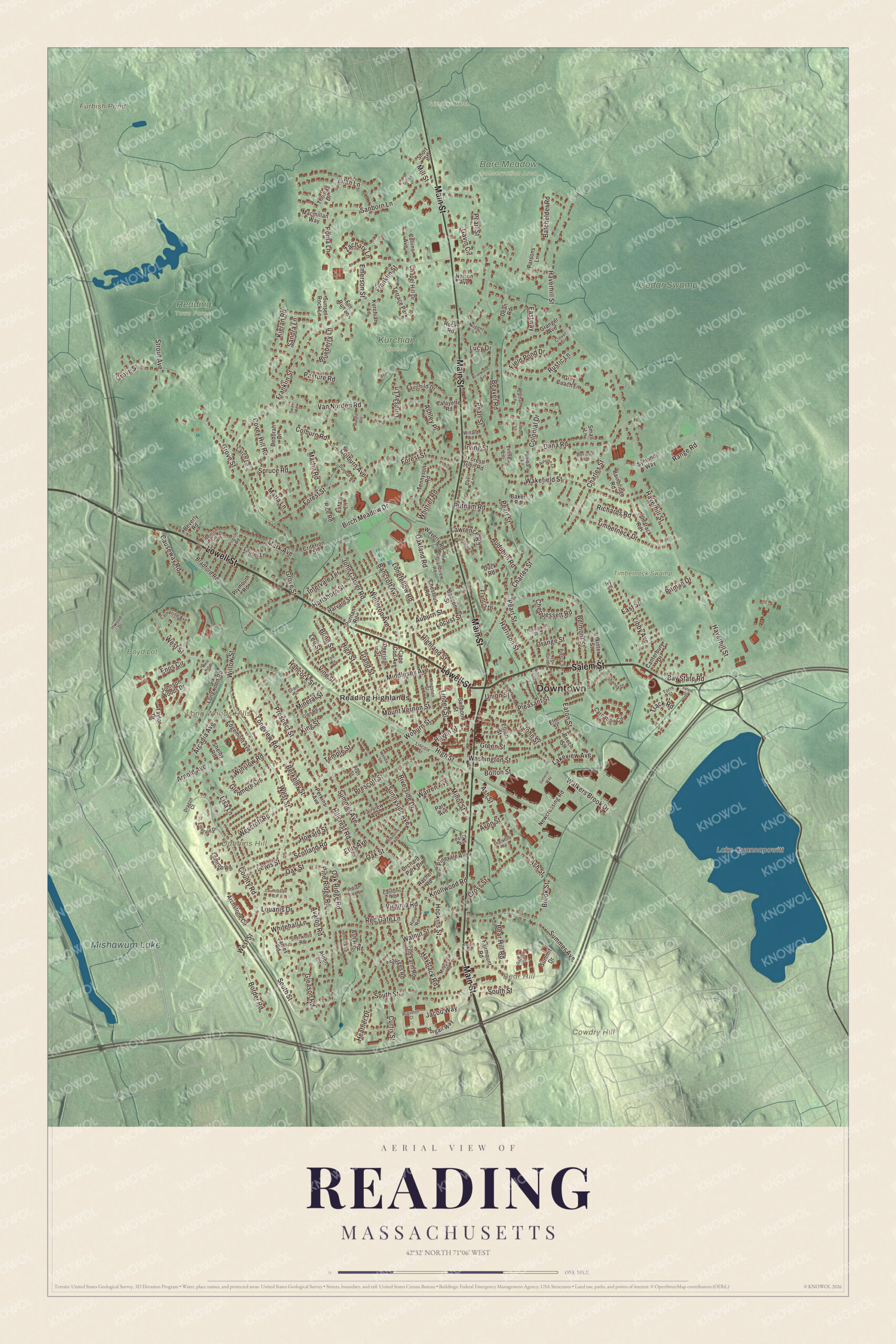
Reading today
By KNOWOL
Main Street, Lowell Street, Salem Street, Summer Avenue, Winslow Road and Lakeview Avenue across the town, with Bear Hill, Cowdry Hill, Dobbins Hill, Bare Meadow, Furbish Pond, Mishawum Lake and Lake Quannapowitt printed on the map.6
The history of Reading, Massachusetts
How Wood End got its own parish
Today's Reading began as Wood End, the west end of a town settled in 1639 and incorporated in 1644. The name was in the records by 1673, probably because woods still stood here while the first parish's land was open farmland. Wood End's farmers had a long trip to the meeting house by the Great Pond, and when they asked to be a parish of their own, the town voted no, 50 to 45. Instead it paid them £17 a year for winter preaching if they would stop asking, and the next year the old parish gave them its old pulpit cushion. In 1769 the General Court set off the Third Parish, with at least 55 houses. It met for the first time on August 9 and finished its meeting house on the Common.789102
Prisoners in the parish
Before the war, Dr. John Brooks drilled his minute-men by evening in the big kitchen of the Wood End parsonage, and the marks of their guns showed in the ceiling until repairs covered them. On the night of April 18, 1775, he went around town as if visiting patients, and his men gathered at Weston's Corner and marched by way of Bedford to Concord. Then the war came to them. Lieutenant Colonel Archibald Campbell and seven other Highland officers were lodged in Colonel Nathan Parker's house, today's Red House on Ash Street, and their constant music annoyed the neighbors. Nearly fifty of Burgoyne's men were kept in the house by today's depot, now the Parker Tavern, and marched under guard around the Great Pond. Years later a spoon stamped with the British lion turned up there.11121314151617
Silk hats and church organs
Reading never had giant mills, but its small shops sent goods across the country. Shoes bound for the South and the West Indies were thrown into barrels and packed down by a boy treading on them. When hats grew dear in the War of 1812, Nathan Weston made a waterproof stovepipe hat, then switched from cotton plush to silk, and the 1880 county history says he was claimed as the inventor of the silk hat. Jonathan Frost and Daniel Pratt made clocks here from 1832. Thomas Appleton, whose organs were said to be honest clear through, like himself, made church organs here for seventeen years from 1857 and built thirty-five for Boston churches. By 1890 the town also made organ pipes, neckties, wire brushes, rubber goods, and fireworks on Lowell Street.18192052122
Reading, Massachusetts through the years
25 moments from 1639 to today.
- 1639Settlers from Lynn begin Lynn Village on the south shore of the Great Pond, in what is now Wakefield.1
- 1644Lynn Village becomes the town of Reading, named for Reading in England.1
- 1673The name Wood End, for the wooded west end of town that is today's Reading, appears in the records.7
- 1694Abraham Bryant's saltbox on Washington Street, later the Parker Tavern, is standing by this year.23
- 1708The first schoolhouse in Wood End is built near today's Woburn and Washington Streets.24
- 1730The town votes 50 to 45 against making Wood End a parish, but pays it £17 a year for winter preaching.8
- 1761James Bancroft opens what was probably the first store in the present town.25
- 1769Wood End becomes the Third Parish, with at least 55 houses, and holds its first meeting on August 9.2
- 1775On April 19 Dr. John Brooks's minute-men gather at Weston's Corner and march by way of Bedford to Concord.12
- 1778Nearly fifty of Burgoyne's captured soldiers are said to be quartered in the house near today's depot.15
- 1791Sixty members start the Federal Library, a subscription library.1
- 1806A private company builds the Andover Turnpike, today's Main Street, in 1806 and 1807.1
- 1811A post office opens in the present town, with Colonel Nathan Parker as postmaster.26
- 1812War with Britain is declared, and not one man in Reading's town meeting votes in favor of it.27
- 1812Nathan Weston starts making hats here, and is later claimed as the inventor of the silk hat.19
- 1825Lafayette stops in town, and Rev. Peter Sanborn tells him Reading raised the first minute company in the colonies.28
- 1833On March 23 the town's women form the Reading Female Antislavery Society, which William Lloyd Garrison called the first in the country.29
- 1844At least 4,000 people mark the old town's 200th anniversary on May 29, in a field lent by Rev. Peter Sanborn.30
- 1845The first Boston and Maine train runs through town on July 1.31
- 1853The old North Parish becomes the separate town of North Reading.1
- 1854Lyceum Hall goes up at the head of Haven Street and serves as the town's meeting hall for decades.32
- 1865The soldiers' monument is dedicated on October 5, carved with forty-six names of men who died in the Civil War.33
- 1868The town votes to start a public library.1
- 1890Union Hall, the Third Parish's first meeting house, burns to the ground on Haven Street.34
- 1916Town meeting votes 86 to 32 to buy the Old Parker Tavern for the Reading Antiquarian Society.35
Places to see in Reading, Massachusetts
Places worth a visit in Reading today.
- Parker TavernWashington Street, west of Main Street. The oldest building in town.
- Capt. Nathaniel Parker Red HouseAsh Street, south of downtown. A red-painted tavern on the coach road.
- Main StreetRoute 28 through downtown. The Andover Turnpike of 1806 and 1807.
- Reading HighlandsWest of downtown. Few houses here until after 1865.
- Summer AvenueSouthwest of downtown. Eaton and Temple homesteads of the 1700s.
- Lowell StreetRoute 129. Hyde and Company made fireworks here.
- Salem StreetEast side of the Common. Cabinet shops and mills of the 1800s.
- Bear HillBy Bear Hill Street. One of the town's two Nike missile sites.
- St. Athanasius ParishHaverhill Street. Concrete roof poured in a single day.
- Lake QuannapowittOver the line in Wakefield. The old Great Pond of Lynn Village.
Reading on the National Register of Historic Places
21 of the 86 places in Reading on the National Register of Historic Places that still stand today, oldest first, and why each one matters. See the full list of National Register places in Reading.4
-
Parker Tavern
Abraham Bryant, a blacksmith and farmer, had built this saltbox by 1694, and it is the oldest building standing in Reading. Ephraim Parker kept a tavern here from 1770 to 1785, and it has been a local history museum since 1923.23
-
Carroll-Hartshorn House
Built about 1700 on an early road between Wakefield and Haverhill, it is one of the oldest buildings in Reading: a First Period house with a central chimney and a saltbox rear, owned by generations of the Hartshorn family.36
-
Samuel Bancroft House
Samuel Bancroft, a civic leader, bought this land in 1748 and built the house about then, facing south rather than toward the street. It is the oldest house in the West Street neighborhood and one of the few left from the late colonial years.37
-
Capt. Nathaniel Parker Red House
Built before 1755, it stood out because it was painted, unusual for its day, and as a tavern on the coach road it was a meeting place for revolutionaries and minute-men. Militia captain Nathaniel Parker's family kept it into the late 1800s, and the Andover Turnpike of 1806 and 1807, which bypassed it, drew its trade away.38
-
Eaton-Prescott House
Its oldest part was built before 1757, on land the Eaton family had held since the late 1600s, and the house stayed in the Eaton and Prescott family until 1902. Its door surround dates from the Greek Revival years of the 1830s and 1840s.39
-
Common Historic District
The civic heart of Reading, around a Common held in common since at least 1737, where the Third Parish built its first meeting house in 1769. It takes in the First Congregational Church, a 1913 copy of an 1817 Asher Benjamin church lost to fire, the library, the town hall and the 1817 house and shop of Thomas Pratt.40
-
Jerry Nichols Tavern
Jeremiah Nichols, a Revolutionary War veteran, farmer and shoemaker, built the oldest part in 1785 on the ground where Reading's minute companies drilled and its powder was kept. By 1830 it was a tavern and stagecoach stop.41
-
Woburn Street Historic District
Sixteen houses on a tree-lined stretch of Woburn Street, one of Reading's oldest roads, built up after the railroad came. The oldest, at 201 Woburn Street, dates from about 1795, and architect Horace G. Wadlin lived at 206.42
-
Carter Mansion
Daniel Chute, owner of one of Reading's first shoemaking businesses, built it in 1802 in the Federal style. Later owners gave it Italianate and Queen Anne touches, and William Carter had the family name cut into the granite front steps.43
-
Rev. Peter Sanborn House
Rev. Peter Sanborn, minister of the Third Parish church and a town leader, built this Federal house about 1812. Clockmaker Benjamin Boyce, son-in-law of Daniel Pratt, bought it from Sanborn's estate in 1860.44
-
Harnden-Browne House
Built in 1831 by Sylvester Harnden, whose furniture factory was one of the town's major businesses. It was later given Queen Anne details and became a boarding house.45
-
Walnut Street School
Built in 1854 as a two-room schoolhouse at Summer Avenue and Walnut Street, it is the town's oldest public building. It was moved here in 1883, taught children until 1944, and since 1962 has been the 150-seat theater of the Quannapowitt Players.46
-
Octagon House
Built in 1860 by Doctor Horace Wakefield, it is a distinctive variant of the type, executed as a series of small octagonal shapes around a central cupola. The building is fashioned from large, heavy timbers in the manner of a log cabin, with long first-floor windows.47
-
Wendell Bancroft House
Built in the late 1860s for Wendell Bancroft, a coal and lumber dealer and founding president of two Reading banks, it is one of the town's few Gothic Revival houses.48
-
Boston and Maine Railroad Depot
The Boston and Maine built this Queen Anne depot in 1870, on the line that reached Reading in 1845. The town bought it in 1960 and briefly kept a railroad museum in it, and it has been privately owned, with preservation restrictions, since 1985.49
-
Jacob Manning House
Built in 1877 for Jacob Manning, whose nursery was one of the largest in the area and who landscaped the Massachusetts pavilion at the 1893 Chicago World's Fair. It is a fine local example of the Stick style.50
-
Reading Municipal Building
The town's first purpose-built municipal building, designed by local architect Horace G. Wadlin, held the town offices, the fire station and the jail until 1918. It stayed a fire station for many years and is now a senior center.51
-
Highland School
Horace G. Wadlin designed this yellow-brick Renaissance Revival school for Reading Highlands, built in 1896 and 1897. It taught children until 1981 and since 1984 has been the Reading Public Library.52
-
Ace Art Company
Built in 1924 for the Ace Art Company, which made the little corners that held photographs in albums, it is the only Art Deco building in Reading.53
-
Haverhill Street Milestone
A small granite slab on the east side of Haverhill Street, cut "B / 12 / M" to mark twelve miles from Boston on the old post road between Boston and Haverhill.54
-
Smith Shoe Shop
A ten-footer, one of the few small workshops left from the days when Reading's shoes were made by hand in back-yard shops, before factories took over in the decades after the Civil War.55
Reading in their words
“[Reading] is far enough from Boston to have a sociability of its own, independent of city attractions.”
Henry G. Kittredge, editor of the Boston Journal of Commerce, in the History of Middlesex County, 189056
“for some time Reading continued to be the banner town in the anti-slavery conflict.”
William Lloyd Garrison, as quoted in the History of Middlesex County, 189057
“There followed an immediate expansion in population, and the West End ceased to be the Cinderella of the Readings.”
Middlesex County and its people, 1927, on Wood End after it became the Third Parish in 17699
Towns near Reading, Massachusetts
Sources for the history of Reading
- Reading, Massachusetts, Wikipedia
- History of Middlesex County, Massachusetts (1890), on the Third Parish of 1769, Internet Archive
- History of Middlesex County, Massachusetts (1890), on Reading's Civil War soldiers, Internet Archive
- National Register of Historic Places listings in Reading, Massachusetts, Wikipedia
- History of Middlesex County, Massachusetts (1880), on Thomas Appleton's church organs, Internet Archive
- Map of Reading, Massachusetts in 2026, KNOWOL
- History of Middlesex County, Massachusetts (1880), Hiram Barrus and Carroll D. Wright's Reading chapter, on the name Wood End, Internet Archive
- History of Middlesex County, Massachusetts (1880), on the vote against a Wood End parish, Internet Archive
- Middlesex County and its people; a history (1927), on Wood End and the Third Parish, Internet Archive
- History of Middlesex County, Massachusetts (1890), Horace G. Wadlin's Reading chapter, on Wood End and the pulpit cushion, Internet Archive
- History of Middlesex County, Massachusetts (1880), on Dr. John Brooks's minute-men in the parsonage kitchen, Internet Archive
- History of Middlesex County, Massachusetts (1880), on April 19, 1775, Internet Archive
- History of Middlesex County, Massachusetts (1880), on the Highland officers held in the West Parish, Internet Archive
- History of Middlesex County, Massachusetts (1890), on Captain Parker's Red House, Internet Archive
- History of Middlesex County, Massachusetts (1880), on Burgoyne's soldiers quartered in Reading, Internet Archive
- History of Middlesex County, Massachusetts (1890), on the Sweetser house on Washington Street, Internet Archive
- History of Middlesex County, Massachusetts (1880), on the spoon stamped with the British lion, Internet Archive
- History of Middlesex County, Massachusetts (1880), on Reading's early shoe trade, Internet Archive
- History of Middlesex County, Massachusetts (1880), on Nathan Weston and the silk hat, Internet Archive
- History of Middlesex County, Massachusetts (1890), on Reading's industries, Internet Archive
- History of Middlesex County, Massachusetts (1890), on organ builder Thomas Appleton, Internet Archive
- History of Middlesex County, Massachusetts (1890), on the fireworks factories on Lowell Street, Internet Archive
- Parker Tavern, Wikipedia
- History of Middlesex County, Massachusetts (1890), on the first schoolhouse in Wood End, Internet Archive
- History of Middlesex County, Massachusetts (1880), on James Bancroft's store of 1761, Internet Archive
- History of Middlesex County, Massachusetts (1880), on the post office of 1811 and Colonel Nathan Parker, Internet Archive
- History of Middlesex County, Massachusetts (1880), on the town meeting vote on the War of 1812, Internet Archive
- History of Middlesex County, Massachusetts (1880), on Lafayette's visit of 1825, Internet Archive
- History of Middlesex County, Massachusetts (1880), on the Reading Female Antislavery Society of 1833, Internet Archive
- History of Middlesex County, Massachusetts (1880), on the 200th anniversary of 1844, Internet Archive
- History of Middlesex County, Massachusetts (1880), on the first train of July 1, 1845, Internet Archive
- History of Middlesex County, Massachusetts (1890), on Lyceum Hall, Internet Archive
- History of Middlesex County, Massachusetts (1880), on the soldiers' monument, Internet Archive
- History of Middlesex County, Massachusetts (1890), on the 1769 meeting house and Union Hall, Internet Archive
- Town of Reading Massachusetts annual report (1916), on the vote to buy the Old Parker Tavern, Internet Archive
- Carroll-Hartshorn House, Wikipedia
- Samuel Bancroft House, Wikipedia
- Capt. Nathaniel Parker Red House, Wikipedia
- Eaton-Prescott House, Wikipedia
- Common Historic District, Wikipedia
- Jerry Nichols Tavern, Wikipedia
- Woburn Street Historic District, Wikipedia
- Carter Mansion, Wikipedia
- Rev. Peter Sanborn House, Wikipedia
- Harnden-Browne House, Wikipedia
- Walnut Street School, Wikipedia
- Octagon House, Wikipedia
- Wendell Bancroft House, Wikipedia
- Boston and Maine Railroad Depot, Wikipedia
- Jacob Manning House, Wikipedia
- Reading Municipal Building, Wikipedia
- Highland School, Wikipedia
- Ace Art Company, Wikipedia
- Haverhill Street Milestone, Wikipedia
- Smith Shoe Shop, Wikipedia
- History of Middlesex County, Massachusetts (1890), the close of the Reading chapter, Internet Archive
- History of Middlesex County, Massachusetts (1890), on Reading's antislavery societies, Internet Archive