
A rocky hill town of farms and lakes, gathered from Colchester, Lyme and Montville as New Salem parish in 1726 and a town in 1819, where Oramel Whittlesey ran his Music Vale Seminary and gave Fairy Lake its name.
Salem on the map
Click the map to look closer.
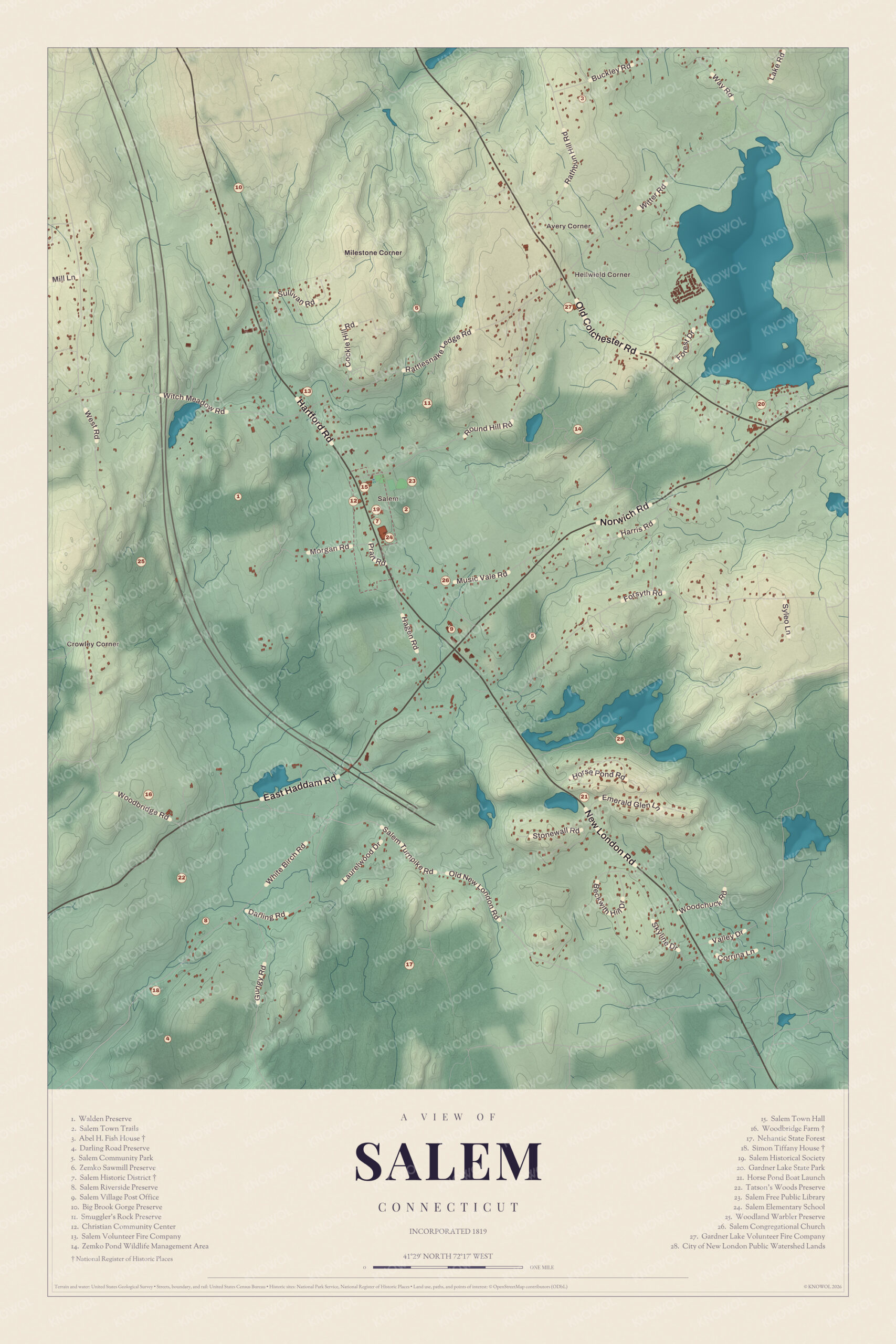
Salem today
By KNOWOL
Shaded hills from Crowley Corner in the west to Gardner Lake in the northeast, every street from Darling Road to Witch Meadow Road, and a guide of 28 numbered landmarks with the National Register sites marked.4
The story of Salem
The music school in the vale
In 1835 Oramel Whittlesey opened Music Vale Seminary about half a mile south of the green. He'd spent three years making pianos in Buffalo with his brothers, and an 1895 article by a family member called his school the first in the country devoted only to music. Students practiced to the click of the metronome and had to play in public once or twice a week. Whittlesey wrote songs and an opera, Ralvo, the Pirate of the Gulf, staged in the seminary hall. In the Civil War he flew the flag out front, fired a cannon for every Union victory, and cut tuition for soldiers' widows and daughters. He died in 1876, the school closed, and fire took the main building in 1897. A barn and a state marker remain.1567891011
Who named Fairy Lake
Some of the names on Salem's woods and waters came from Oramel Whittlesey. He told stories and legends about the hills and lakes, printed in the Gleaner of the Vale, a paper the seminary's young women edited, and he named Elfin Glen, Mountain Lake and Fairy Lake. The villagers took up his names, and in time they reached the county maps. Between 1917 and 1924 Frederick C. Rawolle bought 2,800 acres around Mountain Lake and Fairy Lake and called his place Fairy Lake Farm. In 1920 he made Carr Pond, which still supplies New London's water. Too far from the city's power lines, he built his own hydroelectric plant in 1922, one of the first rural electrification projects in the country, and pilots flying from New York to Boston steered by its lights.81
A bachelor's reveries and an explorer's summers
Donald G. Mitchell finished Yale in 1841 with his health worn down and spent three years on his grandfather's farm in Salem. An 1882 county history says he wrote his best-known book there, Reveries of a Bachelor, which came out under the pen name Ik Marvel in 1850 and became one of the best sellers of its day. Salem's tie to the Mitchells didn't end there. In 1900 Hiram Bingham married Alfreda Mitchell, daughter of Alfred Mitchell of Salem, and by 1911 the couple spent their summers at Woodbridge Farms, the family's place on Woodbridge Road. A 1911 history names those farms as where the Reveries were written. That same year Bingham reached Machu Picchu, and in the late 1920s he gave Salem its first library, a small building by the green.1213141516111
Through the years
25 moments from 1664 to today.
- 1664The first English settlement in what's now Salem, then part of Montville, is deeded.1
- 1685The General Court grants Lyme a strip north of the town, nine miles by two, on land the Mohegans claimed.17
- 1700Samuel Browne of Salem, Massachusetts, buys a 10,000-acre tract here and leases it to tenant farmers.16
- 1718James Harris comes from Massapeag, near Uncasville, and soon keeps what is probably the first tavern.18
- 1720About this year The Tavern is built, later the home of the Rev. John Whittlesey.11
- 1725Settlers ask for a military company of their own and bring a roll of 64 men ready to enlist.18
- 1726New Salem parish is formed, and James Harris deeds it land for a meeting-house, burying ground and training field.19
- 1758Between 1758 and 1760 a number of Salem families move to Horton, Nova Scotia.20
- 1791Thomas Shaw builds the Woodbridge farmhouse for his nephew Nathaniel Woodbridge.16
- 1816Salem's first post office opens in a village store.21
- 1819Salem becomes a town, made from parts of Colchester, Lyme and Montville.1
- 1819The first town meeting is held on June 15 at the Presbyterian meeting-house.22
- 1831An old Norwich church, bought by Salem's Episcopalians, is moved to the green. It's now the Town House.11
- 1835Oramel Whittlesey founds Music Vale Seminary south of the green.1
- 1841Salem becomes its own probate district.23
- 1861Through the Civil War, Whittlesey fires a cannon for every Union victory.8
- 1876Oramel Whittlesey dies on September 9, and Music Vale closes.10
- 1890Salem counts 481 people, most of them farming, reached by daily stage.2
- 1897Fire destroys Music Vale's main building.11
- 1900Hiram Bingham marries Alfreda Mitchell, whose family's Woodbridge Farms in Salem become their summer home.15
- 1911Bingham, a longtime Salem resident, reaches Machu Picchu.1
- 1922Frederick C. Rawolle finishes his own hydroelectric plant at Fairy Lake Farm.1
- 1926Land buying begins for Nehantic State Forest, the first state forest in New London County.24
- 1929About this year the town library, a gift of Hiram Bingham, is built near the green.11
- 2001The state buys the old resort on Gardner Lake for a state park.25
Places to see
The numbers match the landmark guide printed on the 2026 map.
- 3Abel H. Fish HouseNortheastern Salem. Greek Revival farmhouse of about 1835.
- 7Salem Historic DistrictRoute 85. The town center, listed in 1980.
- 15Salem Town HallTown green. Town offices beside the green.
- 16Woodbridge FarmWoodbridge Road. Farm of 1791, later a country house.
- 17Nehantic State ForestSouthwestern Salem. The county's first state forest.Visit their website
- 18Simon Tiffany HouseDarling Road. Gambrel-roofed farmhouse of about 1793.
- 19Salem Historical SocietyTown green. In the old Town House from Norwich.
- 20Gardner Lake State ParkGardner Lake. Swimming beach on the southern shore.Visit their website
- 23Salem Free Public LibraryNear the green. The new library, opened in 2004.
- 26Salem Congregational ChurchTown green. Greek Revival church of about 1840.
On the National Register
All 4 places in Salem on the National Register of Historic Places that still stand today, oldest first, and why each one matters.3
-
Salem Historic District
The town center that grew up after Salem became a town in 1819, mostly built out by 1885. Around the green stand the Congregational Church of about 1840, the Grange Hall built as a school in 1885, and the old Town House, a 1749 Norwich church moved here in 1831. Near its south end are a barn from Music Vale Seminary and The Tavern of about 1720.11
-
Woodbridge Farm
Part of Samuel Browne's 10,000-acre tract, seized when his Loyalist grandson fled, it was bought by Thomas Shaw, who built the house for his nephew Nathaniel Woodbridge. Alfred Mitchell, a Woodbridge grandson, bought it back in 1900 and made the farmhouse a Colonial Revival country house.16
-
Simon Tiffany House
A gambrel-roofed farmhouse built by Simon Tiffany on land his father Ebenezer bought from the state in 1786. Some of its windows keep inside shutters, a feature that rarely survives from the period. The Tiffanys owned it until 1895.26
-
Abel H. Fish House
A well-kept Greek Revival farmhouse on the 165-acre farm Deacon Abel Fish bought in 1826, where he grew potatoes and raised dairy cows and sheep. Inside are a winding stair and a space that may have been used for making soap.27
In their words
“With the pure air, cloud shadows, bird notes, gray rocks protruding from the hills, Salem is all its name would suggest”
Florence Whittlesey Thompson, The Connecticut Quarterly, 189528
“Blessed with a peculiar charm for all who know it, Salem is distinctively a place of association.”
Florence Whittlesey Thompson, The Connecticut Quarterly, 189528
“breathe the air of liberty and freedom, and feel that they were lords of their own manors”
History of New London County, 1882, on Salem's first settlers29
Nearby towns
Sources
- Salem, Connecticut, Wikipedia
- Register and manual of the state of Connecticut (1898), Internet Archive
- National Register of Historic Places listings in New London County, Connecticut, Wikipedia
- Map of Salem, Connecticut in 2026, KNOWOL (USGS elevation, Census Bureau roads)
- The Connecticut Quarterly (1895), on Orramel Whittlesey, Internet Archive
- The Connecticut Quarterly (1895), on teaching at Music Vale, Internet Archive
- The Connecticut Quarterly (1895), on Whittlesey's songs and operas, Internet Archive
- The Connecticut Quarterly (1895), on Fairy Lake and the Civil War at Music Vale, Internet Archive
- The Connecticut Quarterly (1895), on the old seminary building, Internet Archive
- History of New London County, Connecticut (1882), on Oramel Whittlesey, Internet Archive
- Salem Historic District (Salem, Connecticut), Wikipedia
- A modern history of New London County, Connecticut (1922), on Donald G. Mitchell, Internet Archive
- History of New London County, Connecticut (1882), on Donald G. Mitchell, Internet Archive
- Donald Grant Mitchell, Wikipedia
- Genealogical and family history of the state of Connecticut (1911), on Hiram Bingham, Internet Archive
- Woodbridge Farm, Wikipedia
- History of New London County, Connecticut (1882), on the Lyme tract of 1685, Internet Archive
- History of New London County, Connecticut (1882), on James Harris, Internet Archive
- History of New London County, Connecticut (1882), on New Salem parish, Internet Archive
- History of New London County, Connecticut (1882), on the move to Nova Scotia, Internet Archive
- History of New London County, Connecticut (1882), on the first post office, Internet Archive
- History of New London County, Connecticut (1882), on the first town meeting, Internet Archive
- History of New London County, Connecticut (1882), on the probate district, Internet Archive
- Nehantic State Forest, Wikipedia
- Gardner Lake State Park, Wikipedia
- Simon Tiffany House, Wikipedia
- Abel H. Fish House, Wikipedia
- The Connecticut Quarterly (1895), Music Vale by Florence Whittlesey Thompson, Internet Archive
- History of New London County, Connecticut (1882), on Salem's first settlers, Internet Archive