
A seafaring town at the eastern end of Long Island Sound, from the shipyards of Mystic to the old Borough on its stony point, that twice stood up to British guns and sent its sealers to the edge of Antarctica.
Then and now
The same town 147 years apart. Click either map to look closer.
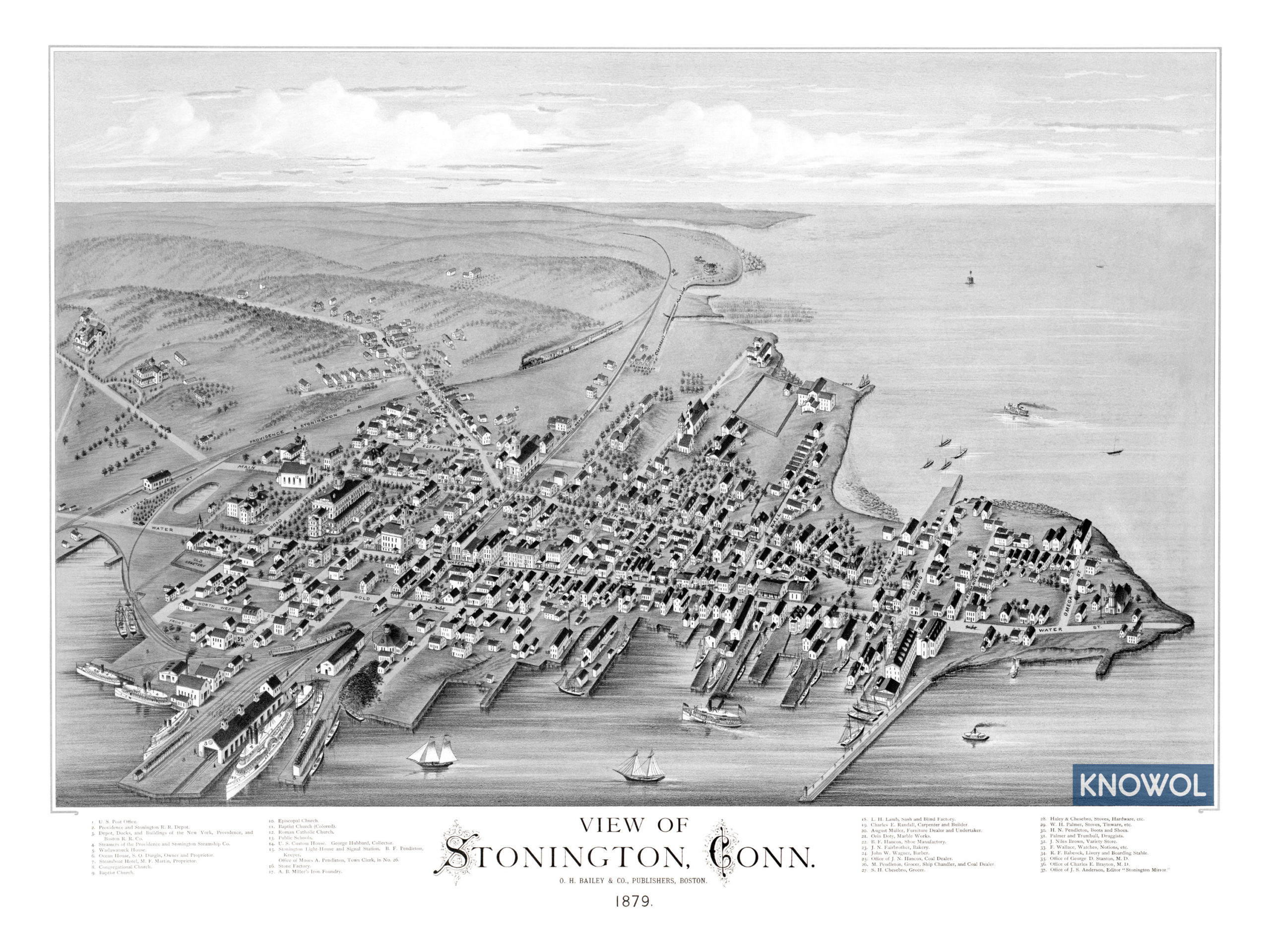
The bird's-eye view
By O.H. Bailey
The town drawn as if from the sky, with its street names and old landmarks, from the Providence and Stonington Railroad and the Providence and Stonington Steamship Company to the Ocean House, the Steamboat Hotel, Miller's Iron Foundry and the Doty Marble Works.3
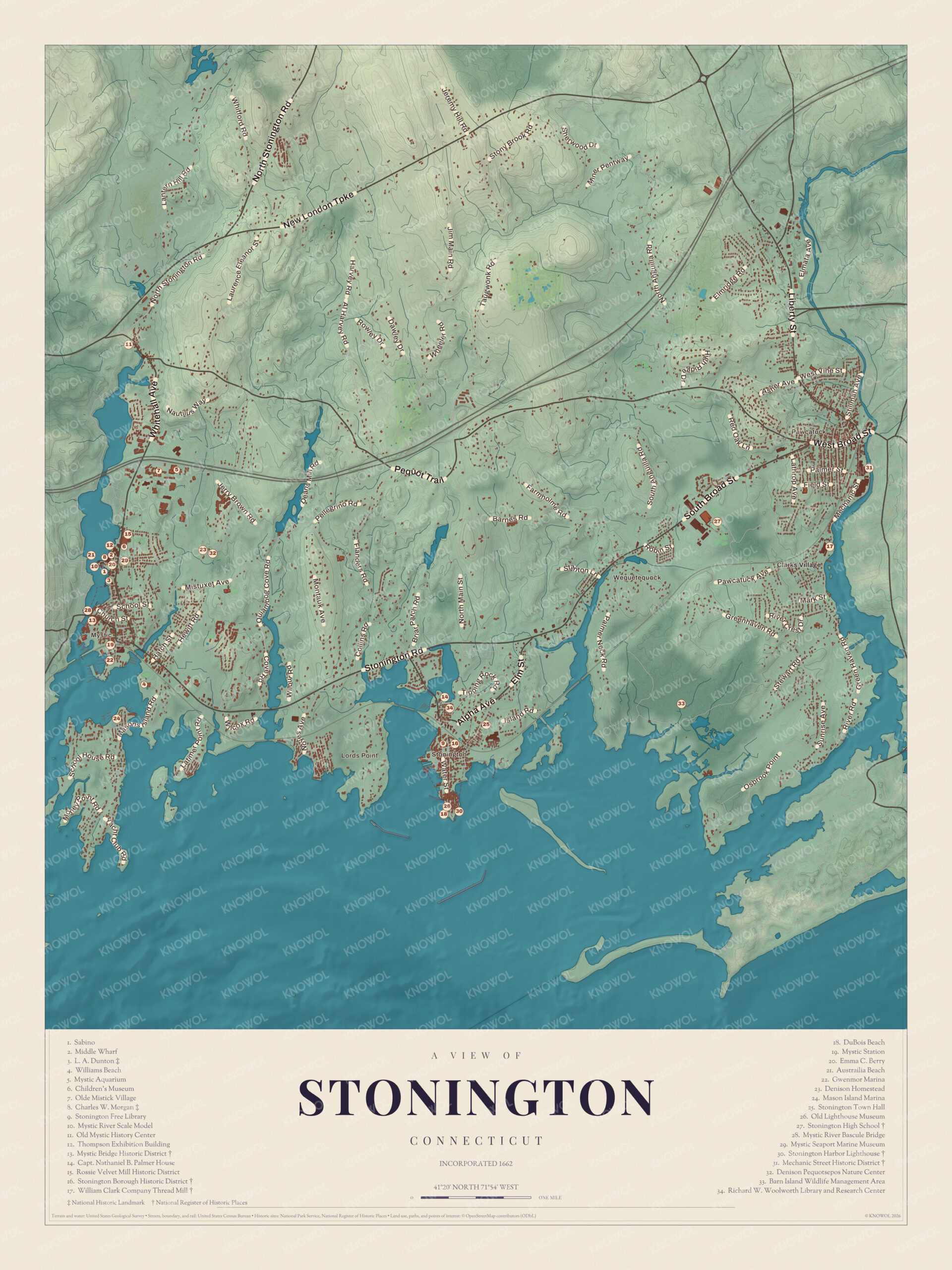
Stonington today
By KNOWOL
Shaded land from the hills above Old Mystic down to the coves and points along the Sound, every street from Pequot Trail to Main Street, Mystic, the Borough and Pawcatuck by name, and a guide of 34 numbered landmarks with the National Register sites marked.4
The story of Stonington
Two bombardments and a goose
The British shelled Stonington twice. In August 1775 the frigate Rose came after the cattle that Block Island had sent here for safekeeping. Musket men from Long Point and a militia company from the Road district kept her boats from landing, and though her guns damaged nearly every house, only one man ashore was hurt, a musician named Jonathan Weaver Jr. In August 1814 Sir Thomas Hardy's squadron tried again. Six volunteers from Mystic arrived on foot and ran straight to help work the battery's gun. Philip Freneau's poem about the fight, with its goose, its hen and three hogs wounded in a pen, became so popular that every Connecticut boy knew it by heart.561
The Stonington side of Mystic
The Mystic River splits Mystic between two towns, and in the 1800s the Stonington half was a village called Mystic Bridge, with 910 people in 1880. In 1836 ships from Mystic worked as wreckers, cruising as far as the West Indies to save wrecked vessels and their cargoes, and its fishing smacks sailed to Cuba to fish for the Spaniards. In 1831 William Clift took the Montgomery out on the first sealing voyage from the village, and on one trip he spent 73 days and nights on a single rock. The Greenman brothers' shipyard later became Mystic Seaport, and just above it the Mystic Twine Company ran a ropewalk 500 feet long.78910
A blacksmith at Wequetequock Cove
The first English settler between the Mystic and Pawcatuck rivers was William Chesebrough, a blacksmith from Rehoboth, who came in 1649 and built at Wequetequock Cove. Connecticut's leaders worried that a smith might mend guns for the Indians, and in March 1651 he had to defend himself before the General Court at Hartford. He was allowed to stay. Walter Palmer settled across the cove from him, and in 1836 the cellars of both houses could still be seen. Massachusetts called the place Southerton, then it was Mistick, and in 1666 it became Stonington. Even Judge Richard A. Wheeler, the historian of the Pequot country, said he had searched the old records as with lighted candles and never found where the name came from.118112
Through the years
23 moments from 1649 to today.
- 1649William Chesebrough, a blacksmith from Rehoboth, settles at Wequetequock Cove, and Thomas Stanton opens a trading house at Pawcatuck.111
- 1651Chesebrough is called before the General Court at Hartford to defend his right to stay, and wins it.11
- 1654Captain George Denison is granted the land near Mystic that his family still owns.13
- 1658Massachusetts names the settlement Southerton.1
- 1662Stonington becomes part of Connecticut under the colony's royal charter.1
- 1666After a year as Mistick, the town is named Stonington.1
- 1717The Denison Homestead, now called Pequotsepos Manor, is built.13
- 1775The British frigate Rose shells the town over Block Island's cattle. Nearly every house is hit, but only one man is wounded.5
- 1814Sir Thomas Hardy's squadron bombards Stonington for three days, and the town's two 18-pounders drive it off.1
- 1815In February, while the town celebrates the end of the war, young Thomas Stanton of Pawcatuck is killed when a cannon goes off too soon.14
- 1819A gazetteer counts 1,100 tons of shipping owned in town and calls Stonington a nursery of seamen.15
- 1820Nathaniel Palmer, a young Stonington captain, sights the land in Antarctica later named Palmer Land.1
- 1831The Montgomery sails from Mystic on August 18, the first sealing vessel to leave the village.9
- 1837The railroad arrives, and Pawcatuck begins to grow from a shipbuilding port into a mill village.16
- 1840The stone Stonington Harbor Light is built at the tip of Stonington Point.17
- 1862The Mystic Iron Works opens at Mystic Bridge to build ships and engines for the government during the Civil War.18
- 1879Leander Barber starts the Mystic Twine Company above Greenmanville, with a ropewalk 500 feet long. O.H. Bailey draws his bird's-eye view the same year.73
- 1892The William Clark Company begins its thread mill on the Pawcatuck River.19
- 1897Velvet makers from Germany open the Rossie Velvet Mill in Mystic.20
- 1914The town marks the battle's hundredth year with three days of parades, and about 5,000 people watch the fireworks.5
- 1925The old lighthouse becomes the Stonington Historical Society's museum, the oldest lighthouse museum in America.1
- 1929Mystic Seaport is founded on the grounds of the Greenman brothers' shipyard.4
- 1941The whaling ship Charles W. Morgan comes to Mystic Seaport.4
Places to see
The numbers match the landmark guide printed on the 2026 map.
- 8Charles W. MorganMystic Seaport. The last wooden whaling ship.Visit their website
- 14Capt. Nathaniel B. Palmer HouseNorth of the Borough. Home of the Antarctic explorer.Visit their website
- 15Rossie Velvet Mill Historic DistrictMystic. German velvet makers' mill of 1897.
- 16Stonington Borough Historic DistrictStonington Borough. The old village on the point.
- 17William Clark Company Thread MillPawcatuck. Brick thread mill begun in 1892.
- 23Denison HomesteadPequotsepos Road. A Denison family house of 1717.Visit their website
- 28Mystic River Bascule BridgeMystic. Lifts at 40 past in summer.
- 29Mystic Seaport Marine MuseumMystic. On the old Greenman shipyard.Visit their website
- 30Stonington Harbor LighthouseStonington Point. Stone tower of 1840, now a museum.Visit their website
- 31Mechanic Street Historic DistrictPawcatuck. The old mill village by the river.
On the National Register
All 16 places in Stonington on the National Register of Historic Places that still stand today, oldest first, and why each one matters.2
-
Robert Stanton House (Stanton-Davis Homestead)
A center-chimney farmhouse tied to Thomas Stanton, one of the town's first settlers. The Davis family farmed the land for generations, and a family society is turning it into a museum.21
-
Pequotsepos Manor (Denison Homestead)
Built on land the Denison family has owned since 1654. It was raised with timber saved from the family's earlier house, which burned on the eve of a wedding, and the Denison Society runs it as a museum.13
-
Stonington Cemetery
Begun as the Chesebrough family burying ground, it became the first incorporated cemetery in New London County in 1849. Nathaniel Palmer, Stephen Vincent Benet and James Merrill are buried here.22
-
Whitehall Mansion
A fine late Georgian house built for Dudley Woodbridge, a Mystic doctor. It was moved across the street in 1962 to make way for Interstate 95, then moved again a short way on its lot, and it's an inn now.23
-
Mystic Bridge Historic District
The old shipbuilding village on the Stonington side of the Mystic River, including Mystic Seaport and the 1920s bascule bridge. The Greenman brothers, Seventh Day Baptists, ran their shipyard on a Saturday Sabbath schedule.10
-
Mechanic Street Historic District
Pawcatuck's mill village, 147 acres with a big brick mill complex on the river and blocks of worker housing, from Greek Revival homes of the shipyard years to later tenements.16
-
Stonington Harbor Lighthouse
A granite tower and keeper's house built partly from the stones of an earlier lighthouse lost to erosion. It went dark in 1889 and has been the Historical Society's museum since 1925.17
-
Charles W. Morgan
National Historic Landmark
A New Bedford whaling ship and the world's oldest surviving merchant vessel, the only wooden whaler left from the American fleet of the 1800s. She's been at Mystic Seaport since 1941.24
-
Rossie Velvet Mill Historic District
A brick velvet mill opened in 1897 by makers from Germany, with the worker housing around it. It was the village's largest employer, with 200 workers, and is now a research center for Mystic Seaport.20
-
Capt. Nathaniel B. Palmer House
National Historic Landmark
Home of the seal hunter, Antarctic explorer and clipper ship designer, with a cupola that looks all around the harbor. The Historical Society saved it from demolition in 1995.25
-
Emma C. Berry
National Historic Landmark
A fishing sloop built at Noank in 1866 and one of the oldest surviving commercial vessels in America. She's the last known American well smack, a design also called the Noank smack.26
-
Stonington High School (the old Borough School)
A Second Empire brick school with a mansard tower, the village school and then Stonington High School from 1910 to 1939. It closed after a fire in 1973 and became homes in 1981.27
-
James Merrill House
National Historic Landmark
The Borough apartment where the poet James Merrill lived from 1954 until 1995 and wrote much of his best work. Writers now live and work there in residencies.28
-
William Clark Company Thread Mill
A steam-powered thread mill with a square tower over the river, a major employer in Pawcatuck and Westerly into the 1950s. It was badly damaged in the 1938 hurricane and repaired.19
-
Sabino
National Historic Landmark
A wooden, coal-fired steamboat from Maine, called America's oldest regularly operating coal-powered steamboat.29
-
L. A. Dunton
National Historic Landmark
A fishing schooner built in Essex, Massachusetts, one of three of her type still afloat. It was once the most common sail-powered fishing boat out of New England ports.30
In their words
“I have searched as with lighted candles all of our New England records to learn the origin of the name of Stonington, but thus far have failed.”
Judge Richard A. Wheeler, quoted in A modern history of New London County, 192212
“Stonington has become conspicuous, as a nursery of seamen, distinguished for their enterprise, perseverance and courage.”
A gazetteer of Connecticut and Rhode Island, 181915
“They kill'd a goose, they kill'd a hen, Three hogs they wounded in a pen.”
Philip Freneau, The Battle of Stonington, 18146
Nearby towns
Sources
- Stonington, Connecticut, Wikipedia
- National Register of Historic Places listings in New London County, Connecticut, Wikipedia
- Bird's-eye view of Stonington, 1879, restored by KNOWOL
- Map of Stonington, Connecticut in 2026, KNOWOL (USGS elevation, Census Bureau roads)
- The Stonington battle centennial, 1915, Internet Archive
- The defence of Stonington (Connecticut) against a British squadron, August 9th to 12th, 1814 (1864), Internet Archive
- The historical, statistical and industrial review of the state of Connecticut (1884), Internet Archive
- John Warner Barber, Connecticut Historical Collections (1836), Internet Archive
- Commemorative biographical record of New Haven County, Connecticut (1902), Internet Archive
- Mystic Bridge Historic District, Wikipedia
- Gideon Hollister, The history of Connecticut (1857), Internet Archive
- A modern history of New London County, Connecticut (1922), Internet Archive
- Pequotsepos Manor, Wikipedia
- A record, genealogical, biographical, statistical, of Thomas Stanton, of Connecticut, and his descendants (1891), Internet Archive
- A Gazetteer of the States of Connecticut and Rhode Island, 1819, Internet Archive
- Mechanic Street Historic District, Wikipedia
- Stonington Harbor Light, Wikipedia
- Commemorative biographical record of Tolland and Windham counties, Connecticut (1903), Internet Archive
- William Clark Company Thread Mill, Wikipedia
- Rossie Velvet Mill Historic District, Wikipedia
- Stanton-Davis Homestead Museum, Wikipedia
- Stonington Cemetery, Wikipedia
- Whitehall Mansion, Wikipedia
- Charles W. Morgan (ship), Wikipedia
- Capt. Nathaniel B. Palmer House, Wikipedia
- Emma C. Berry (sloop), Wikipedia
- Stonington Borough School, Wikipedia
- James Merrill House, Wikipedia
- Sabino (steamer), Wikipedia
- L. A. Dunton (schooner), Wikipedia