
Once the North Bolton parish, Vernon grew around the Hockanum River, which falls 254 feet through the woolen mills of Rockville, while Peter Dobson and the Talcott brothers built cotton and woolen villages in the south of town.
Vernon on the map
Click the map to look closer.
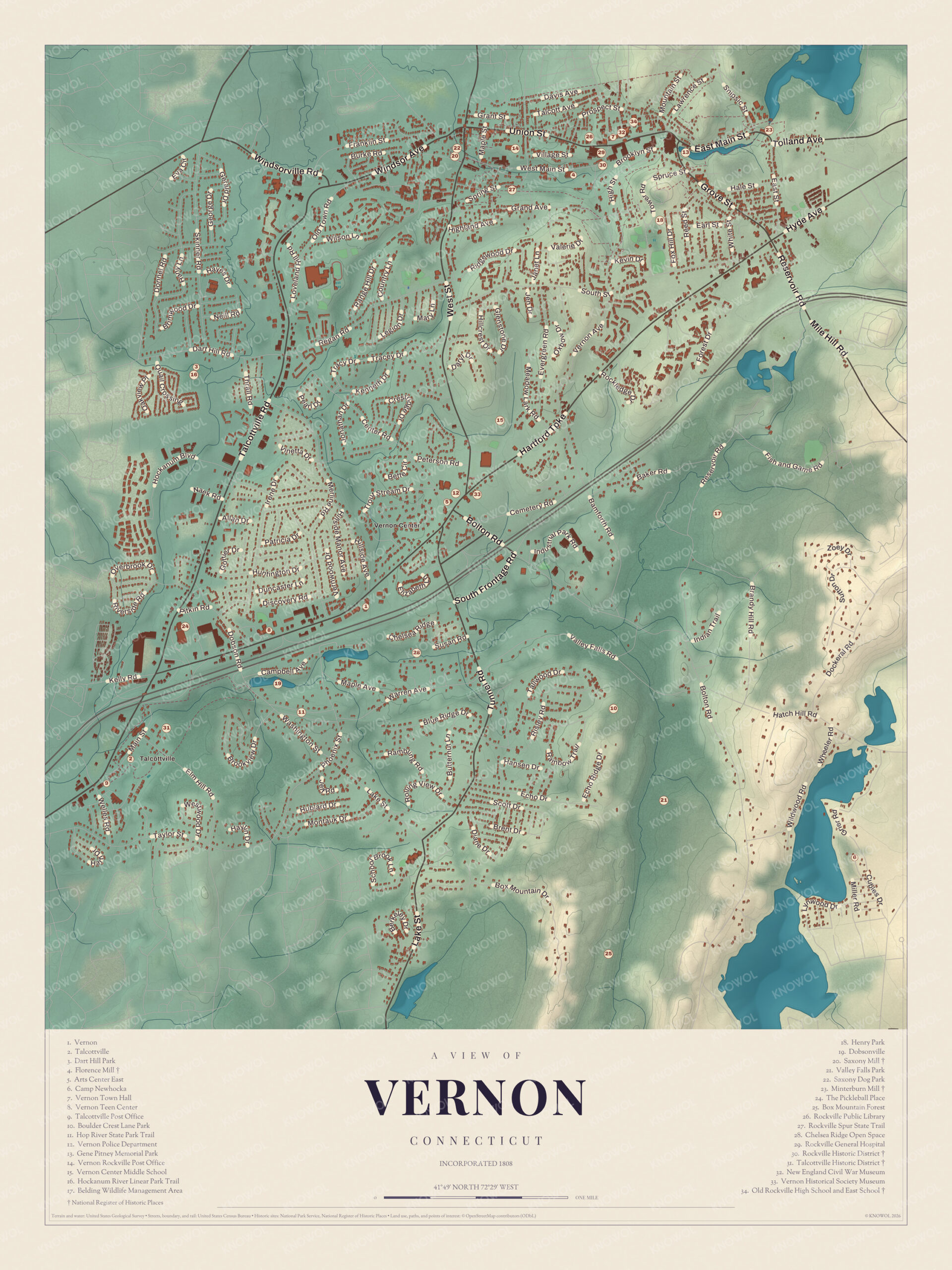
Vernon today
By KNOWOL
Shaded hills from Rockville in the north down to Talcottville in the southwest, every street from West Main Street to Bolton Road, Vernon, Rockville, Talcottville and Dobsonville printed by name, and a guide of 34 numbered landmarks with the National Register sites marked.5
The story of Vernon
Smuggled out in a hogshead
Peter Dobson was born in Preston, England, in 1784 and learned the cotton trade there. England watched its skilled mill men closely so they couldn't carry their know-how abroad, and a 1908 history says Dobson got out hidden in a hogshead bored with gimlet holes so he could breathe. He settled in the south of Vernon, and by 1810 he and his partners had a cotton mill running at what became Dobsonville. When the War of 1812 came, Hartford merchants wouldn't buy American goods, so he sold his yarn to peddlers and kept going. That same year he built the machines Delano Abbott used to make Vernon's first satinet, the cloth Rockville was built on. Dobson was a scientist too, and the head of the Geological Society of London credited him with an early theory of how ice carries boulders.6789
Going to the Rock
In 1726 Samuel Grant swapped a farm of about a hundred acres in Bolton for five hundred acres in the north of the township. The men who got his farm thought the rough land at the outlet of Snipsic was worthless. They hadn't reckoned on the Hockanum, which falls 254 feet in a mile and a half. In 1821 Col. Francis McLean built the Rock Mill beside a natural stone dam called the Rock. For his next mill, the Frank Mill, he used the timbers of Vernon's first meetinghouse. People said they were going to the Rock, and in 1837 the village took the name Rockville. Its worsted later dressed three presidents for their inaugurations, and in 1908 the Grants still owned fifty acres under the 1726 deed.101121213314
Waffles, Lafayette and half a chicken
Stagecoaches on the road between New York and Boston changed horses in Vernon before climbing the Tolland hills. The first hotel in town, built before the Revolution, made waffles so good that travelers went out of their way for them, and everyone called it Waffle Tavern. About 1820 King's Stage House went up, built of brick made close by. When Lafayette came through in 1824, the militia fired its cannon from sunrise to sunset waiting for him and gave up after midnight. Only then did he arrive, and a room at King's had been decorated just for him. Daniel Webster stopped there too. With only minutes to eat, the cook cut his chicken in two and broiled one half while she got the other ready. The tavern closed in 1847, when the stages stopped running.15161718
Through the years
25 moments from 1726 to today.
- 1726Samuel Grant trades his Bolton farm for 500 acres in the north of the township, the land that becomes Rockville.10
- 1740A sawmill goes up at Valley Falls, the earliest mill in town with a sure date.19
- 1749Families in north Bolton, far from the meetinghouse, win the right to hold winter services of their own.20
- 1762The first church is built on Old Meeting House Hill, and Rev. Ebenezer Kellogg begins a pastorate of fifty-five years.20
- 1770sDuring the Revolution, cannon balls are cast from swamp bog ore at a furnace on today's East Main Street.21
- 1802John Warburton builds a dam and cotton mill on the Tankerhoosen River, where Talcottville grows.22
- 1808Vernon is incorporated in October, set off from Bolton and named for Mount Vernon.1
- 1810Peter Dobson and his partners start the cotton mill that becomes Dobson's Mills.7
- 1812Delano Abbott makes Vernon's first piece of satinet on machinery Peter Dobson built for him.8
- 1814Ebenezer Nash builds a small mill on the Hockanum, the start of manufacturing in Rockville.8
- 1818Vernon votes against the new state constitution, ninety-eight to eleven.23
- 1821Col. Francis McLean dams the Hockanum beside the Rock and builds the Rock Mill.2
- 1824Lafayette stops at King's Stage House, where a room has been decorated for him.16
- 1837The mill village votes to call itself Rockville, after the Rock Mill.2
- 1839John Brown, then a wool buyer for the New England Company, writes that he can't yet repay money it advanced him.24
- 1849The first dance in Rockville's new public hall is held on the Fourth of July.25
- 1856Charles and Horace Talcott buy the mills at what becomes Talcottville.22
- 1864The Florence Mill is built on West Main Street after an earlier mill burns.26
- 1871Christian Sharps, inventor of the Sharps rifle, starts a trout hatchery at Valley Falls.27
- 1877The last mill at Valley Falls burns and is never rebuilt.28
- 1881White and Corbin buy the Florence Mill and make it the country's largest envelope factory.26
- 1889Rockville becomes a city, and the Memorial Building goes up in honor of the town's Civil War soldiers.29
- 1892The red brick Rockville High School is built on School Street.30
- 1965The City of Rockville is consolidated with the town of Vernon.1
- 1994Fire destroys the empty Saxony Mill, and its site becomes a town park.31
Places to see
The numbers match the landmark guide printed on the 2026 map.
- 4Florence MillWest Main Street. Once the country's largest envelope factory.
- 7Vernon Town HallRockville. In the 1889 Memorial Building.
- 19DobsonvilleSouthwest. Peter Dobson's cotton mill village.
- 21Valley Falls ParkValley Falls Road. Old millpond, stone dam and hatchery site.
- 23Minterburn MillEast Main Street. Stone warp mill of 1834, now apartments.
- 30Rockville Historic DistrictRockville. 842 buildings over 550 acres.
- 31Talcottville Historic DistrictTalcottville. The Talcotts' mill village of 1870.
- 32New England Civil War MuseumMemorial Building. The Burpee Post's Grand Army hall.Visit their website
- 33Vernon Historical Society MuseumVernon Center. The town's history collection.Visit their website
- 34Old Rockville High School and East SchoolSchool and Park Streets. Schools of 1870 and 1892.
On the National Register
All 7 places in Vernon on the National Register of Historic Places that still stand today, oldest first, and why each one matters.4
-
Valley Falls Cotton Mill Site
Railroad Brook turned mills here from the mid-1700s, first a sawmill, then an oil mill for flaxseed, and from 1847 a woolen mill. Fire destroyed the complex in 1877, and the millpond, stone dam and mill ruins remain in the park.28
-
Talcottville Historic District
John Warburton's cotton mill of 1802, the first financially successful one in Connecticut, grew into a company village under Charles and Horace Talcott. The district keeps their 1870 mill, the stone dam, mill houses and an 1891 iron bridge by the Berlin Iron Bridge Company.22
-
Rockville Historic District
Most of the old city of Rockville, 842 buildings over 550 acres, from the mill owners' houses around Talcott Park and Central Park to the Memorial Building and the mills along the Hockanum.2
-
Minterburn Mill
The first place in Rockville to be developed for industry. Its stone Rockville Warp Building of 1834 is a well-kept Greek Revival mill, and the Minterburn building of 1906 is one of the earliest uses of reinforced concrete in a factory.32
-
Florence Mill
Built to replace a burned textile mill, it is a rare early example of the Second Empire style in a mill. White and Corbin bought it in 1881 and made it the largest envelope factory in the United States, and envelopes were made there until 1975.26
-
Old Rockville High School and East School
The East School of 1870 eased crowding during Rockville's boom after the Civil War. The high school of 1892, designed by Francis Richmond of Springfield, is a fine Richardsonian Romanesque building with a four-story tower.30
-
Sharpe's Trout Hatchery Site
Christian Sharps, inventor of the Sharps rifle, built ponds, a cabin and water works here to raise trout as native stocks declined. He died in 1874, and foundations, small dams and earthen berms remain.27
In their words
“Rockville is set, not on a single hill, nor on seven hills, like ancient Rome, but upon a series of hills.”
The Connecticut magazine, on Rockville at its centennial, 190833
“Small industries have expanded into gigantic corporations with millions of capital, until today the town of Vernon enjoys an international reputation as a great woolen center.”
A century of Vernon, Connecticut, 1808-1908, 191134
“There are few healthier or happier communities in New England.”
The Connecticut magazine, on Talcottville, 190835
Nearby towns
Sources
- Vernon, Connecticut, Wikipedia
- Rockville, Connecticut, Wikipedia
- The Connecticut magazine (1908), Rockville centennial article, on the inauguration cloths, Internet Archive
- National Register of Historic Places listings in Tolland County, Connecticut, Wikipedia
- Map of Vernon, Connecticut in 2026, KNOWOL (USGS elevation, Census Bureau roads)
- The Connecticut magazine (1908), Rockville centennial article, on Peter Dobson, Internet Archive
- Representative citizens of Connecticut, biographical memorial (1916), on Peter Dobson, Internet Archive
- A century of Vernon, Connecticut, 1808-1908 (1911), on Abbott, Dobson and Nash, Internet Archive
- Commemorative biographical record of Tolland and Windham counties, Connecticut (1903), on Peter Dobson, Internet Archive
- The Connecticut magazine (1908), Rockville centennial article, on Samuel Grant's trade, Internet Archive
- The Connecticut magazine (1908), Rockville centennial article, on the rough lands at Snipsic outlet, Internet Archive
- The Connecticut magazine (1908), Rockville centennial article, on the Rock Mill and the Frank Mill, Internet Archive
- The Connecticut magazine (1908), Rockville centennial article, on the first meetinghouse, Internet Archive
- The Connecticut magazine (1908), Rockville centennial article, on the Grant homestead and the 1726 deed, Internet Archive
- The Connecticut magazine (1908), Rockville centennial article, on Waffle Tavern, Internet Archive
- The Connecticut magazine (1908), Rockville centennial article, on King's Stage House and Lafayette, Internet Archive
- The Connecticut magazine (1908), Rockville centennial article, on Lafayette's arrival, Internet Archive
- The Connecticut magazine (1908), Rockville centennial article, on Daniel Webster at King's Tavern, Internet Archive
- The Connecticut magazine (1908), Rockville centennial article, on the first mills, Internet Archive
- A century of Vernon, Connecticut, 1808-1908 (1911), on the North Bolton parish, Internet Archive
- The Connecticut magazine (1908), Rockville centennial article, on the East Main Street furnace, Internet Archive
- Talcottville Historic District, Wikipedia
- The Connecticut magazine (1908), Rockville centennial article, on Phineas Talcott and the 1818 vote, Internet Archive
- The Connecticut magazine (1908), Rockville centennial article, on John Brown's 1839 letter, Internet Archive
- The Connecticut magazine (1908), Rockville centennial article, on the first public hall, Internet Archive
- Florence Mill, Wikipedia
- Sharpe's Trout Hatchery Site, Wikipedia
- Valley Falls Cotton Mill Site, Wikipedia
- The Connecticut magazine (1900), on the Memorial Building, Internet Archive
- Old Rockville High School and East School, Wikipedia
- Saxony Mill, Wikipedia
- Minterburn Mill, Wikipedia
- The Connecticut magazine (1908), Rockville centennial article, on the city's hills, Internet Archive
- A century of Vernon, Connecticut, 1808-1908 (1911), on the mills after the Civil War, Internet Archive
- The Connecticut magazine (1908), Rockville centennial article, on Talcottville, Internet Archive