
A Neponset River town that grew from four families at a Dedham saw mill, where stagecoaches changed horses on the road to Providence and the Neponset's mills turned out hoes, felt hats and paper.
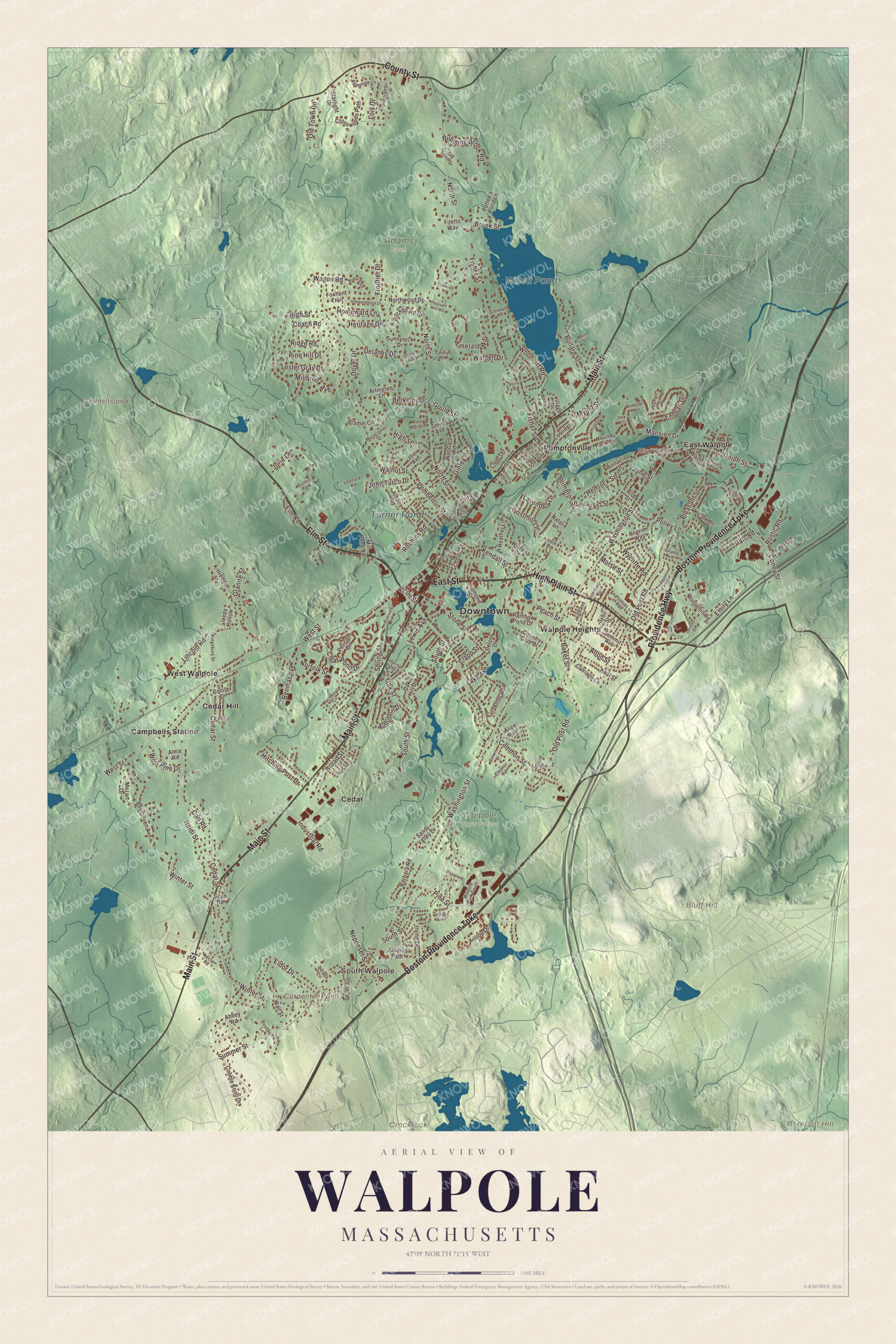
Walpole, Massachusetts on the map
Click the map to look closer.
Walpole today
By KNOWOL
Downtown and South Walpole, with High Plain Street, East Street, Elm Street, Main Street and Providence Highway across town, and Bird Pond, Willett Pond, Turner Pond, Barefoot Hill and Bluff Hill.6
The history of Walpole, Massachusetts
Four neighbors at the saw mill
Walpole began with a saw mill. In March 1659 two Dedham men, Joshua Fisher and Eleazer Lusher, agreed to build one on the Neponset at the edge of a great cedar swamp, and the town promised that no other saw mill would go up on that stream for ten years. James Fales soon set up a home on Spring Brook, probably the first man to own one in what's now Walpole, and by 1666 Dedham spoke of the four neighbors at the saw mill. In 1721 the mill families asked to be set off and were refused twice. When they finally reached Boston, the Council offered only a precinct, but the House held out for a town, and in December 1724 Walpole was born.72
Stagecoach days
For more than a century the road to Providence ran through Walpole. Deacon Ezekiel Robbins kept the Brass Ball tavern at the Centre and set a milestone past his house marking twenty miles from Boston. The first regular stage between Boston and Providence came through in 1767. In 1806 the new turnpike opened through East and South Walpole, and Stephen Fuller's Half-Way House at South Walpole had 18 rooms and an upstairs hall for dancing. Coaches pulled in for breakfast, sometimes a dozen at once. In July 1825 the toll gate just over the Foxborough line counted 207 Citizen's coaches, and on one day alone 16 stages passed. Lafayette stopped at Fuller's in 1824. When the Boston and Providence Railroad opened in 1835, turnpike business fell off at once.89
Pegs, hoes and paper
The Neponset drops 151 feet through Walpole, and its ten mill sites kept the town at work. In 1798 John Frizell, no longer able to follow his trade of shoemaking, advertised a machine that made maple pegs for every shoemaker within 30 miles. Eleazar Smith, who made a watch at 15 with a penknife and a file, built a machine for making the cards used in carding wool. Joshua Stetson's hoes were famous, and his old apprentice Henry Plimpton began making his own at Plimptonville in 1816. Ira Gill made felt hats and raised 22 children. At East Walpole the Bird family built up their paper mills, and when F. W. Bird recovered from hard times, he paid his old creditors in full, with interest, though they had already released him.4
Walpole, Massachusetts through the years
24 moments from 1659 to today.
- 1659Joshua Fisher and Eleazer Lusher of Dedham agree to build a saw mill on the Neponset by the cedar swamp.7
- 1666Dedham's records speak of the four neighbors at the saw mill.7
- 1685Josias Wompatuck confirms Dedham's title but keeps 200 acres near the saw mill for his people, in today's East Walpole.10
- 1721The saw mill families ask to be set off from Dedham and are turned down twice.2
- 1724On December 10 the act dividing Dedham and naming the new town Walpole passes.2
- 1738Ezra Morse and his sons, unhappy in the new town, are set back to Dedham.2
- 1740About this year Deacon Ezekiel Robbins of the Brass Ball tavern sets a milestone marking 20 miles from Boston.8
- 1756Eleven Acadian exiles are sent to Walpole for the winter, and the town looks after them.11
- 1758The town accepts its first schoolhouse, built by Deacon Robbins on land given by Rev. Phillips Payson.12
- 1767The first regular stage between Boston and Providence starts running through the Centre.8
- 1775On April 19, 157 Walpole men march toward Concord, almost one fifth of the town.3
- 1776A smallpox inoculation hospital opens in town, and by fall the townspeople want it shut.12
- 1798John Frizell advertises a machine that makes maple shoe pegs.4
- 1806The Norfolk and Bristol Turnpike opens through East and South Walpole.9
- 1816Women of the Ladies' Literary, Moral Society braid straw while they read, and sell it to buy books.12
- 1816Henry Plimpton starts making hoes at the upper mill site at Plimptonville.4
- 1824Lafayette stops at Fuller's Tavern in South Walpole on his way to Boston.9
- 1825In July the turnpike toll gate south of the village counts 207 Citizen's coaches.9
- 1849The railroad opens between Walpole and Boston on April 23.9
- 1861About this year Willard Lewis starts making lint for Civil War bandages by machine.4
- 1881The brick town hall is dedicated on September 28, with a history of the town by Henry B. Fales.13
- 1886A February flood washes out the Blackburn dam, and the Stetsons save theirs by careful watching.14
- 1903The public library building, helped by Andrew Carnegie, is dedicated in May.12
- 1924Walpole marks its 200th birthday on October 4, with more than five thousand at the evening pageant.15
Places to see in Walpole, Massachusetts
Places worth a visit in Walpole today.
- DowntownWalpole Centre. Grew up around the 1659 saw mill.
- East WalpoleOn the Neponset. The Bird family's paper mill village.
- South WalpoleNear the Foxborough line. Stage stop at Fuller's Half-Way House.
- PlimptonvilleDownstream from the Centre. Henry Plimpton's hoe works from 1816.
- Bird PondEast Walpole. Edge of the land Josias kept in 1685.
- Main StreetThrough the Centre. The old highway to Wrentham village.
- High Plain StreetCorner of Peach Street. Orthodox church organized here in 1826.
- East StreetCorner of Elm Street. L. F. Fales's machine shop of 1898.
- Elm StreetThe Turner place. Bog iron once dug from the meadow.
Walpole on the National Register of Historic Places
All 3 places in Walpole on the National Register of Historic Places that still stand today, oldest first, and why each one matters.5
-
Deacon Willard Lewis House
Horatio Wood built this two-and-a-half-story wood-frame house about 1826, and in 1863 it was bought by Willard Lewis, the mill owner. It is now home to the Walpole Historical Society.16
-
Walpole Town Hall
Designed by J. Williams Beal and completed in 1881, this two-story brick town hall mixes Classical Revival and Romanesque styles. Its best-known feature is the 70-foot square clock tower over a round-arched entrance trimmed in brownstone.17
-
Union Station
The union station built in 1883 where two rail lines crossed burned in April 1893, and work on this Victorian eclectic depot with Richardsonian touches began that August. It is one of the few such stations in Massachusetts built of wood rather than stone, and the best preserved, and trains still stop here.18
Walpole in their words
“That is how the town of Dedham gave away her daughter. But she has grown for all that.”
Henry B. Fales, in his address at the new town hall in 1881, from the History of Norfolk County, 188419
“I assure you our good old town stood up in the front ranks in those days, and I do not believe the breed has all run out yet.”
Henry B. Fales on Walpole in the Revolution, 1881, from the History of Norfolk County, 18843
“Rich and poor walked side by side, chatting freely together, in the procession. They sat side by side in God's country, eating beans and brown bread.”
The story of Walpole, 1925, on the town's 200th birthday, October 4, 192415
Towns near Walpole, Massachusetts
Sources for the history of Walpole
- Walpole, Massachusetts, Wikipedia
- The story of Walpole, 1724-1924 (1925), on the birth of the town
- History of Norfolk County, Massachusetts (1884), on Walpole in the Revolution
- The story of Walpole, 1724-1924 (1925), on industrial Walpole
- National Register of Historic Places listings in Norfolk County, Massachusetts, Wikipedia
- Map of Walpole, Massachusetts in 2026, KNOWOL
- The story of Walpole, 1724-1924 (1925), on the saw mill settlement
- The story of Walpole, 1724-1924 (1925), on post road and tavern days
- The story of Walpole, 1724-1924 (1925), on the turnpike and stagecoach days
- The story of Walpole, 1724-1924 (1925), on the deed of Josias Wompatuck
- The story of Walpole, 1724-1924 (1925), on the Acadians
- The story of Walpole, 1724-1924 (1925), on schools, doctors and the library
- History of Norfolk County, Massachusetts (1884), on the Walpole town hall
- The story of Walpole, 1724-1924 (1925), on the flood of 1886
- The story of Walpole, 1724-1924 (1925), on the bicentennial celebration
- Deacon Willard Lewis House, Wikipedia
- Walpole Town Hall, Wikipedia
- Union Station, Wikipedia
- History of Norfolk County, Massachusetts (1884), Henry B. Fales's history of Walpole