
The Watch City on the Charles, once the middle precinct of Watertown, where the Boston Manufacturing Company's mills, the watch factory and the Parmenter crayon works carried the Waltham name around the world.
Then and now
The same town 149 years apart. Click either map to look closer.
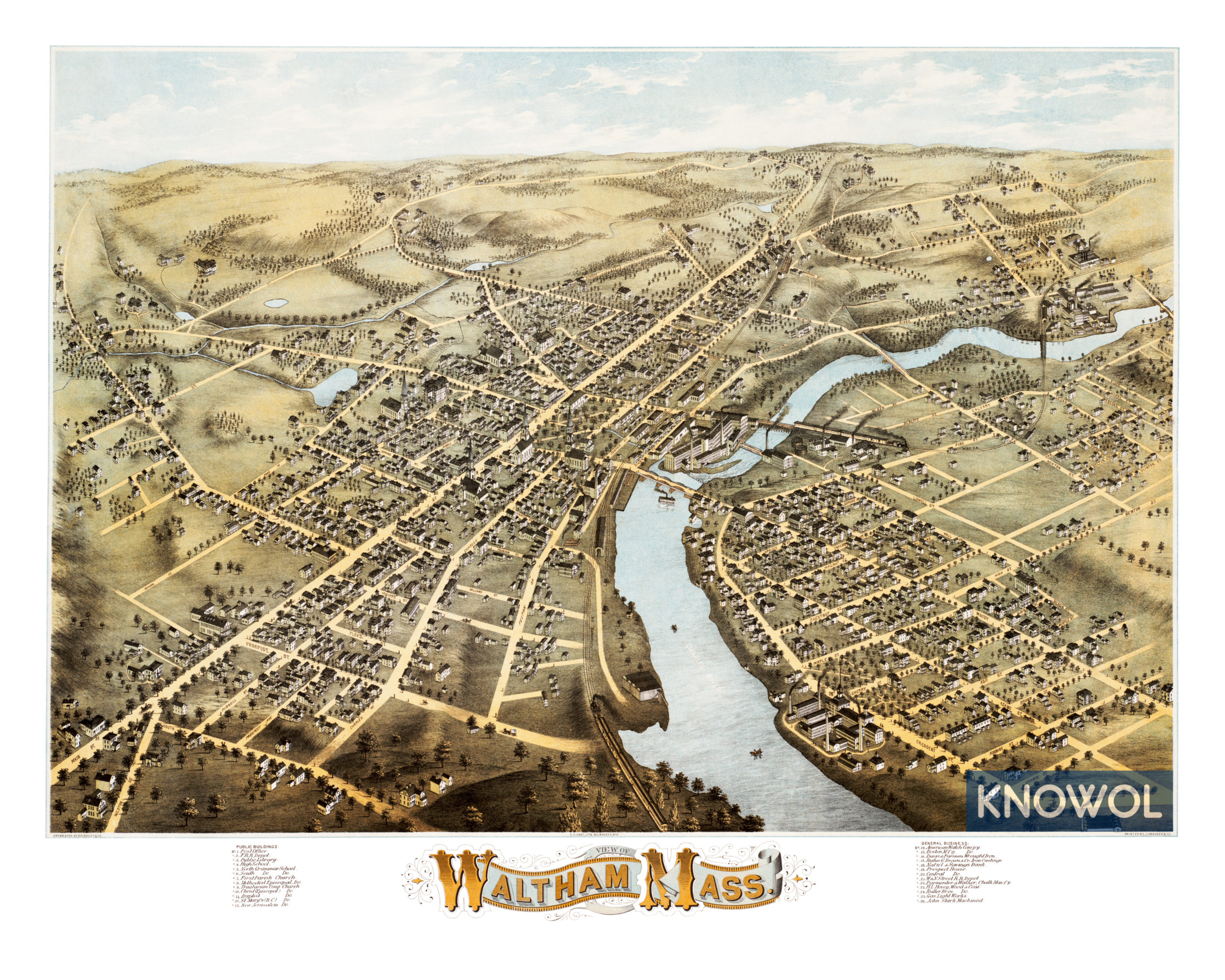
The bird's-eye view
By O.H. Bailey
Waltham drawn as if from the sky in 1877, with the American Watch Company, Boston Manufacturing, Davis & Farnum Wrought Iron, the Prospect Hotel, the Parmenter & Walker chalk manufactory, Hovey Wood & Coal, the North and South Grammar Schools, churches and railroad depots.5
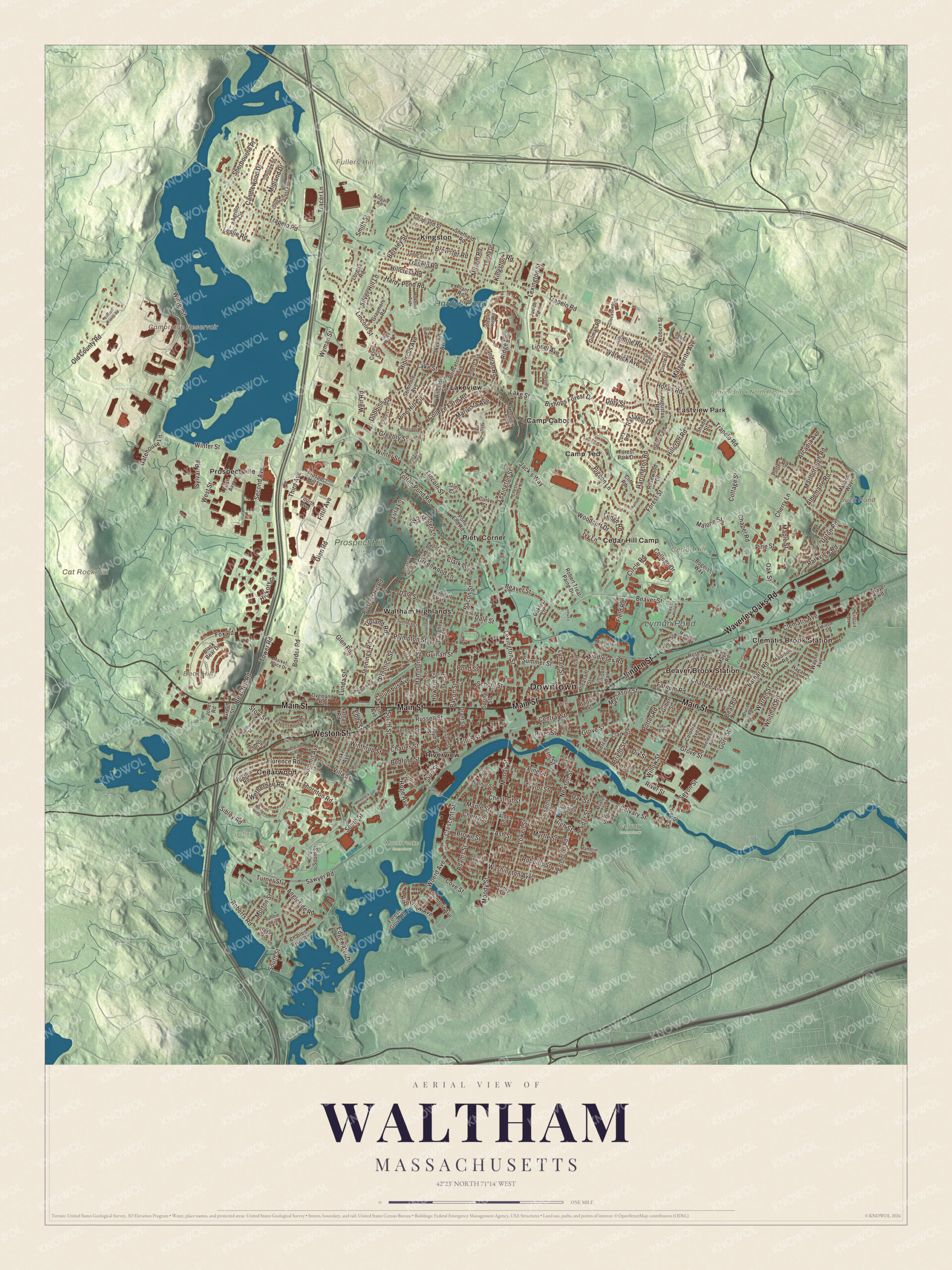
Waltham today
By KNOWOL
Waltham's streets, buildings, neighborhoods and terrain, from downtown and Main Street out to Hardys Pond, the Cambridge Reservoir, Beaver Brook North Reservation, Bear Hill, Cat Rock Hill and Cedar Hill, all named on the map.6
The story of Waltham
The stove the ladies gave
Waltham started out as the Middle Precinct of Watertown, a long way from the meeting-house at the east end, and a church quarrel finally split the town in 1738. Its first meeting-house was secondhand: in October 1721 the precinct bought Newton's old one, took it down and set it up again here. Church business stayed lively. The town argued for years about a bell before voting money for one in 1815. In 1818 somebody put a stove in the meeting-house and asked the town to approve it. The voters ordered it out, then thought better of it and accepted the stove as a present from the ladies of Waltham. The 1880 county history says the threatened revolution was averted by female diplomacy. About 1820 a sleigh ride that left some people uninvited split the parish for years.78910111
Mills, acid and crayons on the Charles
In 1813 Francis Cabot Lowell and his partners organized the Boston Manufacturing Company, and by 1814 Lowell's power loom was running at Waltham. The company's books record its first cloth on February 2, 1816: 1,242 yards of yard-wide cotton. Paul Moody built and kept up the mill's machines. Once, after a meeting at Lowell's house agreed to order a governor from England, Moody couldn't get the problem out of his head on his ride to Waltham, so he made one himself, and it ran in the mill until 1832. In 1820 the Newton Chymical Company began making sulphuric acid on land Waltham later annexed. By 1887 the Parmenter Crayon Company was shipping Waltham crayons all over Europe and as far as New Zealand and Japan, and a city booklet called it the largest crayon maker in the world.12131415161718
The night the watch factory wore a crown
The watch factory made modern Waltham. In 1869 a visitor counted three-quarters of a mile of benches and 750 workers, and in 1888 another writer found about 2,500 men and women there and said the city had grown with the factory. In August 1904, during the Grand Army encampment in Boston, Waltham held a river carnival on the Charles, and the encampment's own book says there was never such a crowd in Waltham. The watch factory turned on nearly all of its 50,000 electric lights and set a crown of 416 lights on top of its 175-foot chimney. The first flash from that crown signaled the start of the parade of lighted boats. C. G. Metz floated an automobile body on a canoe, run by steam, and the crowd cheered it.192202122
Through the years
25 moments from 1634 to today.
- 1634The English settle the area as part of Watertown.1
- 1691Waltham is the Middle Precinct of Watertown, with its own military company.7
- 1703The first burial is made at Grove Hill Cemetery, the town's only cemetery until 1857.23
- 1721The precinct buys Newton's old meeting-house and moves it to Waltham in October.9
- 1738Waltham is incorporated as its own town after a church quarrel splits Watertown.8
- 1775On April 19, Capt. Abraham Peirce's company marches on the alarm to Concord and Lexington.24
- 1793Theodore Lyman lays out his country estate, The Vale.25
- 1798The Waltham Social Library, the town's first library, is founded.26
- 1806Christopher Gore's mansion is built as a summer home.27
- 1813Francis Cabot Lowell and his partners organize the Boston Manufacturing Company.12
- 1814Lowell's power loom goes into operation at Waltham.13
- 1816On February 2 the company's books record its first cloth, 1,242 yards of cotton.14
- 1818Town meeting accepts a stove for the meeting-house as a present from the ladies of Waltham.10
- 1820The Newton Chymical Company starts making sulphuric acid on land later annexed to Waltham.17
- 1826On December 24 sixty or more men organize the Rumford Institute, named for Count Rumford.17
- 1849About 500 acres of Newton become part of Waltham, today's South Side.28
- 1854The watch company opens its factory in Waltham.1
- 1857The Waltham Agricultural Library Association, later the Farmers' Club, is formed.29
- 1865The free public library opens in the Waltham Bank Building.29
- 1877O.H. Bailey publishes his bird's-eye view of Waltham.5
- 1884Waltham becomes a city.6
- 1885The Waltham Training School for nurses starts with a class of seven.30
- 1904A river carnival on the Charles draws the biggest crowd Waltham has ever seen.20
- 1915The public library moves into the Francis Buttrick Library on Main Street.26
- 1957The watch company closes after making more than 35 million watches, clocks and instruments.1
Places to see
Places worth a visit in Waltham today.
- DowntownCentral Square. Built on land the mill company gave.
- Main StreetEast to west through downtown. Route 20, once the leading road west.
- Linden StreetEast side, north of Main Street. Laid out through Lyman land after 1845.
- Hardys PondNorthwest Waltham. Once called Mead's or Sherman's Pond.
- Cambridge ReservoirWestern edge. Part of Cambridge's water supply.
- Beaver Brook North ReservationBelmont line. State woodland along Beaver Brook.Visit their website
- Cedar HillBeaver and Linden Streets. Cornelia Lyman Warren's estate, then the Girl Scouts'.
On the National Register
21 of the 101 places in Waltham on the National Register of Historic Places that still stand today, oldest first, and why each one matters. See the full list of National Register places in Waltham.4
-
Piety Corner Historic District
One of the oldest settled parts of Waltham, around the junction of Totten Pond Road with Lexington and Bacon Streets, with the city's largest group of well-preserved 19th and early 20th century houses. It was first called Hosier's Corner and took its present name from the ministers who lived there.31
-
Grove Hill Cemetery
Established in 1703, the cemetery was Waltham's only cemetery until 1857, when Mount Feake Cemetery opened. It was authorized in 1703, but its initial 2.3-acre (0.93 ha) parcel of land was not purchased until 1704.23
-
Hagar, Smith, Livermore, Sanderson House
Considered the city's oldest surviving building. Deed research suggests its oldest part may date to 1716, though the building itself points to the mid-1700s, and the house grew in stages into the 1800s.32
-
Ephraim Hammond House
Built in 1775, it's Waltham's only side-hall Georgian house. It became part of Cornelia Lyman Warren's Cedar Hill estate and was later given to the Girl Scouts, who restored it.33
-
The Vale
National Historic Landmark
Boston merchant Theodore Lyman laid out this 400-acre country estate in 1793, and Samuel McIntire designed its Federal style mansion, finished in 1798. Its first greenhouse, built before 1800, is thought to be the oldest in the United States, and the Lyman family summered here for over 150 years.25
-
Gore Place
National Historic Landmark
The mansion was built in 1806 as a summer home for Christopher Gore, later governor of Massachusetts, who entertained the Marquis de Lafayette, Daniel Webster and James Monroe here. It's a National Historic Landmark as a large Federal style country house with well-preserved staff quarters, and the estate is now a museum.27
-
Boston Manufacturing Company
National Historic Landmark
Organized in 1813 by Francis Cabot Lowell and his partners, the company built the first integrated spinning and weaving factory in the world here, run by water power. Its first mill was finished in late 1814, and the Waltham System it pioneered was copied at Lowell and across New England.12
-
Lawton Place Historic District
The district preserves some of the nation's oldest textile mill worker housing. The duplex houses located on the south side of Lawton Place were built c. 1815-17 by the Boston Manufacturing Company (BMC), the first mill to process textiles entirely under one roof.34
-
Central Square Historic District
Waltham had no real town center until the 1830s, when the Boston Manufacturing Company gave the town the land that's now its common. The district takes in the common, the City Hall of 1924 to 1926, the 1887 fire station and the commercial blocks facing them.35
-
Prospect House
Built in 1839, this temple-front Greek Revival structure was originally a hotel and tavern, and is one of only a few surviving 19th century hotel buildings in the city. Now an apartment house, the building has four two-story fluted Doric columns supporting a pedimented gable, with a second-story porch behind the columns.36
-
American Waltham Watch Company Historic District
The former factory of the Waltham Watch Company, the leading American watchmaker of the 19th century and the city's largest employer, which began on this site in 1854. Its red brick buildings, from the 1870s to the 1910s, stretch nearly 1,000 feet along the south bank of the Charles.37
-
Mount Feake Cemetery
Opened in 1857 as the city's second cemetery and designed by Robert Morris Copeland, it's one of the best-preserved garden cemeteries in the state. Its hill was named by Governor John Winthrop in 1632 for Robert Feake, one of Watertown's founding settlers.38
-
Robert Treat Paine Jr. House
National Historic Landmark
Architect H. H. Richardson and landscape architect Frederick Law Olmsted designed Stonehurst in 1884 to 1886 for the philanthropist Robert Treat Paine, enlarging an 1866 summer house on a new site atop a rocky ridge. The city has owned it since 1974, and it's believed to be the only home the two designed together that's open to the public.39
-
Moody Street Historic District
It consists of eight commercial properties facing Moody Street as it runs south from the Charles River toward Newton. The area was developed between about 1880 and 1950, and is a reminder of the city's economic prosperity in that time.40
-
Lord's Castle
Rufus Lord built the home in 1886 on property purchased from Oel Farnsworth. Lord, who owned a prominent construction business in Waltham, was known for his work on the Company F State Armory at Sharon and Curtis Streets.41
-
United States Watch Company
Built in 1886 and enlarged in 1901, it represents one of the most successful spinoffs of the American Waltham Watch Company, Waltham's dominant watchmaker of the late 19th century. When the complex was listed on the National Register of Historic Places in 1989, it was the last watch factory left in the city.42
-
Christ Episcopal Church
The parish was founded in 1848. Its fieldstone church, designed by Peabody and Stearns, was built in 1897 and 1898 and has stained glass by several well-known makers, including Clayton and Bell.43
-
Francis Buttrick Library
The main building of the Waltham Public Library, a Georgian Revival library of 1915 paid for by a bequest from Francis Buttrick, a major landowner in the city. The library itself began in 1865 with books given by the Rumford Institute.44
-
The Castle
Built in 1928 for the Middlesex College of Medicine and Surgery and modeled on a Norman castle, it stands on Boston Rock on the Brandeis University campus. Brandeis took down several of its sections in 2017.45
-
First Parish Church
The congregation dates to about 1696, when Waltham was still part of Watertown, and its first meetinghouse was a building moved from what's now Newton. The present Classical Revival church by Allen & Collens went up in 1933, after fire destroyed its 1838 predecessor.46
-
Wilson's Diner
Built by the Worcester Lunch Car Company as diner number 819 and delivered here in March 1949, it keeps its marble counter with 18 stools, its wooden booths and its stainless steel doors.47
In their words
“the Walthamites sat down under their own vine and fig-tree, by the banks of the smooth flowing Charles.”
From the Hub to the Hudson, 1869, on Waltham's split from Watertown8
“her citizens take such pride in their surroundings that Waltham seems destined to have a very bright future.”
The City of Waltham, Massachusetts, 188748
“the fame of Waltham Crayons goes hand in hand with that of Waltham watches, and "makes its mark" in many a clime.”
The City of Waltham, Massachusetts, 1887, on the Parmenter Crayon Company18
Nearby towns
Sources
- Waltham, Massachusetts, Wikipedia
- A model factory in a model city: a social study (1888), Internet Archive
- Old paths and legends of New England (1909), on Prospect Hill and the Beaver Brook oaks, Internet Archive
- National Register of Historic Places listings in Waltham, Massachusetts, Wikipedia
- Beautiful old map of Waltham, Massachusetts from 1877, restored by KNOWOL
- Map of Waltham, Massachusetts in 2026, KNOWOL
- Historic homes and places and genealogical and personal memoirs relating to the families of Middlesex County, Massachusetts (1908), on the Middle Precinct, Internet Archive
- From the Hub to the Hudson (1869), on Waltham's split from Watertown, Internet Archive
- History of Newton, Massachusetts, town and city, 1630-1880 (1880), on the meeting-house moved to Waltham, Internet Archive
- History of Middlesex County, Massachusetts (1880), on the meeting-house bell and stove, Internet Archive
- Historic homes and places and genealogical and personal memoirs relating to the families of Middlesex County, Massachusetts (1908), on the sleigh ride quarrel, Internet Archive
- Boston Manufacturing Company, Wikipedia
- The memorial history of Boston, including Suffolk County, Massachusetts, 1630-1880 (1880), on the Waltham mill, Internet Archive
- History of the origin of the town of Clinton, Massachusetts, 1653-1865 (1896), quoting the History of Waltham, Internet Archive
- A Chronicle of Textile Machinery, 1824-1924 (1923), on Paul Moody, Internet Archive
- Illustrated History of Lowell and Vicinity, Massachusetts (1897), on Paul Moody's governor, Internet Archive
- The City of Waltham, Massachusetts: its advantages to manufacturers and as a place of residence (1887), on the chemical works and the Rumford Institute, Internet Archive
- The City of Waltham, Massachusetts (1887), on the Parmenter Crayon Company, Internet Archive
- From the Hub to the Hudson (1869), on the Waltham Watch Company, Internet Archive
- Unofficial proceedings in connection with the thirty-eighth national encampment, Grand Army of the Republic, Boston, 1904 (1907), on the river carnival, Internet Archive
- Unofficial proceedings … thirty-eighth national encampment, Grand Army of the Republic (1907), on the watch factory lights, Internet Archive
- Unofficial proceedings … thirty-eighth national encampment, Grand Army of the Republic (1907), on the carnival floats, Internet Archive
- Grove Hill Cemetery, Wikipedia
- Massachusetts soldiers and sailors of the revolutionary war (1896), Internet Archive
- The Vale, Wikipedia
- Waltham, Massachusetts city directory (1925), on the public library, Internet Archive
- Gore Place, Wikipedia
- The City of Waltham, Massachusetts (1887), on the South Side annexation, Internet Archive
- The City of Waltham, Massachusetts (1887), on the Farmers' Club and the public library, Internet Archive
- Medical Communications of the Massachusetts Medical Society, Vol. 14 (1889), on the Waltham Training School, Internet Archive
- Piety Corner Historic District, Wikipedia
- Hagar, Smith, Livermore, Sanderson House, Wikipedia
- Ephraim Hammond House, Wikipedia
- Lawton Place Historic District, Wikipedia
- Central Square Historic District, Wikipedia
- Prospect House, Wikipedia
- American Waltham Watch Company Historic District, Wikipedia
- Mount Feake Cemetery, Wikipedia
- Robert Treat Paine Jr. House, Wikipedia
- Moody Street Historic District, Wikipedia
- Lord's Castle, Wikipedia
- United States Watch Company, Wikipedia
- Christ Episcopal Church, Wikipedia
- Francis Buttrick Library, Wikipedia
- The Castle, Wikipedia
- First Parish Church, Wikipedia
- Wilson's Diner, Wikipedia
- The City of Waltham, Massachusetts (1887), on the new city government, Internet Archive