
The Brass City on the Naugatuck, a flood-prone Puritan settlement called Mattatuck that grew into the world's leading maker of brass, buttons, clocks and dollar watches, and still keeps the clock tower and Cass Gilbert buildings of its best years.
Waterbury on the map
Click the map to look closer.
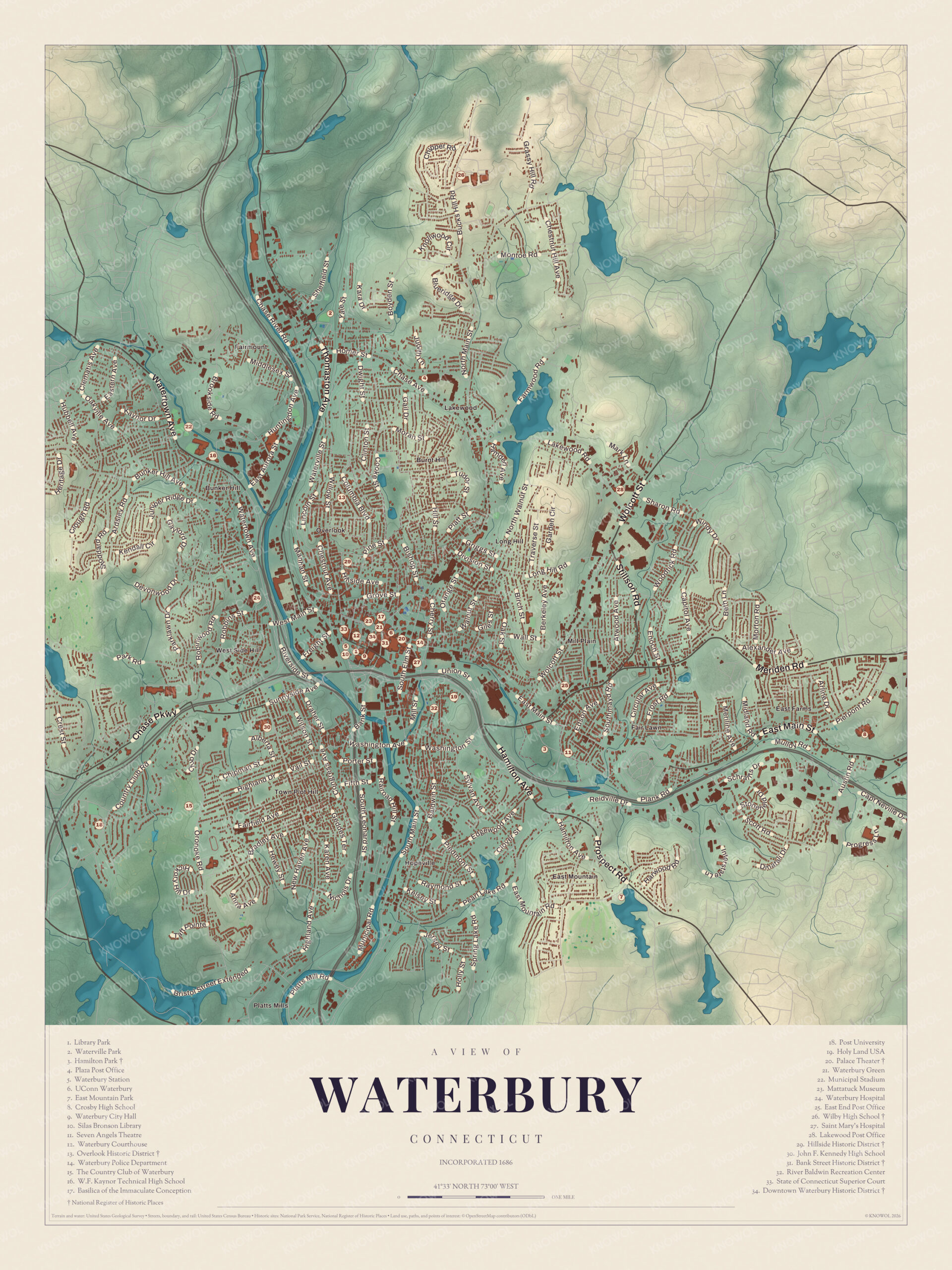
Waterbury today
By KNOWOL
Shaded terrain around Bald Hill and the river valley, every street from downtown and the Green to Hillside, Overlook and East Farms, and a guide of 34 numbered landmarks with the National Register sites marked.4
The story of Waterbury
Buttons before brass
Waterbury's brass began with buttons. Joseph Hopkins opened a silversmith's shop about 1753, and a set of his horn and silver buttons was still being worn 140 years later, on its twenty-seventh vest. In 1802 four partners with little money started Abel Porter and Company to make metal buttons. With nine hired hands they bought worn-out stills, sugar boilers and old kettles for their copper, and finished the sheets on small rolls turned by horse power. J. M. L. Scovill, who later took over the business, liked to tell how he once drove a sled to the mill at Bradleyville sitting inside an old copper boiler, until it rolled off at the top of a hill with him in it. In 1824 the firm gave Lafayette a full set of solid gold buttons.5678
The hill that became a watch factory
Pine Hill once rose 107 feet near the Naugatuck, and for years Waterbury bought its building sand there by the cartload. In March 1880 a steam shovel left over from railroad work went to work on it, and by September 1881 the hill was gone, its sand carted into the low, swampy ground by the river. The Waterbury Watch Company built its factory in a pit dug sixty feet back into the hill and moved in during May 1881. Its first watches had the famous long wind that the papers joked about, but they kept good time, and many were given away as newspaper prizes. By 1918 the Waterbury Clock Company, maker of the Ingersoll watch, had over 3,000 workers and could turn out 23,000 timepieces a day.91011
A town of brooks and floods
When the colony renamed Mattatuck in 1686, it chose Waterbury for the place's many rivers, brooks, ponds, swamps and boggy meadows. The water was a mixed blessing. In February 1691 rain and melting snow sent the river over the meadows, washing away newly plowed soil and burying the rest in sand and stones, and many settlers gave up and left. On November 13, 1853, another flood came down the valley, bigger than anyone living had seen, carrying off bridges and factory raceways. The same streams turned the wheels that built the Brass City, and they needed so many bridges that one resident said it could just as well be called the City of Bridges. Up in Waterville, an old resident remembered when Mack's Brook ran full of salmon.1213141516
Through the years
24 moments from 1674 to today.
- 1674Settlers from Farmington build in what's now the Town Plot section and call the place Mattatuck.1
- 1675King Philip's War empties the settlement; families come back in 1677 and build along the Mad River.1
- 1686The colony admits Mattatuck as its 28th town and renames it Waterbury for its many streams.1
- 1691The Great Flood washes the plowed soil off the river meadows, and many settlers give up and leave.13
- 1753About this year Joseph Hopkins opens a silversmith's shop, the first business to sell beyond the town.5
- 1790Wooden clocks are being made in a room of the Academy.17
- 1796Jared Byington is granted a patent for a machine for cutting nails.18
- 1802Abel Porter and Company starts making metal buttons, the beginning of Scovill and the brass industry.6
- 1824The button makers give Lafayette a full set of solid gold buttons.8
- 1842The Scovills begin making plated metal for daguerreotype plates.19
- 1853Waterbury is incorporated as a city, and in November a flood bigger than anyone living had seen comes down the valley.114
- 1857The Waterbury Clock Company is formed out of Benedict and Burnham.20
- 1862Theodore R. Timby, a Waterbury resident, patents his revolving gun tower and contracts it for the Monitor.21
- 1870The Silas Bronson Library opens on April 1.4
- 1881Pine Hill is dug away, and the Waterbury Watch Company moves into a factory cut sixty feet into it.910
- 1884Waterbury's baseball club wins the state league championship.22
- 1894The American Pin Company moves its works to a new factory in Waterville.23
- 1898Mrs. David Hamilton gives the first 45 acres of Hamilton Park.24
- 1902On February 2 fire sweeps downtown, and the rebuilt blocks give it a matching look.25
- 1904The Elton Hotel opens on the Green and makes money in its first year.26
- 1909Union Station opens, with its clock tower modeled on one in Siena.27
- 1922The Palace Theater opens on East Main Street.28
- 1933The Waterbury Clock Company brings out the Mickey Mouse watch, and 11,000 sell the first day.1
- 1960Forty thousand people wait on the Green until 3 AM to hear John F. Kennedy speak from the hotel balcony.1
Places to see
The numbers match the landmark guide printed on the 2026 map.
- 1Library ParkGrand Street. Laid out when Grand Street was widened.
- 3Hamilton ParkEast End. The city's oldest park, given 1898.
- 5Waterbury StationMeadow Street. Union Station and its clock tower, 1909.
- 9Waterbury City HallGrand Street. Part of Cass Gilbert's municipal complex.
- 10Silas Bronson LibraryGrand Street. First opened April 1, 1870.Visit their website
- 13Overlook Historic DistrictNorth of downtown. The city's first big planned neighborhood.
- 19Holy Land USAPine Hill, above I-84. John Greco's hilltop shrine, lit cross.
- 20Palace TheaterEast Main Street. Thomas W. Lamb's stage of 1922.Visit their website
- 21Waterbury GreenDowntown. What's left of the old town common.
- 23Mattatuck MuseumDowntown. Connecticut art and 15,000 buttons.Visit their website
On the National Register
All 23 places in Waterbury on the National Register of Historic Places that still stand today, oldest first, and why each one matters.3
-
Downtown Waterbury Historic District
The 75-acre heart of the city around the Green and West Main Street, mostly big commercial blocks from the brass boom and the rebuilding after the 1902 fire. Its architects include Henry Bacon and Cass Gilbert.29
-
Hillside Historic District
A 106-acre neighborhood north of downtown where many of the city's leading families lived, with nearly 400 historic buildings from Greek Revival to Tudor Revival.30
-
Waterbury Brass Mill
The archaeological remains of the Waterbury Brass Company, founded in 1846 and once the country's largest maker of rolled brass. Wall fragments and turbine pits survive at the south edge of Hamilton Park.31
-
Riverside Cemetery
A rural cemetery on the west bank of the Naugatuck, dedicated in 1853, with winding paths, two ponds and a Gothic chapel of 1885. Older stones were moved here from the Grand Street burying ground.32
-
Enoch Hibbard House and George Granniss House
A well-kept pair of Italianate houses just south of the Green, thought to be the work of New Haven architect Henry Austin. They now hold offices.33
-
John Kendrick House
A brick Tuscan villa built by brassmaker Green Kendrick for his son John, a judge and later mayor. It's one of the last of the grand houses that once lined the Green, and it housed the Mattatuck Museum in its early years.34
-
Waterbury Clock Company
The factory where the company that became Timex made clocks and the movements for dollar watches, from 1873 until it left the city in 1944. More than 20 brick buildings remain.20
-
Benedict-Miller House
A Queen Anne mansion designed by Palliser, Palliser and Company for brass industrialist Charles Benedict, one of only two grand houses left of those built for the city's industrial leaders.35
-
Bishop School
Built for a mostly Irish neighborhood and enlarged in 1890 and 1895 as families from eastern and southern Europe arrived. It was a school until 1976 and now holds homes.36
-
Washington Avenue Bridge
The oldest known lenticular truss bridge by the Corrugated Metal Company, later the Berlin Iron Bridge Company, and rare for its city setting and decorative finials.37
-
Bank Street Historic District
Four attached brick and brownstone commercial buildings from around 1900, each in a different style, including a rare Queen Anne commercial block, the Griggs Building of 1884.38
-
Sheffield Street Bridge
A wrought iron lenticular truss bridge by the Berlin Iron Bridge Company, built heavy for the mills along Hancock Brook. In 2001 it was one of only seventeen such bridges left in the state.39
-
Overlook Historic District
The city's first major planned neighborhood, laid out by Cornelius Cables around the grass-median boulevard of Columbia Avenue, with nearly 500 historic buildings, most of them Colonial Revival houses.40
-
Hamilton Park
The city's oldest park, begun in 1898 with 45 acres given by Mrs. David Hamilton and grown to 93. Its old dance pavilion is now the Seven Angels Theatre, and its east end is a bird sanctuary.24
-
Webster School
A brick school by local architect Wilfred E. Griggs, built with fireproofing, daylight classrooms and modern heating as the city consolidated its district schools. It's senior housing today.41
-
George S. Abbott Building
A five-story brick block cleverly fitted to a steep triangular lot. From 1930 to about 1980 one of its storefronts held the city's longest-running small business, a tire shop.42
-
Elton Hotel
Built on the Green after the 1902 fire, it made a profit in its first year. F. Scott Fitzgerald stayed here, and John F. Kennedy spoke from its balcony on the eve of the 1960 election.43
-
Waterbury Union Station
Designed by McKim, Mead and White, with a 240-foot clock tower modeled on the Torre del Mangia in Siena, the city's best-known landmark. Up to 66 passenger trains a day once stopped here; it now holds the Republican-American.27
-
Waterbury Municipal Center Complex
Cass Gilbert's group of marble and brick civic buildings on Grand Street, City Hall among them, paid for largely by the Chase family after the 1902 fire. City government still works in City Hall.44
-
Wilby High School
A Tudor Gothic school by Louis A. Walsh set into a steep hillside, named for Crosby High principal Stephen Wilby. It was a school until 1978 and now holds homes.45
-
Lewis Fulton Memorial Park
About 70 acres on an old reservoir, given by foundry owner William Fulton in memory of his son Lewis and designed by the Olmsted Brothers, with ponds, a rock garden and a rose garden.46
-
Palace Theater
Thomas W. Lamb designed it for showman Sylvester Z. Poli, and it opened as the city's finest stage. Dark for eighteen years after 1987, it reopened in 2004 after a $30 million restoration and seats 2,570.28
-
Beth El Synagogue
The first synagogue in Connecticut built in the Byzantine Revival style, with a gold dome. It's now home to Yeshiva Ateres Shmuel.47
In their words
“The new town took its name of Waterbury on account of its numerous rivers, rivulets, ponds, swamps, 'boggy meadows' and wet lands.”
Henry Bronson, quoted in The town and city of Waterbury, 189612
“The City of Brass might with equal propriety be called the City of Bridges.”
A Waterbury resident, quoted in The town and city of Waterbury, 189615
“Waterbury probably owes her prosperity and growth to the manufacture of buttons, for out of this has grown her brass industry which has given her the name of the Brass City.”
Report of the Connecticut Bureau of Labor Statistics, 190217
Nearby towns
Sources
- Waterbury, Connecticut, Wikipedia
- The town and city of Waterbury, Connecticut (1896), vol. 2, on Waterbury patentees, Internet Archive
- National Register of Historic Places listings in New Haven County, Connecticut, Wikipedia
- Map of Waterbury, Connecticut in 2026, KNOWOL (USGS elevation, Census Bureau roads)
- The town and city of Waterbury, Connecticut (1896), vol. 2, on Joseph Hopkins's silver buttons, Internet Archive
- The town and city of Waterbury, Connecticut (1896), vol. 2, on Abel Porter and Company, Internet Archive
- The town and city of Waterbury, Connecticut (1896), vol. 2, on J. M. L. Scovill and the copper boiler, Internet Archive
- The town and city of Waterbury, Connecticut (1896), vol. 2, on the Lafayette buttons, Internet Archive
- The town and city of Waterbury, Connecticut (1896), vol. 2, on the removal of Pine Hill, Internet Archive
- The town and city of Waterbury, Connecticut (1896), vol. 2, on the Waterbury Watch Company, Internet Archive
- History of Waterbury and the Naugatuck Valley, Connecticut (1918), vol. 3, on the Waterbury Clock Company, Internet Archive
- The town and city of Waterbury, Connecticut (1896), vol. 1, on the town's name, Internet Archive
- The history of Waterbury, Connecticut (1858), on the Great Flood of 1691, Internet Archive
- The history of Waterbury, Connecticut (1858), on the flood of 1853, Internet Archive
- The town and city of Waterbury, Connecticut (1896), vol. 2, on the City of Bridges, Internet Archive
- The town and city of Waterbury, Connecticut (1896), vol. 1, on Mack's Brook in Waterville, Internet Archive
- Eighteenth annual report of the Bureau of Labor Statistics of the State of Connecticut (1902), on Waterbury industry, Internet Archive
- The town and city of Waterbury, Connecticut (1896), vol. 2, on Jared Byington's nail patent, Internet Archive
- The town and city of Waterbury, Connecticut (1896), vol. 2, on daguerreotype plates, Internet Archive
- Waterbury Clock Company factory, Wikipedia
- The town and city of Waterbury, Connecticut (1896), vol. 2, on Theodore R. Timby, Internet Archive
- The town and city of Waterbury, Connecticut (1896), vol. 3, on baseball, Internet Archive
- The town and city of Waterbury, Connecticut (1896), vol. 2, on the American Pin Company in Waterville, Internet Archive
- Hamilton Park (Waterbury, Connecticut), Wikipedia
- History of Waterbury and the Naugatuck Valley, Connecticut (1918), vol. 1, on the fire of 1902, Internet Archive
- History of Waterbury and the Naugatuck Valley, Connecticut (1918), vol. 1, on the Elton, Internet Archive
- Waterbury Union Station, Wikipedia
- Palace Theater (Waterbury, Connecticut), Wikipedia
- Downtown Waterbury Historic District, Wikipedia
- Hillside Historic District (Waterbury, Connecticut), Wikipedia
- Waterbury Brass Company, Wikipedia
- Riverside Cemetery (Waterbury, Connecticut), Wikipedia
- Enoch Hibbard House and George Granniss House, Wikipedia
- John Kendrick House, Wikipedia
- Benedict-Miller House, Wikipedia
- Bishop School (Waterbury, Connecticut), Wikipedia
- Washington Avenue Bridge (Waterbury, Connecticut), Wikipedia
- Bank Street Historic District (Waterbury, Connecticut), Wikipedia
- Sheffield Street Bridge, Wikipedia
- Overlook Historic District, Wikipedia
- Webster School (Waterbury, Connecticut), Wikipedia
- George S. Abbott Building, Wikipedia
- Elton Hotel, Wikipedia
- Waterbury Municipal Center Complex, Wikipedia
- Wilby High School (1920 building), Wikipedia
- Lewis Fulton Memorial Park, Wikipedia
- Beth El Synagogue (Waterbury, Connecticut), Wikipedia