
A hill town on the south bank of the Merrimack, the old west end of Newbury that fought a hundred years for its own church and town, and once made horn combs in farm kitchens and steam factories.
West Newbury, Massachusetts on the map
Click the map to look closer.
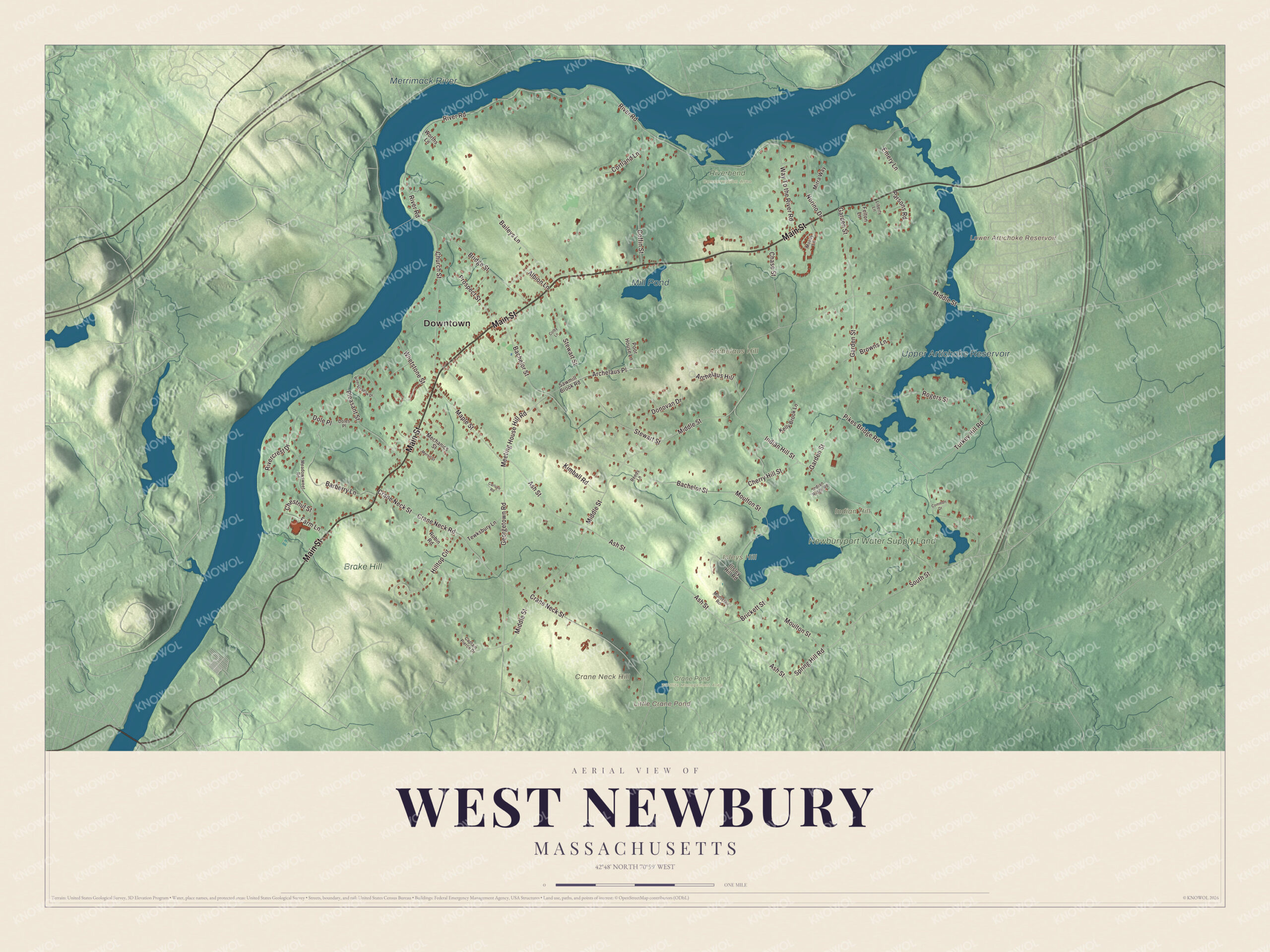
West Newbury today
By KNOWOL
Every street of West Newbury, from Main Street and River Road to Ash Street, Spring Hill Road, Middle Street and South Street, with Mill Pond, the Upper and Lower Artichoke Reservoirs, Little Crane Pond, and Archelaus, Crane Neck and Indian Hills named on the artwork.5
The history of West Newbury, Massachusetts
Horn combs from a farm kitchen
West Newbury's comb trade started in 1770 with Enoch Noyes, a farmer who made horn buttons in his kitchen in winter. The 1888 county history lists his only tools: a hatchet, a saw, a bit of glass and a woolen polishing rag. During the Revolution he hired a Hessian comb-maker who had deserted from Burgoyne's army, and learned to make combs. By about 1830 there were 25 or 30 shops in town, and the makers drove their combs to Boston and brought horns home in one-horse wagons. Later, schooners landed cargoes of horns at the South Amesbury wharf, and they were carted over Rocks Bridge. A neighbor remembered the smell. By 1888 two steam factories did it all, and Haydn Brown's machines made horn combs look like ivory.26
The west end wants its own church
For people on Pipe-Stave, Archelaus, Crane-Neck and Indian Hills, Sunday meant a walk of four miles or more to Newbury's meetinghouse. In 1685 they asked for a minister of their own, and the old town said no for years. Tempers ran so high that Joseph Bayley, a west end man, was indicted for calling a town committee devils incarnate. In 1698 they finally gathered their own church at Pipe-Stave Hill, and in 1729 families farther up built another meetinghouse on Meeting-House Hill, with no chimney at all. A first try at a separate town failed in 1794. In 1819 the west end became the town of Parsons, and a year later it took the name West Newbury.7891
Poore's riflemen in green
Ben Perley Poore, the Washington newspaperman who lived at Indian Hill, raised a battalion of rifles, and Company A was West Newbury's own. One young recruit walked five miles at night to sign up at the armory in the town hall. The uniform was dark green trimmed in light green, and he later wrote that it was hard to tell which was greener, the soldier or the uniform. Their drill was mostly running around the town hall in single file. On April 29, 1861, the town set aside $10,000 for the company and its families. The rifle company became the core of Company A of the 19th Massachusetts, and by the war's end West Newbury had sent 267 men.103
West Newbury, Massachusetts through the years
20 moments from 1635 to today.
- 1635English settlers arrive, and this land becomes the far west end of Newbury.1
- 1685West end families, miles from the old meetinghouse, ask Newbury for a minister of their own.7
- 1698A church is gathered and a meetinghouse built at Pipe-Stave Hill.7
- 1714Rev. John Tufts is ordained; his little book of psalm tunes is called the first of its kind in New England.11
- 1715About this year the Rev. John Tufts House and the brick Samuel Chase House are built on Main Street.1213
- 1729Upper West Parish families build a meetinghouse on Meeting-House Hill, without a chimney.8
- 1770Farmer Enoch Noyes starts making horn buttons in his kitchen, the beginning of the comb trade.2
- 1794Newbury votes to set off its northwest parishes as a town, then takes the vote back.9
- 1819The town of Parsons is incorporated on February 18 and holds its first town meeting on March 8.9
- 1820The legislature changes the name from Parsons to West Newbury.1
- 1830About this year 25 or 30 small shops in town are making combs.2
- 1846Col. Moses Newell builds his brick farmhouse with mantels, doors and shutters salvaged from Beacon Hill.14
- 1851A railroad from Georgetown to Rocks Bridge is chartered. It's never built.15
- 1861On April 29 the town sets aside $10,000 for its rifle company and their families.3
- 1887Ben Perley Poore of Indian Hill dies and is buried in Walnut Hill Cemetery.16
- 1888Two steam comb factories, S. C. Noyes & Co. and the Chases', outproduce all the old shops together.2
- 1900The Soldiers and Sailors Memorial Building goes up on Main Street.17
- 1904S. C. Noyes, the last comb factory in town, closes.1
- 1913Rev. Glenn Tilley Morse conceives All Saints Church as a small copy of St. Michael's in Newbury, England.18
- 1952Julian Steele is elected town moderator, the first African American moderator in Massachusetts.1
Places to see in West Newbury, Massachusetts
Places worth a visit in West Newbury today.
- DowntownMain Street. Town offices and the memorial hall.
- Main StreetAcross town. Route 113, the main road through town.
- River RoadAlong the Merrimack. Following the south bank of the river.
- Mill PondNorth part of town. Trails, canoeing and fishing.
- Archelaus HillCenter of town. The highest point in West Newbury.
- Indian HillWest Newbury. Ben Perley Poore's country home.
- Crane Neck HillWest Newbury. One of the town's named hills.
- Upper Artichoke ReservoirNewburyport line. On the Artichoke River.
- Lower Artichoke ReservoirNewburyport line. Separates the town from Newburyport.
- Little Crane PondSouthern corner. Near the Crane Pond Wildlife Management Area.
West Newbury on the National Register of Historic Places
All 6 places in West Newbury on the National Register of Historic Places that still stand today, oldest first, and why each one matters.4
-
Samuel March House
A First Period house built in two sections, the first in the later years of the 17th century. In the Georgian period its big central chimney was taken out and replaced with two narrow brick chimneys, a sign of changing taste.19
-
Samuel Chase House
Built c. 1715, it is a rare example of a brick house built during the transition between First Period and Georgian styling and construction methods. A story passed down through the Chase family says that bricks for the house were made on the family's farm and were carried to the homesite by Hannah Chase in her apron.13
-
Rev. John Tufts House
The home of Rev. John Tufts, an important early American music teacher and the town's minister from 1714 to 1738. The oak-framed, central-chimney house was built all at once about 1715, unlike many First Period houses that grew in stages.12
-
Timothy Morse House
The 2.5-story wood-frame house was built in stages beginning in 1730. Even though Georgian styling and construction techniques were already taking hold at that time, this house was built in a typical First Period style.20
-
Newell Farm
Col. Moses Newell built this 25-room brick farmhouse in 1846. He hauled home mantels, shutters, doors and windows from buildings torn down on Beacon Hill in Boston for the State House addition, after delivering meat from the farm to the Charlestown Navy Yard.14
-
Soldiers and Sailors Memorial Building
A Gothic Revival memorial hall of 1900, paid for by the bequest of lifelong resident Moses Warren Edwards to honor the town's Civil War soldiers. It housed the Grand Army post, then the American Legion, and the town library from 1927 to 1939.17
West Newbury in their words
“few towns in the State can boast of better farms or better methods of tillage.”
History of Essex County, Massachusetts, 188821
“it was hard to tell which was the greener, the soldier or the uniform.”
A recruit in West Newbury's rifle company, Reminiscences of the Nineteenth Massachusetts Regiment, 189910
“she is the best girl in West Newbury”
Jonathan Chase, a West Newbury joiner, in Reminiscences of a Nonagenarian, 187922
Towns near West Newbury, Massachusetts
Sources for the history of West Newbury
- West Newbury, Massachusetts, Wikipedia
- History of Essex County, Massachusetts, vol. 2 (1888), on the comb manufacture, Internet Archive
- History of Essex County, Massachusetts, vol. 2 (1888), on West Newbury in the Civil War, Internet Archive
- National Register of Historic Places listings in Essex County, Massachusetts, Wikipedia
- Map of West Newbury, Massachusetts in 2026, KNOWOL
- Essex Institute Historical Collections, vol. 82, recollections of South Amesbury, Internet Archive
- History of Essex County, Massachusetts, vol. 2 (1888), West Newbury chapter on the west end parish, Internet Archive
- History of Essex County, Massachusetts, vol. 2 (1888), on the 1729 meetinghouse, Internet Archive
- History of Essex County, Massachusetts, vol. 2 (1888), on the incorporation of Parsons, Internet Archive
- Reminiscences of the Nineteenth Massachusetts Regiment (1899), Internet Archive
- History of Essex County, Massachusetts, vol. 2 (1888), on Rev. John Tufts, Internet Archive
- Rev. John Tufts House, Wikipedia
- Samuel Chase House, Wikipedia
- Newell Farm, Wikipedia
- Historical Collections of the Topsfield Historical Society (1910), on the West Newbury Railroad, Internet Archive
- Essex Institute Historical Collections, vol. 89, on Ben Perley Poore, Internet Archive
- Soldiers and Sailors Memorial Building, Wikipedia
- Essex Institute Historical Collections, vol. 81, on All Saints Church, Internet Archive
- Samuel March House, Wikipedia
- Timothy Morse House, Wikipedia
- History of Essex County, Massachusetts, vol. 2 (1888), on West Newbury's farms, Internet Archive
- Reminiscences of a Nonagenarian (1879), Internet Archive