
A hilltop town set off from Chelmsford in 1729, where the Prescotts forged iron at Forge Pond, boulders from its north woods became the granite pillars of Boston's Quincy Market House, and Abbot & Company spun camel's hair into carpet yarn.
Westford then and now
The same town 140 years apart. Click either map to look closer.
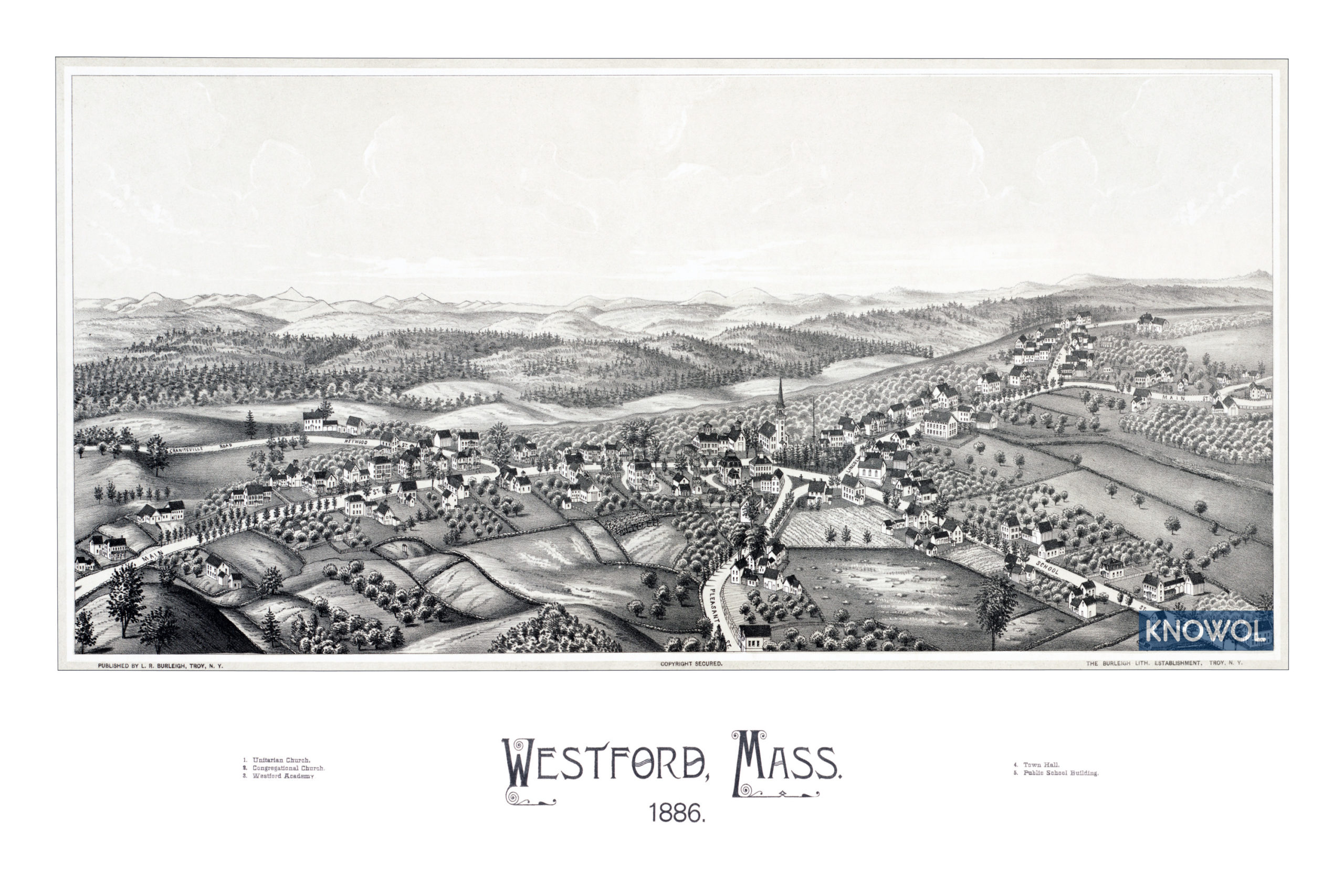
The bird's-eye view
By Lucien R. Burleigh
Westford drawn as if from the sky in 1886, with street names and old landmarks, among them Westford Academy, the Town Hall, the public schools and the Unitarian and Congregational churches.5
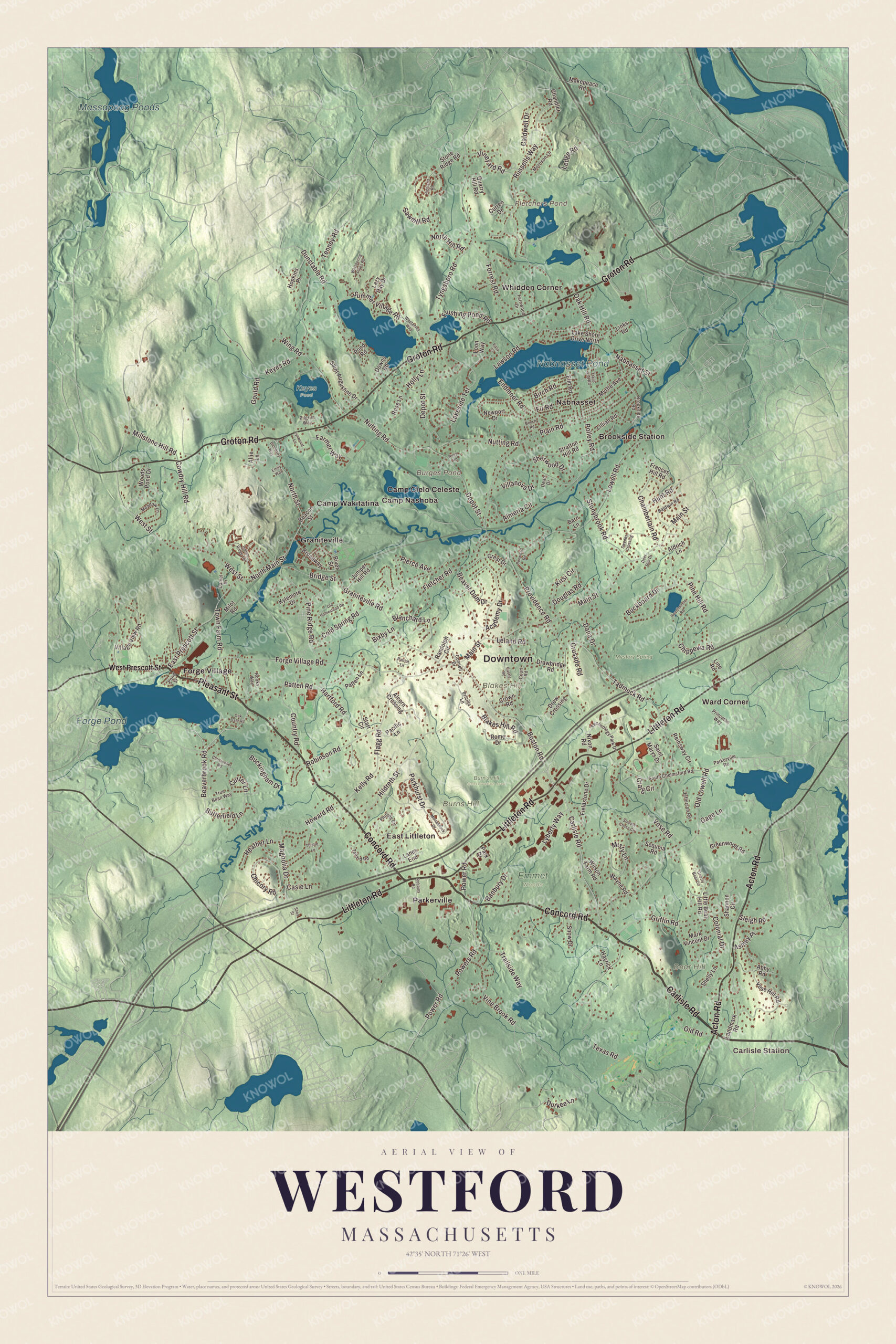
Westford today
By KNOWOL
Westford's streets, buildings, ponds and terrain from Downtown and Carlisle Station out to Forge Village, Graniteville and Nabnasset, with Burges, Fletchers, Forge and Nabnasset ponds and Bear, Blakes and Burns hills.6
The history of Westford, Massachusetts
Twenty yoke of oxen
Westford's granite went to Boston before there was a railroad to carry it. Quarrymen first worked the huge boulders scattered over the north part of town, and the granite pillars of Boston's Quincy Market House were hewn from boulders near the old District Seven schoolhouse and hauled through the center of town by twenty yoke of oxen. In 1833 Edward Hitchcock's report on the geology of Massachusetts noted that the stone Boston called Chelmsford granite really came from Westford and Tyngsborough. Isaac Carkin opened the ledge on Oak Hill in 1826 or 1827. In 1848 Samuel Fletcher piled stone by the new Stony Brook Railroad, and it went into the dam across the Merrimack at Lawrence. The quarry village was called Stone Quarry until about 1856, when Charles G. Sargent suggested Graniteville.23
Iron, nails and camel's hair
About 1680 Jonas Prescott built a mill where Stony Brook leaves Forge Pond, on land that then belonged to Groton, and by about 1710 forges there were making iron from bog ore dug in Groton. The town's 1883 history calls it the fourth or fifth ironworks in New England, though the brittle Groton iron was never much prized. In 1730 that corner along the pond was annexed to Westford, and the Prescotts kept the forges going until 1865. A horse-nail company followed until 1877. In 1879 Abbot & Company, which an 1890 county history calls the first in the country to spin camel's hair into worsted yarn, filled the old works with machinery. The pond gave a winter crop too: in 1881, 175 men and 50 horses cut ice there, and 35,000 tons went to Boston.23
The colonel at the bridge
When the alarm reached Westford on the night of April 18, 1775, Lt. Col. John Robinson mounted his horse and rode for Concord, his granddaughter told the town historian, leaving his hired man to follow with provisions. At the North Bridge, in Rev. Dr. Ripley's account of 1827, Major Buttrick asked the older Robinson to take command; he declined and marched at Buttrick's right hand as a volunteer. The first British shot passed under Robinson's arm and grazed an Acton fifer. A century later the town remembered its ninety-four men who went with scarce an hour's notice. At Bunker Hill, when some men fired too soon, Robinson ran along the top of the parapet knocking their muskets up. He lies in the West Burying Ground, now Westlawn Cemetery, under a stone that says he commanded at the bridge.27
Westford, Massachusetts through the years
25 moments from 1659 to today.
- 1659The first known land grants inside today's Westford are made at Tadmuck, then the west part of Chelmsford.2
- 1664Solomon Keyes is granted land on Frances Hill, which the town history says took its name from his wife, Frances.2
- 1680About this year Jonas Prescott's mill rises where Stony Brook leaves Forge Pond, on land then in Groton.2
- 1702The oldest gravestone in the East Burying Ground, now Fairview Cemetery, is cut for Abram Wright.3
- 1710About this year forges for making iron are added at the pond, the fourth or fifth ironworks in New England, says the 1883 town history.2
- 1724After eleven years of petitions, the west part of Chelmsford becomes the West Precinct.2
- 1724William Chandler buys the Brookside mill site and soon builds the town's first fulling mill.2
- 1729The precinct becomes a town on September 23, spelled Wesford by its town clerks until 1744.2
- 1730A triangle of Groton land along Forge Pond is annexed to Westford on September 10.2
- 1749The town adds a pound to the bounty for every grown wolf killed.2
- 1763A meeting-house bell of about 550 pounds arrives and is hung in a belfry on Ebenezer Stone's land.2
- 1775Lt. Col. John Robinson marches beside Major Buttrick to the North Bridge in Concord on April 19.2
- 1793Westford Academy is incorporated on September 28, free to pupils of any nation, age or sex who can read the Bible.2
- 1794After the second meeting-house burns, the town builds the one that still stands as the First Parish church.2
- 1797Subscribers start the Social Library, which later becomes the town library.2
- 1803The Westford post office opens; ten of its first thirteen postmaster appointments go to Fletchers.3
- 1837The brick main building of the Town Farm, the town's poor farm, goes up.8
- 1841A fence goes around the common and trees are planted, paid for by subscription, with stone posts from Nathan S. Hamblin.9
- 1848The Stony Brook Railroad opens on July 5, and Westford stone goes to build the dam at Lawrence.2
- 1855The Abbot Worsted mills start in Graniteville with about twenty hands.2
- 1856About this year the village of Stone Quarry takes the name Graniteville, at Charles G. Sargent's suggestion.3
- 1871The new Town House is dedicated on March 3.2
- 1879Abbot & Company buys the old forge and horse-nail works at Forge Village.2
- 1881Ice cut on Forge Pond fills Boston orders of 35,000 tons, with 50,000 more stored for the Southern market.2
- 1918The Russian Brotherhood opens the Russian Cemetery for families who came to work in the Abbot mills.10
Places to see in Westford, Massachusetts
Places worth a visit in Westford today.
- DowntownWestford Center. Common, Academy and the 1871 town hall.
- Forge VillageSouthwest, on Forge Pond. Ironworks village, then an Abbot worsted mill.
- Forge PondLittleton line. Ice cut here went to Boston.
- GranitevilleStony Brook, west of the center. Quarry village once called Stone Quarry.
- Brookside StationChelmsford line. Mill village on the first fulling-mill site.
- Nabnasset PondNorth Westford. The old Nubanussuck Pond, 123 acres.
- Burges PondNear Westford Station. Named for the early Burge family.
- Carlisle StationSoutheast. Framingham and Lowell railroad stop of 1871.
- Concord RoadSouth Westford. Proctor and Fletcher houses, Parker Village.
- Blakes HillSouth of the center. A southern spur of Prospect Hill.
Westford on the National Register of Historic Places
All 14 places in Westford on the National Register of Historic Places that still stand today, oldest first, and why each one matters.4
-
Fairview Cemetery
First called the East Burying Ground, it holds a tombstone dated 1702, making it one of the town's oldest cemeteries. New sections were laid out from the 1860s in the rural cemetery style, and it now covers 10.5 acres.11
-
Forge Village Historic District
One of the town's 19th-century mill villages, grown up around the Abbot Worsted Company mill complex on Forge Pond. Before the mill the site held blacksmith shops, iron forges and an 18th-century fulling mill, and worker housing fills the nearby streets.12
-
John Proctor House
One of the oldest houses in Westford, its main block probably built by John Proctor II, though the deed evidence is scanty. It looks like a First Period half house; its chimney came out in the 1800s and most of its inside finish dates to the 1820s or 1830s.13
-
Westford Center Historic District
The town center since settlement began in the 1720s, along Main Street between Graniteville and Leland roads. Its landmarks are Westford Academy and the First Parish Church, both Federal buildings of 1794, and the Italianate town hall of 1871.14
-
Jonathon Keyes Sr. House
Long called the Solomon Keyes House in town histories, it was probably built in the mid-1700s by a descendant of that early settler, as a saltbox later raised to two full stories. It stayed in the Keyes family until 1898.15
-
Hillside Cemetery
Also called the North Burying Ground, it was given to the town in 1753 by Ebenezer and Thomas Wright, and the oldest dated grave, of Jacob and Abigail Wright, is from 1761. About 300 burials lie behind granite retaining walls.16
-
Westlawn Cemetery
Set out in 1761 as the West Burying Ground, it holds about 400 marked graves. Col. John Robinson, who led Westford's minutemen at Concord in 1775, is buried here.7
-
Parker Village Historic District
A rural village center running along Carlisle Road to a triangular green where Concord and Old Lowell roads meet. Its oldest building is the Parker Village Schoolhouse of 1787, of brick and wood, restored in the 1990s, and school classes still visit it dressed as pupils of that era.17
-
Henry Fletcher House
Built about 1810 to 1813 by Henry Fletcher, descended from one of the Westford area's first settlers, in the old Georgian center-chimney style long after it had gone out of fashion. His barn was built the same way.18
-
Wright Cemetery
Set up in 1836 as a private burial ground for the locally numerous Wright family, though its earliest documented burial is from 1819. The town took it over in 1909; its tallest marker is a 10-foot granite obelisk for Joel Wright.19
-
Westford Town Farm
The town's poor farm, whose brick main building went up in 1837 and was enlarged about 1840 and 1900. It cared for the town's poor until 1959, later than most in the state, and has since housed police, fire and school offices.8
-
Graniteville Historic District
Known for its granite quarries until the railroad arrived in 1847, the village then grew quickly around Charles G. Sargent's mill. It takes in worker housing, civic buildings of the later 1800s and a number of old quarry sites.20
-
Brookside Historic District
The smallest of Westford's three 19th-century mill villages, built around the Brookside Woolen Company mill of 1862 on Stony Brook, where the town's first documented fulling mill stood about 1725. It keeps the dam, a 1920 dining hall for the mill hands and rows of worker housing.21
-
Russian Cemetery
Founded in 1918 by the Russian Brotherhood for Belarusian immigrants recruited to work in the Abbot Worsted Company mills, who could not be buried in some of the town's other cemeteries. Many early stones are lettered in Cyrillic.10
Westford in their words
“Its elevated position and picturesque scenery entitle it to rank among the loveliest villages of Northern Middlesex.”
History of the town of Westford, 1883, on the Central Village2
“The pretty little stream that runs from Forge Pond to the Merrimack is worthy of a more poetic name than Stony Brook, albeit it is a benefactor to the people.”
History of the town of Westford, 18832
“Our people are pleasant, neighborly and good-natured; they especially care for those who are ill or have misfortune.”
History of Middlesex County, 1890, Westford chapter3
Towns near Westford, Massachusetts
Sources for the history of Westford
- Westford, Massachusetts, Wikipedia
- History of the town of Westford, in the county of Middlesex, Massachusetts, 1659-1883, by Rev. Edwin R. Hodgman (1883)
- History of Middlesex County, Massachusetts, with biographical sketches of many of its pioneers and prominent men (1890), Westford chapter
- National Register of Historic Places listings in Middlesex County, Massachusetts, Wikipedia
- Beautifully restored map of Westford, MA from 1886, restored by KNOWOL
- Map of Westford, Massachusetts in 2026, KNOWOL
- Westlawn Cemetery, Wikipedia
- Westford Town Farm, Wikipedia
- An address delivered by request before the Ornamental Tree Association, Westford, May 13, 1876, by Edwin R. Hodgman (1876)
- Russian Cemetery, Wikipedia
- Fairview Cemetery, Wikipedia
- Forge Village Historic District, Wikipedia
- John Proctor House, Wikipedia
- Westford Center Historic District, Wikipedia
- Jonathon Keyes Sr. House, Wikipedia
- Hillside Cemetery, Wikipedia
- Parker Village Historic District, Wikipedia
- Henry Fletcher House, Wikipedia
- Wright Cemetery, Wikipedia
- Graniteville Historic District, Wikipedia
- Brookside Historic District, Wikipedia